Are you so flexible you can do tricks? Do you now suffer from terrible pain? Have you been told it's genetic?In a fully reworked book (the first version was just medical studies), Dr. Maloney maps out the origins of the pain, discusses the flaws in the current model, and gives an alternate view of the pain. He also goes into more research and finds the probable culprit in a little-known hormone called Relaxin. For patients with chronic pain and those who love them, this book offers alternatives and hope. Dr. Maloney has been blessed with six EDS patients in his family practice, and he passes on his notes and what he has learned to you.
Are you terrified of Zika? Should you be?Dr. Maloney takes you through the history of Zika, the true risk of birth defects, and which other diseases could increase those risks. Don't base your decisions on headlines, as children are far more at risk for unnecessary abortion than they are for birth defects from Zika.
Dr. Christopher Maloney's bestselling Colon Cancer Diet translated into Chinese for Chinese readers. If you or someone you love have been diagnosed with colon cancer and are more comfortable reading in Chinese, this book is for you. It gives simple, easy to follow diet and lifestyle choices that can lessen your chances of recurring cancer.
Do you want to heal people?Thinking about becoming a doctor?Looking at the schooling, the loans, the lifestyle?Considering alternatives like massage school, nurse practitioner, physical therapy? Wondering what the life of a doctor is really like?Playing with the idea of becoming a Naturopathic Doctor?Dr. Maloney lives with a family of doctors, and walked the path less traveled. After a decade of working as an N.D., he looks back and shows you how to make the decisions you need to make. What seems complicated and confusing becomes clear as Dr. Maloney takes you through the decision-making process of finding the right path for you. While Dr. Maloney is a Naturopathic Doctor, his extended family has six regular medical doctors spanning the range from prenatal to oncology. He knows the behind-the-scenes world of medicine.
Page lives in a world where a person's name determines her character. So why does she think Ebenezer will be a good match, and follow him blindly to the big city? It will take a fair amount of luck and a good bit of magic for Page to survive the trap set for her.I live next to a cemetery. James G. Blaine, Maine's most famous senator, sleeps at the top of the hill. Just down from him is the Turner family, resting together. The youngest Turner, Page, was born on my birthday in 1889. She would have visited the original Lithgow Library during her lifetime. But she didn't live very long. Page died in 1906, just shy of seventeen. It seemed so sad to me that someone named Page Turner should die before her life really got started. So I wrote a book for her. A little austenesque, a little steam punk, a little weird, Page in my book is defined by her name. All the characters are, like self-aware Dickens characters who can't escape their fates because of a few letters applied like a spell to their destinies. Of course she had to be a librarian, but how could Page become engaged to Ebenezer? A series of unfortunate events leave Page working in a magic book shop where she meets a horrible man. Then she has to save an even more horrible man from himself. Imagine Douglas Adams had tried to write Jane Austen and decided to throw in a little magic as well. A little steampunk, a little Victorian romance, a little magical revenge.
Are you at war with your stomach?Gas pains? Odd gurgling? Melt-your-face bowel movements?Has your stomach been upset since you took antibiotics? Did you know that you're up against a jungle, and that you're outnumbered 10-to-1?In this short, packed, and often humorous book, Dr. Maloney takes you on a tour of your inner world and explains how to make peace with your stomach. Over the last ten years, researchers have begun mapping the human gut or microbiome. What they've found changes everything we've thought we knew about our relationship with bacteria, viruses, and fungi. Rather than living separately, we are intimately dependent on our own ecosystem. Dr. Maloney has condensed hundreds of studies into a readable, cutting-edge look at how to survive and thrive with our microbiomes.
Are you married to a "Disney mom?" Do you have no interest in Disney World, but feel like you should take your kids? Does going to Disney sound overwhelming and stressful? Do you just want to do Disney and "Get it over with?"This book is for you Follow the advice in this book and - SURPRISE - you may soon be booking your second Disney World vacation Before my first trip to Disney World, my all-time favorite vacation was in a monastery in Thailand. Now I go to Disney every year and love it. Disney is my new Zen center.
Do you have colon cancer? Does someone you love?Did you know that eating differently, even after you are diagnosed, can lower your risk of dying?When you finish this book I want you to be able to tell me, in a minute or less, how you should eat, exercise, and supplement to lower your risk of dying as a diagnosed colon cancer patient. Last year when I when I was diagnosed I went looking for this book. With all the diet books, I figured someone had written a book specifically for newly diagnosed colon cancer patients. But there was nothing. I checked with my doctors and with the national organizations. Nothing. So I started researching. I wrote this book to put together what I found. It helps that I was trained as a Naturopathic Doctor and practiced for over a decade before my diagnosis. I can read medicalese and I know a fair amount about both conventional and natural alternatives. But my goal is to make a simple, short, understandable book specifically for people with colon cancer (upper, transverse, lower, and rectal). It's terrible to be where we are. But we have choices, and this book is my way of giving us direction and hope. Please, if you buy this book, review it and share it with your fellow patients. Thank you.May we all get well.
Are you going blind? I was. Slowly. One morning I woke up and couldn't read labels anymore. My doctor told me it was a normal part of getting older. But I'm stubborn. I thought there must be another way, but no one seemed to have one. So I finally found my own way. I've completely changed how I see my eyes, I've improved my vision, and I'd like to share what I found with you. I would never claim that my results will be your results, so please don't expect that reading this book will magically improve your eyes. Applying what you read may help or it may not. But doing nothing different is likely to make your eyes worse over time. Dr. Christopher Maloney woke up one day and couldn't read labels without taking off his glasses. He asked his eye doctor what it was, and got a shrug. It was just part of getting older. Unwilling to accept eventual blindness, Dr. Maloney researched. He started off convinced eyesight was genetic, and ended up convinced it isn't genetic at all. Along the way, Dr. Maloney found a secret pandemic that doesn't make the nightly news. We're not going blind as we age, we're going blind as a planet. The developed countries of the world are going blind at an astronomical rate, and young people are going blind long before old age can be blamed. Digging deeper, Dr. Maloney found a conspiracy, complete with doctored data, a madman, and an ongoing prejudice against change so pervasive very few are even questioning the conventional wisdom. All Dr. Maloney wanted to find was a way for him to read grocery store labels without taking off his glasses. What he found instead was a fundamental flaw in the medical model of how we think about our eyesight. Join him as he explores hundreds of studies and explains them in simple language. Dr. Maloney can give you the evidence, and you need to be the judge and jury about if what he's saying might affect your eyes.
Got back pain? Tried treatment without success? Relief might be closer than you think. Try these ten things before resorting to surgery.There's a new science to back pain beyond stretches, rest, and pain killers.You may have developed a habitual pain response, which can be retriggered by both physical and mental stresses. While we consciously feel pain on one side of our bodies, the primitive base of our brain maps pain responses to both sides of the body. These responses can continue to plague us until we track down their initial cause and effect. But once we do, chronic unresolved pain can ease entirely. In this short, researched book, Dr. Maloney explains how habitual pain responses can be caused by both physical and emotional triggers.These triggers form a map of your pain, and finding that map can lead to results when nothing else will work. When he was twelve years old, Christopher Maloney found out he had a "bad back." But decades later Dr. Christopher Maloney, N.D., doesn't live in chronic pain. He has worked for years to discover solutions beyond the conventional. In the process, Dr. Maloney discovered a map of back pain. He has used that map to help hundreds of people with back pain and now shares the map with the world. Before he became a doctor, Dr. Maloney gave massages to friends and family members. In clinic, he became a sought-after last resort for unrelieved back and neck pain. As Dr. Maloney went into practice, he found that bodywork done over time with patient participation resulted in far better outcomes. In the process, patients released habitual responses that had troubled them for years. Healing Your Back of Chronic Pain contains the research behind Dr. Maloney's treatment of the back. It discusses the shortcomings of existing treatments and suggests combining treatments for better results. Dr. Maloney gives an overview of his map of the back, along with patient examples that worked. Then he gives advice on how to map your own back. Ever a realist, Dr. Maloney ends his book with ten things patients should try before resorting to surgery. Short, researched, and direct, Healing Your Back of Chronic Pain combines classic common sense with cutting edge research. By the time patients finish Healing Your Back of Chronic Pain, they should know why their current treatments haven't worked long-term, how to combine treatments, and at come away with at least one new idea for relieving their back pain.
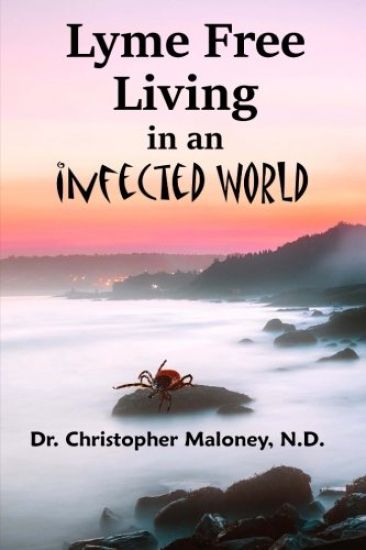
Got Lyme? It's time to learn what you need to protect yourself and your family. You'll learn why antibiotics, even lots of antibiotics, sometimes don't work. If they don't, there are twenty FDA approved medications that might save your life. But for chronic symptoms, more antibiotics may not be the answer. Many doctors recommend three imported herbs that have side effects. Dr. Maloney lists twenty herbs that may help. Learn to shop for your Lyme medications in the aisles of your grocery store rather than in your pharmacy.While most experts rely on their own clinical experience, Dr. Maloney relies on hundreds of researched articles, all listed for patients who want to learn directly from the source. Rather than just getting Dr. Maloney's expertise, patients get to hear from experts all over the globe. Dr. Maloney has worked to make the material simple and readable. He lists only what you need to know, providing links to more information for those who have interest. By the time you finish his short book, Dr. Maloney hopes that you will have the tools you need to face Lyme now or in the future.
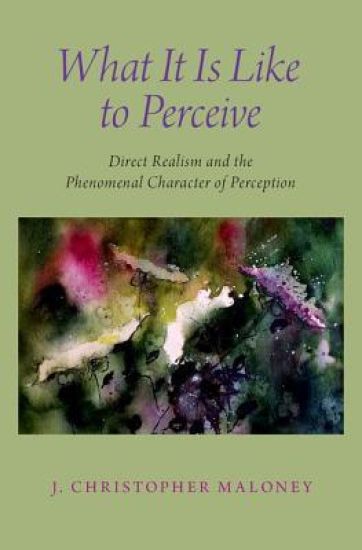
Naturalistic cognitive science, when realistically rendered, rightly maintains that to think is to deploy contentful mental representations. Accordingly, conscious perception, memory, and anticipation are forms of cognition that, despite their introspectively manifest differences, may coincide in content. Sometimes we remember what we saw; other times we predict what we will see. Why, then, does what it is like consciously to perceive, differ so dramatically from what it is like merely to recall or anticipate the same? Why, if thought is just representation, does the phenomenal character of seeing a sunset differ so stunningly from the tepid character of recollecting or predicting the sun's descent? J. Christopher Maloney argues that, unlike other cognitive modes, perception is in fact immediate, direct acquaintance with the object of thought. Although all mental representations carry content, the vehicles of perceptual representation are uniquely composed of the very objects represented. To perceive the setting sun is to use the sun and its properties to cast a peculiar cognitive vehicle of demonstrative representation. This vehicle's embedded referential term is identical with, and demonstrates, the sun itself. And the vehicle's self-attributive demonstrative predicate is itself forged from a property of that same remote star. So, in this sense, the perceiving mind is an extended mind. Perception is unbrokered cognition of what is real, exactly as it really is. Maloney's theory of perception will be of great interest in the philosophy of mind and cognitive science.
Christopher Maloney offers an explanation of the fundamental nature of thought. He posits the idea that thinking involves the processing of mental representations that take the form of sentences in a covert language encoded in the mind. The theory relies upon traditional categories of psychology, including such notions as belief and desire. It also draws upon and thus inherits some of the problems of artificial intelligence which it attempts to answer, including what bestows meaning or content upon a thought and what distinguishes genuine from simulated thought.
Christopher Maloney offers an explanation of the fundamental nature of thought. He posits the idea that thinking involves the processing of mental representations that take the form of sentences in a covert language encoded in the mind. The theory relies upon traditional categories of psychology, including such notions as belief and desire. It also draws upon and thus inherits some of the problems of artificial intelligence which it attempts to answer, including what bestows meaning or content upon a thought and what distinguishes genuine from simulated thought.
Do we have free will? How could we have the psychological leeway to choose and act otherwise than we do? The sum of history and the laws of science, including psychology, deterministically imply all events, including each of our actions. Is nature’s iron determination of deliberation compatible with the will’s freedom? The philosophers who answer affirmatively, both classical and current, assume that either the ultimate scientific laws or the grand historical record—or both—are merely contingent. By proceeding to infer the contingency of lawfully determined actions, these compatibilists would secure the leeway presumably requisite for the will’s liberty. Akratic Compatibilism and All Too Human Psychology: Almost Enough Is Free Will Enough argues, however, that they may be dead wrong about the modality of nature’s laws and history’s plasticity. Might the laws be necessary, and history absolutely fixed? Nevertheless, J. Christopher Maloney posits, we would yet be free. For psychology ordains volitional conflict: sometimes we akratically will to be able to act otherwise than we irresistibly do. Being akratic by nature, we asymptotically resist even a necessitating psychology’s governance. That Sisyphean resistance against the laws of cognition almost achieves the will’s liberating leeway. Nevertheless, almost free is free enough for deliberators as weak-willed as we.
This book analyses the success and adaptation of Michael Morpurgo’s novel War Horse to stage, radio, live events, and feature film, in different cultures, on tours, and in translation. In under a decade, War Horse has gone from obscure children’s novel to arguably one of the world’s most recognisable theatrical brands, thanks to innovative puppet designs from South Africa’s Handspring Puppet Company in an acclaimed stage production from the National Theatre of Great Britain. With emphasis on embodied spectatorship, collaborative meaning-making, and imaginative ‘play,’ this book generates fresh insights into the enduring popularity of the franchise’s eponymous protagonist, Joey, offering the most in-depth study of War Horse to date.