Kirjojen hintavertailu. Mukana 11 244 527 kirjaa ja 12 kauppaa.

Kirjahaku

Etsi kirjoja tekijän nimen, kirjan nimen tai ISBN:n perusteella.

1000 tulosta hakusanalla Christopher R. Browning

An Analysis of Christopher R. Browning's Ordinary Men

An Analysis of Christopher R. Browning's Ordinary Men

Tom Stammers; James Chappel

Macat International Limited
2017
nidottu
Of all the controversies facing historians today, few are more divisive or more important than the question of how the Holocaust was possible. What led thousands of Germans – many of them middle-aged reservists with, apparently, little Nazi zeal – to willingly commit acts of genocide? Was it ideology? Was there something rotten in the German soul? Or was it – as Christopher Browning argues in this highly influential book – more a matter of conformity, a response to intolerable social and psychological pressure?Ordinary Men is a microhistory, the detailed study of a single unit in the Nazi killing machine. Browning evaluates a wide range of evidence to seek to explain the actions of the "ordinary men" who made up reserve Police Battalion 101, taking advantage of the wide range of resources prepared in the early 1960s for a proposed war crimes trial. He concludes that his subjects were not "evil;" rather, their actions are best explained by a desire to be part of a team, not to shirk responsibility that would otherwise fall on the shoulders of comrades, and a willingness to obey authority. Browning's ability to explore the strengths and weaknesses of arguments – both the survivors' and other historians' – is what sets his work apart from other studies that have attempted to get to the root of the motivations for the Holocaust, and it is also what marks Ordinary Men as one of the most important works of its generation.
An Analysis of Christopher R. Browning's Ordinary Men

An Analysis of Christopher R. Browning's Ordinary Men

Tom Stammers; James Chappel

Macat International Limited
2017
sidottu
Of all the controversies facing historians today, few are more divisive or more important than the question of how the Holocaust was possible. What led thousands of Germans – many of them middle-aged reservists with, apparently, little Nazi zeal – to willingly commit acts of genocide? Was it ideology? Was there something rotten in the German soul? Or was it – as Christopher Browning argues in this highly influential book – more a matter of conformity, a response to intolerable social and psychological pressure? Ordinary Men is a microhistory, the detailed study of a single unit in the Nazi killing machine. Browning evaluates a wide range of evidence to seek to explain the actions of the "ordinary men" who made up reserve Police Battalion 101, taking advantage of the wide range of resources prepared in the early 1960s for a proposed war crimes trial. He concludes that his subjects were not "evil;" rather, their actions are best explained by a desire to be part of a team, not to shirk responsibility that would otherwise fall on the shoulders of comrades, and a willingness to obey authority. Browning's ability to explore the strengths and weaknesses of arguments – both the survivors' and other historians' – is what sets his work apart from other studies that have attempted to get to the root of the motivations for the Holocaust, and it is also what marks Ordinary Men as one of the most important works of its generation.
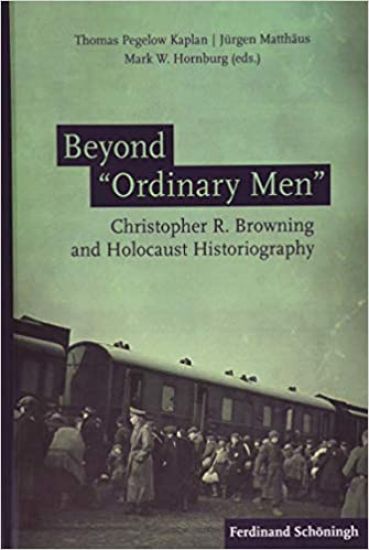
Beyond 'Ordinary Men': Christopher R. Browning and Holocaust Historiography
Reflecting on the work of one of the field's most influential scholars, the twenty essays in this book explore the evolution and application of Holocaust historiography, identify key insights into genocidal settings and point to gaps in our knowledge of humanity's most haunting problem. Why do they kill? The publication in 1992 of Christopher R. Browning's Ordinary Men raised crucial, previously unasked questions about the Holocaust: what made the members of a German police battalion - middle-aged family men of working- and lower-class background - become mass murderers of Jewish children, women, and men? How does motivation tie in with other factors that prompt participation in the final solution? And what can survivor accounts convey about genocide perpetration? Reflecting on the work of one of the field's most influential scholars, the twenty essays in this book explore the evolution and application of Holocaust historiography, identify key insights into genocidal settings and point to gaps in our knowledge of humanity's most haunting problem.
Collected Memories

Collected Memories

Christopher R. Browning

University of Wisconsin Press
2003
nidottu
Christopher R. Browning addresses some of the most heated controversies surrounding the use of postwar testimony: Hannah Arendt's uncritical acceptance of Eichmann's self-portrayal; the conviction of Ivan Demjanjuk on the basis of survivor testimony and its subsequent reversal by the Israeli Supreme Court; the debate in Poland sparked by Jan Gross's use of both survivor and communist courtroom testimony in his book Neighbors; and the conflict between Browning and Daniel Goldhagen, author of Hitler's Willing Executioners, regarding the use of pre-trial testimony. Despite these controversies and challenges, Browning delineates the ways in which the critical use of such problematic sources can provide telling evidence for writing Holocaust history.
Remembering Survival

Remembering Survival

Christopher R. Browning

WW Norton Co
2011
nidottu
Employing the rich testimony of almost three hundred survivors of the slave-labor camps of Starachowice, Poland, Christopher R. Browning draws the experiences of the Jewish prisoners, the Nazi authorities, and the neighboring Poles together into a chilling history of a little-known dimension of the Holocaust. Combining harrowing detail and insightful analysis on the Starachowice camps and their role in the Holocaust, Browning’s history is indispensable scholarship and an unforgettable story of survival.
The Path to Genocide

The Path to Genocide

Christopher R. Browning

Cambridge University Press
1992
sidottu
The Nazi Holocaust haunts the modern imagination as one of the most compelling examples of the human capacity for organised atrocity on a mass scale. This authoritative account of the evolution of Nazi Jewish policy from 1939 to 1942 seeks to answer some of the fundamental questions about what actually happened, and why, between the outbreak of war and the emergence of the Final Solution. Christopher Browning assesses the historians’ interpretations and offers his own insights, based on detailed case studies uncovering important and telling new evidence.
The Path to Genocide

The Path to Genocide

Christopher R. Browning

Cambridge University Press
1995
pokkari
The Nazi Holocaust haunts the modern imagination as one of the most compelling examples of the human capacity for organised atrocity on a mass scale. This authoritative account of the evolution of Nazi Jewish policy from 1939 to 1942 seeks to answer some of the fundamental questions about what actually happened, and why, between the outbreak of war and the emergence of the Final Solution. Christopher Browning assesses the historians’ interpretations and offers his own insights, based on detailed case studies uncovering important and telling new evidence. ‘The clarity as well as economy with which he writes, his firm grasp of the evidence and the balanced judgement he brings to its interpretation make this a most impressive performance … He uses his flair for uncovering new archive material to throw light on the attitudes and roles of a variety of people who became involved in carrying out the Final Solution.’ The Times Literary Supplement
Nazi Policy, Jewish Workers, German Killers

Nazi Policy, Jewish Workers, German Killers

Christopher R. Browning

Cambridge University Press
2000
sidottu
Nazi Policy, Jewish Workers, German Killers focuses on controversial issues in current Holocaust scholarship. How did Nazi Jewish policy evolve during the first years of the war? When did the Nazi regime cross the historic watershed from population expulsion and decimation ('ethnic cleansing') to total and systematic extermination? How did Nazi authorities attempt to reconcile policies of expulsion and extermination with the wartime urge to exploit Jewish labor? How were Jewish workers impacted? What role did local authorities play in shaping Nazi policy? What more can we learn about the mindset and behavior of the local perpetrators? Using new evidence, this book attempts to shed light on these important questions.
Nazi Policy, Jewish Workers, German Killers

Nazi Policy, Jewish Workers, German Killers

Christopher R. Browning

Cambridge University Press
2000
pokkari
Nazi Policy, Jewish Workers, German Killers focuses on controversial issues in current Holocaust scholarship. How did Nazi Jewish policy evolve during the first years of the war? When did the Nazi regime cross the historic watershed from population expulsion and decimation (‘ethnic cleansing’) to total and systematic extermination? How did Nazi authorities attempt to reconcile policies of expulsion and extermination with the wartime urge to exploit Jewish labor? How were Jewish workers impacted? What role did local authorities play in shaping Nazi policy? What more can we learn about the mindset and behavior of the local perpetrators? Using new evidence, this book attempts to shed light on these important questions.
The Origins of the Final Solution

The Origins of the Final Solution

Christopher R. Browning

University of Nebraska Press
2007
pokkari
Published by the University of Nebraska Press, Lincoln, and Yad Vashem, Jerusalem In 1939, the Nazi regime's plans for redrawing the demographic map of Eastern Europe entailed the expulsion of millions of Jews. By the fall of 1941, these plans had shifted from expulsion to systematic and total mass murder of all Jews within the Nazi grasp. The Origins of the Final Solution is the most detailed and comprehensive analysis ever written of what took place during this crucial period—of how, precisely, the Nazis' racial policies evolved from persecution and "ethnic cleansing" to the Final Solution of the Holocaust. Focusing on the months between the German conquest of Poland in September 1939–which brought nearly two million additional Jews under Nazi control—and the beginning of the deportation of Jews to the death camps in the spring of 1942, Christopher R. Browning describes how Poland became a laboratory for experiments in racial policies, from expulsion and decimation to ghettoization and exploitation under local occupation authorities. He reveals how the subsequent attack on the Soviet Union opened the door for an immense radicalization of Nazi Jewish policy—and marked the beginning of the Final Solution. Meticulously documenting the process that led to this fatal development, Browning shows that Adolf Hitler was the key decision-maker throughout, approving major escalations in Nazi persecution of the Jews at victory-induced moments of euphoria. Thoroughly researched and lucidly written, this groundbreaking work provides an essential chapter in the history of the Holocaust.
Helt vanlige menn

Helt vanlige menn

Christopher R. Browning

Dreyers forlag
2021
sidottu
Om morgenen den 13. april 1942 kom mennene i reserve.bataljon 101 til den lille landsbyen Józefów i Polen, en typisk polsk landsby med beskjedne, hvite, stråtekte hus. Da kvelden kom, var 1500 av de 1800 jødiske innbyggerne skutt - kvinner, barn og gamle. Arbeidsdyktige menn ble deportert til en arbeidsleir. I de påfølgende 16 månedene deltok bataljonen i skyting av 38 000 jøder. 45 000 ble sendt til konsentrasjonsleiren Treblinka. Gjerningsmennene var middelaldrende familiefolk fra Hamburg, fra arbeiderklassen og nedre middelklasse. De var ferske rekrutter uten tidligere krigserfaring. Det var mindre enn tre uker siden de kom til Polen. Browning har studert beveggrunnene som drev mennene til å delta. Han hevder at de fleste ikke var fanatiske nazister, men helt vanlige menn som handlet ut fra sammensatte motiver, som gruppepress, autoritetstro og rolletilpasning. Helt vanlige menn er en av de viktigste bøkene som er skrevet om Holocaust. Den stiller et spørsmål vi alle må ta stilling til: Kan jeg være sikker på at jeg ville ha handlet annerledes i en lignende situasjon? Brownings svar er urovekkende.
Helt vanlige menn

Helt vanlige menn

Christopher R. Browning

Dreyers forlag
2024
pokkari
Om morgenen den 13. april 1942 kom mennene i reserve.bataljon 101 til den lille landsbyen Józefów i Polen, en typisk polsk landsby med beskjedne, hvite, stråtekte hus. Da kvelden kom, var 1500 av de 1800 jødiske innbyggerne skutt - kvinner, barn og gamle. Arbeidsdyktige menn ble deportert til en arbeidsleir. I de påfølgende 16 månedene deltok bataljonen i skyting av 38 000 jøder. 45 000 ble sendt til konsentrasjonsleiren Treblinka. Gjerningsmennene var middelaldrende familiefolk fra Hamburg, fra arbeiderklassen og nedre middelklasse. De var ferske rekrutter uten tidligere krigserfaring. Det var mindre enn tre uker siden de kom til Polen. Browning har studert beveggrunnene som drev mennene til å delta. Han hevder at de fleste ikke var fanatiske nazister, men helt vanlige menn som handlet ut fra sammensatte motiver, som gruppepress, autoritetstro og rolletilpasning. Helt vanlige menn er en av de viktigste bøkene som er skrevet om Holocaust. Den stiller et spørsmål vi alle må ta stilling til: Kan jeg være sikker på at jeg ville ha handlet annerledes i en lignende situasjon? Brownings svar er urovekkende.
Helt vanliga män : reservpolisbataljon 101 och den slutliga lösningen i Polen
På morgonen den 13 juli 1942 gick den tyska Reservpolisbataljon 101 in i den polska byn Jozefow. Vid nattens inbrott hade de skjutit 1.500 av byns 1.800 judiska invånare - kvinnor, barn, gamla. Under de följande 16 månaderna deltog de i avrättandet av 38.000 judar och sände ytterligare 45.000 till koncentrationslägret Treblinka.Reservpolisbataljon 101 bestod inte av tyska yrkessoldater utan av helt vanliga män som var för gamla för att kallas in till militärtjänst. De sorterade alltså inte under Wehrmacht och heller inte under Gestapo utan under ordningspolisen.Christopher R. Browning har studerat vilka motiv som drev männen att delta i massakerna. Hans slutsatser är skrämmande: de var inte tvingade att lyda order utan gjorde det av så banala skäl som karriärism och grupptryck.Helt vanliga män är en av de viktigaste böcker som skrivits om Förintelsen. Den ställer den fråga vi alla måste ta ställning till: Kan jag vara säker på att jag skulle agerat annorlunda i samma situation? Det svar Christopher R. Browning ger kommer att göra er sömnlösa.Boken är försedd med ett nyskrivet efterord.
The Origins of the Final Solution: The Evolution of Nazi Jewish Policy, September 1939-March 1942

The Origins of the Final Solution: The Evolution of Nazi Jewish Policy, September 1939-March 1942

Christopher R. Browning; Jurgen Matthaus

University of Nebraska Press
2004
sidottu
Published by the University of Nebraska Press, Lincoln, and Yad Vashem, Jerusalem In 1939, the Nazi regime's plans for redrawing the demographic map of Eastern Europe entailed the expulsion of millions of Jews. By the fall of 1941, these plans had shifted from expulsion to systematic and total mass murder of all Jews within the Nazi grasp. The Origins of the Final Solution is the most detailed and comprehensive analysis ever written of what took place during this crucial period--of how, precisely, the Nazis' racial policies evolved from persecution and "ethnic cleansing" to the Final Solution of the Holocaust. Focusing on the months between the German conquest of Poland in September 1939-which brought nearly two million additional Jews under Nazi control--and the beginning of the deportation of Jews to the death camps in the spring of 1942, Christopher R. Browning describes how Poland became a laboratory for experiments in racial policies, from expulsion and decimation to ghettoization and exploitation under local occupation authorities. He reveals how the subsequent attack on the Soviet Union opened the door for an immense radicalization of Nazi Jewish policy--and marked the beginning of the Final Solution. Meticulously documenting the process that led to this fatal development, Browning shows that Adolf Hitler was the key decision-maker throughout, approving major escalations in Nazi persecution of the Jews at victory-induced moments of euphoria. Thoroughly researched and lucidly written, this groundbreaking work provides an essential chapter in the history of the Holocaust.
Ordinary Men

Ordinary Men

Christopher R Browning

Penguin Books Ltd
2001
pokkari
Ordinary Men has been admired all over the world and is now published in the UK for the first time. It takes as its basis the detailed records of one squad from the Nazis' extermination groups and explores in detail its composition, its actions, andthe methods by which it was trained to perform acts of genocide on an industrial scale. He introduces us to cheerful, friendly, ordinary men who killed without hesitation or apparent remorse for years on end, in docile obedience to an authority theyhappily accepted as legitimate. It is a valuable corrective to the idea of German uniqueness and offers a much more chilling picture of human beings as avidly suggestible and desperate for an organising purpose in their lives, however disgusting.
Ordinary Men

Ordinary Men

Browning Christopher R.

HarperPerennial
2017
nidottu
Christopher R. Browning's shocking account of how a unit of average middle-aged Germans became the cold-blooded murderers of tens of thousands of Jews-now with a new afterword and additional photographs. Ordinary Men is the true story of Reserve Police Battalion 101 of the German Order Police, which was responsible for mass shootings as well as round-ups of Jewish people for deportation to Nazi death camps in Poland in 1942. Browning argues that most of the men of RPB 101 were not fanatical Nazis but, rather, ordinary middle-aged, working-class men who committed these atrocities out of a mixture of motives, including the group dynamics of conformity, deference to authority, role adaptation, and the altering of moral norms to justify their actions. Very quickly three groups emerged within the battalion: a core of eager killers, a plurality who carried out their duties reliably but without initiative, and a small minority who evaded participation in the acts of killing without diminishing the murderous efficiency of the battalion whatsoever. While this book discusses a specific Reserve Unit during WWII, the general argument Browning makes is that most people succumb to the pressures of a group setting and commit actions they would never do of their own volition. Ordinary Men is a powerful, chilling, and important work with themes and arguments that continue to resonate today. "A remarkable-and singularly chilling-glimpse of human behavior...This meticulously researched book...represents a major contribution to the literature of the Holocaust."-Newsweek
Polizei Und Holocaust: Eine Generation Nach Christopher Brownings Ordinary Men
How did "ordinary men" become mass murderers? The debate about the perpetrators of the Holocaust was fundamentally reshaped by Christopher Browning's "Ordinary Men". Controversies over collaboration, space, and gender dynamics are hardly topics exclusively debated in Germany, but more intensely debated across the European continent, Israel and the US than ever before. Browning's impulse was not only focused on historical research, but also on debates about responsibility in the present. The analysis of democratic collapse can be the starting point for processes of recognition of such vulnerabilities today.