

Kirjahaku
Etsi kirjoja tekijän nimen, kirjan nimen tai ISBN:n perusteella.
1000 tulosta hakusanalla Christopher W. Loughlan

In summer 2023, two innovation and technology experts moved into a Cambridge apartment with an AI called Isaac for a unique experiment. They wanted to know what life will really be like when we are all living and working with AI. This book is the result: A practical guide to working smarter with AI, using it at home, at work and in education. It's the first nonfiction book co-written by AI and humans working together - a new genre called 'AI Narratology' - and cuts through the hype to tell the real story of what mass market AI is really all about in relevant, funny and imaginative stories and diary entries by two men and their AI buddy. This is what the future holds for humans living and working in the age of AI.
Labour and the Politics of Disloyalty in Belfast, 1921-39
Christopher J. V. Loughlin
Springer International Publishing AG
2018
sidottu
This book provides the first ‘history from below’ of the inter-war Belfast labour movement. It is a social history of the politics of Belfast labour and applies methodology from history, sociology and political science. Christopher J. V. Loughlin questions previous narratives that asserted the centrality of religion and sectarian conflict in the establishment of Northern Ireland. Labour and the Politics of Disloyalty in Belfast, 1921-39 suggests that political division and violence were key to the foundation and maintenance of the democratic ancien régime in Northern Ireland. It examines the relationship between Belfast Labour, sectarianism, electoral politics, security and industrial relations policy, and women’s politics in the city.

Labour and the Politics of Disloyalty in Belfast, 1921-39
Christopher J. V. Loughlin
Springer International Publishing AG
2019
nidottu
This book provides the first ‘history from below’ of the inter-war Belfast labour movement. It is a social history of the politics of Belfast labour and applies methodology from history, sociology and political science. Christopher J. V. Loughlin questions previous narratives that asserted the centrality of religion and sectarian conflict in the establishment of Northern Ireland. Labour and the Politics of Disloyalty in Belfast, 1921-39 suggests that political division and violence were key to the foundation and maintenance of the democratic ancien régime in Northern Ireland. It examines the relationship between Belfast Labour, sectarianism, electoral politics, security and industrial relations policy, and women’s politics in the city.
Military Enlistment of Hispanic Youth
Beth J Asch; Christopher Buck; Jacob Alex Klerman; Meredith Kleykamp; David S Loughran
RAND
2009
pokkari
Although polls of Hispanic youth show a strong propensity to serve in the military, Hispanics are nonetheless underrepresented among military recruits. The authors discuss the major characteristics that disproportionately disqualify Hispanic youth and explore actions that could be taken to increase Hispanic enlistments.

A Day in the World (eng)
Jeppe Wikström; Johan Erséus; Kim Loughran; Nancy Pick; Christopher Westhorp; Jan Eliasson
Max Ström
2012
sidottu
This is the largest photo book ever made about a single day – a historical and photographic document of everyday life involving photographers from all over the world. The book contains a selection of the best of all the pictures taken on May 15, 2012 – a date that is set to become renowned in the history of photography. This fascinating work contains a thousand pictures selected by an international jury. The book is also available in Swedish.
National Labor Relations Board, Petitioner, V. F. W. Woolworth Co. U.S. Supreme Court Transcript of Record with Supporting Pleadings
Theophil C Kammholz; Christopher W Hoey
Gale Ecco, U.S. Supreme Court Records
2011
pokkari

Long 'on' the Tooth: Dental Evidence of Diet addresses human dental macroscopic and microscopic wear, as well as dental disease, as indicators of diet. The book focuses primarily on 350 pre-contact humans from North America dating from approximately 5,500 to 600 years ago. These populations had subsistence strategies ranging from terrestrial foraging to intensive maize agriculture. The study makes intra- and intergroup comparisons to elucidate dietary nuances that are largely beyond the reach of other means of dietary reconstruction. Finally, the book discusses the importance of using multiple dietary indicators in unison in order to provide paleodietary insights.

In his first novel, British scholar Christopher W.E. Bigsby provides a prequel to The Scarlet Letter, introducing readers to a younger Hester Prynne. He tells of her attempts to flee an oppressive marriage to Roger Chillingworth, her love affair with Arthur Dimmesdale, and her life in the New World. In the process, Bigsby condemns the obstacles and prejudices that strong, intelligent women faced in the 17th century, providing a powerful narrative reframing of a compelling literary character.

Self-Cultivation Philosophies in Ancient India, Greece, and China
Christopher W. Gowans
Oxford University Press Inc
2021
sidottu
Philosophies in several ancient traditions aimed to alleviate people's anxieties and improve their lives. In contrast to the contemporay world, in which philosophy is mostly an academic subject and personal concerns are commonly addressed by psychological therapies, philosophy in these traditions often played a central role in programs that aspired to enable people to achieve a good life. In this volume, Christopher W. Gowans argues that the idea of self-cultivation philosophy provides a valuable approach for comprehending and reflecting on several philosophies in ancient India, Greece and China. Self-cultivation philosophies put forward a program of development for ameliorating the lives of human beings. On the basis of an account of human nature and the place of human beings in the world, they claim that our lives can be substantially transformed from what is thought to be a problematic condition into what purports to be an ideal state of being. Self-cultivation philosophies are preeminently practical in their aspirations: their purpose is to change human life in fundamental ways. Yet, in pursuing these practical ends, these philosophies typically make significant theoretical as well as empirical claims about human nature and the world. The book shows how the concept of self-cultivation philosophy provides an interpretive framework for understanding, comparing, assessing and learning from several philosophical outlooks in India, the Greco-Roman world, and China. The self-cultivation philosophies in India are those expressed in: the Bhagavad Gita; the Samkhya and Yoga philosophies of Isvarakrsna and Patanjali; and the teaching of the Buddha and his followers Buddhaghosa and Santideva. The philosophies originating in Greece, with subsequent development in the Roman world, are the most prominent Hellenistic approaches: the Epicureanism of Epicurus, Lucretius, and Philodemus; the Stoicism of Chrysippus, Epictetus, and Seneca; and Pyrrho and the Pyrrhonism of Sextus Empiricus. The self-cultivation philosophies from China are the early Confucian outlooks of Confucius, Mencius, and Xunzi; the classical Daoist perspectives of the Daodejing and the Zhuangzi; and the Chan tradition of Bodhidharma, Huineng and Linji. Though these philosophies developed in very different traditions, Gowans shows the connections between them in this compelling work of comparative philosophy.
Our lives are such that moral wrongdoing is sometimes inescapable for us. We have moral responsibilities to persons which may conflict and which it is wrong to violate even when they do conflict. Christopher W. Gowans argues that we must accept this conclusion if we are to make sense of our moral experience and the way in which persons are valuable to us. In defending this position, he critically examines the recent moral dilemmas debate. He maintains that what is important in this debate is not whether there are irresolvable moral conflicts, but whether there are moral conflicts in which wrongdoing is unavoidable. Though it would be incoherent to conclude moral deliberation by deciding to perform incompatible actions, he argues that there is nothing incoherent in supposing that we have conflicting moral responsibilities. In this way, he shows that it is possible to capture the intuitions of those who have defended the idea of moral dilemmas while meeting the objections of those who have rejected this idea. Gowans carefully evaluates utilitarian and Kantian analyses of moral dilemmas. He argues that these approaches eliminate genuine moral conflict only by displacing persons as direct objects of moral concern. As an alternative, he develops a more concrete account in which moral responsibilities to persons are central. The book also includes discussions of Melville's Billy Budd, methodology in moral philosophy, moral pluralism, moral tragedy, and `dirty hands' in politics.

Christopher Stephens focuses on canon law as the starting point for a new interpretation of divisions between East and West in the Church after the death of Constantine the Great. He challenges the common assumption that bishops split between 'Nicenes' and 'non-Nicenes', 'Arians' or 'Eusebians'. Instead, he argues that questions of doctrine took second place to disputes about the status of individual bishops and broader issues of the role of ecclesiastical councils, the nature of episcopal authority, and in particular the supremacy of the bishop of Rome. Canon law allows the author to offer a fresh understanding of the purposes of councils in the East after 337 particularly the famed Dedication Council of 341 and the western meeting of the council of Serdica and the canon law written there, which elevated the bishop of Rome to an authority above all other bishops. Investigating the laws they wrote, the author describes the power struggles taking place in the years following 337 as bishops sought to elevate their status and grasp the opportunity for the absolute form of leadership Constantine had embodied. Combining a close study of the laws and events of this period with broader reflections on the nature of power and authority in the Church and the increasingly important role of canon law, the book offers a fresh narrative of one of the most significant periods in the development of the Church as an institution and of the bishop as a leader.

On February 1, 1960, four African American college students entered the Woolworth department store in Greensboro, North Carolina, and sat down at the lunch counter. This lunch counter, like most in the American South, refused to serve black customers. The four students remained in their seats until the store closed. In the following days, they returned, joined by growing numbers of fellow students. These "sit-in" demonstrations soon spread to other southern cities, drawing in thousands of students and coalescing into a protest movement that would transform the struggle for racial inequality. The Sit-Ins tells the story of the student lunch counter protests and the national debate they sparked over the meaning of the constitutional right of all Americans to equal protection of the law. Christopher W. Schmidt describes how behind the now-iconic scenes of African American college students sitting in quiet defiance at "whites only" lunch counters lies a series of underappreciated legal dilemmas--about the meaning of the Constitution, the capacity of legal institutions to remedy different forms of injustice, and the relationship between legal reform and social change. The students' actions initiated a national conversation over whether the Constitution's equal protection clause extended to the activities of private businesses that served the general public. The courts, the traditional focal point for accounts of constitutional disputes, played an important but ultimately secondary role in this story. The great victory of the sit-in movement came not in the Supreme Court, but in Congress, with the passage of the Civil Rights Act of 1964, landmark legislation that recognized the right African American students had claimed for themselves four years earlier. The Sit-Ins invites a broader understanding of how Americans contest and construct the meaning of their Constitution.

On February 1, 1960, four African American college students entered the Woolworth department store in Greensboro, North Carolina, and sat down at the lunch counter. This lunch counter, like most in the American South, refused to serve black customers. The four students remained in their seats until the store closed. In the following days, they returned, joined by growing numbers of fellow students. These "sit-in" demonstrations soon spread to other southern cities, drawing in thousands of students and coalescing into a protest movement that would transform the struggle for racial inequality. The Sit-Ins tells the story of the student lunch counter protests and the national debate they sparked over the meaning of the constitutional right of all Americans to equal protection of the law. Christopher W. Schmidt describes how behind the now-iconic scenes of African American college students sitting in quiet defiance at "whites only" lunch counters lies a series of underappreciated legal dilemmas--about the meaning of the Constitution, the capacity of legal institutions to remedy different forms of injustice, and the relationship between legal reform and social change. The students' actions initiated a national conversation over whether the Constitution's equal protection clause extended to the activities of private businesses that served the general public. The courts, the traditional focal point for accounts of constitutional disputes, played an important but ultimately secondary role in this story. The great victory of the sit-in movement came not in the Supreme Court, but in Congress, with the passage of the Civil Rights Act of 1964, landmark legislation that recognized the right African American students had claimed for themselves four years earlier. The Sit-Ins invites a broader understanding of how Americans contest and construct the meaning of their Constitution.
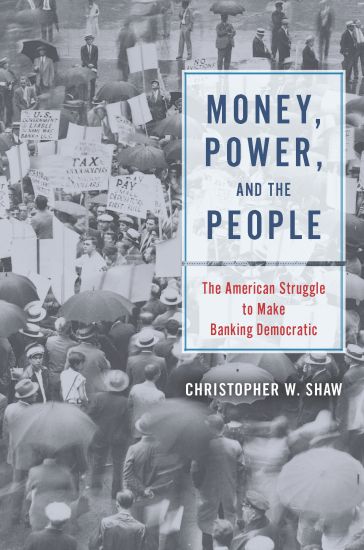
Banks and bankers are hardly the most beloved people and institutions in this country. With its corruptive influence on politics and stranglehold on the American economy, Wall Street is not held in high regard by many outside the financial sector. But the pitchforks raised against this behemoth are largely rhetorical: we rarely see riots in the streets or public demands for an equitable and democratic banking system that result in serious national changes. Yet the situation was vastly different a century ago, as Christopher W. Shaw shows in Money, Power, and the People. His book upends the conventional thinking that financial policy in the early twentieth century was set primarily by the needs and demands of bankers. Shaw shows that banking and politics were directly shaped by the literal and symbolic investments of the grassroots. This engagement remade financial institutions and the national economy, through populist pressure and the establishment of federal regulatory programs and agencies like the Farm Credit System and the Federal Deposit Insurance Corporation. Shaw reveals the surprising groundswell behind such seemingly arcane legislation as the Emergency Currency Act of 1908, as well as the power of the people to demand serious political repercussions for the banks that caused the Great Depression. One result of this sustained interest and pressure was legislation and regulation that brought on a long period of relative financial stability, with a reduced frequency of economic booms and busts. Ironically, though, this stability led to the current decline of the very banking politics that enabled it. Giving voice to a broad swath of American figures, including workers, farmers, politicians, and bankers alike, Money, Power, and the People recasts our understanding of what might be possible in balancing the needs of the people with those of their financial institutions.


For most people in the United States, going almost anywhere begins with reaching for the car keys. This is true, Christopher Wells argues, because the United States is Car Country—a nation dominated by landscapes that are difficult, inconvenient, and often unsafe to navigate by those who are not sitting behind the wheel of a car.The prevalence of car-dependent landscapes seems perfectly natural to us today, but it is, in fact, a relatively new historical development. In Car Country, Wells rejects the idea that the nation's automotive status quo can be explained as a simple byproduct of an ardent love affair with the automobile. Instead, he takes readers on a tour of the evolving American landscape, charting the ways that transportation policies and land-use practices have combined to reshape nearly every element of the built environment around the easy movement of automobiles. Wells untangles the complicated relationships between automobiles and the environment, allowing readers to see the everyday world in a completely new way. The result is a history that is essential for understanding American transportation and land-use issues today.Watch the book trailer: http://www.youtube.com/watch?v=48LTKOxxrXQ

Volumes in New Word Biblical Themes: New Testament series offer short, accessible studies of the key themes of each book of the New Testament.Each volume offers an introduction to the book, a brief exposition of the text with its basic background and a survey of its contents, an overview of its themes, and a deeper look at 3-5 key themes for understanding the book and for preaching and teaching.The Gospel of Mark provided the church with its first written narrative of Jesus's life and ministry. While often overlooked by early commentators in favor of the Gospels of Matthew and John, Mark's seemingly understated account contains a remarkably organized literary structure with a distinctive vision of Jesus's identity and mission, the in-breaking of God's Kingdom, and a theology of discipleship.In this volume, Skinner raises historical and literary questions with a view to elucidating some of Mark's important themes and his unique contributions to our understanding of Jesus of Nazareth. In the process of outlining the valuable contributions of the gospel, Skinner attempts to provide a coherent reading of Mark's themes in their broader literary context. This volume explores themes related to Jesus's mission to the Jewish and Roman worlds and his role in inaugurating of God's Kingdom, while demonstrating that Mark's understanding of Jesus Christ was foundational to what became the written gospel tradition.