Kirjojen hintavertailu. Mukana 11 241 044 kirjaa ja 12 kauppaa.

Kirjahaku

Etsi kirjoja tekijän nimen, kirjan nimen tai ISBN:n perusteella.

1000 tulosta hakusanalla Cicero

Cicero

Cicero

Yelena Baraz

Oxford University Press
2025
nidottu
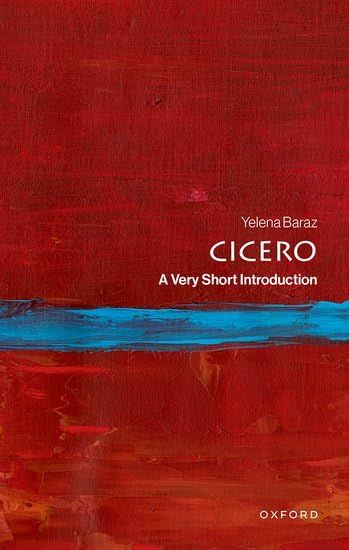
Very Short Introductions: Brilliant, Sharp, Inspiring Marcus Tullius Cicero (106-43 BCE) was one of the most influential figures in late republican Rome, a moment of great social, political, and cultural unrest that would lead to the transition from republic to empire. Cicero was a statesman who held the highest political office, the consulship, and then suffered politically motivated exile. His career was grounded in his continued success as an orator: his speeches were famous during his lifetime and, together with his rhetorical treatises, shaped the practice and theory of public speaking for centuries to come. His ideas influenced early church fathers, Renaissance humanists, and Enlightenment thinkers and his dramatic death captured imagination of his contemporaries, who saw it as standing for the death of the republic and eloquence. In this Very Short Introduction, Yelena Baraz presents a concise and integrated account of Cicero's life and accomplishments, locating him within the political and intellectual contexts of his time. It shows that in all his pursuits Cicero saw himself as a mediating figure: between theory and practice, philosophy and politics, Greek and Roman, and among political interest groups. Baraz tackles each area of Cicero's activity on its own terms while showing how overarching ideas and priorities permeate the apparently separate endeavours. ABOUT THE SERIES: The Very Short Introductions series from Oxford University Press contains hundreds of titles in almost every subject area. These pocket-sized books are the perfect way to get ahead in a new subject quickly. Our expert authors combine facts, analysis, perspective, new ideas, and enthusiasm to make interesting and challenging topics highly readable.
Cicero

Cicero

May; Wisse

Oxford University Press Inc
2001
nidottu
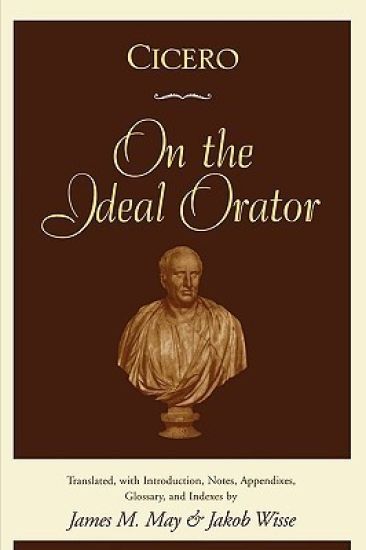
In On the Ideal Orator (De oratore) Cicero, the greatest Roman orator and prosewriter of his day, gives his mature views on rhetoric, oratory and philosophy. Cast in the lively literary form of a dialogue, the work presents a daring view of the orator as the master of all language communcation, while still emphasizing his role at the heart of Roman society and politics. Cicero thus goes far beyond the rules of the standard manuals of the rhetoricians, whom he criticizes for their rigidity and narrowness. But in the age-old quarrel between the philosophers and the rhetoricians, he doesn not side with the philosophers either. His picture of the ideal orator consitutes Cicero's own, original synthesis between the two positions. This translation by May and Wisse aims to be accessible as well as accurate. The translation is based on, and contributes to, the many advances in recent scholarship of De oratore itself, as well as of the many aspects of ancient rhetoric, philosophy, and history relevant to the work. It reflects the many variations of Cicero's style, which are essential ingredients of the work, signalling irony, seriousness, arguments, and climaxes. The extensive annotation, the introduction, the glossary, and the full index of names and places make this book completely accessible to the non-specialist, as well as offering new insights to the specialist.
Cicero

Cicero

Malcolm Schofield

Oxford University Press
2021
sidottu
This book offers an innovative analytic account of Cicero's treatment of key political ideas: liberty and equality, government, law, cosmopolitanism and imperialism, republican virtues, and ethical decision-making in politics. Cicero (106-43 BC) is well known as a major player in the turbulent politics of the last three decades of the Roman Republic. But he was a political thinker, too, influential for many centuries in the Western intellectual and cultural tradition. His theoretical writings stand as the first surviving attempt to articulate a philosophical rationale for republicanism. They were not written in isolation either from the stances he took in his political actions and political oratory of the period, or from his discussions of immediate political issues or questions of character or behaviour in his voluminous correspondence with friends and acquaintances. In this book, Malcolm Schofield situates the intimate interrelationships between Cicero's writings in all these modes within the historical context of a fracturing Roman political order. It exhibits the continuing attractions of Cicero's scheme of republican values, as well as some of its limitations as a response to the crisis that was engulfing Rome.
Cicero

Cicero

Malcolm Schofield

Oxford University Press
2021
nidottu
This book offers an innovative analytic account of Cicero's treatment of key political ideas: liberty and equality, government, law, cosmopolitanism and imperialism, republican virtues, and ethical decision-making in politics. Cicero (106-43 BC) is well known as a major player in the turbulent politics of the last three decades of the Roman Republic. But he was a political thinker, too, influential for many centuries in the Western intellectual and cultural tradition. His theoretical writings stand as the first surviving attempt to articulate a philosophical rationale for republicanism. They were not written in isolation either from the stances he took in his political actions and political oratory of the period, or from his discussions of immediate political issues or questions of character or behaviour in his voluminous correspondence with friends and acquaintances. In this book, Malcolm Schofield situates the intimate interrelationships between Cicero's writings in all these modes within the historical context of a fracturing Roman political order. It exhibits the continuing attractions of Cicero's scheme of republican values, as well as some of its limitations as a response to the crisis that was engulfing Rome.
Cicero

Cicero

Anthony Everitt

Random House USA Inc
2003
nidottu
A lively portrait of the quintessential Roman politician describes the life and times of the ancient statesman, based on the witty and candid letters that Cicero wrote to his friend Atticus in which he described the events and personalities that shaped the final days of Republican Rome. Reprint. 50,000 first printing.
Cicero: Tusculan Disputations Book I
A significant two-fold development in recent classical scholarship has been a revival of interest in, and respect for, post-Aristotelian Greek philosophy and Cicero’s contribution to our knowledge of it. Of Cicero’s major works in this field the Tusculan Disputations is perhaps the most approachable. Less technical than Academia and De Finibus, it still provides many insights into Hellenistic philosophical controversies, especially those concerning the two great schools of Stoicism and Epicureanism. At the same time it contains significant evidence of a reviving interest in Plato and Aristotle themselves. The theme of the first Tusculan is whether death is an evil. Of the many popular beliefs about the nature of the soul and its fate after death Cicero has little to say, but the philosophically based approach which he adopts is rich in material and provides the inspiration for striking passages worthy of the great orator. Latin text with facing-page English translation, introduction and commentary.
Cicero: Verrines II.1

Cicero: Verrines II.1

Cicero

Aris Phillips Ltd
1986
nidottu
Cicero’s first major triumph was the prosecution of Caius Verres for misgovernment in Sicily. This speech was given in the second part of the trial and shows the development of Cicero’s rhetoric. This edition communicates the literary flavour of the original and discusses the historical and political background to the trial, with examination of noteworthy textual cruces and problems of interpretation. [Latin text with facing-page English translation, introduction and commentary.]
Cicero: Philippics II

Cicero: Philippics II

Cicero

Aris Phillips Ltd
1986
nidottu
Cicero’s great polemic against Antony, a literary masterpiece, is here made available with full translation and notes. The introduction to this edition deals with the historical setting, Roman rhetoric and Cicero’s style while the notes are mainly literary, not historical. Attention is paid to Cicero’s use of the devices and techniques of rhetoric, and the variety of tones by which he sustains his attack on Antony without ever losing the reader’s interest. The notes also draw attention to the rhythms of the Latin and the clausulae. Latin text with facing-page English translation, introduction and commentary.
Cicero: Tusculan Disputations II & V
The Fifth Tusculan Disputation is the finest of the five books, its nearest rival being the First (also edited in this series). The middle three books, represented in this edition by the Second, are, as the author clearly intended, less elevated, though still showing Cicero’s flair for elegant and lively exposition, and providing much valuable information about the teaching of the main Hellenistic philosophical schools, especially the Stoics. They argue that the perfect human life, or complete human well-being, that of the ‘wise man’, is unaffected by physical and mental distress or extremes of emotion. Against this background the Fifth puts the positive, mainly Stoic, case that virtue, moral goodness, is alone and of itself sufficient. Latin text with facing-page English translation, introduction and commentary.
Cicero: On Fate

Cicero: On Fate

Cicero

Aris Phillips Ltd
1991
nidottu
Cicero and Boethius did more than anyone else to transmit the insights of Greek philosophy to the Latin culture of Western Europe which has played so influential a part in our civilisation to this day. Cicero’s treatise On Fate (De Fato), though surviving only in a fragmentary and mutilated state, records contributions to the discussion of a central philosophical issue, that of free will and determinism, which are comparable in importance to those of twentieth-century philosophers and indeed sometimes anticipate them. Study of the treatise has been hindered by the lack of a combined Latin text and English translation based on a clear understanding of the arguments; R. W. Sharples’ text is intended to meet this need. The last book of Boethius’ Consolation of Philosophy (Philosophiae Consolationis) is linked with Cicero’s treatise by its theme, the relation of divine foreknowledge to human freedom. Latin text with facing-page English translation, introduction and commentary.
Cicero: In Catilinam I and II

Cicero: In Catilinam I and II

Cicero

Bristol Classical Press
1991
nidottu
This edition, first published by Macmillan in 1943, has the straightforward utilitarian aims of all those prepared by H.E. Gould and J.L. Whiteley: a basic introduction, reliable text, suitable illustrations, and a vocabulary that gives only those meanings that are required. Last and perhaps most important of all, adequate assistance is provided in the notes, so that the student may feel capable of translating with confidence and accuracy.
Cicero

Cicero

Elizabeth Rawson

Bristol Classical Press
1994
pokkari
Drawing on a full range of Cicero's speeches, essays and correspondence, as well as on the most recent research, Rawson's highly regarded biography of Cicero - his politics and philosophy - makes fascinating reading for historians, classicists, and anyone interested in Roman history.
Cicero: Murder at Larinum

Cicero: Murder at Larinum

Cicero

Bristol Classical Press
1991
nidottu
This brief, user friendly edition has long remained popular, for it is pitched at just the right level for school students tackling their first continuous prose, and for other early-stage learners of Latin. Moreover, the text is selected from the Pro Cluentio - the defence speech of one of the most intriguing and lurid ancient murder trials - set in the northern Italian provincial town of Larinum - for which evidence survives, by the young forensic lawyer Cicero, destined to become Rome’s most celebrated political orator. The excitement and scandal of the original case still resonates with those who might compare the ancient reality with the modern fictions of Perry Mason or LA Law. The Introduction elucidates the background situation, the feud between the Cluentil and the villainous Oppicianus; the Notes give ample linguistic and historical assistance and there is also a full Vocabulary. This is unadapted and exciting Latin well within the grasp of those who are tackling a 'real' text for the first time.
Cicero: Pro Roscio Amerino

Cicero: Pro Roscio Amerino

Cicero

Bristol Classical Press
1991
nidottu
Cicero's speech on behalf of Roscius of Ameria in Umbria represents his first public 'cause celebre' in 80 BC when he was just twenty-six. It followed closely the notorius proscriptions made under hte dictator Sulla. One of Sulla's freedman favourites, Chrysogonus, had criminally contrived to have Roscius' wealthy father's name added to the list of the proscribed after his death and after closure of the list, with the aim of depriving Roscius of his substantial inheritance. Cicero's speech, one of his most straightforward and yet powerful, brought him into immediate political danger but at the same time established him as a fearless forensic orator. Donkin's edition, first published as one of the history 'red Macmillan' series, has never been bettered for its concise, yet detailed, introduction and its annotation covering matters of language and content.
Thought of Cicero

Thought of Cicero

Cicero

Bristol Classical Press
1991
nidottu
Aimed at advanced school students, this classic collection - first published in 1964 - contains forty passages, coherent in themselves, illustrating Cicero's thinking on government, religion, law and ethics. This book fills a gap, as most students are only familiar with Cicero's speeches and letters, knowing little of his philosophical works, through which many of our ideas of civilisation have come down to us. The introduction gives the essential background, including a brief outline of Greek philosophy. There are practical notes on the texts, observations on Cicero's style and a select vocabulary.
"Cicero

"Cicero

Malcolm M. Willcock

Bristol Classical Press
1998
nidottu
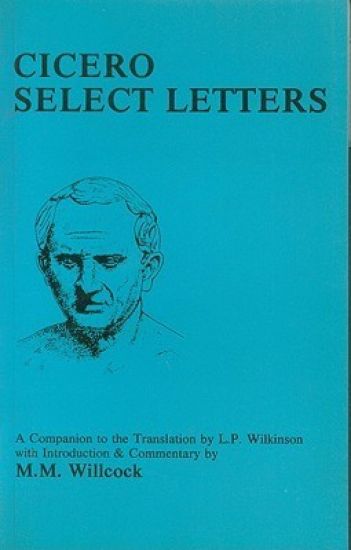
Cicero's letters are unique, both as evidence for a most important period of ancient history, the end of the Roman Republic, and as a portrayal of the world of Cicero and his numerous correspondents; they make Cicero himself the most intimately known person in the whole classical world. The 147 letters dealt with here cover the years 62 to 43 BC. The book provides a useful introduction and extensive notes on L.P. Wilkinson's selected translation ofthe letters (also published by Bristol Classical Press).