Kirjojen hintavertailu. Mukana 11 244 527 kirjaa ja 12 kauppaa.

Kirjahaku

Etsi kirjoja tekijän nimen, kirjan nimen tai ISBN:n perusteella.

1000 tulosta hakusanalla Clarence Bloomfield Moore

The Tennessee, Green and Lower Ohio Rivers Expeditions of Clarence Bloomfield Moore

The Tennessee, Green and Lower Ohio Rivers Expeditions of Clarence Bloomfield Moore

Clarence Bloomfield Moore

The University of Alabama Press
2002
nidottu
This oversized reprint volume presents original materials from Moore's northernmost expeditions conducted in the early 1900s as he surveyed areas of potential archaeological interest in the southeastern United States. Some of the sites he found were later targeted for major excavations during the days of the WPA/CCC. Many National Register Historic Sites are today located along the rivers he explored in this work. In many cases, however, Moore's report documents sites since destroyed by river action or by lake impoundments behind hydroelectric dams or by looters. As with all Moore's other investigations, his thorough documentation and collaboration with other scholars advanced understanding of aboriginal peoples and fueled debate among the experts. For instance, more than 296 burials were recovered from Indian Knoll on the Green River in Kentucky. Some graves included ceremonially ""killed"" artifacts, dogs buried with both adults and children, and exotic materials leading to speculations concerning origins, usage, and trade networks. Stone box graves were widespread and somewhat exclusive to this area, giving rise to early assumptions regarding kinship between scattered modern Indian tribes. Richard Polhemus has compiled a comprehensive inventory of Moore's work in Tennessee, Alabama, Mississippi and Kentucky and written a concise introduction to place the work in context. In so doing, he has made available to contemporary scholars of history, archaeology, and anthropology a trove of resource material on one of the most archaeologically rich and artifact-diverse regions in the nation.
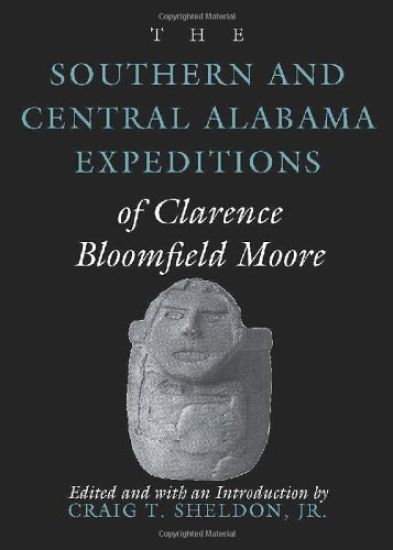
The Southern and Central Alabama Expeditions of Clarence Bloomfield Moore
Covering 19 years of excavations, this volume provides an invaluable collection of Moore's pioneering archaeological investigations along Alabama's waterways. In 1996, The University of Alabama Press published The Moundville Expeditions of Clarence Bloomfield Moore, which covered a large part of Moore's early archaeological expeditions to the state of Alabama. This volume collects the balance of Moore's Alabama expeditions, with the exception of those Moore made along the Tennessee River, which will be collected in another, forthcoming volume focusing on the Tennessee basin. This volume includes: Certain Aboriginal Remains of the Alabama River (1899); Certain Aboriginal Remains of the Tombigbee River(1901); a portion of Certain Aboriginal Remains of the Northwest Florida Coast (1901); The So-Called 'Hoe-Shaped Implement' (1903); Aboriginal Urn-Burial in the United States (1904); A Form of Urn-Burial on Mobile Bay (1905); Certain Aboriginal Remains of the Lower Tombigbee River (1905); Certain Aboriginal Remains on Mobile Bay and on Mississippi Sound (1905); a portion of Mounds of the Lower Chattahoochee and Lower Flint Rivers (1907); a portion of The Northwest Florida Coast Revisited(1918). Craig Sheldon's comprehensive introduction focuses both on the Moore expeditions and on subsequent archaeological excavations at sites investigated by Moore. Sheldon places Moore's archaeological work in the context of his times and against the backdrop of similar investigations in the Southeast. Sheldon discusses practical matters, such as the various assistants Moore employed and their roles in these historic expeditions. He provides brief vignettes of daily life on the Gopher and describes Moore's work habits, revealing professional and personal biographical details previously unknown about this enigmatic archaeologist.
Moundville Expeditions

Moundville Expeditions

Clarence Bloomfield Moore

The University of Alabama Press
1996
nidottu
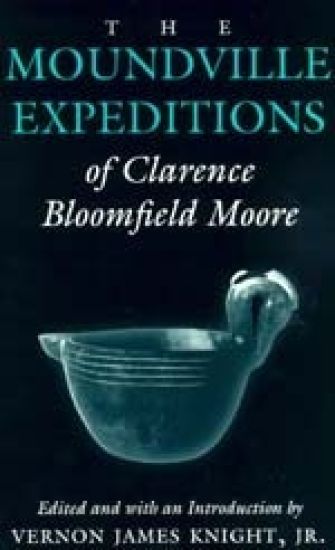
The two works included in this volume represent the pinacle of the career of Clarence Bloomfield Moore. It includes ""Certain Aboriginal Remains of the Black Warrior River"" (1905) and ""Moundville Revisited"" (1907), which brought the Moundville site in Alabama to the attention of the scholarly world.
Aboriginal Urn-Burial in the United States

Aboriginal Urn-Burial in the United States

Clarence Bloomfield Moore

Hutson Street Press
2025
sidottu
"Aboriginal Urn-Burial in the United States" by Clarence Bloomfield Moore is a detailed archaeological study of Native American burial practices in the early 20th century. Moore meticulously documents and analyzes the discovery of urn burials at various sites in the United States. This work offers valuable insights into the mortuary rituals, material culture, and social structures of aboriginal populations. Through detailed descriptions and illustrations, Moore sheds light on a significant aspect of Native American history and prehistory. This book is an essential resource for archaeologists, anthropologists, and historians interested in understanding the rich cultural heritage of the United States' indigenous peoples. Moore's careful observations and systematic approach make this a lasting contribution to the field. This work has been selected by scholars as being culturally important, and is part of the knowledge base of civilization as we know it. This work was reproduced from the original artifact, and remains as true to the original work as possible. Therefore, you will see the original copyright references, library stamps (as most of these works have been housed in our most important libraries around the world), and other notations in the work. This work is in the public domain in the United States of America, and possibly other nations. Within the United States, you may freely copy and distribute this work, as no entity (individual or corporate) has a copyright on the body of the work. As a reproduction of a historical artifact, this work may contain missing or blurred pages, poor pictures, errant marks, etc. Scholars believe, and we concur, that this work is important enough to be preserved, reproduced, and made generally available to the public. We appreciate your support of the preservation process, and thank you for being an important part of keeping this knowledge alive and relevant.