Despite being a major figure of Haitian literature, Jean-Claude Charles (1949-2008) has received relatively little scholarly attention to date. The present volume seeks to serve as an introduction to the work and universe of this unique and capital writer to an English-language readership. The essays in the collection are organized along three major axes: contextual articles, placing Charles’ work within the larger Haitian literary landscape, punctual articles, addressing specific themes in a selection of Charles’ books, and author testimonials, attesting to Charles’ work’s importance both to his contemporaries and to a new generation of writers. With the ongoing republication of Charles’ work by Mémoire d’encrier in Montreal, and the increasing interest in the author, the proposed volume is timely and necessary, and is in large part a critical accompaniment to the republishing programme. Described by Dany Laferrière as “most brilliant Haitian author of his generation,” Charles has until recently remained largely unread and little understood. As the various chapters in the volume show, Charles is an author for now, and the collection will accompany readers seeking strikingly original insights on issues such as race, migration, and exile, and the role of the author and literature in times of crisis.
Despite being a major figure of Haitian literature, Jean-Claude Charles (1949-2008) has received relatively little scholarly attention to date. The present volume seeks to serve as an introduction to the work and universe of this unique and capital writer to an English-language readership. The essays in the collection are organized along three major axes: contextual articles, placing Charles’ work within the larger Haitian literary landscape, punctual articles, addressing specific themes in a selection of Charles’ books, and author testimonials, attesting to Charles’ work’s importance both to his contemporaries and to a new generation of writers. With the ongoing republication of Charles’ work by Mémoire d’encrier in Montreal, and the increasing interest in the author, the proposed volume is timely and necessary, and is in large part a critical accompaniment to the republishing programme. Described by Dany Laferrière as “most brilliant Haitian author of his generation,” Charles has until recently remained largely unread and little understood. As the various chapters in the volume show, Charles is an author for now, and the collection will accompany readers seeking strikingly original insights on issues such as race, migration, and exile, and the role of the author and literature in times of crisis.
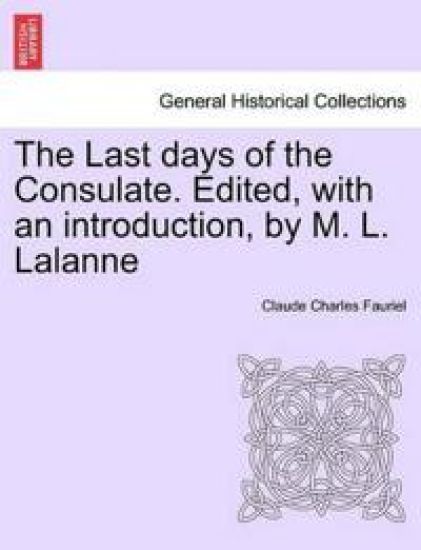
Title: The Last days of the Consulate ... Edited, with an introduction, by M. L. Lalanne.Publisher: British Library, Historical Print EditionsThe British Library is the national library of the United Kingdom. It is one of the world's largest research libraries holding over 150 million items in all known languages and formats: books, journals, newspapers, sound recordings, patents, maps, stamps, prints and much more. Its collections include around 14 million books, along with substantial additional collections of manuscripts and historical items dating back as far as 300 BC.The GENERAL HISTORICAL collection includes books from the British Library digitised by Microsoft. This varied collection includes material that gives readers a 19th century view of the world. Topics include health, education, economics, agriculture, environment, technology, culture, politics, labour and industry, mining, penal policy, and social order. ++++The below data was compiled from various identification fields in the bibliographic record of this title. This data is provided as an additional tool in helping to insure edition identification: ++++ British Library Fauriel, Claude Charles; 1886. 8 . 9225.aa.16.