Kirjojen hintavertailu. Mukana 11 244 527 kirjaa ja 12 kauppaa.

Kirjahaku

Etsi kirjoja tekijän nimen, kirjan nimen tai ISBN:n perusteella.

761 tulosta hakusanalla Clayborne Carson; Kris Shepard

A Call to Conscience: The Landmark Speeches of Dr. Martin Luther King, Jr.

A Call to Conscience: The Landmark Speeches of Dr. Martin Luther King, Jr.

Clayborne Carson; Kris Shepard

Grand Central Publishing
2002
nidottu
A powerful collection of the most essential speeches from famed social activist and key civil rights figure Dr. Martin Luther King, Jr. This companion volume to A Knock At Midnight: Inspiration from the Great Sermons of Rev. Martin Luther King, Jr. includes the text of his most well-known oration, I Have a Dream, his acceptance speech for the Nobel Peace Prize, and Beyond Vietnam, a powerful plea to end the ongoing conflict. Includes contributions from Rosa Parks, Aretha Franklin, the Dalai Lama, and many others.
The Movement 1964-1970

The Movement 1964-1970

Clayborne Carson

Greenwood Press
1993
sidottu
Publication of this complete edition of The Movement is an important contribution to popular understanding of the social movements of the 1960s. No other periodical provided such extensive coverage of the transformation of the civil rights movement into the diverse radical movements of the late 1960s.Malcolm X, Stokely Carmichael, and Huey Newton are among the many black militant leaders who are discussed in The Movement. Its insightful and sympathetic coverage, including participants' accounts, of a wide range of community organizing activities such as anti-war/anti-draft protests and Cesar Chavez's National Farm Workers Association and grape workers' strike in Delano, California. It covers national and international events, with articles on revolutionary movements in Cuba, Vietnam, and Africa. It is an excellent source of information regarding the social change activities of the late 1960s. As such, it is invaluable to students of the New Left, contemporary race relations, African-American history and Black Studies.
The Autobiography of Martin Luther King, Jr.

The Autobiography of Martin Luther King, Jr.

Clayborne Carson

Grand Central Publishing
2001
nidottu
Written by Martin Luther King, Jr. himself, this astounding autobiography brings to life a remarkable man changed the world --and still inspires the desires, hopes, and dreams of us all. Martin Luther King: the child and student who rebelled against segregation. The dedicated minister who questioned the depths of his faith and the limits of his wisdom. The loving husband and father who sought to balance his family's needs with those of a growing, nationwide movement. And to most of us today, the world-famous leader who was fired by a vision of equality for people everywhere. Relevant and insightful, The Autobiography of Martin Luther King, Jr. offers King's seldom disclosed views on some of the world's greatest and most controversial figures: John F. Kennedy, Malcolm X, Lyndon B. Johnson, Mahatma Gandhi, and Richard Nixon. It paints a moving portrait of a people, a time, and a nation in the face of powerful change. And it shows how Americans from all walks of life can make a difference if they have the courage to hope for a better future.
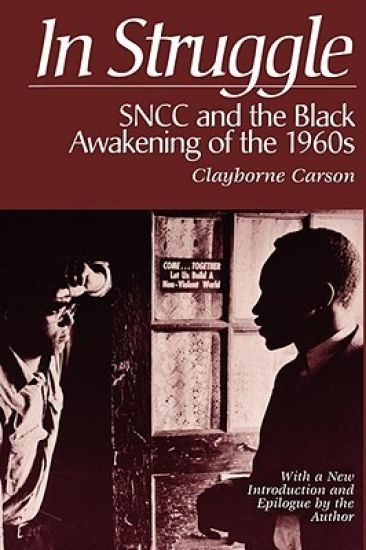
In Struggle

In Struggle

Clayborne Carson

Harvard University Press
1995
nidottu
With its radical ideology and effective tactics, the Student Nonviolent Coordinating Committee (SNCC) was the cutting edge of the civil rights movement during the 1960s. This sympathetic yet evenhanded book records for the first time the complete story of SNCC’s evolution, of its successes and its difficulties in the ongoing struggle to end white oppression.At its birth, SNCC was composed of black college students who shared an ideology of moral radicalism. This ideology, with its emphasis on nonviolence, challenged Southern segregation. SNCC students were the earliest civil rights fighters of the Second Reconstruction. They conducted sit-ins at lunch counters, spearheaded the freedom rides, and organized voter registration, which shook white complacency and awakened black political consciousness. In the process, Clayborne Carson shows, SNCC changed from a group that endorsed white middle-class values to one that questioned the basic assumptions of liberal ideology and raised the fist for black power. Indeed, SNCC’s radical and penetrating analysis of the American power structure reached beyond the black community to help spark wider social protests of the 1960s, such as the anti–Vietnam War movement.Carson’s history of SNCC goes behind the scene to determine why the group’s ideological evolution was accompanied by bitter power struggles within the organization. Using interviews, transcripts of meetings, unpublished position papers, and recently released FBI documents, he reveals how a radical group is subject to enormous, often divisive pressures as it fights the difficult battle for social change.
Bayard Rustin

Bayard Rustin

Clayborne Carson

NEW YORK UNIVERSITY PRESS
2023
sidottu
2024 Outstanding Academic Title, given by Choice Reviews Celebrates the life and legacy of Bayard Rustin, the civil rights leader behind the 1963 March on Washington for Jobs and Freedom While we can all recall images of Martin Luther King Jr. giving his "I Have a Dream" speech in front of a massive crowd at Lincoln Memorial, few of us remember the man who organized this watershed nonviolent protest in eight short weeks: Bayard Rustin. This was far from Rustin's first foray into the fight for civil rights. As a world-traveling pacifist, he brought Gandhi's protest techniques to the forefront of US civil rights demonstrations, helped build the Southern Christian Leadership Conference, led the fight for economic justice, and played a deeply influential role in the life of Dr. King by helping to mold him into an international symbol of nonviolent resistance. Rustin's legacy touches many areas of contemporary life—from civil resistance to violent uprisings, democracy to socialism, and criminal justice reform to war resistance. Despite these achievements, Rustin was often relegated to the background. He was silenced, threatened, arrested, beaten, imprisoned, and fired from important leadership positions, largely because he was an openly gay man in a fiercely homophobic era. With expansive, searching, and sometimes critical essays from a range of esteemed writers—including Rustin's own partner, Walter Naegle—this volume draws a full picture of Bayard Rustin: a gay, pacifist, socialist political radical who changed the course of US history and set a precedent for future civil rights activism, from LGBTQ+ Pride to Black Lives Matter.
Malcolm X

Malcolm X

Clayborne Carson

Allworth Press,U.S.
2012
pokkari
The FBI has made possible a reassembling of the history of Malcolm X that goes beyond any previous research. From the opening of his file in March of 1953 to his assassination in 1965, the story of Malcolm X's political life is a gripping one. Shortly after he was released from a Boston prison in 1953, the FBI watched every move Malcolm X made. Their files on him totaled more than 3,600 pages, covering every facet of his life. Viewing the file as a source of information about the ideological development and political significance of Malcolm X, historian Clayborne Carson examines Malcolm's relationship to other African-American leaders and institutions in order to define more clearly Malcolm's place in modern history. With its sobering scrutiny of the FBI and the national policing strategies of the 1950s and 1960s, Malcolm X: The FBI File is one of a kind: never before has there been so much material on the assassination of Malcolm X in one conclusive volume.
Bayard Rustin

Bayard Rustin

Clayborne Carson

NEW YORK UNIVERSITY PRESS
2025
pokkari
2024 Outstanding Academic Title, given by Choice Reviews Celebrates the life and legacy of Bayard Rustin, the civil rights leader behind the 1963 March on Washington for Jobs and Freedom While we can all recall images of Martin Luther King Jr. giving his "I Have a Dream" speech in front of a massive crowd at Lincoln Memorial, few of us remember the man who organized this watershed nonviolent protest in eight short weeks: Bayard Rustin. This was far from Rustin's first foray into the fight for civil rights. As a world-traveling pacifist, he brought Gandhi's protest techniques to the forefront of US civil rights demonstrations, helped build the Southern Christian Leadership Conference, led the fight for economic justice, and played a deeply influential role in the life of Dr. King by helping to mold him into an international symbol of nonviolent resistance. Rustin's legacy touches many areas of contemporary life - from civil resistance to violent uprisings, democracy to socialism, and criminal justice reform to war resistance. Despite these achievements, Rustin was often relegated to the background. He was silenced, threatened, arrested, beaten, imprisoned, and fired from important leadership positions, largely because he was an openly gay man in a fiercely homophobic era. With expansive, searching, and sometimes critical essays from a range of esteemed writers—including Rustin's own partner, Walter Naegle—this volume draws a full picture of Bayard Rustin: a gay, pacifist, socialist political radical who changed the course of US history and set a precedent for future civil rights activism, from LGBTQ Pride to Black Lives Matter.
The Struggle for Freedom

The Struggle for Freedom

Clayborne Carson; Emma Lapsansky-Werner; Gary Nash

Pearson
2015
nidottu
The Struggle for Freedom provides a compelling narrative centered around individual African American lives. The authors emphasize African Americans' insistent call to the nation to deliver on the constitutional promises made to all its citizens, weaving African American history into a larger story of American history.
The Martin Luther King, Jr., Encyclopedia

The Martin Luther King, Jr., Encyclopedia

Clayborne Carson; Tenisha H. Armstrong; Susan A. Carson; Erin K. Cook; Susan Englander

Greenwood Press
2008
sidottu
As editor of The Papers of Martin Luther King, Jr., Dr. Clayborne Carson, with the assistance of his staff at Stanford's Martin Luther King, Jr., Research and Education Institute, had access to a variety of documents relating to all aspects of Dr. King's life and career. The encyclopedia provides readers with over 280 entries that offer fresh and engaging insights into Dr. King and the civil rights movement. From their unique familiarity with these materials, they have compiled an encyclopedia offering a fresh and exciting look at the work of Dr. King and the course of the civil rights movement.
Confluence of Thought

Confluence of Thought

Bidyut Chakrabarty; Clayborne Carson

Oxford University Press Inc
2013
sidottu
While much has been written about Gandhi and Martin Luther King, Jr., never before has anyone compared the social and political origins and evolution of their thoughts on non-violence. In this path-breaking work, respected political theorist Bidyut Chakrabarty argues that there is a confluence between Gandhi and King's concerns for humanity and advocacy of non-violence, despite the very different historical, economic and cultural circumstances against which they developed their ideas. At the same time, he demonstrates that both were truly shaped by their historical moments, evolving their approaches to non-violence to best advance their respective struggles for freedom. Gandhi and King were perhaps the most influential individuals in modern history to combine religious and political thought into successful and dynamic social ideologies. Gandhi emphasized service to humanity while King, who was greatly influenced by Gandhi, pursued religion-driven social action. Chakrabarty looks particularly at the way in which each strategically used religious and political language to build momentum and attract followers to their movements. The result is a compelling and historically entrenched view of two of the most important figures of the twentieth century and a thoughtful meditation on the common threads that flow through the larger and enduring nonviolence movement.
Confluence of Thought

Confluence of Thought

Bidyut Chakrabarty; Clayborne Carson

Oxford University Press Inc
2013
nidottu
While much has been written about Gandhi and Martin Luther King, Jr., never before has anyone compared the social and political origins and evolution of their thoughts on non-violence. In this path-breaking work, respected political theorist Bidyut Chakrabarty argues that there is a confluence between Gandhi and King's concerns for humanity and advocacy of non-violence, despite the very different historical, economic and cultural circumstances against which they developed their ideas. At the same time, he demonstrates that both were truly shaped by their historical moments, evolving their approaches to non-violence to best advance their respective struggles for freedom. Gandhi and King were perhaps the most influential individuals in modern history to combine religious and political thought into successful and dynamic social ideologies. Gandhi emphasized service to humanity while King, who was greatly influenced by Gandhi, pursued religion-driven social action. Chakrabarty looks particularly at the way in which each strategically used religious and political language to build momentum and attract followers to their movements. The result is a compelling and historically entrenched view of two of the most important figures of the twentieth century and a thoughtful meditation on the common threads that flow through the larger and enduring nonviolence movement.
Fighting for Us

Fighting for Us

Scot Brown; Clayborne Carson

New York University Press
2003
sidottu
The untold story of the Black nationalist group behind the growing popularity of Kwanzaa In spite of the ever-growing popularity of Kwanzaa, the story of the influential Black nationalist organization behind the holiday has never been told. Fighting for Us explores the fascinating history of the US Organization, a Black nationalist group based in California that played a leading role in Black Power politics and culture during the late 1960s and early '70s whose influence is still felt today. Advocates of Afrocentric renewal, US unleashed creative and intellectual passions that continue to fuel debate and controversy among scholars and students of the Black Power movement. Founded in 1965 by Maulana Karenga, US established an extensive network of alliances with a diverse body of activists, artists and organizations throughout the United States for the purpose of bringing about an African American cultural revolution. Fighting for US presents the first historical examination of US' philosophy, internal dynamics, political activism and influence on African American art, making an elaborate use of oral history interviews, organizational archives, Federal Bureau of Investigation files, newspaper accounts, and other primary sources of the period. This book also sheds light on factors contributing to the organization's decline in the early '70s—government repression, authoritarianism, sexism, and elitist vanguard politics. Previous scholarship about US has been shaped by a war of words associated with a feud between US and the Black Panther Party that gave way to a series of violent and deadly clashes in Los Angeles. Venturing beyond the lingering rhetoric of rivalry, this book illuminates the ideological similarities and differences between US's "cultural" nationalism and the Black Panther Party's "revolutionary" nationalism. Today, US's emphasis on culture has endured as evidenced by the popularity of Kwanzaa and the Afrocentrism in Black art and popular media. Engaging and original, Fighting for US will be the definitive work on Maulana Karenga, the US organization, and Black cultural nationalism in America.
Fighting for Us

Fighting for Us

Scot Brown; Clayborne Carson

New York University Press
2005
pokkari
The untold story of the Black nationalist group behind the growing popularity of Kwanzaa In spite of the ever-growing popularity of Kwanzaa, the story of the influential Black nationalist organization behind the holiday has never been told. Fighting for Us explores the fascinating history of the US Organization, a Black nationalist group based in California that played a leading role in Black Power politics and culture during the late 1960s and early '70s whose influence is still felt today. Advocates of Afrocentric renewal, US unleashed creative and intellectual passions that continue to fuel debate and controversy among scholars and students of the Black Power movement. Founded in 1965 by Maulana Karenga, US established an extensive network of alliances with a diverse body of activists, artists and organizations throughout the United States for the purpose of bringing about an African American cultural revolution. Fighting for US presents the first historical examination of US' philosophy, internal dynamics, political activism and influence on African American art, making an elaborate use of oral history interviews, organizational archives, Federal Bureau of Investigation files, newspaper accounts, and other primary sources of the period. This book also sheds light on factors contributing to the organization's decline in the early '70s—government repression, authoritarianism, sexism, and elitist vanguard politics. Previous scholarship about US has been shaped by a war of words associated with a feud between US and the Black Panther Party that gave way to a series of violent and deadly clashes in Los Angeles. Venturing beyond the lingering rhetoric of rivalry, this book illuminates the ideological similarities and differences between US's "cultural" nationalism and the Black Panther Party's "revolutionary" nationalism. Today, US's emphasis on culture has endured as evidenced by the popularity of Kwanzaa and the Afrocentrism in Black art and popular media. Engaging and original, Fighting for US will be the definitive work on Maulana Karenga, the US organization, and Black cultural nationalism in America.
This Light of Ours

This Light of Ours

Julian Bond; Clayborne Carson

UNIVERSITY PRESS OF MISSISSIPPI
2023
pokkari
This Light of Ours: Activist Photographers of the Civil Rights Movement is a paradigm-shifting publication that presents the Civil Rights Movement through the work of nine photographers who participated in the movement as activists with SNCC, SCLC, and CORE. Unlike images produced by photojournalists, who covered breaking news events, these photographers lived within the movement—primarily within the Student Nonviolent Coordinating Committee (SNCC) framework—and documented its activities by focusing on the student activists and local people who together made it happen. The core of the book is a selection of 150 black-and-white photographs, representing the work of photographers Bob Adelman, George Ballis, Bob Fitch, Bob Fletcher, Matt Herron, David Prince, Herbert Randall, Maria Varela, and Tamio Wakayama. Images are grouped around four movement themes and convey SNCC's organizing strategies, resolve in the face of violence, impact on local and national politics, and influence on the nation's consciousness. The photographs and texts of This Light of Ours remind us that the movement was a battleground, that the battle was successfully fought by thousands of "ordinary" Americans among whom were the nation's courageous youth, and that the movement's moral vision and impact continue to shape our lives.
The Movement Makes Us Human

The Movement Makes Us Human

Joanna Shenk; Clayborne Carson

Wipf Stock Publishers
2018
sidottu
How is it that the person who created and defined the field of Black Studies and drafted Dr. Martin Luther King Jr's prophetic Beyond Vietnam speech needs an introduction, even in movement circles today? In this provocative and poignant interview, Dr. Vincent Harding reflects on the communities that shaped his early life, compelled him to join movements for justice, and sustained his ongoing transformation. He challenges those committed to justice today to consider the enduring power of nonviolent social change and to root out white supremacy in all of its forms. With his relentless commitment to education and relationship-building across lines of difference, Harding never doubted the capacity of people to create the world we need. ""Vincent Harding was our greatest 'teacher of the movement, ' in both senses: historian of (and participant in) the Southern Freedom Struggle; and then animator of (and sage among) its many offspring. This intimate, wide-ranging interview of a formidable elder by a young Mennonite pastor-activist can serve as a primer on Harding's fascinating journey and remarkable work. He was a pastor and curator of spirit to so many of us in contemporary social movements, and these pages offer his counsel on how to be human to a new generation."" --Ched Myers and Elaine Enns, Authors of Ambassadors of Reconciliation ""Vincent and Rosemarie Freeney Harding lived democracy as a religious quest. They defined democracy as 'breathing space' and democratic movements as those that make us human. Shenk's interviews with Vincent Harding reveal one of America's most significant freedom struggle leaders reviewing his remarkable life. Together with this younger colleague, Harding reflects on the provocative, momentous questions facing Americans today--and on what will be necessary to make room to breathe for all."" --Rose Marie Berger, Senior Associate Editor, Sojourners Magazine ""Reader be warned, The Movement Makes Us Human isn't the 'hot new thing' to consume quickly to keep up with superficial water cooler banter. Within these pages are the concrete stories and wisdom that have emerged out of a life lived well with others. Harding's distinctive voice still compels us to join the river of struggle and inspires us towards a deeper humanity, a more courageous faith, and a more just society. Read it with care "" --Drew G. I. Hart, Assistant Professor of Theology, Messiah College Joanna Shenk is Associate Pastor at First Mennonite Church of San Francisco and co-producer of The Iconocast podcast. She is a writer, networker, activist, and educator. She is author of Widening the Circle: Experiments in Christian Discipleship.
The Long Shadow of Little Rock

The Long Shadow of Little Rock

Daisy Bates; Clayborne Carson

University of Arkansas Press
2007
nidottu
At an event honoring Daisy Bates as 1990's Distinguished Citizen then-governor Bill Clinton called her ""the most distinguished Arkansas citizen of all time."" Her classic account of the 1957 Little Rock School Crisis, ""The Long Shadow of Little Rock"", couldn't be found on most bookstore shelves in 1962 and was banned throughout the South. In 1988, after the University of Arkansas Press reprinted it, it won an American Book Award. On September 3, 1957, Gov. Orval Faubus called out the National Guard to surround all-white Central High School and prevent the entry of nine black students, challenging the Supreme Court's 1954 order to integrate all public schools. On September 25, Daisy Bates, an official of the NAACP in Arkansas, led the nine children into the school with the help of federal troops sent by President Eisenhower - the first time in eighty-one years that a president had dispatched troops to the South to protect the constitutional rights of black Americans. This new edition of Bates' own story about these historic events is being issued to coincide with the fiftieth anniversary of the Little Rock School crisis in 2007.