
Kirjahaku
Etsi kirjoja tekijän nimen, kirjan nimen tai ISBN:n perusteella.
1000 tulosta hakusanalla Clifford Fuller

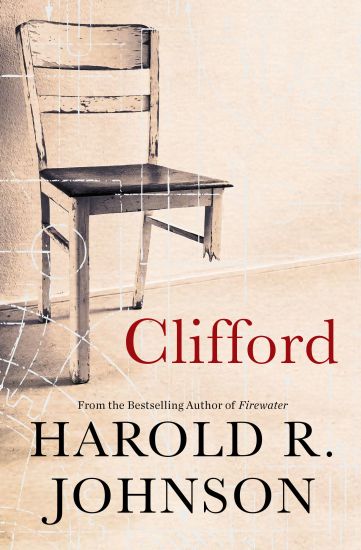
From the bestselling author of Firewater comes a moving tribute to an older brother that traverses the thresholds of memoir, fiction, and fantasy and reimagines what could have been.When Harold Johnson returns to his childhood home in a northern Indigenous community for his brother Clifford’s funeral, the first thing his eyes fall on is a chair. It stands on three legs, the fourth broken off and missing. So begins a journey through the past, a retrieval of recollections of his silent, powerful Swedish father; his formidable Cree mother; and his brother Clifford, a precocious young boy who is drawn to the mysterious workings of the universe. As the night unfolds, memories of Clifford surface in Harold’s mind’s eye. Memory, fiction, and fantasy collide, and Clifford comes to life as the scientist he was meant to be, culminating in his discovery of the Grand Unified Theory.Exquisitely crafted, funny, visionary, and wholly moving, Clifford is an extraordinary work that embraces myriad forms of storytelling. To read it is to be immersed in a home, a family, a community, the wider world, the entire cosmos.

Clifford algebras have become an indispensable tool for physicists at the cutting edge of theoretical investigations. Its applications in physics range from special relativity and the rotating top at one end of the spectrum, to general relativity and Dirac's equation for the electron at the other. Clifford algebras have become a virtual necessity in some areas of physics and their use is expanding in other areas; for example, in algebraic manipulations involving Dirac matrices in quantum thermodynamics, in Kaluza-Klein theories and dimensional renormalization theories, and in the formation of superstring theories. The book is aimed at beginning graduate physics and math students learning mathematical physics, relativity, quantum physics, or applied mathematics; and mathematical physicists.

Although he died in a tragic car accident at twenty-five, Clifford Brown is widely considered one of the most important figures in the history of jazz, a trumpet player who ranks with Louis Armstrong, Dizzy Gillespie, and Miles Davis, and a leading influence on contemporary jazz musicians. Now, in Clifford Brown: The Life and Art of the Legendary Jazz Trumpeter, Nick Catalano gives us the first major biography of this musical giant. Based on extensive interviews with Clifford Brown's family, friends, and fellow jazz musicians, here is a fascinating portrait of a remarkable musician. Catalano depicts Brown's early life, showing how he developed a facility and dazzling technique that few jazz players have ever equaled. We read of his meteoric rise in Philadelphia, where he played with many of the leading jazz players of the 1950s, including Dizzy Gillespie and Charlie Parker; his tour of Europe with Lionel Hampton, which made him famous; and his formation of the Brown-Roach Quintet with prominent drummer Max Roach--one of the most popular hard bop combos of the day. Catalano also shows that Brown was a remarkable individual--he grew up in a middle-class African-American home in Wilmington, Delaware, attended college, was a skilled mathematician, and had wide cultural interests. Moreover, in an era when most jazz players were either alcoholics or addicts, Brown was clean living and drug free. Indeed, he became a role model for musicians who were struggling with drugs and had great influence in this area with one prominent colleague, tenor sax player Sonny Rollins. Clifford Brown not only provides a colourful account of Brown's life, but also features an informed analysis of his major recorded solos, highlighting Brown's originality and revealing why he remains a great influence on trumpet players today. It is a book that anyone with a serious interest in jazz will want to own.

Clifford Geertz by His Colleagues
University of Chicago Press
2005
sidottu
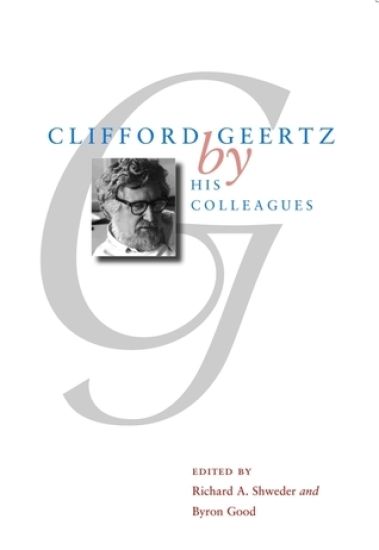
Clifford Geertz is the most influential American anthropologist of the past four decades. His writings have defined and given character to the intellectual agenda of a meaning-centered, non-reductive interpretive social science and have provoked much excitement and debate about the nature of human understanding. As part of the American Anthropological Association's centennial celebration, the executive board sponsored a presidential session honoring Geertz. Clifford Geertz by His Colleagues compiles the speeches given then by a distinguished panel of social scientists along with a concluding piece by Geertz in which he responds to each speaker and reflects on his own career. These edited speeches cover a broad range of topics, including Geertz's views on morality, cultural critique, interpretivism, time and change, Islam, and violence. A fitting tribute to one of the great thinkers of our age, this collection will be enjoyed by anthropologists as well as students of psychology, history, and philosophy.
Clifford Geertz by His Colleagues
University of Chicago Press
2005
nidottu
Clifford Geertz is the most influential American anthropologist of the past four decades. His writings have defined and given character to the intellectual agenda of a meaning-centered, non-reductive interpretive social science and have provoked much excitement and debate about the nature of human understanding. As part of the American Anthropological Association's centennial celebration, the executive board sponsored a presidential session honoring Geertz. Clifford Geertz by His Colleagues compiles the speeches given then by a distinguished panel of social scientists along with a concluding piece by Geertz in which he responds to each speaker and reflects on his own career. These edited speeches cover a broad range of topics, including Geertz's views on morality, cultural critique, interpretivism, time and change, Islam, and violence. A fitting tribute to one of the great thinkers of our age, this collection will be enjoyed by anthropologists as well as students of psychology, history, and philosophy.
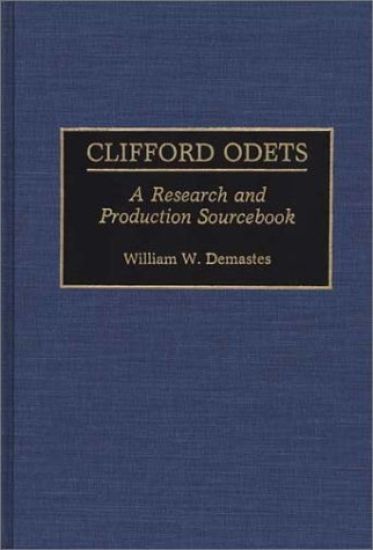
Best known as a revolutionary playwright of the 1930s, Clifford Odets may have reached his zenith when four of his plays were produced on Broadway in 1935: Waiting for Lefty, Till the Day I Die, Awake and Sing!, and Paradise Lost. His plays, however, also show a romantic strain and are at least as much inimate and personal as they are political, often reflecting the isolation and loneliness of individuals in family settings. Never achieving the acclaim of Eugene O'Neill, who came before, or Tennessee Williams and Arthur Miller, who followed, Odets bridged the gap between earlier melodramatic theatre and the mature post-World War II drama on the American stage, creating rich and varied drama well into the 1950s. That his plays continue to be appraised and performed is clearly evident in this detailed and carefully articulated sourcebook.A near-exhaustive resource for both literary and theatrical research materials on Odets's dramatic career, the volume is organized and indexed for quick reference. Included are a biographical essay; critical overview, production history, and plot summary of each dramatic product; annotated primary and secondary bibliographies and information on archival sources; and production credits. Essential for research libraries and theatre collections, the volume will be useful to theatre scholars and practitioners and to anyone interested in the work of this significant modern American playwright.
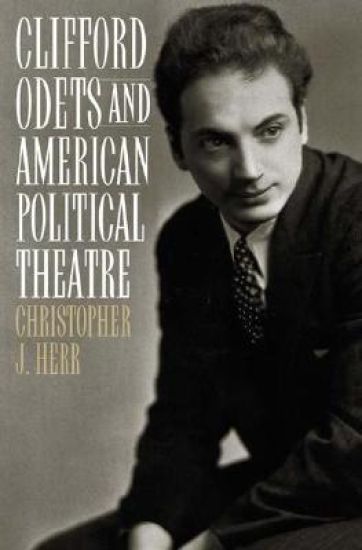
Clifford Odets and American Political Theatre
Christopher J. Herr
Praeger Publishers Inc
2003
sidottu
Clifford Odets, one of the 20th century's leading American playwrights, was a fervent believer in democracy and the human ability to overcome obstacles. Yet his legacy has been overshadowed by persistent attempts to read him as a thoroughly political playwright. This new consideration reads his career—the work itself and the conditions of its invention—as cultural creations in a time of political, social, and economic change.Spanning two World Wars, the Depression, and the Cold War, the works of Clifford Odets illuminate a period of tremendous change in American life and theatre. Herr adroitly examines Odets's plays and screenplays against the backdrop of the artistic and economic pressures placed upon him by the Group Theatre, Broadway, Hollywood, and the 1952 HUAC hearings in which he testified. He avers that Odets's experience as a writer in the film and theatre industries is reflected in expressions of economic struggle in his plays. While a culture of abundance in the face of economic catastrophe shaped the structure and content of his early works, political pressures, especially during the Cold War, shaped his later career.This book illustrates the deeply utopian nature of Odets's vision, which existed alongside a continuing ambivalence toward consumer culture as a means of political and social change. Herr's fresh new look at Odets's works and contributions to the American stage invites readers to reconsider accepted notions about the playwright's importance.

This new book contains the most up-to-date and focused description of the applications of Clifford algebras in analysis, particularly classical harmonic analysis. It is the first single volume devoted to applications of Clifford analysis to other aspects of analysis. All chapters are written by world authorities in the area. Of particular interest is the contribution of Professor Alan McIntosh. He gives a detailed account of the links between Clifford algebras, monogenic and harmonic functions and the correspondence between monogenic functions and holomorphic functions of several complex variables under Fourier transforms. He describes the correspondence between algebras of singular integrals on Lipschitz surfaces and functional calculi of Dirac operators on these surfaces. He also discusses links with boundary value problems over Lipschitz domains. Other specific topics include Hardy spaces and compensated compactness in Euclidean space; applications to acoustic scattering and Galerkin estimates; scattering theory for orthogonal wavelets; applications of the conformal group and Vahalen matrices; Newmann type problems for the Dirac operator; plus much, much more! Clifford Algebras in Analysis and Related Topics also contains the most comprehensive section on open problems available. The book presents the most detailed link between Clifford analysis and classical harmonic analysis. It is a refreshing break from the many expensive and lengthy volumes currently found on the subject.
Clifford K. Madsen's Contributions to Music Education and Music Therapy
Jessica Nápoles; Rebecca B. MacLeod
Routledge
2020
sidottu
Clifford K. Madsen’s Contributions to Music Education and Music Therapy: Love of Learning summarizes the life and work of Dr. Clifford Madsen, a luminary in music education and author of a dozen books, the first recipient of the Senior Researcher Award from the Music Educators National Conference, and mentor and teacher to generations of music educators and music therapists. This text presents Madsen’s philosophy, career, and legacy through an exploration of primary sources and extensive interviews with former students, outlining the philosophical tenets Madsen espouses while contextualizing those tenets within his teachings, research, and service. What began as an exercise to record Madsen’s work for archival purposes resulted in a study of how his philosophy manifested in a significant offering to music educators. Throughout a prolific academic career, Dr. Madsen has led Florida State University to a position of preeminence in the fields of music education and music therapy. Yet as detailed here, his greatest impact goes beyond lesson plans and syllabi, epitomized by a love of learning. As Bob Duke stated, "What is monumental about Cliff is not what he has written. It is what he has done as a human being for other human beings."

Clifford Geertz in Morocco
Routledge
2011
nidottu
Between 1963 and 1986, eminent American anthropologists Clifford and Hildred Geertz - together and alone - conducted ethnographic fieldwork for varying periods in Sefrou, a town situated in north-central Morocco, south of Fez. This book considers Geertz’s contributions to sociocultural theory and symbolic anthropology. Clifford Geertz made an immense impact on the American academy: his interpretative and symbolic approaches reoriented anthropology analytically away from classic social science presuppositions, while his publications profoundly influenced both North American and Maghribi researchers alike. After his death at the age of 80 on October 30, 2006, scholars from local, national, and international universities gathered at the University of California, Los Angeles, to analyze his contributions to sociocultural theory and symbolic anthropology in relation to Islam; ideas of the sacred; Morocco’s cityscapes (notably Sefrou’s bazaar or suq); colonialism and post-independence economic development; gender, and political structures at the household and village levels.This book looks back to a specific era of American anthropology beginning in the 1960s as it unfolded in Morocco; and at the same time, the contributions examine new lines of enquiry that opened up after key texts by Geertz were translated into French and introduced to generations of francophone Maghribi researchers who sustain lively and inventive meditations on his Morocco writings.This book was published as a special issue of Journal of North African Studies.

Clifford Geertz in Morocco
Routledge
2010
sidottu
Between 1963 and 1986, eminent American anthropologists Clifford and Hildred Geertz - together and alone - conducted ethnographic fieldwork for varying periods in Sefrou, a town situated in north-central Morocco, south of Fez. This book considers Geertz’s contributions to sociocultural theory and symbolic anthropology. Clifford Geertz made an immense impact on the American academy: his interpretative and symbolic approaches reoriented anthropology analytically away from classic social science presuppositions, while his publications profoundly influenced both North American and Maghribi researchers alike. After his death at the age of 80 on October 30, 2006, scholars from local, national, and international universities gathered at the University of California, Los Angeles, to analyze his contributions to sociocultural theory and symbolic anthropology in relation to Islam; ideas of the sacred; Morocco’s cityscapes (notably Sefrou’s bazaar or suq); colonialism and post-independence economic development; gender, and political structures at the household and village levels.This book looks back to a specific era of American anthropology beginning in the 1960s as it unfolded in Morocco; and at the same time, the contributions examine new lines of enquiry that opened up after key texts by Geertz were translated into French and introduced to generations of francophone Maghribi researchers who sustain lively and inventive meditations on his Morocco writings.This book was published as a special issue of Journal of North African Studies.
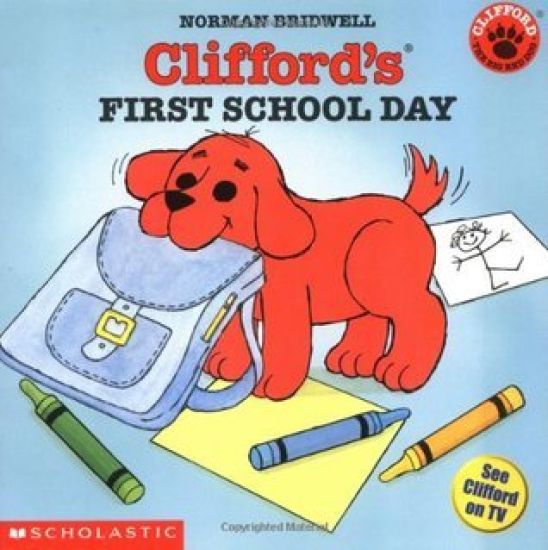
Clifford is going to school Emily Elizabeth remembers taking her small red puppy Clifford to school and all the comical calamities that occured there. Clifford tries to fingerpaint and, sliding through the paint, makes a very creative masterpiece. Then, during water play, he is captain of the ship, until he tips over the mast and falls into the water A bag of flour used to make cookies for snack time intrigues Clifford, until it falls on him, and covers him with white powder Oh Clifford But Clifford's not done yet. Outside, Emily Elizabeth puts him on a slide and, CRASH He lands in someone's sand castle But Clifford helps repair it and all is well. Emily Elizabeth's teacher asks her to bring Clifford back when he's a little bigger. As Emily Elizabeth says, "She should see him now."

In this rhyming story, Clifford the Small Red Puppy and Emily Elizabeth go for a walk in the park, where Clifford barks at the birds in the trees/at the bees, at the postman, /at whomever he sees

Clifford the small red puppy and his big friends teach young children about slow/fast; first/last; up/down; wet/dry; and more

Easy words, a funny Valentine's Day story, and everyone's favorite Big Red Dog It's Valentine's Day, and Clifford receives valentines from so many friends Then when it snows, Clifford has an idea for how to give everyone a very special valentine Featuring a full page of stickers

Enjoy the winning combination of the bilingual Spanish-English format, baby Clifford, and a favorite early childhood concept --all in a sturdy board book.At first, Clifford the Small Red Puppy doesn't want to take a bath. Then he finds out how much fun it can be.

Enjoy the winning combination of the bilingual Spanish-English format, baby Clifford, and a favorite early childhood concept --all in a sturdy board book.Clifford, el cachorrito, piensa en qu hacer para no tener que irse a la cama temprano.

Clifford y los Sonidos de los Animales/Clifford's Animal Sounds
Norman Bridwell
Scholastic
2003
sidottu
Enjoy the winning combination of the bilingual Spanish-English format, baby Clifford, and a favorite early childhood concept --all in a sturdy board book.Clifford, el cachorrito, conoce a muchos animales y descubre los sonidos que stos hacen.