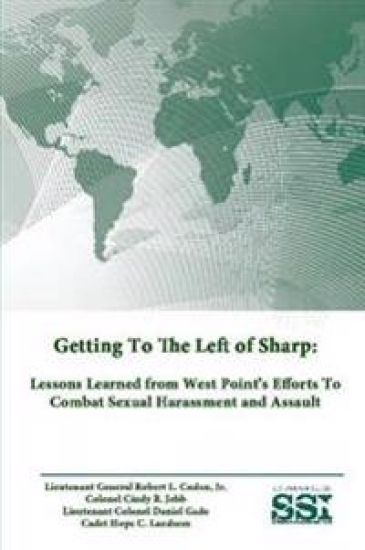
The U.S. Army has been and is struggling with sexual harassment, assault, and rape in its ranks, but the future can be different. In this monograph, three seasoned officers and one cadet propose a series of steps-based on West Point's experiences-to "get to the left" of these incidents by changing the cultural structures that allow them to occur. This will only become more critical as the Army works on the policies that will fully integrate women into the combat arms, introducing women to sub-cultures that have, for years, equated martial virtues with masculine ones.
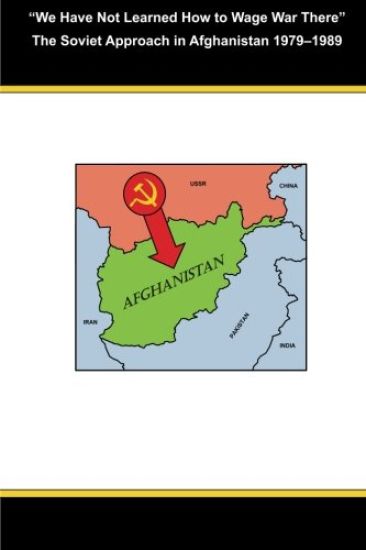
In this timely Occasional Paper, Dr. Tom Bruscino analyzes a critical issue in the GWOT, and one which has bedeviled counterinsurgents past and present. He examines the role played by sanctuaries as they relate to irregular warfare in two conflicts. An active sanctuary refers to the practice of using territory outside the geographical limits of an irregular war to provide various forms of support to one side, usually the insurgent or guerrilla force.In the first case study, he looks at the United States' efforts to defeat the advantages gained by the Viet Cong (and later the North VietnameseArmy) by the use of sanctuaries in Cambodia and Laos during the Vietnam War. In doing so, he points out the diplomatic, military, and economicchallenges which develop when trying to prevent the use of transnational sanctuaries by irregular forces. In the second case study, he examines theSoviet incursion into Afghanistan in the 1980s, but this time he does so from the perspective of the insurgency, the Mujahideen. Bruscino illustratesthe advantages accrued by the Afghan resistance in the use of Pakistan as a sanctuary; the Soviet efforts to neutralize those advantages; and the Mujahideen's responses to overcome the Soviet actions.In both cases the author finds that the use of an active sanctuary by the insurgents was a major component of their eventual victory. Without a sanctuary it is hard to see how the Viet Cong/NVA or the Mujahideen could have succeeded. In regards to a sanctuary, it is hard to see how theU.S./South Vietnamese or the Soviet Union could have defeated the insurgencies. Active sanctuaries present the counterinsurgent with a host of military problems, but denying an insurgent the use of an active sanctuary is far more than a military task. All the elements of national power must be employed if one hopes to defeat the challenge posed by active sanctuaries.