Smell is a social phenomenon, given particular meanings and values by different cultures. Odours form the building blocks of cosmologies, class hierarchies, and political odours. They can enforce social structures or transgress them, unite people or divide them, empower or disempower. The authors argue that the sociology of smell is repressed in the modern West, and its social history ignored. This book breaks the "olfactory silence" of modernity. It offers the first comprehensive exploration of the cultural role of odours in Western history - from antiquity to the present. It also covers a wide variey of non-Western societies. Its topics range from the medieval concept of the "odour of sanctity", to the aromatherapies of South America, and from olfactory stereotypes of gender and ethnicity in the modern West to the role of smell in postmodernity. Its subject matter will fascinate anyone who likes to nose around in the inner workings of culture.
Smell is a social phenomenon, given particular meanings and values by different cultures. Odours form the building blocks of cosmologies, class hierarchies, and political odours. They can enforce social structures or transgress them, unite people or divide them, empower or disempower. The authors argue that the sociology of smell is repressed in the modern West, and its social history ignored. This book breaks the "olfactory silence" of modernity. It offers the first comprehensive exploration of the cultural role of odours in Western history - from antiquity to the present. It also covers a wide variey of non-Western societies. Its topics range from the medieval concept of the "odour of sanctity", to the aromatherapies of South America, and from olfactory stereotypes of gender and ethnicity in the modern West to the role of smell in postmodernity. Its subject matter will fascinate anyone who likes to nose around in the inner workings of culture.
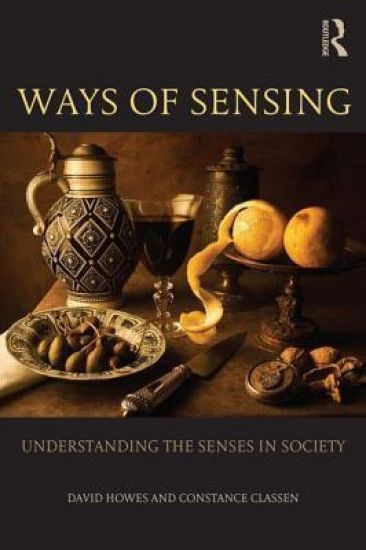
Ways of Sensing is a stimulating exploration of the cultural, historical and political dimensions of the world of the senses. The book spans a wide range of settings and makes comparisons between different cultures and epochs, revealing the power and diversity of sensory expressions across time and space. The chapters reflect on topics such as the tactile appeal of medieval art, the healing power of Navajo sand paintings, the aesthetic blight of the modern hospital, the role of the senses in the courtroom, and the branding of sensations in the marketplace. Howes and Classen consider how political issues such as nationalism, gender equality and the treatment of minority groups are shaped by sensory practices and metaphors. They also reveal how the phenomenon of synaesthesia, or mingling of the senses, can be seen as not simply a neurological condition but a vital cultural mode of creating social and cosmic interconnections. Written by leading scholars in the field, Ways of Sensing provides readers with a valuable and engaging introduction to the life of the senses in society.
Ways of Sensing is a stimulating exploration of the cultural, historical and political dimensions of the world of the senses. The book spans a wide range of settings and makes comparisons between different cultures and epochs, revealing the power and diversity of sensory expressions across time and space. The chapters reflect on topics such as the tactile appeal of medieval art, the healing power of Navajo sand paintings, the aesthetic blight of the modern hospital, the role of the senses in the courtroom, and the branding of sensations in the marketplace. Howes and Classen consider how political issues such as nationalism, gender equality and the treatment of minority groups are shaped by sensory practices and metaphors. They also reveal how the phenomenon of synaesthesia, or mingling of the senses, can be seen as not simply a neurological condition but a vital cultural mode of creating social and cosmic interconnections. Written by leading scholars in the field, Ways of Sensing provides readers with a valuable and engaging introduction to the life of the senses in society.
From the softest caress to the harshest blow, touch lies at the heart of our experience of the world. Now, for the first time, this deepest of senses is the subject of an extensive historical exploration. The Deepest Sense: A Cultural History of Touch fleshes out our understanding of the past with explorations of lived experiences of embodiment from the middle ages to modernity. This intimate and sensuous approach to history makes it possible to foreground the tactile foundations of Western culture--the ways in which feelings shaped society. Constance Classen explores a variety of tactile realms including the feel of the medieval city; the tactile appeal of relics; the social histories of pain, pleasure, and affection; the bonds of touch between humans and animals; the strenuous excitement of sports such as wrestling and jousting; and the sensuous attractions of consumer culture. She delves into a range of vital issues, from the uses--and prohibitions--of touch in social interaction to the disciplining of the body by the modern state, from the changing feel of the urban landscape to the technologization of touch in modernity. Through poignant descriptions of the healing power of a medieval king's hand or the grueling conditions of a nineteenth-century prison, we find that history, far from being a dry and lifeless subject, touches us to the quick.
From the softest caress to the harshest blow, touch lies at the heart of our experience of the world. Now, for the first time, this deepest of senses is the subject of an extensive historical exploration. The Deepest Sense: A Cultural History of Touch fleshes out our understanding of the past with explorations of lived experiences of embodiment from the middle ages to modernity. This intimate and sensuous approach to history makes it possible to foreground the tactile foundations of Western culture--the ways in which feelings shaped society. Constance Classen explores a variety of tactile realms including the feel of the medieval city; the tactile appeal of relics; the social histories of pain, pleasure, and affection; the bonds of touch between humans and animals; the strenuous excitement of sports such as wrestling and jousting; and the sensuous attractions of consumer culture. She delves into a range of vital issues, from the uses--and prohibitions--of touch in social interaction to the disciplining of the body by the modern state, from the changing feel of the urban landscape to the technologization of touch in modernity. Through poignant descriptions of the healing power of a medieval king's hand or the grueling conditions of a nineteenth-century prison, we find that history, far from being a dry and lifeless subject, touches us to the quick.
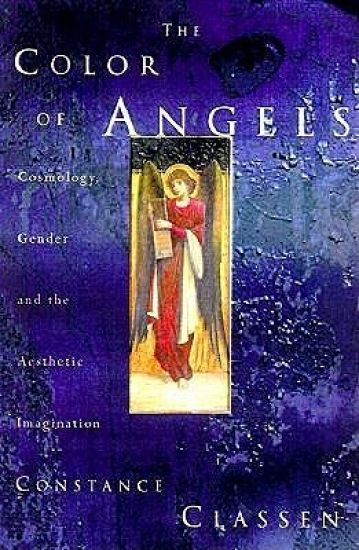
The Colour of Angels uncovers the gender politics behind our attitude to the senses. Using a wide variety of examples, ranging from the sensuous religious visions of the middle ages through to nineteenth-century art movements, this book reveals a previously unexplored area of womens history.
The Colour of Angels uncovers the gender politics behind our attitude to the senses. Using a wide variety of examples, ranging from the sensuous religious visions of the middle ages through to nineteenth-century art movements, this book reveals a previously unexplored area of womens history.
First published in 1993, Worlds of Sense is an exploration of the historical and cultural formation of the senses. As the author demonstrates, different cultures have strikingly different ways of ‘making sense’ of the world. In the modern urban West, we are accustomed to thinking in terms of visual models such as ‘world view,’ whereas the Ongee of the Andaman Islands, for example, live in a world ordered by smell and the Tzotzil of Mexico hold that temperature is the basic force of the cosmos. In a fascinating examination of the role of the senses in diverse societies and eras, Constance Classen shows the extent to which perception is shaped by and expressive of cultural values. This book will be of interest to students of cultural studies, sociology, anthropology, and philosophy.
First published in 1993, Worlds of Sense is an exploration of the historical and cultural formation of the senses. As the author demonstrates, different cultures have strikingly different ways of ‘making sense’ of the world. In the modern urban West, we are accustomed to thinking in terms of visual models such as ‘world view,’ whereas the Ongee of the Andaman Islands, for example, live in a world ordered by smell and the Tzotzil of Mexico hold that temperature is the basic force of the cosmos. In a fascinating examination of the role of the senses in diverse societies and eras, Constance Classen shows the extent to which perception is shaped by and expressive of cultural values. This book will be of interest to students of cultural studies, sociology, anthropology, and philosophy.
Traditionally sight has been the only sense with a ticket to enter the museum. The same is true of histories of art, in which artworks are often presented as purely visual objects. In The Museum of the Senses Constance Classen offers a new way of approaching the history of art through the senses, revealing how people used to handle, smell and even taste collection pieces. Topics range from the tactile power of relics to the sensuous allure of cabinets of curiosities, and from the feel of a Rembrandt to the scent of Monet's garden. The book concludes with a discussion of how contemporary museums are stimulating the senses through interactive and multimedia displays.Classen, a leading authority on the cultural history of the senses, has produced a fascinating study of sensual and emotional responses to artefacts from the middle ages to the present. The Museum of the Senses is an important read for anyone interested in the history of art as well as for students and researchers in cultural studies and museum studies.
Traditionally sight has been the only sense with a ticket to enter the museum. The same is true of histories of art, in which artworks are often presented as purely visual objects. In The Museum of the Senses Constance Classen offers a new way of approaching the history of art through the senses, revealing how people used to handle, smell and even taste collection pieces. Topics range from the tactile power of relics to the sensuous allure of cabinets of curiosities, and from the feel of a Rembrandt to the scent of Monet's garden. The book concludes with a discussion of how contemporary museums are stimulating the senses through interactive and multimedia displays.Classen, a leading authority on the cultural history of the senses, has produced a fascinating study of sensual and emotional responses to artefacts from the middle ages to the present. The Museum of the Senses is an important read for anyone interested in the history of art as well as for students and researchers in cultural studies and museum studies.
Questo studio ha analizzato attentamente e in modo coerente il ruolo che la posizione della scuola e la dimensione della classe possono avere sul rendimento scolastico degli studenti delle scuole superiori. Lo studio si concentrato sulle materie fondamentali delle scuole superiori, cio matematica, biologia e inglese. stato analizzato in modo approfondito l'impatto della variabile "ubicazione" sul rendimento scolastico degli studenti, cos come il grado di influenza della variabile "dimensione della classe". Lo studio ha privilegiato il parametro di Williams relativo alla dimensione della classe, che a sua volta dipende dalla vicinanza della scuola rispetto alle residenze degli studenti. Il materiale sar quindi di interesse per studiosi, amministratori e pianificatori nel campo dell'istruzione e, in generale, per il pubblico interessato all'istruzione.
Cette tude a soigneusement et syst matiquement examin le r le que peuvent jouer l'emplacement de l' cole et la taille des classes dans les r sultats scolaires des l ves du secondaire. Elle s'est concentr e sur les mati res de base du secondaire, savoir les maths, la biologie et l'anglais. L'impact de la variable emplacement sur les r sultats scolaires des l ves a t bien analys , tout comme l'influence de la variable taille des classes . L' tude a privil gi le param tre Williams de la taille des classes, qui d pend de la proximit de l' cole par rapport au lieu de r sidence des l ves. Ce document int ressera donc les chercheurs, les administrateurs et les planificateurs de l' ducation, ainsi que le grand public concern par l' ducation.
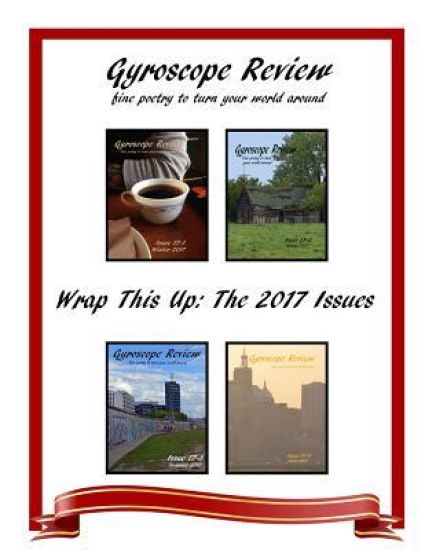
Collection of all four 2017 issues of Gyroscope Review with work by S.R. Aichinger, Clyde Always, Linda Baldanzi, Janet Barry, Kate Bernadette Benedict, Sarah Bigham, Aje Bj rkman, CL Bledsoe, Micki Blenkush, Ace Boggess, Jota Boombaba, Carl Boon, Virginia Boudreau, V.L. Bovalino, Beth Boylan, Micah Bradley, Michelle Brooks, Catherine Bull, Judith Waller Carroll, Sylvia Cavanaugh, Yu-Han Chao, Barry Charman, Michael Chin, Joe Cottonwood, Natalie Crick, Dan Darrah, Deborah L. Davitt, Holly Day, Carol L. Deering, Jude Dillon, Alan Elyshevitz, Alexis Rhone Fancher, Laura Fast, Mark A. Fisher, Fletch Fletcher, Laura Foley, Michael Wayne Friedman, Bill Garten, Marissa Glover, James Graham, John Grey, Lois Marie Harrod, Sabrina Hicks, Laura Hoffman, Sue Howell, Kake Huck, James Croal Jackson, Jeff Jeppesen, Oonah V Joslin, Jacqueline Jules, Mike Jurkovic, Stepy Kamei, Marie Kane, Charles Kell, Steve Klepetar, Sandra Kohler, Kristian Kuhn, Daniel Kuriakose, Kristin LaFollette, Susan L. Leary, Greg Lyons, Pigpen Madigan, Suzanne Rogier Marshall, Janaya Martin, Jenny McBride, Beth McDonough, Ashley Memory, Terry Jude Miller, Mark J. Mitchell, Daniel Edward Moore, Dave Morehouse, Sean Murphy, Toti O'Brien, Lyndi Bell O'Laughlin, Kanyinsola Olorunnisola, Sergio A. Ortiz, AJ Oxenford, James Penha, Robert L. Penick, Alan Perry, M.P. Powers, Ken Poyner, Ron Pullins, Jennifer A. Reimer, henry 7. reneau, jr., Alexander Rigby, A.R. Robins, Jane Roop, Mary Kay Rummel, Samuel Salerno, Raji A. Samuel, Eric W. Schramm, Carla Schwartz, Amber Scott, Claire Scott, Mary Sesso, Terry Severhill, Marian Kaplun Shapiro, T.J. Smith, Sarah Dickenson Snyder, Joannie Stangeland, Debra Stone, M. Stone, Adam Szetela, Judith Taylor, Kelly Terwilliger, Zach Trebino, John Vanek, Laura Grace Weldon, Ed Werstein, Martin Willitts Jr, Linda Wimberly, Laura Madeline Wiseman, James Wolf, Sally Zakariya, and Matt Zambito.
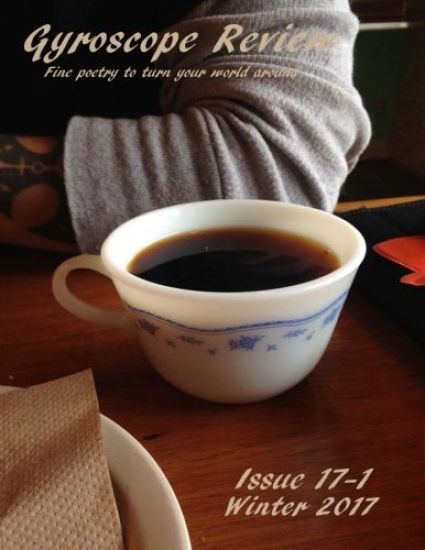
In this Winter 2017 issue of Gyroscope Review, we are truly pleased to offer a diverse group of poetic voices and hope you find something that lodges itself in your head or your heart. We welcome poets new to us as well as old friends who never fail to make us think. Authors in this issue include Janet Barry, Sarah Bigham, CL Bledsoe, Micki Blenkush, Jota Boombaba, Judith Waller Carroll, Michael Chin, Natalie Crick, Jude Dillon, Alan Elyshevitz, Alexis Rhone Fancher, Laura Foley, John Grey, Lois Marie Harrod, Sabrina Hicks, Mike Jurkovic, Steve Klepetar, Kristian Kuhn, Grey Lyons, Suzanne Rogier Marshall, Mark J. Mitchell, Toti O'Brien, James Penha, Robert L. Penick, Ron Pullins, Jennifer A. Reimer, henry 7. reneau, jr., Jane Roop, Raji A. Samuel, Amber Scott, Claire Scott, Terry Severhill, Marian Kaplun Shapiro, Kelly Terwilliger, Laura Grace Weldon, and Ed Werstein.
Fine contemporary poetry by Micki Blenkush, Elya Braden, Paul Edward Costa, Deborah L. Davitt, Alexandra Donovan, Roberta Feins, Kate Garrett, Joan Gerstein, Todd Heldt, Craig Heyne, Oonah V Joslin, Jennifer Judge, Babo Kamel, Peggy Landsman, Susanna Lang, Barbara Lawhorn, Eileen Malone, Nicole Mason, Joan Moritz, Daryl Muranaka, Scott Norenberg, Charlotte Ozment, Horia Pop, Clara Power, Donna Pucciani, Remi Recchia, Steven Reese, Amy Schmitz, Kimbol Soques, Laurel Szymkowiak, Bonnie Thibodeau, Elyse Thomas, Sarah Brown Weitzman, John Sibley Williams, Christy Wise, and Kobina Wright.