

Kirjahaku
Etsi kirjoja tekijän nimen, kirjan nimen tai ISBN:n perusteella.
1000 tulosta hakusanalla D'Arcy Jones

Public Investment Management Reference Guide
Jay-Hyung Kim; Jonas Alp Fallov; Simon Groom; Martin Darcy
World Bank Publications
2020
nidottu
The Public Investment Management (PIM) Reference Guide aims to convey country experiences and good international practices as a basis for decisions on how to address a country-specific PIM reform agenda. The country references are drawn largely from previous diagnostics and technical assistance reports of the World Bank.The application of country diagnostics and assessments has revealed a need to address the following issues when undertaking a country reform in PIM:• Clarification of the definition and scope of public investment and public investment management• Establishment of a sound legal, regulatory, and institutional setting for PIM, making sure it is linked to the budget process• Allocation of roles and responsibilities for key players in PIM across government• Strengthening of guidance on project preappraisal, appraisal, and selection-prioritization procedures and deepening of project appraisal methodologies• Integration of strategic planning, project appraisal-selection, and capital budgeting• Management of multiyear capital budget allocations and commitments• Efforts to address effective implementation, procurement, and monitoring of projects• Strengthening of asset management and ex post evaluation• Integration of PIM and public-private partnership (PPP) in a unified framework• Rationalization and prioritization of the existing PIM project portfolio• Development of a PIM database and information technology in the form of a PIM information system.The PIM Reference Guide does not seek to provide definitive answers or standard guidance for the common PIM issues facing countries. Nor does it seek to provide a detailed template for replication across countries: this would be impossible given the diversity of country situations. Instead, each chapter begins with an overview of the specific reform issue, lists approaches and experiences from different countries, and summarizes the references and good practices to be considered in designing country-specific reform actions.


D'Arcy McNickle's ""The Hungry Generations
University of New Mexico Press
2007
sidottu
William D'arcy Mckickle was born in 1904 in Montana to a father of Scottish-Irish heritage and a French-Canadian Cree mother. His mixed-blood heritage and his parents' rocky marriage and subsequent divorce would strongly influence the future versions of his first novel ""The Surrounded."" ""The Hungry Generations"" is an early, handwritten version of McNickle's groundbreaking and semi-autobiographical novel ""The Surrounded"" and consists of three distinct parts. Part one is set in McNickle's native Montana and has the protagonist, Archilde, reconciling with his father. This part corresponds most closely to the ""The Surrounded"". Part two takes place in Paris where Archilde meets Claudia and her family and explores the community of the American expatriate artists. This section was cut out entirely during revisions of the novel. Part three shows Archilde as a farmer on his father's land in Montana and his arrest and trial for the murder of the game warden. ""The Hungry Generations"" is a social document providing insight into Indian-White marriages at the turn of the twentieth century, the life of the mixed-blood children of these marriages, and the attempts to assimilate them into mainstream American life. Partially autobiographical, the novel serves as a mirror of McNickle's adolescence on the Flathead Reservation in Montana and his experiences in Europe. Birgit Hans offers an extensive introduction to ""The Hungry Generations"" and presents the novel here as it was originally written in the 1930s. This manuscript version of ""The Hungry Generations"" is located in the archives of The Newberry Library in Chicago and has never before been published.

D'Arcy Wentworth Thompson's Generative Influences in Art, Design, and Architecture
BLOOMSBURY PUBLISHING PLC
2023
nidottu
Scottish zoologist D’Arcy Wentworth Thompson’s visionary ideas in On Growth and Form continue to evolve a century after its publication, aligning it with current developments in art and science. Practitioners, theorists, and historians from art, science, and design reflect on his ongoing influence. Overall, the anthology links evolutionary theory to form generation in both scientific and cultural domains. It offers a close look at the ways cells, organisms, and rules become generative in fields often otherwise disconnected. United by Thompson’s original exploration of how physical forces propel and shape living and nonliving forms, essays range from art, art history, and neuroscience to architecture, design, and biology. Contributors explore how translations are made from the discipline of biology to the cultural arena. They reflect on how Thompson’s study relates to the current sciences of epigenesis, self-organization, biological complex systems, and the expanded evolutionary synthesis. Cross-disciplinary contributors explore the wide-ranging aesthetic ramifications of these sciences. A timeline links the history of evolutionary theory with cultural achievements, providing the reader with a valuable resource.


In 1861, in the small town of Manhattan, Kansas, the Curran girls have expectations of what their lives will be. D'Arcy, 12, redheaded and freckled, curious and rebellious, wants to grow up and dominate her world. Suzanne, not yet 18, wants only to marry her handsome lieutenant from Fort Riley, Jonathan Taylor. The beginning of the Civil War and Suzanne's one night of passion sends everyone's lives in an unexpected direction. Jonathan is sent to the battlefields that will determine the survival of the nation. To avoid scandal in their small town, the girls are sent to Detroit to live with family.They not only find a welcoming aunt and uncle, they discover a burgeoning city, both ugly and beautiful, rough and cultured, drunk and refined.As she matures, D'Arcy develops a friendship with the older boy next door, and it changes her opinion of men. Fate throws both girls undreamed-of twists, and D'Arcy is forced to cope. A rash decision changes everything. Will D'Arcy be prepared for the consequences?


D'Arcy McGee, T: Notes sur les gouvernements fédéraux
Antigonos Verlag
2025
nidottu

D'Arcy McGee, T: Notes sur les gouvernements fédéraux
Thomas D'Arcy McGee
Antigonos Verlag
2025
sidottu

This collection brings together some of the best and most frequently performed plays by John Arden and Margaretta D'Arcy whose collaboration stems from the political years of the Sixties The Business of Good Government is a nativity play which develops a sense of a disappearing community; Ars Longa Vita Brevis is composed out of children's games and The Royal Pardon tells the story of the adventures of a group of strolling players who fall in with a deserter from the war in Flanders. Other plays in this collection such as Little Gray Home in the West and The Vandaleur's Folly arise from the highly charged political arena of the 1970s in Ireland.Arden and D'Arcy have been consistently interested in using drama to extend the very boundaries of national identity and human freedom.

The Poems Of Thomas D'Arcy McGee 1870
Thomas D'Arcy McGee; Mrs. J. Sadlier
Kessinger Pub
2007
pokkari


A brilliant writer, outstanding orator, and charismatic politician, Thomas D'Arcy McGee is best known for his prominent role in Irish-Canadian politics, his inspirational speeches in support of Canadian Confederation, and his assassination by an Irish revolutionary who accused him of betraying his earlier Irish nationalist principles. Thomas D'Arcy McGee, the first volume in a two-part biography, explores the development of those principles in Ireland and the United States. David Wilson follows McGee from Wexford, Ireland across the Atlantic to Boston, where at nineteen he became the editor of America's leading Irish newspaper, and traces his subsequent involvement with the Young Ireland movement, his reactions to the Famine, and his role in the Rising of 1848. Wilson goes on to examine McGee's experiences as a political refugee in the United States, where his increasing disillusionment with revolutionary Irish nationalism and his opposition to American nativism propelled him towards conservative Catholicism and sent him on a trajectory that ultimately led to Canada - his experiences are the subject of volume 2, Thomas D'Arcy McGee: The Extreme Moderate, 1857-1868.
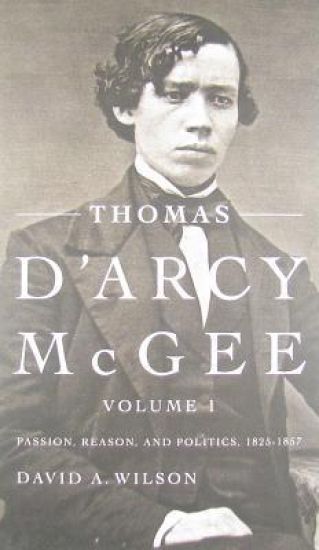
A brilliant writer, outstanding orator, and charismatic politician, Thomas D'Arcy McGee is best known for his prominent role in Irish-Canadian politics, his inspirational speeches in support of Canadian Confederation, and his assassination by an Irish revolutionary who accused him of betraying his earlier Irish nationalist principles. Thomas D'Arcy McGee, the first volume in a two-part biography, explores the development of those principles in Ireland and the United States. David Wilson follows McGee from Wexford, Ireland across the Atlantic to Boston, where at nineteen he became the editor of America's leading Irish newspaper, and traces his subsequent involvement with the Young Ireland movement, his reactions to the Famine, and his role in the Rising of 1848. Wilson goes on to examine McGee's experiences as a political refugee in the United States, where his increasing disillusionment with revolutionary Irish nationalism and his opposition to American nativism propelled him towards conservative Catholicism and sent him on a trajectory that ultimately led to Canada - his experiences are the subject of volume 2, Thomas D'Arcy McGee: The Extreme Moderate, 1857-1868.

After a tumultuous career as a revolutionary in Ireland and an ultra-conservative Catholic in the United States, Thomas D'Arcy McGee moved to Canada in 1857, where he became a force for moderation and the leading Irish Canadian politician in the country. Determined that Canada should avoid the ethno-religious strife that afflicted Ireland, he articulated an inclusive, broad-minded nationalism based on generosity of spirit, a willingness to compromise, and a reasonable balance between order and liberty. To realize his vision, McGee became a strong supporter of the "new northern nationality." A spellbinding orator who emerged as the youngest and most intellectually gifted of the Fathers of Confederation, he fought what he saw as the atavistic and intolerant elements of Canadian life - the Orange Order, with its strident anti-Catholicism; the opponents of separate schools, whom he viewed as enemies of minority rights; and above all the Fenian Brotherhood, with its dreams of revolutionizing Ireland and annexing Canada to the United States. Convinced that compromise with Fenianism was impossible, he set out to destroy the movement through a strategy of confrontation and polarization - channeling his earlier extreme tendencies in the service of moderation and attempting to reduce the influence of Fenianism within his own community. In the process, he alienated many of his former supporters, who came to regard him as a traitor who sacrificed the cause of Irish nationalism on the altar of personal ambition. On 7 April 1868, McGee was assassinated on the doorstep of his Ottawa boarding house. As someone who took an uncompromising stand against militants within his own ethno-religious community, and who attempted to balance core values with minority rights, McGee has become increasingly relevant in today's complex multicultural society.
Thomas D'Arcy McGee
Alexander Brady; W Stewart (William Stewart) Wallace
Anson Street Press
2025
pokkari