

Kirjahaku
Etsi kirjoja tekijän nimen, kirjan nimen tai ISBN:n perusteella.
1000 tulosta hakusanalla D. W. Belton
Beeton's Book of Needlework. Consisting Of Descriptions And Instructions, Illustrated By Six Hundred Engravings, Of Tatting Patterns. Crochet Patterns. Knitting Patterns. Netting Patterns. Embroidery Patterns. Point Lace Patterns. Guipure D'art. Berlin W
Isabella Mary Beeton
BENEDICTION CLASSICS
2010
sidottu


Physics of Solid Surfaces
G. Benedek; C.M. Bertoni; D. Campi; G. Cappellini; F. Cesano; R.M. Feenstra; Fabio Finocchi; M.J. Gladys; L. Gross; S.W. Hla; D. Iannuzzi; L. Mattera; G. Meyer; P. Monachesi; W. Moritz; D.J. O'Connor; J. Repp; M. Rocca; M. Sauvage-Simkin; D. Scarano; R. Sedmik; J.P. Toennies; A. Zecchina
Springer-Verlag Berlin and Heidelberg GmbH Co. K
2015
sidottu
The reader will get an overview of the past and present research in all fields of Surface Science. Readers not familiar with a given field will benefit from the tutorial character of the Introductions, as a rule present in every chapter. Throughout the book emphasis is mainly given to clean surfaces although sometimes adsorbate-covered surfaces are also accounted for. Many readers will be particularly interested in chapters dealing with recently developed topics (graphene, nanotubes, metal oxides, solid-liquid interfaces, theoretical simulations, manipulation of atoms at surfaces with the methods of scanning probe microscopy, Casimir effect, etc.), for which research is continuously evolving. As it is customary in the LB Series, the results obtained in a given field are quoted as thoroughly as possible. The most relevant among them are presented in the form of figures (or tables), and comments or comparisons with other results are usually provided.
The Lectures, Sermons, Addresses And Letters Of D. W. Cahill
D. W. Cahill; Jeremiah C. (EDT) Curtin
Kessinger Pub
2007
pokkari

D. W. Griffith, most famous for his controversial film Birth of a Nation, was one of the undisputed pioneers of the film industry. This illustrated monograph, first published in 1940, traces Griffith's rise from an obscure actor-poet to the most imaginative and resourceful film producer of his time. In this facsimile edition of this classic book, Iris Barry gives a critical evaluation of the man under whose aegis the basic principles of the art of motion pictures were first fully developed. As Barry writes in the book's conclusion, 'the men who make films today know who it was that taught them the basis of their craft. The American public, who for 45 years have so keenly enjoyed and supported the motion picture...are recognizing that in Griffith they have one of the greatest and most original artists of our time.'

D. W. Griffith, American Film Master: Museum of Modern Art Film Library Series, No. 1
Iris Barry
Literary Licensing, LLC
2013
nidottu
The Lectures, Sermons, Addresses And Letters Of D. W. Cahill (1879)
D. W. Cahill
KESSINGER PUBLISHING, LLC
2008
sidottu
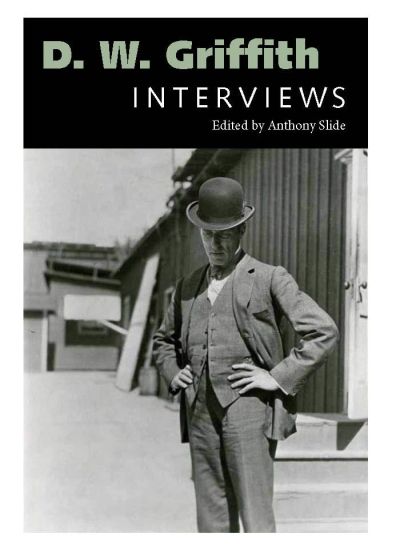
D. W. Griffith
UNIVERSITY PRESS OF MISSISSIPPI
2024
pokkari
D. W. Griffith (1875–1948) is one of the most influential figures in the history of the motion picture. As director of The Birth of a Nation, he is also one of the most controversial. He raised the cinema to a new level of art, entertainment, and innovation, and at the same time he illustrated, for the first time, its potential to influence an audience and propagandize a cause. Collected together here are virtually all of the "interviews" given by D. W. Griffith from the first in 1914 to the last in 1948. Some of the interviews concentrate on specific films, including The Birth of a Nation, Intolerance, and, most substantially, Hearts of the World, while others provide the director with an opportunity to expound on topics of personal interest, including the importance of proper exhibition of his and other’s films, and his search for truth and beauty on screen. The interviews are taken from many sources, including leading newspapers, trade papers, and fan magazines. They are often marked by humor and by a desire to please the interviewer and thus the reader. Griffith may not have been particularly enthusiastic about giving interviews, but he seems always determined to put on a good show. Ultimately, D. W. Griffith: Interviews provides the reader with a unique insight into the mind and filmmaking techniques of a director whose work and philosophy is as relevant today as it was when he was at the height of his fame in the 1910s and 1920s.

Discovering Duluoz: Poems by D. W. Metz
D. W. Metz
Createspace Independent Publishing Platform
2014
nidottu

D. W. Griffith's the Birth of a Nation
MANCHESTER UNIVERSITY PRESS
2022
sidottu
In 1915, American filmmaker D. W. Griffith released a film that went on to become one of the most controversial of all time. Over a century later, The Birth of a Nation continues to stimulate debate on the relationship between Hollywood and racism. This volume reveals new perspectives on Griffith’s film across ten original chapters, re-considering it as text, historical milestone and influence. The volume also includes a helpful timeline that lists key publications and events in Birth’s ongoing history, revealing the rich and stimulating discourse on its art, its cultural impact and its ethical dimensions.
D. W. Griffith
University Press of Mississippi
2012
sidottu
D. W. Griffith (1875-1948) is one of the most influential figures in the history of the motion picture. As director of The Birth of a Nation, he is also one of the most controversial. He raised the cinema to a new level of art, entertainment, and innovation, and at the same time he illustrated, for the first time, its potential to influence an audience and propagandize a cause. Collected together here are virtually all of the ""interviews"" given by D. W. Griffith from the first in 1914 to the last in 1948. Some of the interviews concentrate on specific films, including The Birth of a Nation, Intolerance, and, most substantially, Hearts of the World, while others provide the director with an opportunity to expound on topics of personal interest, including the importance of proper exhibition of his and other's films, and his search for truth and beauty on screen. The interviews are taken from many sources, including leading newspapers, trade papers, and fan magazines. They are often marked by humor and by a desire to please the interviewer and thus the reader. Griffith may not have been particularly enthusiastic about giving interviews, but he seems always determined to put on a good show. Ultimately, D. W. Griffith: Interviews provides the reader with a unique insight into the mind and filmmaking techniques of a director whose work and philosophy is as relevant today as it was when he was at the height of his fame in the 1910s and 1920s.


D. W. Griffith
OmniScriptum
2026
pokkari

Miami D.O A.: Bambi the Body B&W
Melody Black Thorp
Createspace Independent Publishing Platform
2014
nidottu

Catalogue d'Estampes Anciennes Et Modernes: Collection de W. Drugulin Vente 19 Novembre 1860
Sans Auteur
Hachette Livre - BNF
2013
pokkari
Catalogue d'estampes anciennes et modernes...: collection de M. D. V... W. Drugulin] ... vente... 19 novembre 1860... / expert] VigneresDate de l'edition originale: 1860Sujet de l'ouvrage: Drugulin, Wilhelm Eduard (1825-1879) -- Collections d'art" Vente. Estampes. 1860-11-19 - 1860-11-20. Paris] Collection. Estampes. Drugulin, W.. 1860]Reference bibliographique: Lugt, 25807"Ce livre est la reproduction fidele d'une oeuvre publiee avant 1920 et fait partie d'une collection de livres reimprimes a la demande editee par Hachette Livre, dans le cadre d'un partenariat avec la Bibliotheque nationale de France, offrant l'opportunite d'acceder a des ouvrages anciens et souvent rares issus des fonds patrimoniaux de la BnF.Les oeuvres faisant partie de cette collection ont ete numerisees par la BnF et sont presentes sur Gallica, sa bibliotheque numerique.En entreprenant de redonner vie a ces ouvrages au travers d'une collection de livres reimprimes a la demande, nous leur donnons la possibilite de rencontrer un public elargi et participons a la transmission de connaissances et de savoirs parfois difficilement accessibles.Nous avons cherche a concilier la reproduction fidele d'un livre ancien a partir de sa version numerisee avec le souci d'un confort de lecture optimal. Nous esperons que les ouvrages de cette nouvelle collection vous apporteront entiere satisfaction.Pour plus d'informations, rendez-vous sur www.hachettebnf.frhttp: //gallica.bnf.fr/ark: /12148/bpt6k63710146

D-r Y.S.R Rythubharosa: Finansowaq pomosch' fermeram w ATR
Yerram Venkata Subba Reddy; Morusu Siwa Cankar
Sciencia Scripts
2022
nidottu

Donal'd Tramp i bor'ba s terrorizmom w Sahele. Primer Mali
Jeka Jesongo Saleh; Justin Mulendq Dady
Sciencia Scripts
2022
nidottu
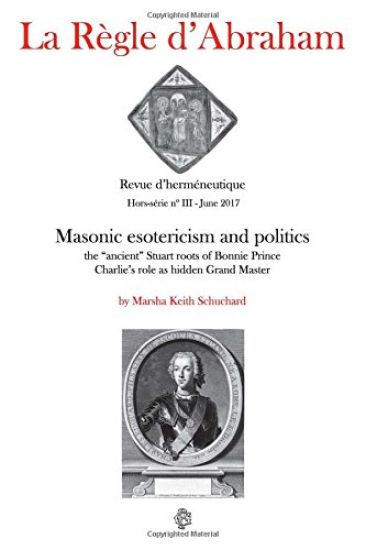
La Règle d'Abraham Hors-série #3 (B&W): Masonic esotericism and politics: the "ancient" Stuart roots of Bonnie Prince Charlie's role as hidden Grand M
Marsha Keith Schuchard
Createspace Independent Publishing Platform
2017
nidottu
Mainly focused on the study of esoteric traditions within the three monotheist Revelations, La R gle d'Abraham is a periodical founded and directed by Patrick Geay since April 1996. This special edition in English, with 20 rare Masonic illustrations, is dedicated to an important article by Marsha Keith Schuchard on Masonic esotericism and politics: the "ancient" Stuart roots of Bonnie Prince Charlie's role as hidden Grand Master Research into Charles Edward Stuart's alleged affiliation with Jacobite or Ecossais Freemasonry has long been hampered by the misleading assumption, which became academic "conventional wisdom," that Freemasonry virtually began in England when the Grand Lodge of London was formed in 1717. Moreover, it was generally characterized as non-political and rationalistic, devoted to the Protestant succession, the Hanoverian government, Newtonian science, and latitudinarian religion. However, the recent international expansion of Masonic and Jacobite studies makes possible a more credible and documented study of the Stuart prince's political and Masonic activities, within a context of anti-Hanoverian, politically-active, diplomatically-diverse, and spiritually-oriented Masonry that draws upon the early Scots-Irish traditions maintained by the Stuart kings in Greater Britain and by the exiles in the Jacobite diaspora. Ranging from the 1590s in Scotland to the 1780s in Italy, the Stuart-Masonic themes of Jewish mysticism, Lullist illuminated knighthood, Solomonic architecture, and religious toleration sustained the military and political campaigns of James II, James III, and "Bonnie Prince Charlie" in their struggle to reclaim the thrones of their ancestors. Table of contents Introduction Swift, Lull, and the masonic Art of Memory Stuart freemasonry and solomonic architecture Jacobite versus Hanoverian rivalries Mar, Ramsay, and the restoration of Stuart freemasonry "Bonnie Prince Charlie" emerges on the masonic stage The Royal Order of Heredom and Kilwinning The ancient chivalry of the Temple of Jerusalem The fates of the Jacobite Grand Masters The hidden Grand Master and the cossais network Old world royalists and new world revolutionaries Restoring the Temple in the North Conclusion Fond e en 1996 La R gle d'Abraham est une revue annuelle fran aise d'herm neutique principalement consacr e l' tude des traditions sot riques issues des trois r v lations monoth istes: juda sme, christianisme, islam. Pour autant, elle est aussi vou e la connaissance approfondie de toutes les religions du monde. Son but est de favoriser une meilleure compr hension de celles-ci, mais galement d' tablir l'existence d'un v ritable fond commun universel partir de leur dimension int rieure, m taphysique, cosmologique et symbolique. Notre revue vise en ce sens le r tablissement d'une interpr tation spirituelle du sacr en g n ral, en opposition toutes les formes de r ductionnisme qu'elle critique. Elle fait appel des sp cialistes, universitaires le plus souvent ou ind pendants. Nous publions des recherches originales in dites ainsi que des traductions de textes anciens et contemporains. Certains articles parus dans La R gle d'Abraham ont eux-m mes t traduits et publi s en Espagne, en Italie et aux Etats-Unis.