Kirjojen hintavertailu. Mukana 11 244 527 kirjaa ja 12 kauppaa.

Kirjahaku

Etsi kirjoja tekijän nimen, kirjan nimen tai ISBN:n perusteella.

1000 tulosta hakusanalla D. W. Hardin

Scotland Delineated in a Series of Views by C. Stanfield ... G. Cattermole ... (Sir W. Allan) ...Drawn in Lithography by J. D. Harding (Carrick, Etc.). with Historical, Antiquarian and Descriptive Letterpress by J. P. L.
Title: Scotland delineated in a series of views by C. Stanfield ... G. Cattermole ... (Sir W. Allan) ...Drawn in lithography by J. D. Harding (Carrick, etc.). With historical, antiquarian and descriptive letterpress by J. P. L.Publisher: British Library, Historical Print EditionsThe British Library is the national library of the United Kingdom. It is one of the world's largest research libraries holding over 150 million items in all known languages and formats: books, journals, newspapers, sound recordings, patents, maps, stamps, prints and much more. Its collections include around 14 million books, along with substantial additional collections of manuscripts and historical items dating back as far as 300 BC.The HISTORY OF EUROPE collection includes books from the British Library digitised by Microsoft. This collection includes works chronicling the development of Western civilisation to the modern age. Highlights include the development of language, political and educational systems, philosophy, science, and the arts. The selection documents periods of civil war, migration, shifts in power, Muslim expansion into Central Europe, complex feudal loyalties, the aristocracy of new nations, and European expansion into the New World. ++++The below data was compiled from various identification fields in the bibliographic record of this title. This data is provided as an additional tool in helping to insure edition identification: ++++ British Library Lawson, John Parker; 1858 4 . 10370.g.11.

A Time to Lie

A Time to Lie

D. W. Hardin

Douglas W. Hardin
2012
nidottu
In a life or death situation, a police officer has milliseconds to make a decision that will affect the rest of his life. The flash of a gun forces Officer John Drake to make such a decision. Not only is the suspect killed, but a fellow officer is mortally wounded. Before the internal investigation can ramp up into high gear, the "Monday morning quarterbacking" starts from the press. Was the officer accidentally killed by Drake? Should he be charged with killing another officer? Politics skew the investigation and damn Drake, forcing him to take unorthodox action. The realistic fast-paced scenario follows what an officer experiences when lethal force is used.
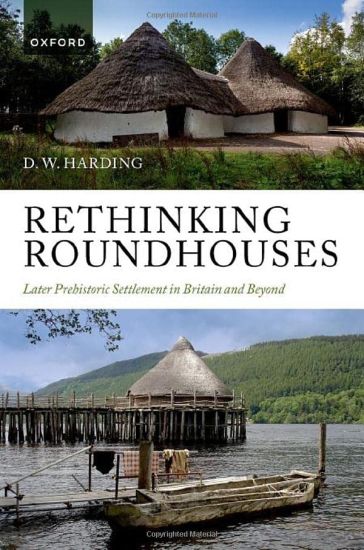
Rethinking Roundhouses

Rethinking Roundhouses

D. W. Harding

Oxford University Press
2023
sidottu
Excavated plans of roundhouses may compound multiple episodes of activity, design, construction, occupation, repair, and closure, reflecting successive stages of a building's biography. What does not survive archaeologically, through use of materials or methods that leave no tangible trace, may be as important for reconstruction as what does survive, and can only be inferred from context or comparative evidence. The great diversity in structural components suggests a greater diversity of superstructure than was implied by the classic Wessex roundhouses, including split-level roofs and penannular ridge roofs. Among the stone-built houses of the Atlantic north and west there likewise appears to have been a range of regional and chronological variants in the radial roundhouse series, and probably within the monumental Atlantic roundhouses too. Important though recognition of structural variants may be, morphological classification should not be allowed to override the social use of space for which the buildings were designed, whether their structural footprint was round or rectangular. Atlantic roundhouses reveal an important division between central space and peripheral space, and a similar division may be inferred for lowland timber roundhouses, where the surviving evidence is more ephemeral. Some larger houses were evidently byre-houses or barn houses, some with upper or mezzanine floor levels, in which livestock might be brought in or agricultural produce stored. Such 'great houses' doubtless served community needs beyond those of the resident extended family. The massively-increased scale of development-led excavations of recent years has resulted in an increased database that enables evaluation of individual sites in a wider landscape environment than was previously possible. Circumstances of recovery and recording in commercially-driven excavations, however, are not always compatible with research objectives, and the undoubted improvements in standards of environmental investigation are sometimes offset by shortcomings in the publication of basic structural or stratigraphic detail.
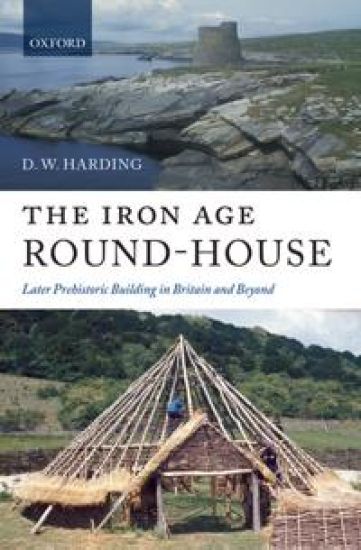
The Iron Age Round-House

The Iron Age Round-House

D. W. Harding

Oxford University Press
2009
sidottu
In contrast to Continental Europe, where the Iron Age is abundantly represented by funerary remains as well as by hill-forts and major centres, the British Iron Age is mainly represented by its settlement sites, and especially by houses of circular ground-plan, apparently in marked contrast to the Central and Northern European tradition of rectangular houses. In lowland Britain the evidence for timber round-houses comprises the footprint of post-holes or foundation trenches; in the Atlantic north and west, the remains of monumental stone-built houses survive as upstanding ruins, testimony to the building skills of Iron Age engineers and masons. D. W. Harding's fully illustrated study explores not just the architectural aspects of round-houses, but more importantly their role in the social, economic and ritual structure of their communities, and their significance as symbols of Iron Age society in the face of Romanization.
Regulated Hatred and Other Essays on Jane Austen

Regulated Hatred and Other Essays on Jane Austen

D. W. Harding; L.C. Knights

Continuum International Publishing Group Ltd.
2000
pokkari
A literary criticism of Jane Austen and her work. A compilation in which Harding has selected his best writings about Austen. Includes details of the social habitat and family life of Austen and her moral judgement along with details of family life in the eighteenth and early nineteenth centuries. Also provides a biographical chronology of Harding.
Words into Rhythm

Words into Rhythm

D. W. Harding

Cambridge University Press
2010
pokkari
Critics take for granted the importance of rhythm in poetry and prose, above all its capacity for suggesting states of mind, especially emotional states. But they are seldom clear what range of effects rhythm can reasonably be credited with, nor even, at times, what exactly the term refers to. Professor Harding here views these and allied problems from a psychological standpoint. Rhythm as a means of suggesting states of mind is discussed in the light of its being not merely something the reader listens to, but something he does, a system of movement. Throughout the book, the realities of spoken language take precedence of prosodic fictions, and emphasis is placed on the poet's organization of speech rhythms within a line of verse, metrical or free. Poetry and prose from the fifteenth to the twentieth century provide passages for illustration and analysis.
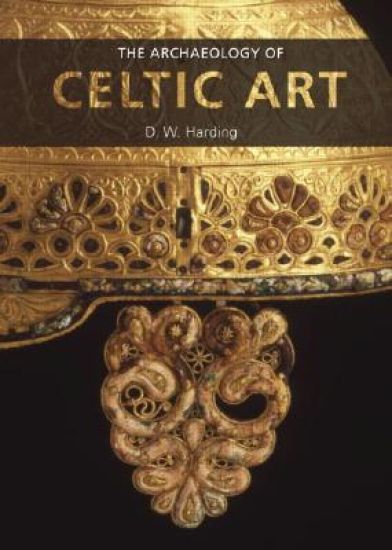
The Archaeology of Celtic Art

The Archaeology of Celtic Art

D.W. Harding

Routledge
2007
sidottu
More wide ranging, both geographically and chronologically, than any previous study, this well-illustrated book offers a new definition of Celtic art. Tempering the much-adopted art-historical approach, D.W. Harding argues for a broader definition of Celtic art and views it within a much wider archaeological context. He re-asserts ancient Celtic identity after a decade of deconstruction in English-language archaeology.Harding argues that there were communities in Iron Age Europe that were identified historically as Celts, regarded themselves as Celtic, or who spoke Celtic languages, and that the art of these communities may reasonably be regarded as Celtic art. This study will be indispensable for those people wanting to take a fresh and innovative perspective on Celtic Art.
The Archaeology of Celtic Art

The Archaeology of Celtic Art

D.W. Harding

Routledge
2007
nidottu
More wide ranging, both geographically and chronologically, than any previous study, this well-illustrated book offers a new definition of Celtic art. Tempering the much-adopted art-historical approach, D.W. Harding argues for a broader definition of Celtic art and views it within a much wider archaeological context. He re-asserts ancient Celtic identity after a decade of deconstruction in English-language archaeology.Harding argues that there were communities in Iron Age Europe that were identified historically as Celts, regarded themselves as Celtic, or who spoke Celtic languages, and that the art of these communities may reasonably be regarded as Celtic art. This study will be indispensable for those people wanting to take a fresh and innovative perspective on Celtic Art.
The Iron Age in Lowland Britain

The Iron Age in Lowland Britain

D.W. Harding

Routledge
2014
sidottu
This book was written at a time when the older conventional diffusionist view of prehistory, largely associated with the work of V. Gordon Childe, was under rigorous scrutiny from British prehistorians, who still nevertheless regarded the ‘Arras’ culture of eastern Yorkshire and the ‘Belgic’ cemeteries of south-eastern Britain as the product of immigrants from continental Europe. Sympathetic to the idea of population mobility as one mechanism for cultural innovation, as widely recognized historically, it nevertheless attempted a critical re-appraisal of the southern British Iron Age in its continental context. Subsequent fashion in later prehistoric studies has favoured economic, social and cognitive approaches, and the cultural-historical framework has largely been superseded. Routine use of radiocarbon dating and other science-based applications, and new field data resulting from developer-led archaeology have revolutionized understanding of the British Iron Age, and once again raised issues of its relationship to continental Europe.
The Iron Age in Lowland Britain

The Iron Age in Lowland Britain

D.W. Harding

Routledge
2016
nidottu
This book was written at a time when the older conventional diffusionist view of prehistory, largely associated with the work of V. Gordon Childe, was under rigorous scrutiny from British prehistorians, who still nevertheless regarded the ‘Arras’ culture of eastern Yorkshire and the ‘Belgic’ cemeteries of south-eastern Britain as the product of immigrants from continental Europe. Sympathetic to the idea of population mobility as one mechanism for cultural innovation, as widely recognized historically, it nevertheless attempted a critical re-appraisal of the southern British Iron Age in its continental context. Subsequent fashion in later prehistoric studies has favoured economic, social and cognitive approaches, and the cultural-historical framework has largely been superseded. Routine use of radiocarbon dating and other science-based applications, and new field data resulting from developer-led archaeology have revolutionized understanding of the British Iron Age, and once again raised issues of its relationship to continental Europe.
Principles of General Management

Principles of General Management

John L. Colley; Jacqueline L. Doyle; Robert D. Hardie; George W. Logan; Wallace Stettinius

Yale University Press
2007
sidottu
An up-to-date and comprehensive guide to the responsibilities of the general manager and the capabilities and tactics for meeting them Stop! If you have been looking for the one resource for managing a business of any size, this is it. Based on the extensive business experience of five experts, this authoritative guide provides an in-depth look at what every leader must know about managing across departments, functions, divisions, or companies. Drawing on decades of combined experience, John Colley and colleagues detail the wide range of skills, tools, and conceptual understanding as well as the qualities of leadership that a successful general manager must acquire. In an era of specialization and specialists, the authors return due focus to the generalist. No other book so passionately and thoroughly examines the roles and responsibilities of the general manager and the full scope of this distinct, pressure-filled occupation. The authors explore the quantitative and qualitative aspects of the job and discuss how the skilled manager moves an organization from abstract goals to definitive action. For every profit center or plant manager, function head, division president, or CEO, this book is indispensable reading.Published in association with The Darden Graduate School of Business Administration