Kirjojen hintavertailu. Mukana 11 238 394 kirjaa ja 12 kauppaa.

Kirjahaku

Etsi kirjoja tekijän nimen, kirjan nimen tai ISBN:n perusteella.

1000 tulosta hakusanalla D. Z. Phillips

D. Z. Phillips on Religious Language, Religious Truth, and God
D. Z. Phillips (1934-2006) was one of the most influential, ingenious, and perhaps controversial thinkers in the Anglo-American philosophy of religion. In particular, he is widely regarded as a leading proponent of a Wittgensteinian approach to the philosophy of religion. While almost every book on religious language or Anglophone philosophy of religion deals with Phillips' thought or, at least, mentions his name, all too frequently his position has been grossly misunderstood and has often attracted unwarranted criticism from various sides. Seeking to offer a constructive presentation and critical discussion of Phillips' view of philosophy, religious language, religious truth, and God, Hyoseok Kim endeavors to resolve some misunderstandings, refute undue criticisms of Phillips' position, and make some suggestions concerning directions in which his view might and ought to be further developed.
D.Z. Phillips' Contemplative Philosophy of Religion
This collection presents a critical discussion and exploration of the late D.Z. Phillips' contemplative approach in the philosophy of religion. What are the main characteristics of this ground-breaking approach, which is inspired by thinkers like Kierkegaard and Wittgenstein and meant as a serious, critical alternative to the mainstream way of doing philosophy of religion? What is its aim, if it is deliberately avoiding apology and defence of faith? How does Phillips' approach relate to systematic, historical and empirical theology and is it really as 'neutral' as he claims it to be? Or is he, perhaps, a certain kind of theologian? What are the implications of his contemplative philosophy for central issues of religious life today, such as petitionary prayer, the hope of 'eternal life' and radical religious diversity? The essays of six distinguished scholars from five different nations critically and sympathetically address these questions and are responded to by Phillips in essays of his own, written briefly before his sudden death in July 2006.
D.Z. Phillips' Contemplative Philosophy of Religion
This collection presents a critical discussion and exploration of the late D.Z. Phillips' contemplative approach in the philosophy of religion. What are the main characteristics of this ground-breaking approach, which is inspired by thinkers like Kierkegaard and Wittgenstein and meant as a serious, critical alternative to the mainstream way of doing philosophy of religion? What is its aim, if it is deliberately avoiding apology and defence of faith? How does Phillips' approach relate to systematic, historical and empirical theology and is it really as 'neutral' as he claims it to be? Or is he, perhaps, a certain kind of theologian? What are the implications of his contemplative philosophy for central issues of religious life today, such as petitionary prayer, the hope of 'eternal life' and radical religious diversity? The essays of six distinguished scholars from five different nations critically and sympathetically address these questions and are responded to by Phillips in essays of his own, written briefly before his sudden death in July 2006.
Ethics of Belief: Essays in Tribute to D.Z. Phillips

Ethics of Belief: Essays in Tribute to D.Z. Phillips

E.T. Long

Springer-Verlag New York Inc.
2008
nidottu
Eugene Thomas Long Originally published in the International Journal for Philosophy of Religion, Volume 63, Nos 1–3. DOI: 10. 1007/s11153-007-9155-4 © Springer Science+Business Media B. V. 2007 This volume is presented as a tribute to the life and work of D. Z. Phillips. Six of the articles were originally presented at the annual conference on the philosophy of religion organized by Phillips and held at Claremont Graduate University, February 9–10, 2007. Unfortunately, Phillipsdidnotlivetoparticipateintheconferenceitself. HediedunexpectedlyJuly25,2006 in the library of his beloved University of Wales, Swansea. Previously published volumes of essays,basedonconferencesorganizedbyPhillipsinClaremont,includedachapterentitled, “Voices in Discussion,” in which Phillips provided his own reactions to the discussions wr- ten almost immediately after the conference. Sadly, this volume appears without the addition of his voice. Born in Morriston, near Swansea, Phillips was a Welsh speaker, a strong supporter of Welsh speaking schools and the author of many works in philosophy and literature in Welsh and English. Known widely as the leading representative of the movement in the philo- phy of religion called Wittgensteinianism, Phillips spent much of his effort challenging the tendency of philosophers to elevate one kind of discourse to the point where it becomes the norm by which other forms of discourse are to be judged.
Contemplating Religious Forms of Life: Wittgenstein and D.Z. Phillips
Ludwig Wittgenstein (1889-1951) made profound contributions to many areas of philosophy and cultural understanding, and his thought and methods have inspired numerous inquirers into the forms of our religious life. D. Z. Phillips (1934-2006) pioneered the application of Wittgenstein-influenced approaches to the philosophy of religion, and emphasized the contemplative, non-dogmatic nature of the philosophical task. In Contemplating Religious Forms of Life, Mikel Burley elucidates and critically examines the work of these two philosophers in relation to various aspects of religion, including ritual, mystical experience, faith and reason, realism and non-realism, conceptions of eternal life, and the use of literature as a resource for the contemplation of religious and non-religious beliefs. The book will be of significant value to academics, students and general readers interested in philosophy, religious studies, theology, and the interrelations between these disciplines.
Contemplating Religious Forms of Life: Wittgenstein and D.Z. Phillips
Ludwig Wittgenstein (1889-1951) made profound contributions to many areas of philosophy and cultural understanding, and his thought and methods have inspired numerous inquirers into the forms of our religious life. D. Z. Phillips (1934-2006) pioneered the application of Wittgenstein-influenced approaches to the philosophy of religion, and emphasized the contemplative, non-dogmatic nature of the philosophical task. In Contemplating Religious Forms of Life, Mikel Burley elucidates and critically examines the work of these two philosophers in relation to various aspects of religion, including ritual, mystical experience, faith and reason, realism and non-realism, conceptions of eternal life, and the use of literature as a resource for the contemplation of religious and non-religious beliefs. The book will be of significant value to academics, students and general readers interested in philosophy, religious studies, theology, and the interrelations between these disciplines.
The Concept of Prayer (Routledge Revivals)
Many contemporary philosophers assume that, before one can discuss prayer, the question of whether there is a God or not must be settled. In this title, first published in 1965, D. Z. Phillips argues that to understand prayer is to understand what is meant by the reality of God. Beginning by placing the problem of prayer within a philosophical context, Phillips goes on to discuss such topics as prayer and the concept of talking, prayer and dependence, superstition and the concept of community. This is a fascinating reissue that will be of particular value to students with an interest in the philosophy of religion, prayer and religious studies more generally.
The Concept of Prayer (Routledge Revivals)
Many contemporary philosophers assume that, before one can discuss prayer, the question of whether there is a God or not must be settled. In this title, first published in 1965, D. Z. Phillips argues that to understand prayer is to understand what is meant by the reality of God. Beginning by placing the problem of prayer within a philosophical context, Phillips goes on to discuss such topics as prayer and the concept of talking, prayer and dependence, superstition and the concept of community. This is a fascinating reissue that will be of particular value to students with an interest in the philosophy of religion, prayer and religious studies more generally.
Religion and the Hermeneutics of Contemplation

Religion and the Hermeneutics of Contemplation

D. Z. Phillips

Cambridge University Press
2001
pokkari
Leading philosopher of religion D. Z. Phillips argues that intellectuals need not see their task as being for or against religion, but as one of understanding it. What stands in the way of this task are certain methodological assumptions about what enquiry into religion must be. Beginning with Bernard Williams on Greek gods, Phillips goes on to examine these assumptions in the work of Hume, Feuerbach, Marx, Frazer, Tylor, Marett, Freud, Durkheim, Lévy-Bruhl, Berger and Winch. The result exposes confusion, but also gives logical space to religious belief without advocating personal acceptance of that belief, and shows how the academic study of religion may return to the contemplative task of doing conceptual justice to the world. Religion and the Hermeneutics of Contemplation extends in important ways D. Z. Phillips’ seminal 1976 book Religion Without Explanation. It will be of interest to scholars and students of philosophy, anthropology, sociology and theology.
Religion and the Hermeneutics of Contemplation

Religion and the Hermeneutics of Contemplation

D. Z. Phillips

Cambridge University Press
2001
sidottu
Leading philosopher of religion D. Z. Phillips argues that intellectuals need not see their task as being for or against religion, but as one of understanding it. What stands in the way of this task are certain methodological assumptions about what enquiry into religion must be. Beginning with Bernard Williams on Greek gods, Phillips goes on to examine these assumptions in the work of Hume, Feuerbach, Marx, Frazer, Tylor, Marett, Freud, Durkheim, Lévy-Bruhl, Berger and Winch. The result exposes confusion, but also gives logical space to religious belief without advocating personal acceptance of that belief, and shows how the academic study of religion may return to the contemplative task of doing conceptual justice to the world. Religion and the Hermeneutics of Contemplation extends in important ways D. Z. Phillips' seminal 1976 book Religion without Explanation. It will be of interest to scholars and students of philosophy, anthropology, sociology and theology.
Introducing Philosophy

Introducing Philosophy

D. Z. Phillips

Blackwell Publishers
1995
nidottu
Written specifically with beginning undergraduates with little or no previous knowledge of the subject in mind, this is a distinctive and thoughtful introduction to the main problems of philosophy structured around a philosophical argument which is clearly and carefully developed throughout the book.
The Problem Of Evil And The Problem Of God

The Problem Of Evil And The Problem Of God

D. Z. Phillips

Augsburg Fortress
2005
pokkari
Creative and original, here is D. Z. Phillips's most systematic attempt to address the problem of evil. He argues that the problem is inextricably linked to our conception of God and that the concept of God in recent philosophy of religion is problematic, even harmful. That intellectual inheritance, he claims, attempts to distinguish between logical and existential problems of evil and offers us distorted accounts of God's omnipotence and will. As a result, God is ridiculed out of existence or found unfit before the bar of decency. Yet Phillips elucidates in a second part a neglected tradition in which we reach a different understanding of God's presence amid suffering and which addresses the ultimate question of how God can be said to be with those who are crushed by life's afflictions. This new work is an ideal text for students of philosophy, religion, or theology, but it also speaks clearly to anyone who reflects seriously on the danger of adding to human evil by the way in which we write and think about it.
Philosophy's Cool Place

Philosophy's Cool Place

D. Z. Phillips

Cornell University Press
1999
sidottu
Ludwig Wittgenstein established a "cool" stance for philosophy, contemplating the world without meddling in it. D. Z. Phillips explores this position, focusing on its implications for philosophical authorship and the philosophical investigation of the nature of reality. Influenced by the views of Wittgenstein and his pupil Rush Rhees, Phillips—who is one of Rhees's own students—first contrasts Wittgenstein's methods with Kierkegaard's religiously oriented dialectic. He describes the difficulty in sustaining a contemplative view of philosophy and discusses efforts to go beyond it in the work of Richard Rorty, Stanley Cavell, Annette Baier, and Martha Nussbaum, who, in different ways, propose to make philosophy a guide to living. A provocative and challenging work, Philosophy's Cool Place is one of the few books that addresses the discipline as an enterprise and explores its relation to moral values, religious belief, and the nature of Reality. By advancing the cause of neutrality, it will stimulate debate and foster discussion of what philosophy is to become in the postmodern era.
Interventions in Ethics

Interventions in Ethics

D. Z. Phillips

Palgrave Macmillan
1992
nidottu
This collection of essays explores the area of ethics in relation to issues such as the nature of moral endeavour and the request for a justification of moral endeavour. Professor Phillips considers the work of Thomas Nagel and Peter Winch in this book.
Moral Practices Vol 6

Moral Practices Vol 6

D. Z. Phillips; H. O. Mounce

Routledge
2003
sidottu
This is Volume VI of nine in a collection of studies in Ethics and the Philosophy of Religion. Originally published in 1970, this volume looks at moral practices and the question which has puzzled philosophers: whether any value judgement can follow logically from the facts, can follow in such a way that someone who assents to the facts is bound in logic to assent also to the value judgement based upon them.
The Problem of Evil and the Problem of God
By his own admission this is by far D Z Phillip’s most systematic attempt to discuss the problem of evil. Within the text the author argues that the majority of Anglo-American philosophers of religion who make a distinction between what is called the logical problem of evil and what is known as the practical, emotive or pastoral problem of evil are making false distinction. He argues that the logical is rooted in the practical. He does not intend to offer one 'correct' response to the problem of evil, but to point out the the confusions that are created by reflecting on the logical, conceptual problem in isolation. He advocates that there will always be more than one response to dealing with the problem of evil, but sees it as the job pf philosophers to point out where conceptual confusion arises.
Moral Practices Vol 6

Moral Practices Vol 6

D.Z. Phillips; H.O. Mounce

Routledge
2010
nidottu
This is Volume VI of nine in a collection of studies in Ethics and the Philosophy of Religion. Originally published in 1970, this volume looks at moral practices and the question which has puzzled philosophers: whether any value judgement can follow logically from the facts, can follow in such a way that someone who assents to the facts is bound in logic to assent also to the value judgement based upon them.
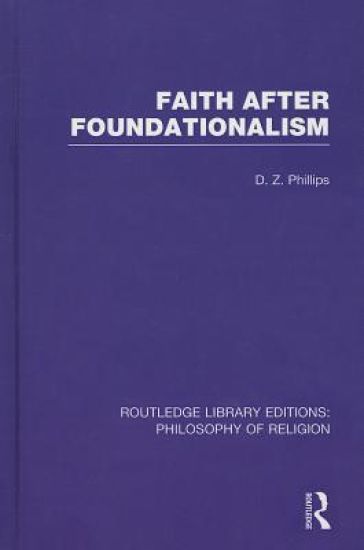
Faith after Foundationalism

Faith after Foundationalism

D.Z. Phillips

Routledge
2013
sidottu
Foundationalism is the view that philosophical propositions are of two kinds, those which need supporting evidence, and those which in themselves provide the evidence which renders them irrefutable. This book, originally published 1988, describes the battle between foundationalism, which places belief in God in the first category, and various other approaches to the problem of faith – ‘Reformed Epistemology’, hermeneutics; and sociological analysis. In the concluding section of the book, an examination of concept formation in religious belief is used to reinterpret the gap between the expressive power of language and the reality of God.
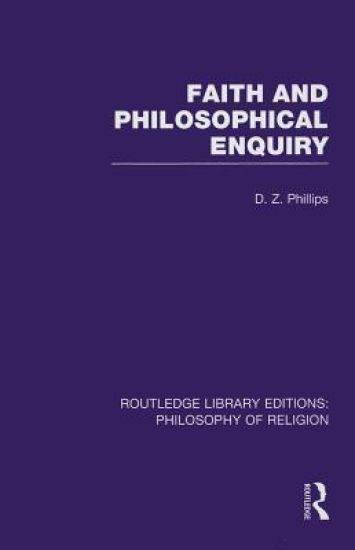
Faith and Philosophical Enquiry

Faith and Philosophical Enquiry

D.Z. Phillips

Routledge
2013
sidottu
The concern of this book is the nature of religious belief and the ways in which philosophical enquiry is related to it. Six chapters present the positive arguments the author wishes to put forward to discusses religion and rationality, scepticism about religion, language-games, belief and the loss of belief.The remaining chapters include criticisms of some contemporary philosophers of religion in the light of the earlier discussions, and the implications for more specific topics, such as religious education, are investigated. The book ends with a general attempt to say something about the character of philosophical enquiry, and to show how important it is to realise this character in the philosophy of religion.