

Kirjahaku
Etsi kirjoja tekijän nimen, kirjan nimen tai ISBN:n perusteella.
1000 tulosta hakusanalla Dale T. Phillips


A Certain Slant of Light: A Zack Taylor Mystery
Dale T. Phillips
Genretarium Publishing
2015
nidottu

Fables and Fantasies: A 5 Story Collection
Dale T. Phillips
Createspace Independent Publishing Platform
2012
nidottu
This collection of five different tales gives some new takes on old stories. It's like following a familiar road, only to discover a new, unusual side path that takes you to an alternate destination. Here are new worlds to explore, with magic, swords, vampires, princesses in peril, and choices to be made. Heroes and villains and something in between. Monsters, both internal and external. Encounters with the unusual to make you think, laugh, and shiver with fright.Three stories are all new, and two have been previously published, in Aoife's Kiss and Sorcerous Signals.

Strange Tales: A Five Story Collection
Dale T. Phillips
Createspace Independent Publishing Platform
2012
nidottu

More Crooked Paths: 5 Stories of Crime and Mystery
Dale T. Phillips
Createspace Independent Publishing Platform
2015
nidottu

While searching for a missing man, Zack Taylor stumbles across another body. Though it looks like a suicide, Zack doesn't buy it, and he tampers with the crime scene to keep the police on the case. They do so, but are suspicious of Zack's involvement. More than his freedom is at stake when pieces of the dead man's activities become known, and the danger mounts for Zack and the woman who hired him.

The Last Crooked Paths: A Five Story Collection
Dale T. Phillips
Createspace Independent Publishing Platform
2017
nidottu
Here are five more tales of crime and mystery, telling of those who walk crooked paths and pay the price for it. Here are crooks and cops, killers and victims, and those who walk the line between good and evil. Take a few short trips down the darker side of life, where crime can be a casual or planned event. This set of stories shows people on the run, and police and ordinary citizens solving crimes. Sometimes the perpetrator gets away, but so often people pay for their deeds.




Horrific Beginnings
Stacey Turner; William F. Nolan; Dale T. Phillips
Createspace Independent Publishing Platform
2017
nidottu

Job Matching, Wage Dispersion, and Unemployment
Dale T. Mortensen; Christopher A. Pissarides
Oxford University Press
2016
nidottu
Dale T. Mortensen and Christopher A. Pissarides are the recipients (with Peter Diamond) of the Nobel memorial Prize in Economics 2010. They have made path-breaking contributions to the analysis of markets with search and matching frictions, which account for much of the success of job search theory and the flows approach in becoming a leading tool for microeconomic and macroeconomic analysis of labor markets. Both scientists have gained groundbreaking insights through individual as well as joint research. Consequently, this volume not only features several papers which helped shape the equilibrium search model, including some early contributions which have initiated the research on what is known today as the search and matching model of the labor market, but it also presents a joint paper by the IZA Prize Laureates, which is a complete statement of the equilibrium search and matching model with endogenous job creation and job destruction. As part of the IZA Prize Series, the book presents a selection of their most important work which has highly enriched research on unemployment as an equilibrium phenomenon, on labor market dynamics, and on cyclical adjustment.
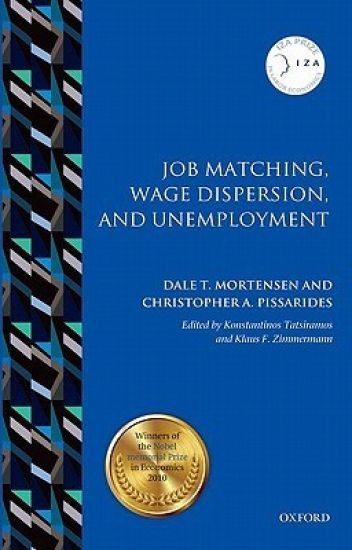
Job Matching, Wage Dispersion, and Unemployment
Dale T. Mortensen; Christopher A. Pissarides
Oxford University Press
2011
sidottu
Dale T. Mortensen and Christopher A. Pissarides are the recipients (with Peter Diamond) of the Nobel memorial Prize in Economics 2010. They have made path-breaking contributions to the analysis of markets with search and matching frictions, which account for much of the success of job search theory and the flows approach in becoming a leading tool for microeconomic and macroeconomic analysis of labor markets. Both scientists have gained groundbreaking insights through individual as well as joint research. Consequently, this volume not only features several papers which helped shape the equilibrium search model, including some early contributions which have initiated the research on what is known today as the search and matching model of the labor market, but it also presents a joint paper by the IZA Prize Laureates, which is a complete statement of the equilibrium search and matching model with endogenous job creation and job destruction. As part of the IZA Prize Series, the book presents a selection of their most important work which has highly enriched research on unemployment as an equilibrium phenomenon, on labor market dynamics, and on cyclical adjustment.
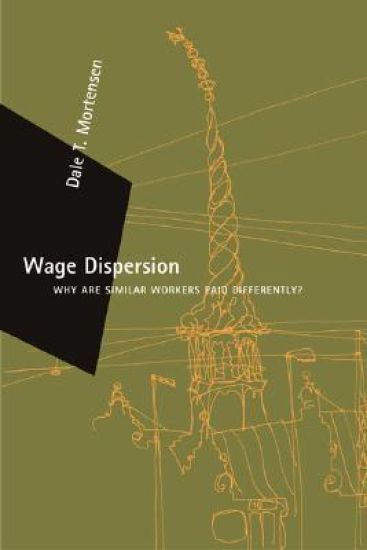
Why are workers with identical skills found in both "good" jobs and "bad" jobs? Why are workers who do similar jobs paid differently, contrary to standard competitive theory? Observable differences in workers doing the same job account for only 30 percent of wage variation. In Wage Dispersion, Dale Mortensen examines the reasons for pay differentials in the other 70 percent. He finds that these differentials, or wage dispersion, are largely the result of job search friction (which arises when workers do not know the wages offered by all employers) and cross-firm differences in wage policy and productivity.Mortensen examines previous theoretical explanations for wage dispersion, testing them against data from a Danish matched employer-employee database. He begins by offering a simple one-period model of the problem, then expands this basic model intertemporally to include the role of on-the-job worker search behavior. Following this, he discusses theoretical modifications that offer an explanation for the nature of observed wage dispersion, particularly the shape of cross-firm wage distribution. He then examines the hypothesis that wage policies are determined by profit-maximizing behavior and finds that the Danish data do not support it; he argues that bilateral wage bargaining is the more likely determinant. Finally, he reviews recent work that extends the basic theoretical framework to explain wage dispersion within firms.

American Portrait Miniatures in the Manney Collection
Dale T. Johnson; Carol (CON) Aiken
Metropolitan Museum of Art
2012
pokkari
Miniature portraits of family members and sweethearts were valued possessions before the advent of photography. They were as highly prized as full-size portraits in oil, and frequently they took as long to produce. Miniatures were meticulously painted in watercolor on ivory, a difficult medium that demanded considerable technical mastery. When completed they were set in decorative cases that enabled them to be worn as jewelry or placed on display. The American tradition of miniature painting, like that of full-size portraiture, was adapted from European models, particularly English painting of the Rococo period. However, portraits painted in this country emphasize the individuality of the sitter with a penetrating realism that is characteristically American. Some of America's best-known artists painted miniatures, among them John Singleton Copley, Charles Willson Peale, George Catlin, Thomas Sully, and Henry Inman. Other talented painters were miniaturists exclusively; miniature portraits by James Peale, John Ramage, Edward Greene Malbone, Benjamin Trott, Sarah Goodridge, Thomas Seir Cummings, Nathaniel Rogers, and a host of others were in great demand.Itinerant miniaturists possessing an entire range of skills plied their trade all across the young nation. In Richard and Gloria Manney's superb collection of over three hundred miniatures, almost every noted American miniaturist who painted between 1750 and 1850 is represented. An unusually large proportion of the miniatures are signed or documented. Remarkable for its comprehensiveness and high quality, the collection will be fascinating to the general observer and an ideal subject for the student of American portraiture. This catalogue presents a great deal of new material based on careful study of the miniatures and extensive research into the conditions surrounding their production. Many of the miniatures have been newly attributed. A full biography is included for every known miniaturist represented in the collection. Each miniature is catalogued with a physical description, an illustration at actual size, and a discussion that whenever possible includes information about the subject of the portrait. One third of the miniatures are also illustrated in color. In an introductory essay, Dale T.Johnson, author of the catalogue, traces the development of miniature painting in America, elucidating the relationship between American and European approaches and describing the growth of the art in different regions of the United States. An essay bv conservator Carol Aiken brings together a wealth of information on the technique of miniatures. The catalogue contains full references and a selected bibliography. (This title was originally published in 1990/91.)

This book draws on research in psychology and behavioral economics to show how striving to live up to our identity claims profoundly affects our daily lives. The author argues the claims we make about who we are and what we stand for powerfully influence us, and our social world. Asking questions such as: Why do people resist the temptation to cheat when cheating would benefit them greatly and no one would find out? Why do people express different beliefs about climate change when they are first reminded of their political affiliation? Why do people prefer to be compensated for donating blood with cholesterol screening than with money? Miller puts forth a novel and compelling argument regarding how strongly our identity claims affect our daily lives. The book provides explanations for many forms of puzzling behavior, such as why people sometimes act against their economic self-interest, how they avoid situations that test their moral identities, and how they respond to failures to live up to their moral identities. It paints an intriguing picture of people’s investment in their identity claims by showing how they seek opportunities to demonstrate their validity, avoid actions and circumstances that challenge their legitimacy, and employ psychological defenses when others challenge their legitimacy. Based on extensive research in the fields of psychology, economics, and political science, this book is fascinating reading for students and academics interested in identity and the self. It also provides an expanded tool kit for those who seek behavioral change in their organization or community.

This book draws on research in psychology and behavioral economics to show how striving to live up to our identity claims profoundly affects our daily lives. The author argues the claims we make about who we are and what we stand for powerfully influence us, and our social world. Asking questions such as: Why do people resist the temptation to cheat when cheating would benefit them greatly and no one would find out? Why do people express different beliefs about climate change when they are first reminded of their political affiliation? Why do people prefer to be compensated for donating blood with cholesterol screening than with money? Miller puts forth a novel and compelling argument regarding how strongly our identity claims affect our daily lives. The book provides explanations for many forms of puzzling behavior, such as why people sometimes act against their economic self-interest, how they avoid situations that test their moral identities, and how they respond to failures to live up to their moral identities. It paints an intriguing picture of people’s investment in their identity claims by showing how they seek opportunities to demonstrate their validity, avoid actions and circumstances that challenge their legitimacy, and employ psychological defenses when others challenge their legitimacy. Based on extensive research in the fields of psychology, economics, and political science, this book is fascinating reading for students and academics interested in identity and the self. It also provides an expanded tool kit for those who seek behavioral change in their organization or community.


This autobiography of Dale T. Sheets covers his life from 1920 to 2003. Tom Brokaw calls that "the greatest generation" in American history, citing unbelievable technological advances-from horses pulling plows on Mr. Sheets' family farm to astronauts plowing the outer fields of space. This book is a dramatic life story, which the author likens to a three-act play. While the scenes and the cast keep changing in step with the various stages of his life, the writer continues to view his world with a mixture of horse sense, good humor, and wit. The author grew up roaming the woods of an Indiana farm, graduated from college, survived World War II naval battles, and returned to devote the rest of his life to public education-first as an English teacher and later as a school administrator. After retiring he traveled extensively in Europe, Asia, and Africa. In recognition of his service to public education, he was named a Sagamore of the Wabash by Governor Robert Orr in 1983.