

Kirjahaku
Etsi kirjoja tekijän nimen, kirjan nimen tai ISBN:n perusteella.
1000 tulosta hakusanalla Dale W Rogers






Last-mile Supply Network Distribution in Omni-Channel Retailing
Stanley Frederick W. T. Lim; Elliot Rabinovich; Dale S. Rogers; Timothy M. Lasester
now publishers Inc
2016
nidottu
Omni-channel retailing (OCR) strategies have recently emerged as a powerful engine of growth in the retail industry. The goal is to provide consumers with a seamless and consistent shopping experience across different channels and devices. Success in implementing OCR strategies depends on sophisticated compromises between fulfilment responsiveness and product variety across different product types, consumer segments, and shopping occasions. Failures in OCR strategies to optimize the trade-offs between responsiveness and variety are rooted in a poor understanding of how OCR strategies should build on last-mile supply network (LMSN) distribution configurations.This book addresses this issue by developing a typology of LMSN distribution configurations in OCR. Typologies are useful for four reasons:(1) They provide a mechanism for incorporating holistic principles of inquiry into organizational research.(2) They explicitly define patterns of constructs that determine dependent variables while enabling researchers to move beyond traditional linear theories.(3) They provide a means to incorporate equifinality.(4) They establish connections between the findings of various studies.The existing literature covers a number of last-mile typological systems in the supply chain. However, these typologies do not provide a satisfactory characterization of various forms of LMSN distribution configurations in OCR and their unique structure, product/order and information flow, service architecture, and relational and governance aspects.To address these deficiencies in the literature, this typology updates the linearly “chain-centric” extended supply chain models developed previously and provides a framework that integrates multiple theoretical domains and terminologies that have been used disjointedly to describe the various forms of LMSN distribution configurations in OCR. After an introduction, Section 2 presents a review of the literature. Section 3 describes the methodology used to identify the different configuration dimensions and provides definitions of the terminologies. Section 4 describes the LMSN configuration-based typology while Section 5 presents LMSN evolution patterns through the discussion of example cases. Section 6 highlights key insights derived from the typology, elaborates on academic implications, and suggests some research extensions. Section 7 discusses the managerial implications and concludes.


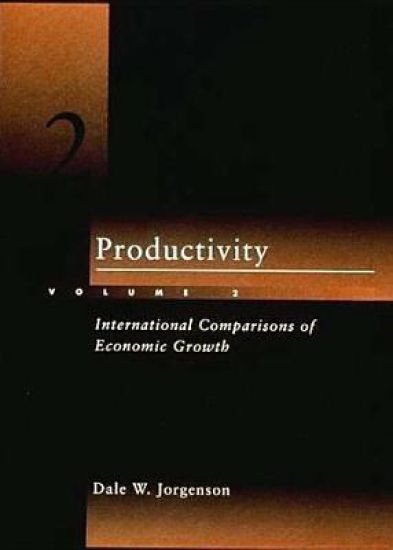
These two volumes present empirical studies that have permanently altered professional debates over investment and productivity as sources of postwar economic growth in industrialized countries. The distinctive feature of investment is that returns can be internalized by the investor. The most straightforward application of this idea is to investments that create property rights, but these volumes broaden the meaning of capital formation to include investments in education and training.International Comparisons of Economic Growth focuses on comparisons among industrialized countries. Although Germany and Japan are often portrayed as economic adversaries of the U.S., postwar experiences in all three countries support policies that give high priority to stimulating and rewarding capital formation. In the Asian model of growth exemplified by Japan investments in tangible assets and human capital are especially critical during periods of rapid growth.
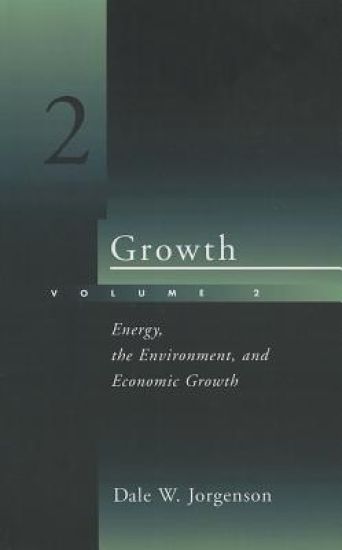
Volume 1: Econometric General Equilibrium Modeling presents an econometric approach to general equilibrium modeling of the impact of economic policies. Earlier approaches were based on the "calibration" of general equilibrium models to a single data point. The obvious disadvantage of calibration is that it requires highly restrictive assumptions about technology and preferences, such as fixed input-output coefficients. These assumptions are contradicted by the massive evidence of energy conservation in response to higher world energy prices, beginning in 1973. The econometric approach to general equilibrium modeling successfully freed economic policy analysis from the straitjacket imposed by calibration.As a consequence of changes in energy prices and new environmental policies, a wealth of historical experience has accumulated over the past two decades. Interpreted within the framework of the neoclassical theory of economic growth, this experience provides essential guidelines for future policy formation. Volume 2: Energy, the Environment, and Economic Growth presents a new econometric general equilibrium model of the United States that captures the dynamic mechanisms underlying growth trends and responses to energy and environmental policies. Jorgenson uses the model to analyze the impacts of environmental regulations on US economic growth and tax policies for controlling US emissions of carbon dioxide.

This book presents a comprehensive treatment of the cost-of-capital approach for analyzing the economic impact of tax policy. This approach has provided an intellectual impetus for reforms of capital income taxation in the United States and around the world. The cost of capital and the marginal effective tax rate are combined with estimates of substitution possibilities by businesses and households in analyzing tax and spending programs. This makes it possible to evaluate tax reforms and changes in government spending. Studies of the economic impact of tax policies have taken two forms. First, the cost of capital has been incorporated into investment functions in macroeconomic models, which are used to model the short-run responses to tax policy changes. Second, the cost-of-capital approach has been integrated into applied general-equilibrium models used in evaluating the long-run economic effects of tax reforms.The cost-of-capital approach suggests two avenues for tax reform. One would retain the income tax base of the existing U.S. tax system, but would equalize tax burdens on all forms of assets as well as average and marginal tax rates on labor income. The other would substitute consumption for income as a tax base, while equating average and marginal tax rates on labor income.

Originally published in 1985, twenty-three chapters are brought together in 4 parts dealing with, respectively, problems in rural finance, interest rate policies, politics and finance, and new directions for rural financial markets. In an introduction it is argued that cheap and abundant credit is often regarded as essential for rural development but that actions taken on the basis of this assumption have given disappointing results. Low-interest policies and the improper use of financial markets are seen as the principal reasons for this. It is recommended that higher and more flexible interest rates are allowed and that little or no attention is given to target loans. Informal lenders are thought to offer valuable services therefore they should not be discouraged. More emphasis should be put on voluntary savings mobilization and access to formal loans by non-farm rural firms. It is concluded that many traditional agricultural credit programmes are counterproductive and that attractive product and input prices together with higher yields would be more powerful in stimulating agricultural development.
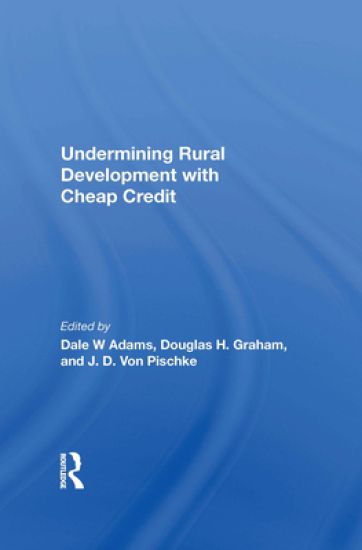
Originally published in 1985, twenty-three chapters are brought together in 4 parts dealing with, respectively, problems in rural finance, interest rate policies, politics and finance, and new directions for rural financial markets. In an introduction it is argued that cheap and abundant credit is often regarded as essential for rural development but that actions taken on the basis of this assumption have given disappointing results. Low-interest policies and the improper use of financial markets are seen as the principal reasons for this. It is recommended that higher and more flexible interest rates are allowed and that little or no attention is given to target loans. Informal lenders are thought to offer valuable services therefore they should not be discouraged. More emphasis should be put on voluntary savings mobilization and access to formal loans by non-farm rural firms. It is concluded that many traditional agricultural credit programmes are counterproductive and that attractive product and input prices together with higher yields would be more powerful in stimulating agricultural development.

This volume is a collection of the papers presented at the Twelfth Conference on the Catalysis of Organic Reactions, where all phases of catalysis, including heterogeneous catalytic hydrogenation, catalytic oxidation, homogeneous catalysis, carbonylation, and amination have been discussed.

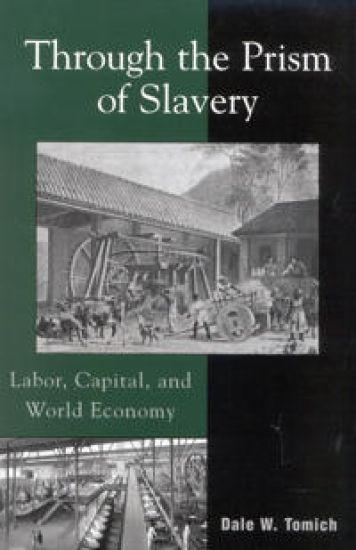
In this thoughtful book, Dale W. Tomich explores the contested relationship between slavery and capitalism. Tracing slavery's integral role in the formation of a capitalist world economy, he reinterprets the development of the world economy through the "prism of slavery." Through a sustained critique of Marxism, world-systems theory, and new economic history, Tomich develops an original conceptual framework for answering theoretical and historical questions about the nexus between slavery and the world economy. The author explores how particular slave systems were affected by their integration into the world market, the international division of labor, and the interstate system. He further examines the ways that the particular "local" histories of such slave regimes illuminate processes of world economic change. His deft use of specific New World examples of slave production as local sites of global transformation highlights the influence of specific geographies and local agency in shaping different slave zones. Tomich's cogent analysis of the struggles over the organization of work and labor discipline in the French West Indian colony of Martinique vividly illustrates the ways that day-to-day resistance altered the relationship between master and slave, precipitated crises in sugar cultivation, and created the local conditions for the transition to a post-slavery economy and society.

In this thoughtful book, Dale W. Tomich explores the contested relationship between slavery and capitalism. Tracing slavery's integral role in the formation of a capitalist world economy, he reinterprets the development of the world economy through the "prism of slavery." Through a sustained critique of Marxism, world-systems theory, and new economic history, Tomich develops an original conceptual framework for answering theoretical and historical questions about the nexus between slavery and the world economy. The author explores how particular slave systems were affected by their integration into the world market, the international division of labor, and the interstate system. He further examines the ways that the particular "local" histories of such slave regimes illuminate processes of world economic change. His deft use of specific New World examples of slave production as local sites of global transformation highlights the influence of specific geographies and local agency in shaping different slave zones. Tomich's cogent analysis of the struggles over the organization of work and labor discipline in the French West Indian colony of Martinique vividly illustrates the ways that day-to-day resistance altered the relationship between master and slave, precipitated crises in sugar cultivation, and created the local conditions for the transition to a post-slavery economy and society.

Selling Hate is a fascinating and powerful story about the power of a southern PR firm to further the Ku Klux Klan’s agenda. Dale W. Laackman’s uncovered never-before-published archival material, census records, and obscure books and letters to tell the story of an emerging communications industry—an industry filled with potential and fraught with peril.The brilliant, amoral, and spectacularly bold Bessie Tyler and Edward Young Clarke—together, the Southern Publicity Association—met the fervent William Joseph Simmons (founder of the second KKK), saw an opportunity, and played on his many weaknesses. It was the volatile, precarious terrain of post–World War I America. Tyler and Clarke took Simmons's dying and broke KKK, with its two thousand to three thousand associates in Georgia and Alabama, and in a few short years swelled its membership to nearly five million. Chapters were established in every state of the union, and the Klan began influencing American political and social life. Between one-third and one-half of the eligible men in the country belonged to the organization. Even to modern sensibilities, the extent of Tyler and Clarke’s scheme is shocking: the limitlessness of their audacity; the full-scale and ongoing con of Simmons; the size of the personal fortunes they earned, amassed, and stole in the process; and just how easily and expertly they exploited the particular fears and prejudices of every corner of America. You will recognize in this pair a very American sense of showmanship and an accepted, even celebrated, brash entrepreneurial hustle. And as their story winds down, you will recognize the tainted and ultimately ineffectual congressional hearings into the Klan's monumental growth.

This volume is a collection of the papers presented at the Twelfth Conference on the Catalysis of Organic Reactions, where all phases of catalysis, including heterogeneous catalytic hydrogenation, catalytic oxidation, homogeneous catalysis, carbonylation, and amination have been discussed.