Kirjojen hintavertailu. Mukana 11 244 527 kirjaa ja 12 kauppaa.

Kirjahaku

Etsi kirjoja tekijän nimen, kirjan nimen tai ISBN:n perusteella.

1000 tulosta hakusanalla Daniel B. Klein

Knowledge and Coordination

Knowledge and Coordination

Daniel B. Klein

Oxford University Press Inc
2014
nidottu
Adam Smith and Friedrich Hayek saw the liberty principle as focal and accorded it strong presumption, but their wisdom invokes how little we can know. In Knowledge and Coordination, Daniel Klein re-examines the elements of economic liberalism. He interprets Hayek's notion of spontaneous order from the aestheticized perspective of a Smithian spectator, real or imagined. Klein addresses issues economists have had surrounding the notion of coordination by distinguishing the concatenate coordination of Hayek, Ronald Coase, and Michael Polanyi from the mutual coordination of Thomas Schelling and game theory. Clarifying the meaning of cooperation, he resolves debates over whether entrepreneurial innovation enhances or upsets coordination, and thus interprets entrepreneurship in terms of discovery or new knowledge. Beyond information, knowledge entails interpretation and judgment, emergent from tacit reaches of the "society of mind," itself embedded in actual society. Rejecting homo economicus in favor of the "deepself," Klein offers a distinctive formulation of knowledge economics, entailing asymmetric interpretation, judgment, entrepreneurship, error, and correction-and kinds of discovery-which all serve the cause of liberty. This richness of knowledge joins agent and analyst, and meaningful theory depends on tacit affinities between the two. Knowledge and Coordination highlights the recurring connections to underlying purposes and sensibilities, of analysts as well as agents. Behind economic talk of market communication and social error and correction lies Klein's Smithian allegory, with the allegorical spectator representing a conception of the social. Knowledge and Coordination instructs us to declare such allegory. Knowledge and Coordination is an authoritative take on how, by confessing the looseness of its judgments and the by-and-large status of its claims, laissez-faire liberalism makes its economic doctrines more robust and its presumption of liberty more viable.
Knowledge and Coordination

Knowledge and Coordination

Daniel B. Klein

Oxford University Press Inc
2012
sidottu
Adam Smith and Friedrich Hayek saw the liberty principle as focal and accorded it strong presumption. But their wisdom invokes how little we can know. In Knowledge and Coordination, Daniel Klein re-examines the elements of economic liberalism. He interprets Hayek's notion of spontaneous order from the aestheticized perspective of a Smithian spectator, real or imagined. Klein addresses issues economists have had surrounding the notion of coordination by distinguishing the concatenate coordination of Hayek, Ronald Coase, and Michael Polanyi from the mutual coordination of Thomas Schelling and game theory. Clarifying the meaning of cooperation, he resolves debates over whether entrepreneurial innovation enhances or upsets coordination, and thus interprets entrepreneurship in terms of discovery, or new knowledge. Beyond information, knowledge entails interpretation and judgment, emergent from tacit reaches of the "society of mind," itself embedded in actual society. Rejecting homo economicus in favor of the "deepself," Klein offers a distinctive formulation of knowledge economics, entailing asymmetric interpretation, judgment, entrepreneurship, error, and correction-and kinds of discovery-which all serve the cause of liberty. This richness of knowledge joins agent and analyst, and meaningful theory depends on tacit affinities between the two. Knowledge and Coordination highlights the recurring connections to underlying purposes and sensibilities, of analysts as well as agents. Behind economic talk of market communication and social error and correction lies Klein's Smithian allegory, with the allegorical spectator representing a conception of the social. Knowledge and Coordination instructs us to declare such allegory. Knowledge and Coordination is an authoritative take on how, by confessing the looseness of its judgments and the by-and-large status of its claims, laissez-faire liberalism makes its economic doctrines more robust and its presumption of liberty more viable.
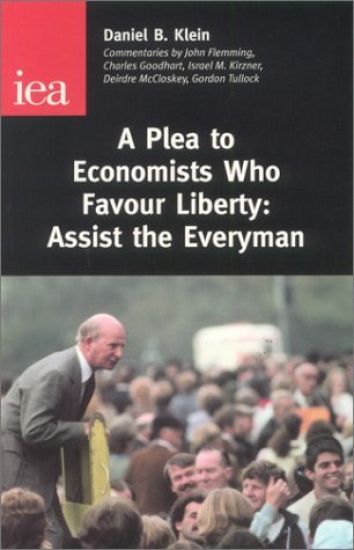
A Plea to Economists Who Favour Liberty

A Plea to Economists Who Favour Liberty

Daniel B. Klein

Institute of Economic Affairs
2001
sidottu
Should economists remain as detached scholars, pursuing their research to the satisfaction of themselves and fellow academics? Or should they try to educate their fellow men and women in economic ideas, hoping to have an impact on economic policy? In this Occasional Paper, Professor Daniel B. Klein addresses these issues, concluding that if economists want to be influential in policy-making, they must be willing to communicate with the 'Everyman'. Scholasticism is valuable in encouraging high research standards, but it has been carried too far in the economics profession, to the detriment of research and teaching which are relevant to policy. Five well-known economists - John Flemming, Charles Goodhart, Israel Kirzner, Deirdre McCloskey and Gordon Tullock - then comment on Klein's paper.
What Do Economists Contribute?

What Do Economists Contribute?

Daniel B. Klein

Palgrave Macmillan
1999
sidottu
The title of this book raises a provocative question that should make all economists think. What is our raison d'etre ? Only a few economists have specifically addressed the issue. Several of the more challenging efforts are included here. Do economists have much influence on government policy, particularly over, say, five or ten years? Is that because they don't try hard enough or is it because politicians care more about the next election than about the opinion of economists? In this splendid collection, some published as long ago as the 1930s, nine great economists consider these questions. The editor's illuminating introduction sorts out the area of agreement and disagreement between them.
What Do Economists Contribute?

What Do Economists Contribute?

Daniel B. Klein

Palgrave Macmillan
1999
nidottu
The title of this book raises a provocative question that should make all economists think. What is our raison d'etre ? Only a few economists have specifically addressed the issue. Several of the more challenging efforts are included here. Do economists have much influence on government policy, particularly over, say, five or ten years? Is that because they don't try hard enough or is it because politicians care more about the next election than about the opinion of economists? In this splendid collection, some published as long ago as the 1930s, nine great economists consider these questions. The editor's illuminating introduction sorts out the area of agreement and disagreement between them.
Curb Rights

Curb Rights

Daniel B. Klein; Adrian T. Moore; Binyam Reja

Brookings Institution
1997
nidottu
Transit services in the United States are in trouble. Ridership has dwindled, productivity has declined, and operating deficits have widened. The traditional approaches to running transit systems—government planning or operation of bus and rail services, government subsidization of private operations, heavy regulation of all transit modes—have failed, and there is little hope of their ever succeeding under current practices. But public transportation cannot simply be abandoned. Can it, then, be made more self-supporting and efficient? The authors of this book say it's time to rethink the fundamental structure of transit policy. The book focuses on street-based transit—buses, shuttles, and jitneys. (While street-based transit in the U.S. today usually means bus service, in other times and places streets have also been served by smaller vehicles called jitneys that follow a route but not a schedule.) The authors examine a variety of transit services: jitney services from America's past, illegal jitneys today, airport shuttle van services, bus deregulation in Great Britain, and jitney services in less developed countries. The authors propose that urban transit be brought into the fold of market activity by establishing property rights not only in vehicles, but also in curb zones and transit stops. Market competition and entrepreneurship would depend on a foundation of what they call "curb rights." By creating exclusive and transferable curb rights (to bus stops and other pickup points) leased by auction, the authors contend that American cities can have the best of both kinds of markets—scheduled (and unsubsidized) bus service and unscheduled but faster and more flexible jitneys. They maintain that a carefully planned transit system based on property rights would rid the transit market of inefficient government production and overregulation. It would also avoid the problems of a lawless market—cutthroat competition, schedule jockeying, and even curbside conflict among rival operators. Entrepreneurs would be able to introduce ever better service, revise schedules and route structures, establish connections among transit providers, and use new pricing strategies. And travelers would find public transit more attractive than they do now. Once the system of curb rights is sensibly implemented, the authors conclude, the market process will take over. Then the invisible hand can do in transit what it does so well in other parts of the economy.
What Do Economists Contribute?

What Do Economists Contribute?

Daniel B. (EDT) Klein

New York University Press
1999
sidottu
Economists direct their research mainly to the technical frontiers of the discipline. But the actual decisions of political economy are made, not by experts, but by ordinary public officials and voters-the "Everyman." However, the task of educating the Everyman is neglected, sometimes even denigrated, by academic economists. Daniel Klein has here gathered essays of 9 great economists of this century-Friedrich Hayek, Ronald Coase, Thomas Schelling, Gordon Tullock, Israel Kirzner, Frank Graham, William Hutt, Clarence Philbrook, and D. McCloskey-addressing the existential issue for economists: "How do we contribute to human betterment?" The authors express their esteem for economic research firmly rooted in public issues and that contributes to public discourse. Some suggest that the academic focus on technical refinement not only diverts economists from efforts at public edification, but might even mislead economists in their own understanding of economic affairs.
Smithian Morals

Smithian Morals

Daniel B Klein

Fraser Institute
2022
pokkari
Smithian Morals takes up Adam Smith's thought on justice, virtue, propriety, beneficialness, liberty, God, and the conscience. Smith is pursued as exemplar, sage, moral guide, and therapist. Smith teaches us to think dialectically. At the center of Smith's thought Klein sees a robust affirmation: "allowing every man to pursue his own interest his own way, upon the liberal plan of equality, liberty, and justice." Smith teaches a presumption of liberty. The strength of that presumption is up to us. Smith's liberalism is outspoken to the point of abolitionism on particular issues, but in a broader sense it is conservative; it is an engaging, humane conservative liberalism. It emanates from a true moralist and his philosophy of virtue. Smith teaches a presumption of liberty not from first principles or purportedly self-evident propositions. He picks up midstream, mindful of the waters about all he treats and about his own weather-beaten vessel, for he is coursing upon the waters with us. As interpreter of Smith's texts, Klein is open about his tendencies toward classical liberalism, non-foundationalism, and esoteric reading.
Central Notions of Smithian Liberalism

Central Notions of Smithian Liberalism

Daniel B Klein

Fraser Institute
2023
pokkari
The present book treats Adam Smith and the liberalism he shared with David Hume and Edmund Burke. It explores notions jural, political, and economic, though other things as well. It uses Smith and others in developing classical liberalism. The work contains substantial pieces deriving from scholarly articles.
Urbana ekosystemtjänster : arbeta med naturen för goda livsmiljöer

Urbana ekosystemtjänster : arbeta med naturen för goda livsmiljöer

Ulf E. Andersson; Daniel Bergquist; Caroline Dahl; Johanna Deak Sjöman; Tobias Emilsson; Ann-Mari Fransson; Marcus Hedblom; Harald Klein; Göran Nilsson; Titti Olsson; Thomas B. Randrup; Anders Rasmusson

Stad Land
2019
nidottu
Ekosystemtjänster uppmärksammas alltmer som ett viktigt inslag för en hållbar utveckling av städer och samhällen. Dessa handlar inte bara om ett miljö- och biodiversitetsperspektiv, utan också om hur ekosystemen bidrar till människans livsmiljö och stadens attraktivitet, samt de praktiska och rekreativa nyttor som befintlig och anlagd natur kan skapa i den byggda miljön. Denna rapport har tillkommit på initiativ från Naturvårdsverket, som också delvis har finansierat den. Arbetet har sammanfallit med ett opinionsbildande projekt, lett av Tankesmedjan Movium och finansierat av Vinnova, kallat Påverkansplattform för urbana ekosystemtjänster. Båda dessa aktiviteter har efterfrågat kartläggning av nuläget och redovisningar av lärande exempel, varför vi har valt att arbeta integrerat med aktiviteterna. I rapporten har vi försökt att kombinera generella reflektioner med konkreta exempel. Vi har också valt att hämta lärdomar från såväl praktik som akademi.
Daniel B-H Liebermann

Daniel B-H Liebermann

Sigmund Asmervik

Kolofon
2019
nidottu
Modernisme med sjel og poesi Daniel B-H Liebermann var født i 1930 og døde i 2015. Han vokste opp i Middletown og senere bodde familien noen få steinkast fra Albert Einsteins hus i Princeton. Han fortalte gjerne om når han som beskjeden tenåring sammen med sin mor hadde lunsj med Albert Einstein. I perioden 1956-58 arbeidet han hos Frank Lloyd Wright i Taliesin West i Arizona. Begge deler har hatt betydelig innflytelse på hans tenkning om arkitektur. Han var et viktig bindeledd for utviklingen av modernismen innen arkitektur fra midten av 1950-tallet og fram til han døde i 2015. Liebermann hadde et spesielt forhold til Norge, hvor han bodde i årene 1967-1975. Han underviste ved NTH høsten 1967 og våren 1968. Selv mener han at han har hentet mye inspirasjon fra norske og nordiske arkitekter som Knut Knutsen, Wenche Selmer, Alvar Aalto og Reima Pietelä. Han var en genuin humanistisk modernist, og allerede på slutten av 1950-tallet viste han interesse for tema som; klima, økologi, energiøkonomisering, og gjenbruk, som er svært aktuelle tema for dagens arkitekter, landskapsarkitekter, og designere. Når han tegnet prototypen Pine II, som eget hus i Marin Valley like nord for San Francisco på slutten av 1950-tallet, var det omfattende gjenbruk av tre, tegl, og et toalett i rustfritt stål fra et fengsel. Under norgesoppholdet arbeidet han også nyskapende med plast, og da spesielt med epoxy. Dette resulterte i oppgaver som bord, stoler og lamper på flere norskeide cruiseskip. Utdanning Johns Hopkins University Harvard University University of Colorado Boulder Taliesin Fellowship Arizona, Frank Lloyd Wright Praksis Liebermann drev stort sett egen praksis fra slutten av 1950 tallet, og i hovedsak med utgangspunkt i Berkeley, California. Han prosjekterte lite i perioden han bodde i Europa fra 1966 til midten av 1970-tallet.