The book presents a unique view of failure analysis of high technology devices. It describes capabilities and limitations of many analytical techniques and testing paths and decisions best followed in example failure analysis studies.
This 1983 Abt Books publication was written by the expert witnesses in the 1980ó81 trial over racial desegregation and discrimination between HEW and later the Department of Education and the University of North Carolina. Examines the dispute over state policy and federal support, and provides a brief history of blacks in higher education, particularly in North Carolina.
Nature is wild and eagles and wolves will never be lovers. But certainly Poetry can overcome every obstacle and translates our dreams, desires, passions, .. in images that evoke even a new, different Universe It fulfills the very nature of poetry that we 7 poets publish our poems in a common anthology and witness how these diverse poems reflect each other, relate to each other, amplify each other This Anthology of Poetry collects 72 poems from 7 Authors living in 7 different Countries of the World. As Fabrizio Frosini puts it: When I first proposed this idea for a book to my Minnesotan friend Daniel Brick, we decided together to open it to other "voices of poetry" from different parts of our troubled world. Maybe we put it a bit too emphatically, like "voices of poetry conveying the joy of creativity," to point out the real issues of human passions mediated through poetry. Yet, Poetry is a sum of hope and despair. It is a sum of wishes, hopes, dreams, inspirations, wanderings on the wings of Imagination. It is a long flight our hearts and minds took, revisiting reality, memories, expectations. Life itself is revisited through the multicolored glasses of poetry. As Dylan Thomas wrote: "These poems, with all their crudities, doubts, and confusions, are written for the love of Man" and, I add, they are written out of the joy of creativity, even when created in the darkest moments of despairing depression. Everyone who reads our poetry enters our own Universe -even if for a while. Through Poetry, we all -Authors and Readers- are in touch.
Many years ago, in a poetry class for beginners, I read one of my early efforts which contained the following three lines: "A young poet drops his pen, astonished / by the twenty lines he has just written, / certain it is the Poem of Total Realization." The teacher smiled and said, "I remember thinking I had written that poem when I was sixteen." What we learn from writing poems over a long expanse of time is that each one takes further along the path of our daily life, leading eventually to whatever fulfills our existence. Each poem illuminates for its moment the darkness surrounding us, and in that light we can see the World in its glory or, sadly, in its degradation. Finally, we will carry within, not only the poem as a piece of literature but also the emotional growth it promotes. DJ Brick] ***Nature is wild and eagles and wolves will never be lovers. But certainly Poetry can overcome every obstacle and translates our dreams, desires, passions.. in images that evoke even a new, different Universe. Furthermore, Poetry is such a powerful tool: violence can kill, of course, but Words are stronger. Thus, Ideals/Values will be the final winner, because they can speak directly to hearts and minds - and touching them deeply, they can profoundly change a human being - Even the whole Humankind F. Frosini] ***In the arts repetition is the path of mastery. John Gielgud is said to have performed the role of Hamlet more than any actor in history. Only his innate modesty and respect for Shakespeare's genius kept him from claiming he had mastered the role. Those who witnessed his stage performances several times readily called him the master. A pianist of the caliber of Glenn Gould achieves greatness by rehearsing 'The Goldberg Variations' over and over, performing them again and again, continually discovering new details for each new performance. And the venerable Robert Frost was still reciting from memory poems he had written just before World War I in the 1960s and still charming audiences who knew them almost as well as he did. DJ Brick] ***Stating that our human nature is evil, would not be acceptable at all. Yet, it is beyond doubt that we humans are capable of behaving much and much worse than the most ferocious beasts, when our mental inhibitory-control fails to curb the worst and most pressing impulses. Nowadays, the rise of mass media has changed the way societies think and, unfortunately, exploiting mass psychology has become a lucrative affair for many. Politicians and CEOs of large corporations, in particular, know very well how to manipulate the masses, and in doing so, they can profoundly change our societies -our lives. Above all, through an increase in social inequality. And failing to deal with inequalities only leads to a rise of political extremes. F. Frosini]
In this book, Daniel J. D. Stulac brings a canonical-agrarian approach to the Elijah narratives and demonstrates the rhetorical and theological contribution of these texts to the Book of Kings. This unique perspective yields insights into Elijah's iconographical character (1 Kings 17-19), which is contrasted sharply against the Omride dynasty (1 Kings 20-2 Kings 1). It also serves as a template for Elisha's activities in chapters to follow (2 Kings 2-8). Under circumstances that foreshadow the removal of both monarchy and temple, the book's middle third (1 Kings 17-2 Kings 8) proclaims Yhwh's enduring care for Israel's land and people through various portraits of resurrection, even in a world where Israel's sacred institutions have been stripped away. Elijah emerges as the archetypal ancestor of a royal-prophetic remnant with which the reader is encouraged to identify.
In this book, Daniel J. D. Stulac brings a canonical-agrarian approach to the Elijah narratives and demonstrates the rhetorical and theological contribution of these texts to the Book of Kings. This unique perspective yields insights into Elijah's iconographical character (1 Kings 17-19), which is contrasted sharply against the Omride dynasty (1 Kings 20-2 Kings 1). It also serves as a template for Elisha's activities in chapters to follow (2 Kings 2-8). Under circumstances that foreshadow the removal of both monarchy and temple, the book's middle third (1 Kings 17-2 Kings 8) proclaims Yhwh's enduring care for Israel's land and people through various portraits of resurrection, even in a world where Israel's sacred institutions have been stripped away. Elijah emerges as the archetypal ancestor of a royal-prophetic remnant with which the reader is encouraged to identify.
"Dr. van Ingen has produced a masterful tool for parents." - Pastor Richard Crisco, Rochester Christian Church "Throughout this devotional, you will feel the gentle aid from one parent to another as you gain insight and advice from not only Daniel's understanding, but also from the beautiful counsel in the Word of God." - Jeri Hill, President of Together in the Harvest & Ryan's Hope In his introduction, Dr. Daniel van Ingen shares how his heart went from soft to hard. During the course of hearing 1,000+ trauma stories, many of them involving children, his heart hardened and became calloused. His empathy diminished as he over-analyzed and compartmentalized. Out of finally realizing this emotional pain and the healing process of Jesus softening him again, this parenting devotional was born. In the midst of deep emotional pain and the tenderizing by the Love of God, Dr. van Ingen came to realize that he isn't 'psychological superman.' He writes, "While it's a process, my numbness has transitioned back to empathy. My hardness has transitioned back to tenderness. Life has a way of hardening us. The hard things of life have a way of building up callouses around our hearts. Hearing stories of evil over and over built up callouses. My heart hardened. And as much as I want to point to a completely transformative moment, I have learned that my journey is a process of softening again." Allow the Lord to soften you. This 40-day devotional gives parents focused prayer on the 40 most pressing areas of parenting. As parents, we may often feel like we are a 'psychological superman' or 'psychological superwoman' as we try to do it all. Then we are hit by tough waves. Sometimes it's a tsunami. God has a way of bringing us back to what matters most-the Lord himself. Daniel J. van Ingen (Psy.D., University of St. Thomas)is president of Parenting Doctors, and a clinical and sports psychologist in Sarasota, FL. He has been dubbed the Sarasota Parenting Doctor for his work with families. He is a published scholar in the areas of anxiety, disabilities, and parenting. Featured on ABC, he is a national speaker and author of You Are Your Child's Best Psychologist: 7 Keys to Excellence in Parenting.
"No other book of the Bible is quite so R-rated. No other book is quite so ugly or grotesque. Judges offers its reader not a roster of angelic saints, but an astonishing tempest of brutality, feces, slaughter, assassinations, conspiracy, genocide, child sacrifice, rage, betrayal, mass graves, gang-rape, corpse mutilation, kidnapping, and civil war." Gift of the Grotesque offers readers a series of seven theological essays focused on one of the most confusing and challenging books in the biblical canon. Stulac's captivating style combines sensitive exegesis with broadly accessible meditations on culture, art, music, literature, memoir, theology, and spirituality. Better understood as a companion rather than a biblical commentary, this unusual resource will kickstart the theological imagination of anyone who struggles to understand how the book of Judges points forward to the life and work of Jesus Christ. Dare to follow an experienced biblical scholar into the heart of Israel's theological Dark Age, and you will encounter there the transformative Word of God in ways you do not expect. The prophetic book of Judges, writes Stulac, "wants to gut you like a fish, because on the far side of that unenviable prospect, it wants you alive like you've never lived before."
"No other book of the Bible is quite so R-rated. No other book is quite so ugly or grotesque. Judges offers its reader not a roster of angelic saints, but an astonishing tempest of brutality, feces, slaughter, assassinations, conspiracy, genocide, child sacrifice, rage, betrayal, mass graves, gang-rape, corpse mutilation, kidnapping, and civil war." Gift of the Grotesque offers readers a series of seven theological essays focused on one of the most confusing and challenging books in the biblical canon. Stulac's captivating style combines sensitive exegesis with broadly accessible meditations on culture, art, music, literature, memoir, theology, and spirituality. Better understood as a companion rather than a biblical commentary, this unusual resource will kickstart the theological imagination of anyone who struggles to understand how the book of Judges points forward to the life and work of Jesus Christ. Dare to follow an experienced biblical scholar into the heart of Israel's theological Dark Age, and you will encounter there the transformative Word of God in ways you do not expect. The prophetic book of Judges, writes Stulac, "wants to gut you like a fish, because on the far side of that unenviable prospect, it wants you alive like you've never lived before."
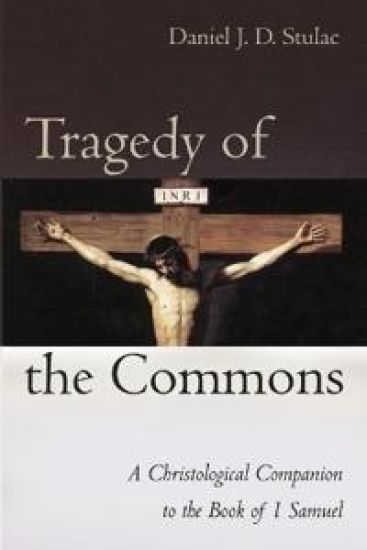
Tragedy of the Commons invites readers into a fresh exploration of the book of 1 Samuel, which tells the story of Saul, Israel's first monarch and the personification of its chronic sins. Stulac's unique voice combines sensitive exegesis with probing meditations on culture, art, literature, memoir, and Christian spirituality. He cuts deftly through the moralistic reductions of Old Testament stories for which the church too often settles, and in doing so, reveals the life-giving rhetoric of a biblical book aimed squarely at the reader's transformation of mind and heart. "Israel's common tragedy," writes Stulac, "will be solved through a lengthening and a deepening of the tragedy itself. Finding his people up to their eyeballs in sewage, God dives into the polluted abyss, swims to the bottom, and unplugs the pipe below their flailing feet." From Hannah's miracle baby to Saul's suicide, Tragedy helps readers to recognize both their own predilection for idols as well as the surprising ways that 1 Samuel anticipates the gospel of Jesus Christ. "King Saul serves not as a finger-wagging argument for God's disengagement from his people's fate," Stulac claims, "but as the shocking conduit of God's incarnational involvement in their corporate mess."
Tragedy of the Commons invites readers into a fresh exploration of the book of 1 Samuel, which tells the story of Saul, Israel's first monarch and the personification of its chronic sins. Stulac's unique voice combines sensitive exegesis with probing meditations on culture, art, literature, memoir, and Christian spirituality. He cuts deftly through the moralistic reductions of Old Testament stories for which the church too often settles, and in doing so, reveals the life-giving rhetoric of a biblical book aimed squarely at the reader's transformation of mind and heart. "Israel's common tragedy," writes Stulac, "will be solved through a lengthening and a deepening of the tragedy itself. Finding his people up to their eyeballs in sewage, God dives into the polluted abyss, swims to the bottom, and unplugs the pipe below their flailing feet." From Hannah's miracle baby to Saul's suicide, Tragedy helps readers to recognize both their own predilection for idols as well as the surprising ways that 1 Samuel anticipates the gospel of Jesus Christ. "King Saul serves not as a finger-wagging argument for God's disengagement from his people's fate," Stulac claims, "but as the shocking conduit of God's incarnational involvement in their corporate mess."