Kirjojen hintavertailu. Mukana 11 244 527 kirjaa ja 12 kauppaa.

Kirjahaku

Etsi kirjoja tekijän nimen, kirjan nimen tai ISBN:n perusteella.

1000 tulosta hakusanalla Daniel M. Abramson

Obsolescence

Obsolescence

Daniel M. Abramson

University of Chicago Press
2016
sidottu
In our architectural pursuits, we often seem to be in search of something newer, grander, or more efficient—and this phenomenon is not novel. In the spring of 1910 hundreds of workers labored day and night to demolish the Gillender Building in New York, once the loftiest office tower in the world, in order to make way for a taller skyscraper. The New York Times puzzled over those who would sacrifice the thirteen-year-old structure, “as ruthlessly as though it were some ancient shack.” In New York alone, the Gillender joined the original Grand Central Terminal, the Plaza Hotel, the Western Union Building, and the Tower Building on the list of just one generation’s razed metropolitan monuments. In the innovative and wide-ranging Obsolescence, Daniel M. Abramson investigates this notion of architectural expendability and the logic by which buildings lose their value and utility. The idea that the new necessarily outperforms and makes superfluous the old, Abramson argues, helps people come to terms with modernity and capitalism’s fast-paced change. Obsolescence, then, gives an unsettling experience purpose and meaning. Belief in obsolescence, as Abramson shows, also profoundly affects architectural design. In the 1960s, many architects worldwide accepted the inevitability of obsolescence, experimenting with flexible, modular designs, from open-plan schools, offices, labs, and museums to vast megastructural frames and indeterminate building complexes. Some architects went so far as to embrace obsolescence’s liberating promise to cast aside convention and habit, envisioning expendable short-life buildings that embodied human choice and freedom. Others, we learn, were horrified by the implications of this ephemerality and waste, and their resistance eventually set the stage for our turn to sustainability—the conservation rather than disposal of resources. Abramson’s fascinating tour of our idea of obsolescence culminates in an assessment of recent manifestations of sustainability, from adaptive reuse and historic preservation to postmodernism and green design, which all struggle to comprehend and manage the changes that challenge us on all sides.
Obsolescence

Obsolescence

Daniel M. Abramson

University of Chicago Press
2017
nidottu
In our architectural pursuits, we often seem to be in search of something newer, grander, or more efficient and this phenomenon is not novel. In the spring of 1910 hundreds of workers labored day and night to demolish the Gillender Building in New York, once the loftiest office tower in the world, in order to make way for a taller skyscraper. The New York Times puzzled over those who would sacrifice the thirteen-year-old structure, "as ruthlessly as though it were some ancient shack." In New York alone, the Gillender joined the original Grand Central Terminal, the Plaza Hotel, the Western Union Building, and the Tower Building on the list of just one generation's razed metropolitan monuments. In the innovative and wide-ranging Obsolescence, Daniel M. Abramson investigates this notion of architectural expendability and the logic by which buildings lose their value and utility. The idea that the new necessarily outperforms and makes superfluous the old, Abramson argues, helps people come to terms with modernity and capitalism's fast-paced change. Obsolescence, then, gives an unsettling experience purpose and meaning. Belief in obsolescence, as Abramson shows, also profoundly affects architectural design. In the 1960s, many architects worldwide accepted the inevitability of obsolescence, experimenting with flexible, modular designs, from open-plan schools, offices, labs, and museums to vast megastructural frames and indeterminate building complexes. Some architects went so far as to embrace obsolescence's liberating promise to cast aside convention and habit, envisioning expendable short-life buildings that embodied human choice and freedom. Others, we learn, were horrified by the implications of this ephemerality and waste, and their resistance eventually set the stage for our turn to sustainability the conservation rather than disposal of resources. Abramson's fascinating tour of our idea of obsolescence culminates in an assessment of recent manifestations of sustainability, from adaptive reuse and historic preservation to postmodernism and green design, which all struggle to comprehend and manage the changes that challenge us on all sides.
Getting It Done

Getting It Done

Mark A. Abramson; Daniel Chenok; John M. Kamensky

Rowman Littlefield
2016
sidottu
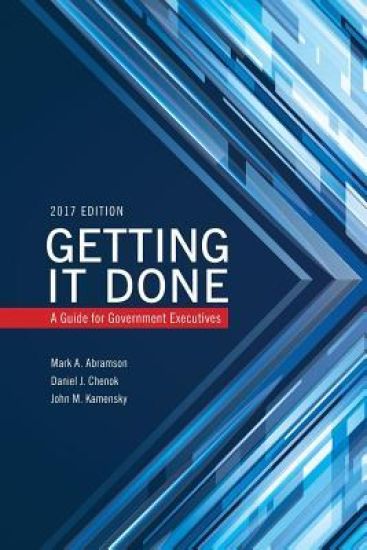
Getting It Done was written for those who have answered the call to public service. Now, in this 2017 edition, the editors of IBM’s Center for The Business of Government series have assembled a comprehensive guide to navigating the current environment of government, and what government leaders ought to know to survive and thrive with respect to the ways it’s evolved over the years. Concise analyses of the roles and responsibilities of those involved in any political decision accompany informative and instructional chapters, each highlighting a key step any public servant must take to ensure they do all they can for the people and causes they represent. From the patient and careful study of an issue, to the assembly of a trusted advisory team and the development and execution of a focused vision and agenda, leaders of all kinds will find some part of this book to incorporate into their own leadership strategies, for which this book’s expert and pragmatic insights prove a refreshing boon.
Getting It Done

Getting It Done

Mark A. Abramson; Daniel Chenok; John M. Kamensky

Rowman Littlefield
2016
nidottu
Getting It Done was written for those who have answered the call to public service. Now, in this 2017 edition, the editors of IBM’s Center for The Business of Government series have assembled a comprehensive guide to navigating the current environment of government, and what government leaders ought to know to survive and thrive with respect to the ways it’s evolved over the years. Concise analyses of the roles and responsibilities of those involved in any political decision accompany informative and instructional chapters, each highlighting a key step any public servant must take to ensure they do all they can for the people and causes they represent. From the patient and careful study of an issue, to the assembly of a trusted advisory team and the development and execution of a focused vision and agenda, leaders of all kinds will find some part of this book to incorporate into their own leadership strategies, for which this book’s expert and pragmatic insights prove a refreshing boon.
Government for the Future

Government for the Future

Mark A. Abramson; Daniel J. Chenok; John M. Kamensky

Rowman Littlefield
2018
sidottu
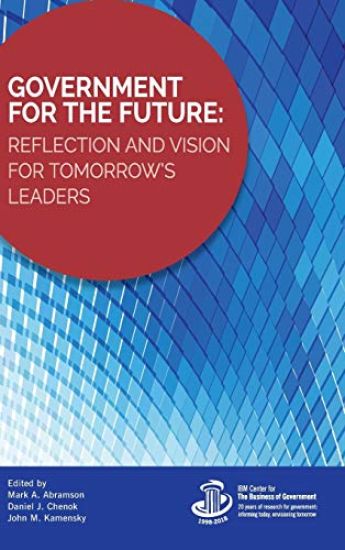
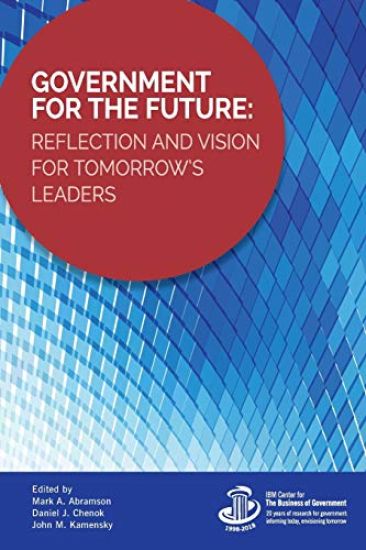
In recognition of its 20th anniversary, The IBM Center for the Business of Government offers a retrospective of the most significant changes in government management during that period and looks forward over the next 20 years to offer alternative scenarios as to what government management might look like by the year 2040. Part I will discuss significant management improvements in the federal government over the past 20 years, based in part on a crowdsourced survey of knowledgeable government officials and public administration experts in the field. It will draw on themes and topics examined in the 350 IBM Center reports published over the past two decades. Part II will outline alternative scenarios of how government might change over the coming 20 years. The scenarios will be developed based on a series of envisioning sessions which are bringing together practitioners and academics to examine the future. The scenarios will be supplemented with short essays on various topics. Part II will also include essays by winners of the Center’s Challenge Grant competition. Challenge Grant winners will be awarded grants to identify futuristic visions of government in 2040. Contributions by Mark A. Abramson, David A. Bray, Daniel J. Chenok, Lee Feldman, Lora Frecks, Hollie Russon Gilman, Lori Gordon, John M. Kamensky, Michael J. Keegan, W. Henry Lambright, Tad McGalliard, Shelley H. Metzenbaum, Marc Ott, Sukumar Rao, and Darrell M. West.
Government for the Future

Government for the Future

Mark A. Abramson; Daniel J. Chenok; John M. Kamensky

Rowman Littlefield
2018
nidottu
In recognition of its 20th anniversary, The IBM Center for the Business of Government offers a retrospective of the most significant changes in government management during that period and looks forward over the next 20 years to offer alternative scenarios as to what government management might look like by the year 2040. Part I will discuss significant management improvements in the federal government over the past 20 years, based in part on a crowdsourced survey of knowledgeable government officials and public administration experts in the field. It will draw on themes and topics examined in the 350 IBM Center reports published over the past two decades. Part II will outline alternative scenarios of how government might change over the coming 20 years. The scenarios will be developed based on a series of envisioning sessions which are bringing together practitioners and academics to examine the future. The scenarios will be supplemented with short essays on various topics. Part II will also include essays by winners of the Center’s Challenge Grant competition. Challenge Grant winners will be awarded grants to identify futuristic visions of government in 2040. Contributions by Mark A. Abramson, David A. Bray, Daniel J. Chenok, Lee Feldman, Lora Frecks, Hollie Russon Gilman, Lori Gordon, John M. Kamensky, Michael J. Keegan, W. Henry Lambright, Tad McGalliard, Shelley H. Metzenbaum, Marc Ott, Sukumar Rao, and Darrell M. West.
Nominations of Luis A. Aguilar, Daniel M. Gallagher, Jr., Anthony Frank D'Agostino, and Gregory S. Karawan

Nominations of Luis A. Aguilar, Daniel M. Gallagher, Jr., Anthony Frank D'Agostino, and Gregory S. Karawan

United States Senate; Committee on Banking; United States Congress

Createspace Independent Publishing Platform
2017
nidottu
Nominations of Luis A. Aguilar, Daniel M. Gallagher, Jr., Anthony Frank D'Agostino, and Gregory S. Karawan: hearing before the Committee on Banking, Housing, and Urban Affairs, United States Senate, One Hundred Twelfth Congress, first session, on nominations of Luis A. Aguilar, of Georgia, to be a member, Securities and Exchange Commission; Daniel M. Gallagher, Jr.,
Can Your Heart Stand the Shocking Facts? by Dr. Brentwood Masterling, M.F.A., D.V.M., Ph. D.
(a parody by Daniel M. Kimmel)Daniel M. Kimmel has made us think about film as the veteran critic who wrote the Hugo finalist Jar Jar Binks Must Die... and other observations about science fiction movies. He's made us laugh as the author of Shh It's a Secret: a novel about aliens, Hollywood, and the Bartender's Guide, Time on My Hands: My Misadventures in Time Travel, and Father of the Bride of Frankenstein. Now, for the first time anywhere, in the guise of his pompous alter ego Dr. Brentwood Masterling, M.F.A., D.V.M., Ph. D., he gets to do both.Can Your Heart Stand the Shocking Facts? is indeed a "deep dive" into the world of director Edward D. Wood, Jr.'s Golden Turkey Award winner for Worst Film, Plan 9 from Outer Space. In it, Dr. Masterling provides an annotated complete transcript of the movie, along with an essay about Wood, and several questions for further discussion. Herein you'll learn how star Bela Lugosi cleverly died before the film was even made, and how Plan 1 had been to bring a gift basket to Earth. Is any of it true? As the Amazing Criswell asks in the film's stirring climax, "Can you prove that it didn't happen?"
Dear Prudence: Liberating Lessons from Slate.Com's Beloved Advice Column
Based on the long-running Slate advice column, a collection of the most eye-opening, illuminating, and provocative installments during Daniel M. Lavery's tenure as the titular Prudence.Every week, millions of readers visit Slate for the irresistible "Dear Prudence," an advice column that promises a healthy dose of reality and good humor alongside its indispensable suggestions and life lessons. The ever-hilarious and insightful Danny Lavery was one of "Dear Prudence"'s most beloved columnists, and he recounts his time as Prudie in this side-splitting, candid collection--complete with new commentary and exclusive stories--drawing out the broader themes of his informative, unfailingly illuminating guidance. From guilt and blame ("Am I in the Wrong Here?") to downright confusion ("Maybe This Is All a Misunderstanding"), from recently discovered wrenches-in-the-machine ("The Other Shoe Just Dropped") to the travails of parenthood ("My Kids Are Growing Up. Can Someone Please Stop This?"), Dear Prudence isn't afraid to go the extra mile in its search for the much-needed corrective, gentle reminder, or tough love. This is the go-to guide for anyone who's just trying to figure it all out--with a helpful nudge.
Women's Hotel

Women's Hotel

Daniel M. Lavery

Harpervia
2024
sidottu
National BestsellerONE OF FALL'S MOST ANTICIPATED READS--New York Times, Vulture, BookPage, Kirkus Reviews, and moreFrom the New York Times bestselling author and advice columnist, a poignant and funny debut novel about the residents of a women's hotel in 1960s New York City.The Biedermeier might be several rungs lower on the ladder than the real-life Barbizon, but its residents manage to occupy one another nonetheless. There's Katherine, the first-floor manager, lightly cynical and more than lightly suggestible. There's Lucianne, a workshy party girl caught between the love of comfort and an instinctive bridling at convention, Kitty the sponger, Ruth the failed hairdresser, and Pauline the typesetter. And there's Stephen, the daytime elevator operator and part-time Cooper Union student.The residents give up breakfast, juggle competing jobs at rival presses, abandon their children, get laid off from the telephone company, attempt to retrain as stenographers, all with the shared awareness that their days as an institution are numbered, and they'd better make the most of it while it lasts.As trenchant as the novels of Dawn Powell and Rona Jaffe and as immersive as The Marvelous Mrs. Maisel and Lessons in Chemistry, Women's Hotel is a modern classic--and it is very, very funny.
Meeting New People

Meeting New People

Daniel M. Lavery

Harpervia
2026
sidottu
From the author of the national bestseller Women's Hotel, the irresistible and wildly entertaining story of one woman contending with age and friendship--a narrative that reads like an homage to Nora Ephron's Heartburn. Sixtysomething, twice-divorced Barbara is at a crossroads. In the midst of her emotional uncertainty, she looks back on the dissolution of the nine best friendships of her life, in hopes of figuring out how to optimize finding her tenth, and hopefully last, best friend. Barbara is acerbic, opinionated, and wrong about many things, but she also doesn't shy away when she's at fault. The turning point of her predicament comes from Barbara's choice, in friends, between (too-young) Caitlyn and the (unsuitable) Other Barbara. Will she repeat the exciting mistakes of the past, or will she try a new kind of mistake for a change? She feels like an out-of-season Scrooge who is unexpectedly, and all at once, surprised and entirely transformed by the possibility of joy. For readers who loved Bobby Finger's The Old Place and Elif Bautmann's Either/Or, Meeting New People will feel like a long-lost companion--Lavery at the height of his storytelling powers. It is an unforgettable novel from one of our most inventive and brilliant writers.
Christmas at the Women's Hotel: A Biedermeier Story
New York Times bestselling author Daniel M. Lavery returns to the world of Women's Hotel in this delightful and heartwarming novella about one especially lively Christmastime at the Biedermeier. Christmas at the Biedermeier Hotel means work. For much of the year, employment comes infrequently to Biedermeier residents. But during the Advent season, they're in high demand all over the city: as holiday window dressers, sales-girls at the card stores on Forty-Second Street, Broadway usherettes, assisting the Lincoln Center laundress at the Nutcracker, or working for Pinkerton as off-season security guards at the World's Fair.Katherine explores the possibility of reconnecting with a younger sister moving to New York. Lucianne goes into business for herself, running a telephone-order, strictly Social Register male escort agency out of her room, while Mrs. Mossler attempts to solve the mystery of the Biedermeier's skyrocketing phone bill and frets over Christmas tips for the hotel's few remaining employees.And while the three gem thieves who broke into the American Museum of Natural History have recently been apprehended, not all of the stolen jewels have been recovered--and Patricia and Carol have been behaving very strangely recently. Christmas is a season of wonder and mystery, after all.
Calculus of Thought

Calculus of Thought

Daniel M Rice

Academic Press Inc
2013
sidottu
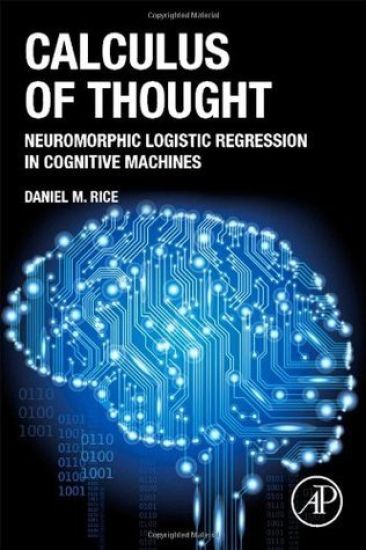
Calculus of Thought: Neuromorphic Logistic Regression in Cognitive Machines is a must-read for all scientists about a very simple computation method designed to simulate big-data neural processing. This book is inspired by the Calculus Ratiocinator idea of Gottfried Leibniz, which is that machine computation should be developed to simulate human cognitive processes, thus avoiding problematic subjective bias in analytic solutions to practical and scientific problems. The reduced error logistic regression (RELR) method is proposed as such a "Calculus of Thought." This book reviews how RELR's completely automated processing may parallel important aspects of explicit and implicit learning in neural processes. It emphasizes the fact that RELR is really just a simple adjustment to already widely used logistic regression, along with RELR's new applications that go well beyond standard logistic regression in prediction and explanation. Readers will learn how RELR solves some of the most basic problems in today’s big and small data related to high dimensionality, multi-colinearity, and cognitive bias in capricious outcomes commonly involving human behavior.