Kirjojen hintavertailu. Mukana 11 244 527 kirjaa ja 12 kauppaa.

Kirjahaku

Etsi kirjoja tekijän nimen, kirjan nimen tai ISBN:n perusteella.

1000 tulosta hakusanalla Darrel W. Staat

Exponential Technologies

Exponential Technologies

Darrel W. Staat

Rowman Littlefield
2019
sidottu
Exponential Technologies:Higher Education in an Era of Serial Disruptions provides an introduction to leaders in community colleges and universities to the near future impact of technologies that a developing in an exponential manner. Whereas past technologies grew in a linear pattern, gradually, the technologies of the twenty-first century develop in what appears initially to be gradual, almost off to side without much fanfare. However, the gradual process reaches a certain point when it suddenly, without warning, increases in speed phenomenally; it appears to come from nowhere to the surprise of many. Although the technologies first impact the business community, it rapidly follows up toward the educational environment. If leaders in higher education are unaware of the exponential growth of the technologies, the institutions they lead will be caught unprepared and may find it very difficult, if not impossible, to catch up. Moore’s law, which claims that computer power doubles every 18 months, is the force behind the exponential velocity. Leaders and faculty must become aware of the technologies and learn how to deal with them or the technologies will deal with the unprepared.

Exponential Technologies

Exponential Technologies

Darrel W. Staat

Rowman Littlefield
2019
nidottu
Exponential Technologies:Higher Education in an Era of Serial Disruptions provides an introduction to leaders in community colleges and universities to the near future impact of technologies that a developing in an exponential manner. Whereas past technologies grew in a linear pattern, gradually, the technologies of the twenty-first century develop in what appears initially to be gradual, almost off to side without much fanfare. However, the gradual process reaches a certain point when it suddenly, without warning, increases in speed phenomenally; it appears to come from nowhere to the surprise of many. Although the technologies first impact the business community, it rapidly follows up toward the educational environment. If leaders in higher education are unaware of the exponential growth of the technologies, the institutions they lead will be caught unprepared and may find it very difficult, if not impossible, to catch up. Moore’s law, which claims that computer power doubles every 18 months, is the force behind the exponential velocity. Leaders and faculty must become aware of the technologies and learn how to deal with them or the technologies will deal with the unprepared.

Higher Education Planning in an Exponential Age

Higher Education Planning in an Exponential Age

Darrel W. Staat

Rowman Littlefield
2021
sidottu
This book fulfills a need for planning in higher education due to the impending impact of ten twenty-first century technologies: 3D printing, artificial intelligence, autonomous vehicles, bitcoin/blockchain, genome development: agricultural, genome: medical, internet of things, nanotechnology, personal robot, and quantum computing. Each of these technologies develop in a two-stage manner: Stage 1, Linear, and Stage 2, Exponential.Uber and Airbnb are excellent examples that developed for a short time in Stage 1, a step-by-step manner, before then reaching Stage 2, where they accelerated with exponential velocity. Both were able to accomplish rapid development through the use of digital support. The ten technologies listed above are all currently developing in Stage 1; however, each will reach Stage 2, and when they do, they will have powerful impacts on community colleges and universities. Their extremely rapid development in the second stage could take higher education by storm if the leaders, faculty, and staff are not prepared for them.This book presents ARPAC, a planning method to successfully deal with the impact of these technologies. This planning method is critical for the future viability and success of community colleges and universities.
Higher Education Planning in an Exponential Age

Higher Education Planning in an Exponential Age

Darrel W. Staat

Rowman Littlefield
2021
nidottu
This book fulfills a need for planning in higher education due to the impending impact of ten twenty-first century technologies: 3D printing, artificial intelligence, autonomous vehicles, bitcoin/blockchain, genome development: agricultural, genome: medical, internet of things, nanotechnology, personal robot, and quantum computing. Each of these technologies develop in a two-stage manner: Stage 1, Linear, and Stage 2, Exponential.Uber and Airbnb are excellent examples that developed for a short time in Stage 1, a step-by-step manner, before then reaching Stage 2, where they accelerated with exponential velocity. Both were able to accomplish rapid development through the use of digital support. The ten technologies listed above are all currently developing in Stage 1; however, each will reach Stage 2, and when they do, they will have powerful impacts on community colleges and universities. Their extremely rapid development in the second stage could take higher education by storm if the leaders, faculty, and staff are not prepared for them.This book presents ARPAC, a planning method to successfully deal with the impact of these technologies. This planning method is critical for the future viability and success of community colleges and universities.
Leading the Community College

Leading the Community College

Darrel W. Staat

BLOOMSBURY PUBLISHING PLC
2022
sidottu
Leading the Community College: Pathways Through an Exponentially Digital Age explains the differences between the technologies of the twentieth and twenty-first century. It provides an understanding of the differences between the linear development of twentieth century technologies and the exponential development of twenty-first century technologies, and discusses how the business community is already preparing for the exponential stage of the twenty-first century technologies. Furthermore, this book describes the impact of the exponential stage of these technologies on community colleges in terms of students, faculty, learning methods, staff, and the training the colleges provide to the business community. It predicts how businesses and community colleges may possibly merge in the future, and demonstrates the importance of each institution developing its own research to help guide the colleges to a viable future. This book provides a warning to those in community college leadership as to what is coming and provides guidance as to how to deal with the technologies when they move to the exponential stage.
Leading the Community College

Leading the Community College

Darrel W. Staat

BLOOMSBURY PUBLISHING PLC
2022
nidottu
Leading the Community College: Pathways Through an Exponentially Digital Age explains the differences between the technologies of the twentieth and twenty-first century. It provides an understanding of the differences between the linear development of twentieth century technologies and the exponential development of twenty-first century technologies, and discusses how the business community is already preparing for the exponential stage of the twenty-first century technologies. Furthermore, this book describes the impact of the exponential stage of these technologies on community colleges in terms of students, faculty, learning methods, staff, and the training the colleges provide to the business community. It predicts how businesses and community colleges may possibly merge in the future, and demonstrates the importance of each institution developing its own research to help guide the colleges to a viable future. This book provides a warning to those in community college leadership as to what is coming and provides guidance as to how to deal with the technologies when they move to the exponential stage.
Medicine, Society, and Faith in the Ancient and Medieval Worlds

Medicine, Society, and Faith in the Ancient and Medieval Worlds

Darrel W. Amundsen

Johns Hopkins University Press
2000
pokkari
In Medicine, Society, and Faith in the Ancient and Medieval Worlds, Darrel Amundsen explores the disputed boundaries of medicine and Christianity by focusing on the principle of the sanctity of human life, including the duty to treat or attempt to sustain the life of the ill. As he examines his themes and moves from text to context, Amundsen clarifies a number of Christian principles in relation to bioethical issues that are hotly debated today. In his examination of the moral stance of the earliest syphilographers, for example, he finds insights into the ethical issues surrounding the treatment of AIDS, which he believes has its closest historical antecedent not in plague but in syphilis. He also shows that the belief that all healing comes from God, whether directly, through prayer, or through the use of medicine -- a sentiment commonly held by contemporary Christians -- cannot be accurately attributed to any extant source from the patristic period. Indeed, all the Church Fathers were convinced that healing sometimes came from evil sources: Satan and his demons were able to heal, for example, and Asclepius was a demon "to be taken very seriously indeed".
God Virus

God Virus

Darrel W Ray

I P C Press
2009
nidottu
Dr Darrel Ray, psychologist and lifelong student of religion, discusses religious infection from the inside out. How does guilt play into religious infection? Why is sexual control so important to so many religions? What causes the anxiety and neuroticism around death and dying? How does religion inject itself into so many areas of life, culture, and politics? The author explores this and much more in his book The God Virus: How Religion Infects Our Lives and Culture. This second-generation book takes the reader several steps beyond previous offerings and into the realm of the personal and emotional mechanisms that affect anyone who lives in a culture steeped in religion. Examples are used that anyone can relate to and the author gives real-world guidance in how to deal with and respond to people who are religious in our families, and among our friends and co-workers.
The Rowman & Littlefield Handbook of Policing, Communication, and Society

The Rowman & Littlefield Handbook of Policing, Communication, and Society

Executive Director Darrel W. Stephens

Rowman Littlefield
2021
sidottu
The Rowman & Littlefield Handbook of Policing, Communication, and Society brings together well-regarded academics and experienced practitioners to explore how communication intersects with policing in areas such as cop-culture, race and ethnicity, terrorism and hate crimes, social media, police reform, crowd violence, and many more. By combining research and theory in criminology, psychology, and communication, this handbook provides a foundation for identifying and understanding many of the issues that challenge police and the public in today’s society. It is an important and comprehensive analysis of the enormous changes in the roles of gender in society, digital technology, social media, and organizational structures have impacted policing and public perceptions about law enforcement.
The Rowman & Littlefield Handbook of Policing, Communication, and Society

The Rowman & Littlefield Handbook of Policing, Communication, and Society

Executive Director Darrel W. Stephens

BLOOMSBURY PUBLISHING PLC
2023
nidottu
The Rowman & Littlefield Handbook of Policing, Communication, and Society brings together well-regarded academics and experienced practitioners to explore how communication intersects with policing in areas such as cop-culture, race and ethnicity, terrorism and hate crimes, social media, police reform, crowd violence, and many more. By combining research and theory in criminology, psychology, and communication, this handbook provides a foundation for identifying and understanding many of the issues that challenge police and the public in today’s society. It is an important and comprehensive analysis of the enormous changes in the roles of gender in society, digital technology, social media, and organizational structures have impacted policing and public perceptions about law enforcement.
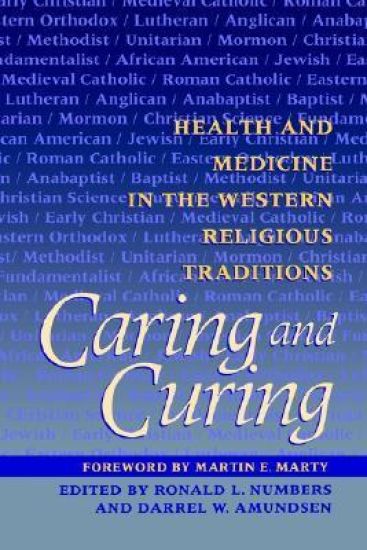
Caring and Curing

Caring and Curing

Ronald L. Numbers; Darrel W. Amundsen; Martin E. Marty

Johns Hopkins University Press
1998
pokkari
Most religious traditions have a rich, if largely forgotten, heritage of involvement in medical issues of life, death, and health. Religious values influence our behavior and attitudes toward sickness, sexuality, and lifestyle, to say nothing of more controversial subjects such as abortion and euthanasia. The essays in this important book illuminate the history of health and medicine within the Judeo-Christian tradition. Bringing together 20 original articles by expert scholars in the fields of the history of religion and the history of medicine, Caring and Curing provides a fascinating and enlightening overview of how religious values have come to affect the practice of medicine and medical care.
On the (Divine) Origin of Our Species

On the (Divine) Origin of Our Species

Darrel R Falk; Philip Batterham; Cara Wall-Scheffler; Robert W Wall

Cascade Books
2023
pokkari
The Bible's opening chapter includes these words: "So God created humans in his image, in the image of God he created them; male and female he created them." We are created beings, with a unique status in creation. Nothing is more fundamental to Christian faith. Yet biologists present extensive data and provide a picture of how our species came to be, but there is no Creator in the intricate details of the painting they provide. If the scientific evidence for the evolution picture is reasonable--and, in general, it is--and if humans were indeed created from a common ancestor of the great apes, then what can be said about the Artist who Christians believe was at work? Vague answers are not satisfactory anymore--not in this scientific age. Recent mainstream data from paleoanthropology and genetics suggest that the basis of our species' success was not that they were superior fighters. Rather, the reason our ancestors thrived was likely their ability to function cooperatively in groups--to respect each other and to get along. This reframes the question about the nature of the hovering Spirit's activity in bringing our species into being. And that is the subject of this book.
On the (Divine) Origin of Our Species

On the (Divine) Origin of Our Species

Darrel R Falk; Philip Batterham; Cara Wall-Scheffler; Robert W Wall

Cascade Books
2023
sidottu
The Bible's opening chapter includes these words: "So God created humans in his image, in the image of God he created them; male and female he created them." We are created beings, with a unique status in creation. Nothing is more fundamental to Christian faith. Yet biologists present extensive data and provide a picture of how our species came to be, but there is no Creator in the intricate details of the painting they provide. If the scientific evidence for the evolution picture is reasonable--and, in general, it is--and if humans were indeed created from a common ancestor of the great apes, then what can be said about the Artist who Christians believe was at work? Vague answers are not satisfactory anymore--not in this scientific age. Recent mainstream data from paleoanthropology and genetics suggest that the basis of our species' success was not that they were superior fighters. Rather, the reason our ancestors thrived was likely their ability to function cooperatively in groups--to respect each other and to get along. This reframes the question about the nature of the hovering Spirit's activity in bringing our species into being. And that is the subject of this book.
Racial Resentment in the Political Mind

Racial Resentment in the Political Mind

Darren W. Davis; David C. Wilson

University of Chicago Press
2021
sidottu
A thought-provoking look at how racial resentment, rather than racial prejudice alone, motivate a growing resistance among whites to improve the circumstances faced by racial minorities. In Racial Resentment in the Political Mind, Darren W. Davis and David C. Wilson challenge the commonly held notion that all racial negativity, disagreements, and objections to policies that seek to help racial minorities stem from racial prejudice. They argue that racial resentment arises from just-world beliefs and appraisals of deservingness that help explain the persistence of racial inequality in America in ways more consequential than racism or racial prejudice alone. The culprits, as many White people see it, are undeserving people of color, who are perceived to benefit unfairly from, and take advantage of, resources that come at Whites’ expense—a worldview in which any attempt at modest change is seen as a challenge to the status quo and privilege. Yet, as Davis and Wilson reveal, many Whites have become racially resentful due to their perceptions that African Americans skirt the “rules of the game” and violate traditional values by taking advantage of unearned resources. Resulting attempts at racial progress lead Whites to respond in ways that retain their social advantage—opposing ameliorative policies, minority candidates, and other advancement on racial progress. Because racial resentment is rooted in beliefs about justice, fairness, and deservingness, ordinary citizens, who may not harbor racist motivations, may wind up in the same political position as racists, but for different reasons.
Racial Resentment in the Political Mind

Racial Resentment in the Political Mind

Darren W. Davis; David C. Wilson

University of Chicago Press
2021
nidottu
A thought-provoking look at how racial resentment, rather than racial prejudice alone, motivate a growing resistance among whites to improve the circumstances faced by racial minorities. In Racial Resentment in the Political Mind, Darren W. Davis and David C. Wilson challenge the commonly held notion that all racial negativity, disagreements, and objections to policies that seek to help racial minorities stem from racial prejudice. They argue that racial resentment arises from just-world beliefs and appraisals of deservingness that help explain the persistence of racial inequality in America in ways more consequential than racism or racial prejudice alone. The culprits, as many White people see it, are undeserving people of color, who are perceived to benefit unfairly from, and take advantage of, resources that come at Whites’ expense—a worldview in which any attempt at modest change is seen as a challenge to the status quo and privilege. Yet, as Davis and Wilson reveal, many Whites have become racially resentful due to their perceptions that African Americans skirt the “rules of the game” and violate traditional values by taking advantage of unearned resources. Resulting attempts at racial progress lead Whites to respond in ways that retain their social advantage—opposing ameliorative policies, minority candidates, and other advancement on racial progress. Because racial resentment is rooted in beliefs about justice, fairness, and deservingness, ordinary citizens, who may not harbor racist motivations, may wind up in the same political position as racists, but for different reasons.
Architecture in Black

Architecture in Black

Darrell W. Fields

Continuum International Publishing Group Ltd.
2000
sidottu
This text argues that architecture, as an aesthetic practice, and blackness, as a linguistic practice, operate within the same semiotic paradigm. The book presents a systematic analysis of the theoretical relationship between architecture and blackness. Employing a technique whereby works are related through the repetition and revision of their semiotic structures, this text reconstructs the genaeology of a black racial subject represented by the simultaneous reading of a range of canonical texts from Hegel to Saussure to Henry Louis Gates, Jr.
Trauma-Informed Christian Ethics

Trauma-Informed Christian Ethics

Darryl W. Stephens

BLOOMSBURY PUBLISHING PLC
2026
sidottu
Darryl W. Stephens suggests that human dignity and equality under God can be used to address the most intractable moral problems of our time: war, sexual abuse, racism, environmental degradation, and more. This work examines Christian ethics sensitive to the trauma histories that are already present individually and collectively in and among our faith communities. Stephens encourages us to see that Christian ethics is real, perspectival, dialogical, participatory and purposeful – he reconceives the entirety of Christian ethics through trauma-informed lens, recognizing that many people wrestle with significant trauma histories every day. He explores the theological implications of trauma-informed approach to a wide range of social issues, and engages with Wesleyan, feminist and liberationist perspectives.Designed for classroom use, it includes a number of pedagogical features, such as case studies and questions for discussion, engaging with key areas of contemporary concern.
Trauma-Informed Christian Ethics

Trauma-Informed Christian Ethics

Darryl W. Stephens

BLOOMSBURY PUBLISHING PLC
2026
nidottu
Darryl W. Stephens suggests that human dignity and equality under God can be used to address the most intractable moral problems of our time: war, sexual abuse, racism, environmental degradation, and more. This work examines Christian ethics sensitive to the trauma histories that are already present individually and collectively in and among our faith communities. Stephens encourages us to see that Christian ethics is real, perspectival, dialogical, participatory and purposeful – he reconceives the entirety of Christian ethics through trauma-informed lens, recognizing that many people wrestle with significant trauma histories every day. He explores the theological implications of trauma-informed approach to a wide range of social issues, and engages with Wesleyan, feminist and liberationist perspectives.Designed for classroom use, it includes a number of pedagogical features, such as case studies and questions for discussion, engaging with key areas of contemporary concern.
Florence Foster Jenkins

Florence Foster Jenkins

Darryl W. Bullock

Duckworth
2016
nidottu
'Darryl Bullock's timely biography - delightfully cheering' Alexander McCall Smith, Guardian Madame Jenkins couldn't carry a tune in a bucket: despite that, in 1944 at the age of 76, she played Carnegie Hall to a capacity audience and had celebrity fans by the score. Her infamous 1940s recordings are still highly-prized today. In his well-researched and thoroughly entertaining biography, Darryl W. Bullock tells of Florence Foster Jenkins meteoric rise to success and the man who stood beside her, through every sharp note. Florence was ridiculed for her poor control of timing, pitch, and tone, and terrible pronunciation of foreign lyrics, but the sheer entertainment value of her caterwauling packed out theatres around the United States, with the 'singer' firmly convinced of her own talent, partly thanks to the devoted attention from her husband and manager St Clair Bayfield. Her story is one of triumph in the face of adversity, of courage, conviction and of the belief that with dedication and commitment a true artist can achieve anything. With a major Hollywood movie about her life out now (starring Meryl Streep, Hugh Grant and Simon Helberg), the genius of Florence Foster Jenkins is about to be discovered by a whole new audience. 'The first full biography of Foster Jenkins' Clemency Burton-Hill, BBC 'Listening to her pathetic bleating is something like eavesdropping on a padded cell inmate' Billboard magazine