Kirjojen hintavertailu. Mukana 11 244 527 kirjaa ja 12 kauppaa.

Kirjahaku

Etsi kirjoja tekijän nimen, kirjan nimen tai ISBN:n perusteella.

1000 tulosta hakusanalla David A. Lake

Common Flora of the Playa Lakes

Common Flora of the Playa Lakes

David A. Haukos; Loren M. Smith

Texas Tech Press,U.S.
1997
nidottu
Common Flora of the Playa Lakes is intended to be a technical resource for private landowners, conservation groups, and governmental agencies interested in playa conservation and management, as well as a handy field guide for walkers, bird watchers, and other naturalists who enjoy exploring the Playa Lakes Region of Texas, New Mexico, Oklahoma, Kansas, and Colorado. Based on a detailed plant survey of 230 playas in these five states, this publication provides detailed descriptions of 72 plant species most frequently associated with playas, their common and scientific names (including synonyms), a botanical treatment of distinguishing characteristics, the wetland indicator status of the species, wildlife and livestock use of the species, seasonal and geographic distribution of species occurrence, and references to characteristics separating similar species. Color photographs throughout highlight key field identification characteristics for each species description. Also provided is an introduction to the ecology of playa lakes and an appendix listing all known plant species reported from playa lakes.
Lake District of Minneapolis

Lake District of Minneapolis

David A. Lanegran

University of Minnesota Press
2004
nidottu
A colorful history of one of the city’s most beloved neighborhoods-now back in print!The Minneapolis lake district, which includes Lowry Hill, Kenwood, Lake of the Isles, and East Calhoun, has always attracted a unique mix of people. Some came to make their fortune, others to live a splendid life in what was then open country. Some came to build comfortable family homes, others to promenade along the lake shores or to revel in outdoor sports and recreation. No matter the year or the season, the lake district has always taken center stage in Minneapolis’s urban life.David A. Lanegran and Ernest R. Sandeen give us the complete history of the area-from the early Native American villages and pioneering missionaries, through the era of the grand resort and the coming of the streetcars, to the park board’s remaking of the lakes and the landscape in 1911. With many vivid photographs and illustrations, the book concludes with historical walking tours of the Lowry Hill, Kenwood, East Lowry Hill, Lake of the Isles, East Calhoun, and Cottage City neighborhoods.
Amphibians and Reptiles of the Great Lakes Region, Revised Ed.

Amphibians and Reptiles of the Great Lakes Region, Revised Ed.

James H. Harding; David A Mifsud

The University of Michigan Press
2017
nidottu
The revised edition of this well-loved guide is the essential reference for the identification of amphibians and reptiles in the Great Lakes region. Fully updated treatments of over 70 species feature detailed information on the distribution, habitat, behavior, and life history of these fascinating animals. This edition includes all new distribution maps as well as 90 additional color photographs showing close-ups of distinguishing features, common color phases, and different metamorphic stages. A thorough introduction provides a wealth of information on the evolution, natural history, classification, and conservation of these animals and examines changing Great Lakes ecosystems and their impact on herpetological diversity. Amphibians and Reptiles of the Great Lakes Region is a must-have resource for teachers, students, naturalists, professional biologists, and anyone else with an interest in this region’s ecology.
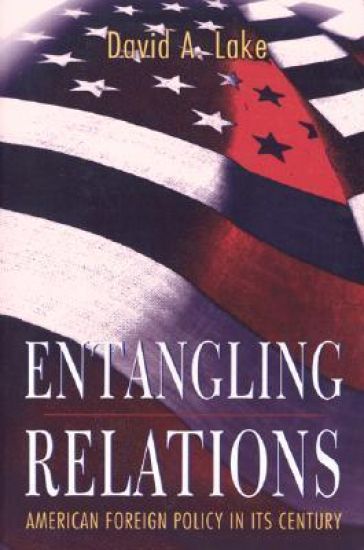
Entangling Relations

Entangling Relations

David A. Lake

Princeton University Press
1999
pokkari
Throughout what publisher Henry Luce dubbed the "American century," the United States has wrestled with two central questions. Should it pursue its security unilaterally or in cooperation with others? If the latter, how can its interests be best protected against opportunism by untrustworthy partners? In a major attempt to explain security relations from an institutionalist approach, David A. Lake shows how the answers to these questions have differed after World War I, during the Cold War, and today. In the debate over whether to join the League of Nations, the United States reaffirmed its historic policy of unilateralism. After World War II, however, it broke decisively with tradition and embraced a new policy of cooperation with partners in Europe and Asia. Today, the United States is pursuing a new strategy of cooperation, forming ad hoc coalitions and evincing an unprecedented willingness to shape but then work within the prevailing international consensus on the appropriate goals and means of foreign policy. In interpreting these three defining moments of American foreign policy, Lake draws on theories of relational contracting and poses a general theory of security relationships. He arrays the variety of possible security relationships on a continuum from anarchy to hierarchy, and explains actual relations as a function of three key variables: the benefits from pooling security resources and efforts with others, the expected costs of opportunistic behavior by partners, and governance costs. Lake systematically applies this theory to each of the "defining moments" of twentieth-century American foreign policy and develops its broader implications for the study of international relations.
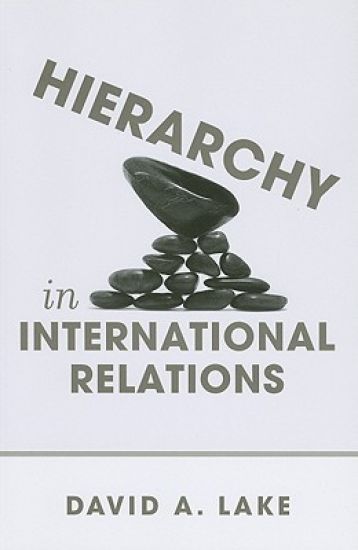
Hierarchy in International Relations

Hierarchy in International Relations

David A. Lake

Cornell University Press
2011
pokkari
International relations are generally understood as a realm of anarchy in which countries lack any superior authority and interact within a Hobbesian state of nature. In Hierarchy in International Relations, David A. Lake challenges this traditional view, demonstrating that states exercise authority over one another in international hierarchies that vary historically but are still pervasive today. Revisiting the concepts of authority and sovereignty, Lake offers a novel view of international relations in which states form social contracts that bind both dominant and subordinate members. The resulting hierarchies have significant effects on the foreign policies of states as well as patterns of international conflict and cooperation. Focusing largely on U.S.-led hierarchies in the contemporary world, Lake provides a compelling account of the origins, functions, and limits of political order in the modern international system. The book is a model of clarity in theory, research design, and the use of evidence. Motivated by concerns about the declining international legitimacy of the United States following the Iraq War, Hierarchy in International Relations offers a powerful analytic perspective that has important implications for understanding America's position in the world in the years ahead.
The Statebuilder's Dilemma

The Statebuilder's Dilemma

David A. Lake

Cornell University Press
2016
sidottu
The central task of all statebuilding is to create a state that is regarded as legitimate by the people over whom it exercises authority. This is a necessary condition for stable, effective governance. States sufficiently motivated to bear the costs of building a state in some distant land are likely to have interests in the future policies of that country, and will therefore seek to promote loyal leaders who are sympathetic to their interests and willing to implement their preferred policies. In The Statebuilder's Dilemma, David A. Lake addresses the key tradeoff between legitimacy and loyalty common to all international statebuilding attempts. Except in rare cases where the policy preferences of the statebuilder and the population of the country whose state is to be built coincide, as in the famous success cases of West Germany and Japan after 1945, promoting a leader who will remain loyal to the statebuilder undermines that leader's legitimacy at home. In Iraq, thrust into a statebuilding role it neither anticipated nor wanted, the United States eventually backed Nouri al-Malaki as the most favorable of a bad lot of alternative leaders. Malaki then used the support of the Bush administration to govern as a Shiite partisan, undermining the statebuilding effort and ultimately leading to the second failure of the Iraqi state in 2014. Ethiopia faced the same tradeoff in Somalia after the rise of a promising but irredentist government in 2006, invading to put its own puppet in power in Mogadishu. But the resulting government has not been able to build significant local support and legitimacy. Lake uses these cases to demonstrate that the greater the interests of the statebuilder in the target country, the more difficult it is to build a legitimate state that can survive on its own.
The Statebuilder's Dilemma

The Statebuilder's Dilemma

David A. Lake

Cornell University Press
2016
pokkari
The central task of all statebuilding is to create a state that is regarded as legitimate by the people over whom it exercises authority. This is a necessary condition for stable, effective governance. States sufficiently motivated to bear the costs of building a state in some distant land are likely to have interests in the future policies of that country, and will therefore seek to promote loyal leaders who are sympathetic to their interests and willing to implement their preferred policies. In The Statebuilder's Dilemma, David A. Lake addresses the key tradeoff between legitimacy and loyalty common to all international statebuilding attempts. Except in rare cases where the policy preferences of the statebuilder and the population of the country whose state is to be built coincide, as in the famous success cases of West Germany and Japan after 1945, promoting a leader who will remain loyal to the statebuilder undermines that leader's legitimacy at home. In Iraq, thrust into a statebuilding role it neither anticipated nor wanted, the United States eventually backed Nouri al-Malaki as the most favorable of a bad lot of alternative leaders. Malaki then used the support of the Bush administration to govern as a Shiite partisan, undermining the statebuilding effort and ultimately leading to the second failure of the Iraqi state in 2014. Ethiopia faced the same tradeoff in Somalia after the rise of a promising but irredentist government in 2006, invading to put its own puppet in power in Mogadishu. But the resulting government has not been able to build significant local support and legitimacy. Lake uses these cases to demonstrate that the greater the interests of the statebuilder in the target country, the more difficult it is to build a legitimate state that can survive on its own.
Power, Protection, and Free Trade

Power, Protection, and Free Trade

David A. Lake

Cornell University Press
2018
pokkari
Why do nations so frequently abandon unrestricted international commerce in favor of trade protectionism? David A. Lake contends that the dominant explanation, interest group theory, does not adequately explain American trade strategy or address the contradictory elements of cooperation and conflict that shape the international economy. Power, Protection, and Free Trade offers an alternative, systemic approach to trade strategy that builds on the interaction between domestic and international factors. In this innovative book, Lake maintains that both protection and free trade are legitimate and effective instruments of national policy, the considered responses of nations to varying international structures.
Indirect Rule

Indirect Rule

David A. Lake

CORNELL UNIVERSITY PRESS
2024
sidottu
Indirect Rule examines how states indirectly exercise authority over others and how this mode of rule affects domestic and international politics. Indirect rule has long characterized interstate relationships and US foreign relations. A key mechanism of international hierarchy, indirect rule involves an allied group within a client state adopting policies preferred by a dominant state in exchange for the dominant state's support. Drawing on the history of US involvement in the Caribbean and Central America, Western Europe, and the Arab Middle East, David A. Lake shows that indirect rule is more likely to occur when the specific assets at risk are large and governance costs are low. Lake's conceptualization of indirect rule sharpens our understanding of how the United States came to occupy the pinnacle of world power. Yet the consequences of indirect rule he documents—including anti-Americanism—reveal its shortcomings. As US efforts at democracy promotion and other forms of intervention abroad face declining support at home, Indirect Rule compels us to consider whether this method of rule ultimately advances US interests.
Indirect Rule

Indirect Rule

David A. Lake

CORNELL UNIVERSITY PRESS
2024
pokkari
Indirect Rule examines how states indirectly exercise authority over others and how this mode of rule affects domestic and international politics. Indirect rule has long characterized interstate relationships and US foreign relations. A key mechanism of international hierarchy, indirect rule involves an allied group within a client state adopting policies preferred by a dominant state in exchange for the dominant state's support. Drawing on the history of US involvement in the Caribbean and Central America, Western Europe, and the Arab Middle East, David A. Lake shows that indirect rule is more likely to occur when the specific assets at risk are large and governance costs are low. Lake's conceptualization of indirect rule sharpens our understanding of how the United States came to occupy the pinnacle of world power. Yet the consequences of indirect rule he documents—including anti-Americanism—reveal its shortcomings. As US efforts at democracy promotion and other forms of intervention abroad face declining support at home, Indirect Rule compels us to consider whether this method of rule ultimately advances US interests.
THE INTERNATIONAL POLITICAL ECONOMY OF TRADE

THE INTERNATIONAL POLITICAL ECONOMY OF TRADE

David A. Lake

Edward Elgar Publishing Ltd
1993
sidottu
The political economy of international trade and trade policy - at both the domestic and international levels - has spawned a vast literature from both economists and political scientists. This two volume set includes seminal contributions to our understanding of international trade among the advanced industrial countries, between them and the lesser developed countries and between East and West. It includes work on the political economy of trade liberalization, protectionism and sanctions.
World Politics

World Politics

Frieden Jeffry A.; Lake David A.; Schultz Kenneth A.

WW Norton Co
2012
nidottu
In the Second Edition, two new chapters--one on civil war and terrorism and one on international law--bring the book's successful approach to additional topics. Added features stress real-world applications and provide extensive study and review help, making the authors' analytical approach even more accessible and engaging.
Power, Protection, and Free Trade

Power, Protection, and Free Trade

Lake David A.

Cornell University Press
1988
sidottu
Why do nations so frequently abandon unrestricted international commerce in favor of trade protectionism? David A. Lake contends that the dominant explanation, interest group theory, does not adequately explain American trade strategy or address the contradictory elements of cooperation and conflict that shape the international economy. Power, Protection, and Free Trade offers an alternative, systemic approach to trade strategy that builds on the interaction between domestic and international factors. In this innovative book, Lake maintains that both protection and free trade are legitimate and effective instruments of national policy, the considered responses of nations to varying international structures.
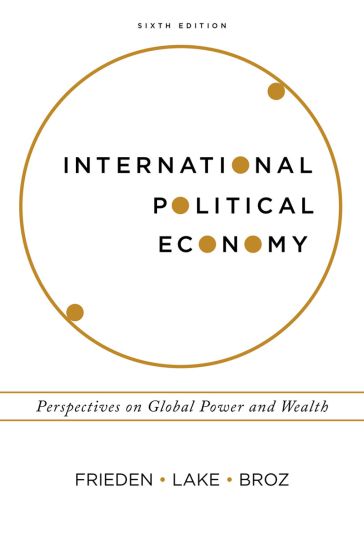
International Political Economy: Perspectives on Global Power and Wealth

International Political Economy: Perspectives on Global Power and Wealth

Jeffry A. Frieden; David A. Lake; J. Lawrence Broz

W. W. Norton Company
2017
nidottu
With 70 percent new readings, the Sixth Edition of International Political Economy has been extensively updated to reflect changes in the scholarship and the global economy. This compact book brings together a flexible and provocative set of articles and excerpts on a broad range of topics, including the global economic crisis, international migration, and the ongoing challenges in the Eurozone. The text also provides clear introductions and headnotes to help students get the most out of each reading.
World Politics: Interests, Interactions, Institutions

World Politics: Interests, Interactions, Institutions

Jeffry A. Frieden; David A. Lake; Kenneth A. Schultz

W. W. Norton Company
2018
nidottu
With a framework based on interests, interactions, and institutions, World Politics gives students the tools to understand international relations. In the thoroughly updated Fourth Edition, new Controversy units provide models for applying the concepts in each chapter to real-world issues and events. New InQuizitive activities--created and tested by instructors who teach with World Politics--then invite students to practice applying the analytical tools from the text to alternative examples and cases.
World Politics

World Politics

Jeffry A. (Columbia University) Frieden; David A. (University of California Lake; Kenneth A. (Stanford University) Schultz

WW NortonCo
2022
muu
The accessible analytical framework to make sense of global events, and the tools to apply it.
International Political Economy

International Political Economy

Jeffry A. Frieden; David A. Lake

Routledge
1999
nidottu
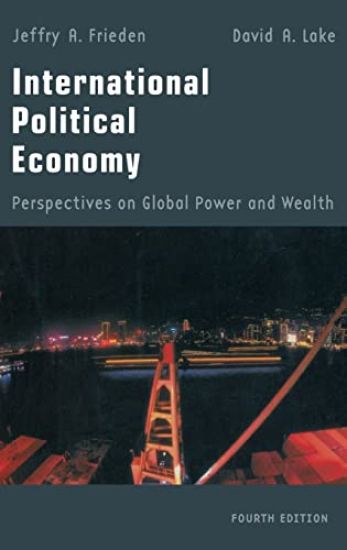
Now in its fourth edition, this best-selling reader in international political economy offers 31 solid articles - 15 new - by renowned scholars in political science and economics. Frieden and Lake have edited and introduced each reading with care to ensure its accessibility to students who are new to the subject. This reader continues to offer a provocative look at the postive and negative impacts of globalization.
International Political Economy

International Political Economy

Jeffry A. Frieden; David A. Lake

Routledge
2015
sidottu
Now in its fourth edition, this best-selling reader in international political economy offers 31 solid articles - 15 new - by renowned scholars in political science and economics. Frieden and Lake have edited and introduced each reading with care to ensure its accessibility to students who are new to the subject. This reader continues to offer a provocative look at the postive and negative impacts of globalization.