Kirjojen hintavertailu. Mukana 11 244 527 kirjaa ja 12 kauppaa.

Kirjahaku

Etsi kirjoja tekijän nimen, kirjan nimen tai ISBN:n perusteella.

1000 tulosta hakusanalla David A. Rich

Get Rich Fast in the Knowledge Era: Top Tips To Get Rich Fast In The Knowledge Era
Unless you've found a way to live entirely free, you likely need some sort of steady income in order to endure. The traditional way to bring in revenue, naturally, is by having a job. You work for a company or begin your own, and the work you do earns you revenue, which you spend on things like a mortgage, rent, food, apparel, utilities and amusement.Most individuals commonly work from their company's central location, a physical space where everybody from that organization gathers to exchange ideas and organize their efforts.However, a few lucky souls have discovered ways to make revenue within the comfort of their own home. With the Net, an ever-changing arena for businesses, some looking to bring in revenue are discovering ways to do so.A few forms are best for part-time endeavors for those looking to make a little extra revenue on the side, while other people may lead to full-time jobs and Net success stories. We've put together ways to make money on the Net, in no particular order.If you are to bring in never-ending money, Blogging is a great choice. Quality content and writing style is the key to a great blog. Traffic and cash are by-products. So for a beginning you have to build a blog and write the things that you're great at.If you're great at it, results will follow in about 3 month's time. Chief source of money for bloggers is advertisement like Google Adsense, Adbrite etc.
The Richest Mindset: How To Become The Richest Person In Modern Era
This book deals with the personal successes of everyone us. Success means achievements as the result of our own efforts and abilities.Proper planning is the key to our success. Our acts may be no wiser than our ideas.Our thought may be no wiser than our understanding. The objective of all life is developing; and everything that lives has an unalienable right to all the development it's capable of attaining.Babylon became the most affluent city of the ancient world, as its citizens were the richest individuals of their time. They treasured the value of money. They applied sound financial precepts in gaining money, maintaining money and making their money pull in moremoney. They supplied for themselves what we all want...monies for the future.In the annuls of history there was no city more glamorous thanBabylon. It's very name arouses visions of riches and magnificence. Its treasures of gold and gems were fabulous.Babylon is a great example of man's power to accomplish great objectives, utilizing whatever means are at his disposal. As a city, Babylon exists no longer.Nowadays, this valley, once a thickly settled irrigated farming district, is once again a wind-swept arid waste. But it's inhabitants weren't mere barbarians living inside protecting walls.They were an educated and knowledgeable people. The glory of Babylon has faded however; its wiseness has been preserved for us.
Discovery Of Anti-matter, The: The Autobiography Of Carl David Anderson, The Second Youngest Man To Win The Nobel Prize
In 1936, at age 31, Carl David Anderson became the second youngest Nobel laureate for his discovery of antimatter when he observed positrons in a cloud chamber.He is responsible for developing rocket power weapons that were used in World War II.He was born in New York City in 1905 and was educated in Los Angeles. He served for many years as a physics professor at California Institute of Technology. Prior to Oppenheimer, Anderson was offered the job of heading the Los Alamos atomic bomb program but could not assume the role because of family obligations.He was a pioneer in studying cosmic rays at high altitudes, first atop Pike's Peak, then after the war in a specially equipped B-29.
Richard Barr

Richard Barr

David A. Crespy

Southern Illinois University Press
2013
nidottu
Richard Barr: The Playwright’s Producer is a biography of producer Richard Barr (1917-1989), who worked on Broadway, off-Broadway at the Cherry Lane Theatre, and off-off-Broadway at the Playwrights Unit. Crespy’s research material includes nearly sixty interviews with actors, directors, designers, stage managers, and fellow producers who worked with Barr; the producer’s personal papers; and Barr’s own unpublished memoirs.
Holding a Mirror up to Nature

Holding a Mirror up to Nature

James Gilligan; David A.J. Richards

Cambridge University Press
2021
sidottu
Shakespeare has been dubbed the greatest psychologist of all time. This book seeks to prove that statement by comparing the playwright's fictional characters with real-life examples of violent individuals, from criminals to political actors. For Gilligan and Richards, the propensity to kill others, even (or especially) when it results in the killer's own death, is the most serious threat to the continued survival of humanity. In this volume, the authors show how humiliated men, with their desire for retribution and revenge, apocryphal violence and political religions, justify and commit violence, and how love and restorative justice can prevent violence. Although our destructive power is far greater than anything that existed in his day, Shakespeare has much to teach us about the psychological and cultural roots of all violence. In this book the authors tell what Shakespeare shows, through the stories of his characters: what causes violence and what prevents it.
Holding a Mirror up to Nature

Holding a Mirror up to Nature

James Gilligan; David A.J. Richards

Cambridge University Press
2021
pokkari
Shakespeare has been dubbed the greatest psychologist of all time. This book seeks to prove that statement by comparing the playwright's fictional characters with real-life examples of violent individuals, from criminals to political actors. For Gilligan and Richards, the propensity to kill others, even (or especially) when it results in the killer's own death, is the most serious threat to the continued survival of humanity. In this volume, the authors show how humiliated men, with their desire for retribution and revenge, apocryphal violence and political religions, justify and commit violence, and how love and restorative justice can prevent violence. Although our destructive power is far greater than anything that existed in his day, Shakespeare has much to teach us about the psychological and cultural roots of all violence. In this book the authors tell what Shakespeare shows, through the stories of his characters: what causes violence and what prevents it.
A Primer of Conservation Genetics

A Primer of Conservation Genetics

Frankham Richard; Ballou Jonathan D.; Briscoe David A.

Cambridge University Press
2004
sidottu
This concise, entry level text provides an introduction to the importance of genetic studies in conservation and presents the essentials of the discipline in an easy-to-follow format, with main points and terms clearly highlighted. The authors assume only a basic knowledge of Mendelian genetics and simple statistics, making the book accessible to those with a limited background in these areas. Connections between conservation genetics and the wider field of conservation biology are interwoven throughout the book. Worked examples are provided throughout to help illustrate key equations and glossary and suggestions for further reading provide additional support for the reader. Many beautiful pen and ink portraits of endangered species are included to enhance the text. Written for short, introductory level courses in genetics, conservation genetics and conservation biology, this book will also be suitable for practising conservation biologists, zoo biologists and wildlife managers.
Analyzing a More Resilient National Positioning, Navigation, and Timing Capability

Analyzing a More Resilient National Positioning, Navigation, and Timing Capability

Richard Mason; James Bonomo; Tim Conley; Ryan Consaul; David R Frelinger; David A Galvan; Dahlia Anne Goldfeld; Scott A Grossman; Brian A Jackson; Michael Kennedy; V Ray Koym; Jason Mastbaum; Jenny Oberholtzer; Ellen M Pint; Parousia Rockstroh; Melissa Corinne Shostak; Karlyn D Stanley; Anne Stickells; Michael J D Vermeer; Stephen M Worman

RAND
2021
nidottu
Because of the widespread use of the Global Positioning System (GPS) for positioning, navigation, and timing (PNT), concerns have been expressed that a disruption of GPS might require a national investment in backup capabilities. The authors assess the costs associated with realistic threats to domestic, nonmilitary uses of GPS, and review possible additions to the PNT ecosystem in light of those costs.
A Primer of Conservation Genetics

A Primer of Conservation Genetics

Richard Frankham; Jonathan D. Ballou; David A. Briscoe

Cambridge University Press
2004
pokkari
This concise, entry level text provides an introduction to the importance of genetic studies in conservation and presents the essentials of the discipline in an easy-to-follow format, with main points and terms clearly highlighted. The authors assume only a basic knowledge of Mendelian genetics and simple statistics, making the book accessible to those with a limited background in these areas. Connections between conservation genetics and the wider field of conservation biology are interwoven throughout the book. Worked examples are provided throughout to help illustrate key equations and glossary and suggestions for further reading provide additional support for the reader. Many beautiful pen and ink portraits of endangered species are included to enhance the text. Written for short, introductory level courses in genetics, conservation genetics and conservation biology, this book will also be suitable for practising conservation biologists, zoo biologists and wildlife managers.
Nova: Richard Rider Omnibus

Nova: Richard Rider Omnibus

Marv Wolfman; Len Wein; David A Kraft

MARVEL COMICS
2023
sidottu
Richard Rider is Nova, the original 1970s Human Rocket Struck by energy sent by a dying alien, Rich has inherited the mantle of an intergalactic Nova Centurion Now, the newly-minted hero must somehow balance schoolwork, a social life and a constant string of villains including Condor, Powerhouse, Diamondhead, Blackout...and the dreaded Sphinx, who seeks a secret that Nova doesn't even know he's carrying Plus, Nova and Spider-Man unravel a murder mystery, Rich's father is ensnared in an underworld scheme, and Nova joins...the dynamic Defenders? And when the Nova Corps' homeworld Xandar comes under attack, Rich and his new allies leave Earth behind to join the cosmic fray -- while the Fantastic Four tackle the Sphinx COLLECTING: Nova (1976) 1-25; Amazing Spider-Man (1963) 171; Fantastic Four Annual (1963) 12; Defenders (1972) 62-64; Marvel Two-in-One Annual (1976) 3; Fantastic Four (1961) 204-206, 208-214; Marvel Two-in-One (1974) 91; Thing (1983) 34; material from What If? (1977) 36
ASA S3/SC1.4 TR-2014 Sound Exposure Guidelines for Fishes and Sea Turtles: A Technical Report prepared by ANSI-Accredited Standards Committee S3/SC1 and registered with ANSI

ASA S3/SC1.4 TR-2014 Sound Exposure Guidelines for Fishes and Sea Turtles: A Technical Report prepared by ANSI-Accredited Standards Committee S3/SC1 and registered with ANSI

Arthur N. Popper; Anthony D. Hawkins; Richard R. Fay; David A. Mann; Soraya Bartol; Thomas J. Carlson; Sheryl Coombs; William T. Ellison; Roger L. Gentry; Michele B. Halvorsen; Svein Løkkeborg; Peter H. Rogers; Brandon L. Southall; David G. Zeddies; William N. Tavolga

Springer International Publishing AG
2014
nidottu
This Technical Report presents the outcome of a Working Group that was established to determine broadly applicable sound exposure guidelines for fishes and sea turtles. After consideration of the diversity of fish and sea turtles, guidelines were developed for broad groups of animals, defined by the way they detect sound. Different sound sources were considered in terms of their acoustic characteristics and appropriate metrics defined for measurement of the received levels. The resultant sound exposure guidelines are presented in a set of tables. In some cases numerical guidelines are provided, expressed in appropriate metrics. When there were insufficient data to support numerical values, the relative likelihood of effects occurring was evaluated, although the actual likelihood of effects depends on the received level. These sound exposure guidelines, which are based on the best scientific information at the time of writing, should be treated as interim. The expectation is that with more research the guidelines can be refined and more cells in the tables completed. Recommendations are put forward defining the research requirements of highest priority for extending these interim exposure guidelines.
7 Biblical Truths You Won't Hear in Church

7 Biblical Truths You Won't Hear in Church

David A. Rich

Harvest House Publishers,U.S.
2006
nidottu
Concise and straightforward, 7 Biblical Truths You Won't Hear in Church is a fast-moving, thought-stimulating book for believers who want "something more"...or for Christians who've given up expecting anything from their faith. Author and speaker David Rich points to key issues that can refresh readers' enthusiasm in such provocatively titled chapters as the Ten Commandments were not given to be kept trying to live for Jesus will only frustrate you prayer doesn't change God's mind God doesn't grade on a curve what you see in the mirror is not the real you Readers will be encouraged that the truth is still there to be found-and through it, a truly fulfilling relationship with Jesus Christ.
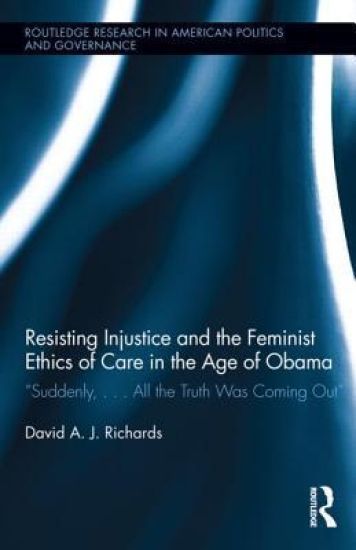
Resisting Injustice and the Feminist Ethics of Care in the Age of Obama
David A. J. Richards’s Resisting Injustice and The Feminist Ethics of Care in The Age of Obama: "Suddenly,…All The Truth Was Coming Out" builds on his and Carol Gilligan’s The Deepening Darkness to examine the roots of the resistance movements of the 1960s, the political psychology behind contemporary conservatism, and President Obama’s present-day appeal as well as the reasons for the reactionary politics against him.Richards begins by laying out the basics of the ethics of care and proposing an alternative basis for ethics: relationality, which is based in convergent findings in infant research, neuroscience, and evolutionary psychology. He critically analyzes patriarchal politics and states that they are rooted in a reactionary psychology that attacks human relationality and ethics. From there, the book examines the 1960s resistance movements and argues that they were fundamentally oriented around challenging patriarchy. Richards asserts that the reactionary politics in America from the 1960s to the present are in service of an American patriarchy threatened by the resistance movements ranging from the 1960s civil rights movements to the present gay rights movement. Reactionary politics intend to marginalize and even reverse the ethical achievements accomplished by resistance movements—creating, in effect, a system of patriarchy hiding in democracy. Richards consequently argues that Obama’s appeal is connected to his challenge to this system of patriarchy and will examine both Obama’s appeal and the reactions against him in light of the 2012 presidential election.This book positions recent American political development in a broad analysis of the role of patriarchy in human oppression throughout history, and argues that a feminist-based ethics of care is necessary to form a more humane and inclusive democratic politics.
Conscience and the Constitution

Conscience and the Constitution

David A.J. Richards

Princeton University Press
2014
pokkari
At stage center of the American drama, maintains David A. J. Richards, is the attempt to understand the implications of the Reconstruction Amendments--Amendments Thirteen, Fourteen, and Fifteen to the United States Constitution. Richards evaluates previous efforts to interpret the amendments and then proposes his own view: together the amendments embodied a self-conscious rebirth of America's revolutionary, rights-based constitutionalism. Building on an approach to constitutional law developed in his Toleration and the Constitution and Foundations of American Constitutionalism, Richards links history, law, and political theory. In Conscience and the Constitution, this method leads from an analysis of the Reconstruction Amendments to a broad discussion of the American constitutional system as a whole. Richards's interpretation focuses on the abolitionists and their radical commitment to the "dissenting conscience." In his view, the Reconstruction Amendments expressed not only the constitutional arguments of a particular historical period but also a general political theory developed by the abolitionists, who restructured the American political community in terms of respect for universal human rights. He argues further that the amendments make a claim on our generation to keep faith with the vision of the "founders of 1865." In specific terms he points out what such allegiance would mean in the context of present-day constitutional issues. Originally published in 1993. The Princeton Legacy Library uses the latest print-on-demand technology to again make available previously out-of-print books from the distinguished backlist of Princeton University Press. These editions preserve the original texts of these important books while presenting them in durable paperback and hardcover editions. The goal of the Princeton Legacy Library is to vastly increase access to the rich scholarly heritage found in the thousands of books published by Princeton University Press since its founding in 1905.
Conscience and the Constitution

Conscience and the Constitution

David A.J. Richards

PRINCETON UNIVERSITY PRESS
2016
sidottu
At stage center of the American drama, maintains David A. J. Richards, is the attempt to understand the implications of the Reconstruction Amendments--Amendments Thirteen, Fourteen, and Fifteen to the United States Constitution. Richards evaluates previous efforts to interpret the amendments and then proposes his own view: together the amendments embodied a self-conscious rebirth of America's revolutionary, rights-based constitutionalism. Building on an approach to constitutional law developed in his Toleration and the Constitution and Foundations of American Constitutionalism, Richards links history, law, and political theory. In Conscience and the Constitution, this method leads from an analysis of the Reconstruction Amendments to a broad discussion of the American constitutional system as a whole. Richards's interpretation focuses on the abolitionists and their radical commitment to the "dissenting conscience." In his view, the Reconstruction Amendments expressed not only the constitutional arguments of a particular historical period but also a general political theory developed by the abolitionists, who restructured the American political community in terms of respect for universal human rights. He argues further that the amendments make a claim on our generation to keep faith with the vision of the "founders of 1865." In specific terms he points out what such allegiance would mean in the context of present-day constitutional issues. Originally published in 1993. The Princeton Legacy Library uses the latest print-on-demand technology to again make available previously out-of-print books from the distinguished backlist of Princeton University Press. These editions preserve the original texts of these important books while presenting them in durable paperback and hardcover editions. The goal of the Princeton Legacy Library is to vastly increase access to the rich scholarly heritage found in the thousands of books published by Princeton University Press since its founding in 1905.
Italian American

Italian American

David A.J. Richards

New York University Press
1999
sidottu
When southern Italians began emigrating to the U.S. in large numbers in the 1870s-part of the "new immigration" from southern and eastern rather than northern Europe-they were seen as racially inferior, what David A. J. Richards terms "nonvisibly" black. The first study of its kind, Italian American explores the acculturation process of Italian immigrants in terms of then-current patterns of European and American racism. Delving into the political and legal context of flawed liberal nationalism both in Italy (the Risorgimento) and the United States (Reconstruction Amendments), Richards examines why Italian Americans were so reluctant to influence depictions of themselves and their own collective identity. He argues that American racism could not have had the durability or political power it has had either in the popular understanding or in the corruption of constitutional ideals unless many new immigrants, themselves often regarded as racially inferior, had been drawn into accepting and supporting many of the terms of American racism. With its unprecedented focus on Italian American identity and an interdisciplinary approach to comparative culture and law, this timely study sheds important light on the history and contemporary importance of identity and multicultural politics in American political and constitutional debate.
Resisting Injustice and the Feminist Ethics of Care in the Age of Obama
David A. J. Richards’s Resisting Injustice and The Feminist Ethics of Care in The Age of Obama: "Suddenly,…All The Truth Was Coming Out" builds on his and Carol Gilligan’s The Deepening Darkness to examine the roots of the resistance movements of the 1960s, the political psychology behind contemporary conservatism, and President Obama’s present-day appeal as well as the reasons for the reactionary politics against him.Richards begins by laying out the basics of the ethics of care and proposing an alternative basis for ethics: relationality, which is based in convergent findings in infant research, neuroscience, and evolutionary psychology. He critically analyzes patriarchal politics and states that they are rooted in a reactionary psychology that attacks human relationality and ethics. From there, the book examines the 1960s resistance movements and argues that they were fundamentally oriented around challenging patriarchy. Richards asserts that the reactionary politics in America from the 1960s to the present are in service of an American patriarchy threatened by the resistance movements ranging from the 1960s civil rights movements to the present gay rights movement. Reactionary politics intend to marginalize and even reverse the ethical achievements accomplished by resistance movements—creating, in effect, a system of patriarchy hiding in democracy. Richards consequently argues that Obama’s appeal is connected to his challenge to this system of patriarchy and will examine both Obama’s appeal and the reactions against him in light of the 2012 presidential election.This book positions recent American political development in a broad analysis of the role of patriarchy in human oppression throughout history, and argues that a feminist-based ethics of care is necessary to form a more humane and inclusive democratic politics.