Kirjojen hintavertailu. Mukana 11 244 527 kirjaa ja 12 kauppaa.

Kirjahaku

Etsi kirjoja tekijän nimen, kirjan nimen tai ISBN:n perusteella.

1000 tulosta hakusanalla David Arnold Sprecher

subterfuge in academia

subterfuge in academia

David Arnold Sprecher

Createspace Independent Publishing Platform
2016
nidottu
A university campus is a remarkable place. It is a place of learning, scholarship, collegiality, inventiveness, and creation of knowledge that moves civilization forward. These coexist side by side with egotism, pettiness, petulance and personal rivalries. At the time I am speaking of, many a university was run by a scholar lacking experience or training to administer it, yet the institution continued to exist and function from day to day and from one year to the next, turning out graduates and publications at the steady rhythm of a metronome ceaselessly marking time. These two faces of a university campus are seen through the eyes of one who served as academic administrator under a succession of administrations. The campus of this novel cannot be found in listings of colleges and universities or on any map, because it does not exist. Neither does the mosaic of events described in this novel. Some might have happened at one time or another at some American university, but any similarity to actual events is purely coincidental. The characters depicted are completely fictitious, constructed with flesh and bones and endowed with features and character traits to fit their role in the unfolding drama. Any resemblance to living persons is fortuitous.
Mosquitoland

Mosquitoland

David Arnold

Penguin Young Readers Group
2016
nidottu
"Top-notch" --USA Today "Illuminating" --Washington Post "A breath of fresh air" --Entertainment Weekly "Memorable" --People After the sudden collapse of her family, Mim Malone is dragged from her home in northern Ohio to the "wastelands" of Mississippi, where she lives in a medicated milieu with her dad and new stepmom. Before the dust has a chance to settle, she learns her mother is sick back in Cleveland. So she ditches her new life and hops aboard a northbound Greyhound bus to her real home and her real mother, meeting a quirky cast of fellow travelers along the way. But when her thousand-mile journey takes a few turns she could never see coming, Mim must confront her own demons, redefining her notions of love, loyalty, and what it means to be sane.*Includes a discussion guide, exclusive author interview, and music lyrics written by David Arnold
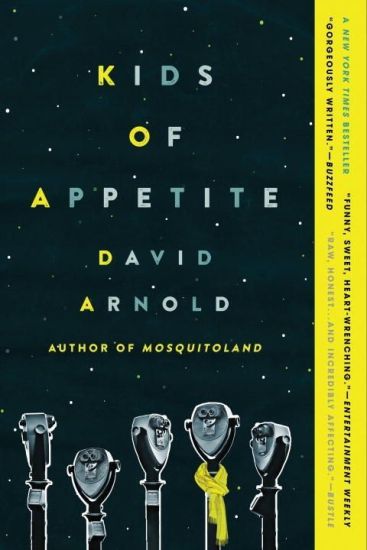
Kids of Appetite

Kids of Appetite

David Arnold

Speak
2017
nidottu
"Funny, sweet, utterly heart-wrenching." --Entertainment WeeklyThe New York Times bestseller from the critically acclaimed author of Mosquitoland Victor Benucci and Madeline Falco have a story to tell. It begins with the death of Vic's father. It ends with the murder of Mad's uncle. The Hackensack Police Department would very much like to hear it. But in order to tell their story, Vic and Mad must focus on all the chapters in between. This is a story about: 1. A coded mission to scatter ashes across New Jersey. 2. The momentous nature of the Palisades in winter. 3. One dormant submarine. 4. Two songs about flowers. 5. Being cool in the traditional sense. 6. Sunsets & ice cream & orchards & graveyards. 7. Simultaneous extreme opposites. 8. A narrow escape from a war-torn country. 9. A story collector. 10. How to listen to someone who does not talk. 11. Falling in love with a painting. 12. Falling in love with a song. 13. Falling in love.
Pandemic India: From Cholera to Covid-19

Pandemic India: From Cholera to Covid-19

David Arnold

Oxford University Press
2022
sidottu
Covid-19 has given renewed, urgent attention to "the pandemic" as a devastating, recurrent global phenomenon. Today the term is freely and widely used-but in reality, it has a long and contested history, centred on South Asia. Pandemic India is an innovative enquiry into the emergence of the idea and changing meaning of pandemics, exploring the pivotal role played by-or assigned to-India over the past 200 years. Using the perspectives of the social historian and the historian of medicine, and a wide range of sources, it explains how and why past pandemics were so closely identified with South Asia; the factors behind outbreaks' exceptional destructiveness in India; responses from society and the state, both during and since the colonial era; and how such collective catastrophes have changed lives and been remembered. Giving a 'long history' to India's current pandemic, the book offers comparisons with earlier epidemics of cholera, plague and influenza. David Arnold assesses the distinctive characteristics and legacies of each episode, tracking the evolution of public health strategies and containment measures. This is a historian's reflection on time as seen through the pandemic prism, and on the ways the past is used--or misused--to serve the present.
The Handbook Of Brand Management

The Handbook Of Brand Management

David Arnold

Westview Press Inc
1993
sidottu
Establishing a brand name is the goal of anyone introducing a new product, and maintaining a brand over time is even more profitable. Established brands are now major corporate assets, as shown when Philip Morris bought Kraft for four times its book value. The Handbook of Brand Management explains the ins and outs of managing brand names in today's fast-changing, competitive marketplace. Developed by marketing expert David Arnold to answer managers' actual questions about brands, this essential guide combines expert advice with the stories of thirteen successful companies from around the world.This book describes how to research, target, budget, and promote new brand. It presents detailed analyses of marketing plans used in situations both good (how did Anheuser-Busch introduce Michelob Dry so successfully?) and bad (how could Perrier survive the benzene scare?).For established brands, managers learn tactics to reverse a market-share decline, to extend brands internationally, and to appraise a brand name's financial value. They find insights in the examples of Schering-Plough stretching" the Coppertone brand to include sunscreens for children, Birds Eye freezing out competitors by how it positioned a new meal in consumers' minds, and many other popular brand-name products.
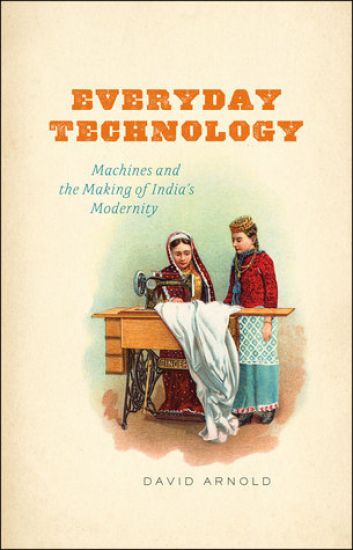
Everyday Technology

Everyday Technology

David Arnold

University of Chicago Press
2015
nidottu
Everyday Technology is a pioneering account of how small machines and consumer goods that originated in Europe and North America became objects of everyday use in India in the late nineteenth and early twentieth centuries. Rather than investigate "big" technologies such as railways and irrigation projects, Arnold examines the assimilation and appropriation of bicycles, rice mills, sewing machines, and typewriters in India, and follows their impact on the ways in which people worked and travelled, the clothes they wore, and the kind of food they ate. But the effects of these machines were not limited to the daily rituals of Indian society, and Arnold demonstrates how such small-scale technologies became integral to new ways of thinking about class, race, and gender, as well as about the politics of colonial rule and Indian nationhood.
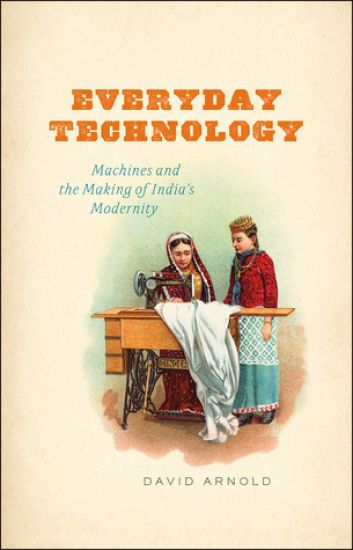
Everyday Technology

Everyday Technology

David Arnold

University of Chicago Press
2013
sidottu
In 1909 Mohandas Karamchand Gandhi, on his way back to South Africa from London, wrote his now celebrated tract Hind Swaraj, laying out his vision for the future of India and famously rejecting the technological innovations of Western civilization. Despite his protestations, Western technology endured and helped to make India one of the leading economies in our globalized world. Few would question the dominant role that technology plays in modern life, but to fully understand how India first advanced into technological modernity, argues David Arnold, we must consider the technology of the everyday. "Everyday Technology" is a pioneering account of how small machines and consumer goods that originated in Europe and North America became objects of everyday use in India in the late nineteenth and early twentieth centuries. Rather than investigate "big" technologies such as railways and irrigation projects, Arnold examines the assimilation and appropriation of bicycles, rice mills, sewing machines, and typewriters in India, and follows their impact on the ways in which people worked and traveled, the clothes they wore, and the kinds of food they ate. But the effects of these machines were not limited to the daily rituals of Indian society, and Arnold demonstrates how such small-scale technologies became integral to new ways of thinking about class, race, and gender, as well as about the politics of colonial rule and Indian nationhood. Arnold's fascinating book offers new perspectives on the globalization of modern technologies and shows us that to truly understand what modernity became, we need to look at the everyday experiences of people in all walks of life, taking stock of how they repurposed small technologies to reinvent their world and themselves.
Abelian Groups and Representations of Finite Partially Ordered Sets
A recurring theme in a traditional introductory graduate algebra course is the existence and consequences of relationships between different algebraic structures. This is also the theme of this book, an exposition of connections between representations of finite partially ordered sets and abelian groups. Emphasis is placed throughout on classification, a description of the objects up to isomorphism, and computation of representation type, a measure of when classification is feasible. David M. Arnold is the Ralph and Jean Storm Professor of Mathematics at Baylor University. He is the author of "Finite Rank Torsion Free Abelian Groups and Rings" published in the Springer-Verlag Lecture Notes in Mathematics series, a co-editor for two volumes of conference proceedings, and the author of numerous articles in mathematical research journals. His research interests are in abelian group theory and related topics, such as representations of partially ordered sets and modules over discrete valuation rings, subrings of algebraic number fields, and pullback rings. He received his Ph. D. from the University of Illinois, Urbana and was a member of the faculty at New Mexico State University for many years.
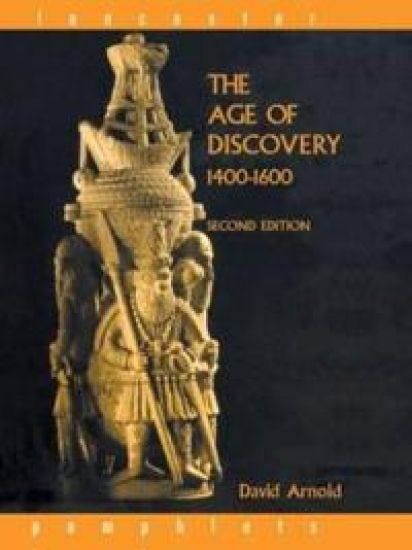
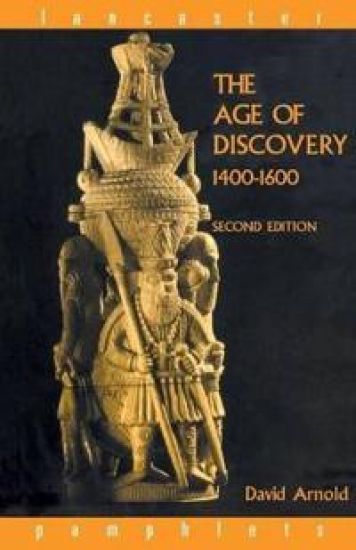
The Age of Discovery, 1400-1600

The Age of Discovery, 1400-1600

David Arnold

Routledge
2002
sidottu
The Age of Discovery explores one of the most dramatic features of the late medieval and early modern period: when voyagers from Western Europe led by Spain and Portugal set out across the world and established links with Africa, Asia and the Americas. This book examines the main motivations behind the voyages and discusses the developments in navigation expertise and technology that made them possible.This second edition brings the scholarship up to date and includes two new chapters on the important topics of the idea of "discovery" and on biological and environmental factors which favoured or limited European expansion.
The Age of Discovery, 1400-1600

The Age of Discovery, 1400-1600

David Arnold

Routledge
2002
nidottu
The Age of Discovery explores one of the most dramatic features of the late medieval and early modern period: when voyagers from Western Europe led by Spain and Portugal set out across the world and established links with Africa, Asia and the Americas. This book examines the main motivations behind the voyages and discusses the developments in navigation expertise and technology that made them possible.This second edition brings the scholarship up to date and includes two new chapters on the important topics of the idea of "discovery" and on biological and environmental factors which favoured or limited European expansion.
Colonizing the Body

Colonizing the Body

David Arnold

University of California Press
1993
pokkari
In this innovative analysis of medicine and disease in colonial India, David Arnold explores the vital role of the state in medical and public health activities, arguing that Western medicine became a critical battleground between the colonized and the colonizers. Focusing on three major epidemic diseases - smallpox, cholera, and plague - Arnold analyzes the impact of medical interventionism. He demonstrates that Western medicine as practiced in India was not simply transferred from West to East, but was also fashioned in response to local needs and Indian conditions. By emphasizing this colonial dimension of medicine, Arnold highlights the centrality of the body to political authority in British India and shows how medicine both influenced and articulated the intrinsic contradictions of colonial rule.
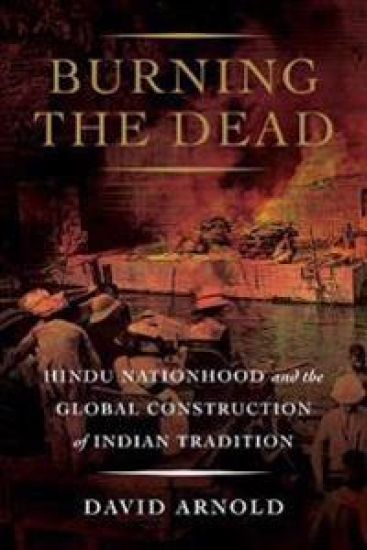
Burning the Dead

Burning the Dead

David Arnold

University of California Press
2021
sidottu
Burning the Dead traces the evolution of cremation in India and the South Asian diaspora across the nineteenth and twentieth centuries. Through interconnected histories of movement, space, identity, and affect, it examines how the so-called traditional practice of Hindu cremation on an open-air funeral pyre was culturally transformed and materially refashioned under British rule, following intense Western hostility, colonial sanitary acceptance, and Indian adaptation. David Arnold examines the critical reception of Hindu cremation abroad, particularly in Britain, where India formed a primary reference point for the cremation debates of the late nineteenth century, and explores the struggle for official recognition of cremation among Hindu and Sikh communities around the globe. Above all, Arnold foregrounds the growing public presence and assertive political use made of Hindu cremation, its increasing social inclusivity, and its close identification with Hindu reform movements and modern Indian nationhood.
Science, Technology and Medicine in Colonial India

Science, Technology and Medicine in Colonial India

David Arnold

Cambridge University Press
2000
sidottu
Interest in the science, technology and medicine of India under British rule has grown in recent years and has played an ever-increasing part in the reinterpretation of modern South Asian history. Spanning the period from the establishment of East India Company rule through to Independence, David Arnold’s wide-ranging and analytical survey demonstrates the importance of examining the role of science, technology and medicine in conjunction with the development of the British engagement in India and in the formation of Indian responses to western intervention. One of the first works to analyse the colonial era as a whole from the perspective of science, the book investigates the relationship between Indian and western science, the nature of science, technology and medicine under the Company, the creation of state-scientific services, ‘imperial science’ and the rise of an Indian scientific community, the impact of scientific and medical research and the dilemmas of nationalist science.
Science, Technology and Medicine in Colonial India

Science, Technology and Medicine in Colonial India

David Arnold

Cambridge University Press
2004
pokkari
Interest in the science, technology and medicine of India under British rule has grown in recent years and has played an ever-increasing part in the reinterpretation of modern South Asian history. Spanning the period from the establishment of East India Company rule through to Independence, David Arnold’s wide-ranging and analytical survey demonstrates the importance of examining the role of science, technology and medicine in conjunction with the development of the British engagement in India and in the formation of Indian responses to western intervention. One of the first works to analyse the colonial era as a whole from the perspective of science, the book investigates the relationship between Indian and western science, the nature of science, technology and medicine under the Company, the creation of state-scientific services, ‘imperial science’ and the rise of an Indian scientific community, the impact of scientific and medical research and the dilemmas of nationalist science.
Gandhi

Gandhi

David Arnold

Routledge
2001
nidottu
Gandhi's is an extraordinary and compelling story. Few individuals in history have made so great a mark upon their times. And yet Gandhi never held high political office, commanded no armies and was not even a compelling orator. His 'power' therefore makes a particularly fascinating subject for investigation. David Arnold explains how and why the shy student and affluent lawyer became one of the most powerful anti-colonial figures Western empires in Asia ever faced and why he aroused such intense affection, loyalty (and at times much bitter hatred) among Indians and Westerners alike. Attaching as much influence to the idea and image of Gandhi as to the man himself, Arnold sees Gandhi not just as a Hindu saint but as a colonial subject, whose attitudes and experiences expressed much that was common to countless others in India and elsewhere who sought to grapple with the overwhelming power and cultural authority of the West.A vivid and highly readable introducation to Gandhi's life and times, Arnold's book opens up fascinating insights into one of the twentieth century's most remarkable men.
The Electric Kingdom

The Electric Kingdom

David Arnold

Viking Books for Young Readers
2021
sidottu
New York Times bestseller David Arnold's most ambitious novel to date; Station Eleven meets The 5th Wave in a genre-smashing story of survival, hope, and love amid a ravaged earth. When a deadly Fly Flu sweeps the globe, it leaves a shell of the world that once was. Among the survivors are eighteen-year-old Nico and her dog, on a voyage devised by Nico's father to find a mythical portal; a young artist named Kit, raised in an old abandoned cinema; and the enigmatic Deliverer, who lives Life after Life in an attempt to put the world back together. As swarms of infected Flies roam the earth, these few survivors navigate the woods of post-apocalyptic New England, meeting others along the way, each on their own quest to find life and love in a world gone dark. The Electric Kingdom is a sweeping exploration of art, storytelling, eternal life, and above all, a testament to the notion that even in an exterminated world, one person might find beauty in another.
The Electric Kingdom

The Electric Kingdom

David Arnold

Viking Books for Young Readers
2022
nidottu
New York Times bestseller David Arnold's most ambitious novel to date; Station Eleven meets The 5th Wave in a genre-smashing story of survival, hope, and love amid a ravaged earth. When a deadly Fly Flu sweeps the globe, it leaves a shell of the world that once was. Among the survivors are eighteen-year-old Nico and her dog, on a voyage devised by Nico's father to find a mythical portal; a young artist named Kit, raised in an old abandoned cinema; and the enigmatic Deliverer, who lives Life after Life in an attempt to put the world back together. As swarms of infected Flies roam the earth, these few survivors navigate the woods of post-apocalyptic New England, meeting others along the way, each on their own quest to find life and love in a world gone dark. The Electric Kingdom is a sweeping exploration of art, storytelling, eternal life, and above all, a testament to the notion that even in an exterminated world, one person might find beauty in another.
I Loved You in Another Life

I Loved You in Another Life

David Arnold

Viking Books for Young Readers
2023
sidottu
A USA Today bestseller A poignant love story about two teens whose souls come together time and again through the ages--for fans of Nina LaCour and Matt Haig. Evan Taft has plans. Take a gap year in Alaska, make sure his little brother and single mother are taken care of, and continue therapy to process his father's departure. But after his mom's unexpected diagnosis, as Evan's plans begin to fade, he hears something: a song no one else can hear, the voice of a mysterious singer . . . Shosh Bell has dreams. A high school theater legend, she's headed to performing arts college in LA, a star on the rise. But when a drunk driver takes her sister's life, that star fades to black. All that remains is a void--and a soft voice singing in her ear . . . Over it all, transcending time and space, a celestial bird brings strangers together: from an escaped murderer in 19th century Paris, to a Norwegian kosmonaut in low-earth orbit, something is happening that began long ago, and will long outlast Evan and Shosh. With lyrical prose and original songs (written and recorded by the author), I LOVED YOU IN ANOTHER LIFE explores the history of love, and how some souls are meant for each other--yesterday, today, forever.