

Kirjahaku
Etsi kirjoja tekijän nimen, kirjan nimen tai ISBN:n perusteella.
1000 tulosta hakusanalla David B Morris

The Stirling guildry book. Extracts from the records of the merchant guild of Stirling A.D. 1592-1846
David B Morris
Alpha Edition
2020
pokkari
This book has been considered by academicians and scholars of great significance and value to literature. This forms a part of the knowledge base for future generations. So that the book is never forgotten we have represented this book in a print format as the same form as it was originally first published. Hence any marks or annotations seen are left intentionally to preserve its true nature.

Eine Geschichte des Körpers im Schmerz. Theorien von Elaine Scarry und David B. Morris im Vergleich
Diana Bryg
Grin Verlag
2007
pokkari
This is a book about the meanings we make out of pain. The greatest surprise I encountered in discussing this topic over the past ten years was the consistency with which I was asked a single unvarying question: Are you writing about physical pain or mental pain? The overwhelming consistency of this response convinces me that modern culture rests upon and underlying belief so strong that it grips us with the force of a founding myth. Call it the Myth of Two Pains. We live in an era when many people believe--as a basic, unexamined foundation of thought--that pain comes divided into separate types: physical and mental. These two types of pain, so the myth goes, are as different as land and sea. You feel physical pain if your arm breaks, and you feel mental pain if your heart breaks. Between these two different events we seem to imagine a gulf so wide and deep that it might as well be filled by a sea that is impossible to navigate.
Illness and Culture in the Postmodern Age
David B. Morris
University of California Press
2000
pokkari
We become ill in ways our parents and grandparents did not, with diseases unheard of and treatments undreamed of by them. Illness has changed in the postmodern era - roughly the period since World War II - as dramatically as technology, transportation, and the texture of everyday life. Exploring these changes, David B. Morris tells the fascinating story, or stories, of what goes into making the postmodern experience of illness different, perhaps unique. Even as he decries the overuse and misuse of the term 'postmodern', Morris shows how brightly ideas of illness, health, and postmodernism illuminate one another in late-twentieth-century culture. Modern medicine traditionally separates disease - an objectively verified disorder - from illness - a patient's subjective experience. Postmodern medicine, Morris says, can make no such clean distinction; instead, it demands a biocultural model, situating illness at the crossroads of biology and culture. Maladies such as chronic fatigue syndrome and post-traumatic stress disorder signal our awareness that there are biocultural ways of being sick. The biocultural vision of illness not only blurs old boundaries but also offers a new and infinitely promising arena for investigating both biology and culture. In many ways "Illness and Culture in the Postmodern Age" leads us to understand our experience of the world differently.



Susan Sontag once described illness as “the night-side of life.” When we or our loved ones fall ill, our world is thrown into darkness and disarray, our routines are interrupted, our deepest beliefs shaken. The modern regime of hyper-logical biomedicine offers little solace when it comes to the effects of ill health on our inner lives. By exploring the role of desire in illness, Eros and Illness offers an alternative: an unconventional, deeply human exploration of what it means to live with, and live through, disease.When we face down illness, something beyond biomedicine’s extremely valuable advances in treatment and prevention is sorely needed. Desire in its many guises plays a crucial part in illness, David Morris shows. Emotions, dreams, and stories—even romance and eroticism—shape our experiences as patients and as caregivers. Our perception of the world we enter through illness—including too often a world of pain—is shaped by desire.Writing from his own heartbreaking experience as a caretaker for his wife, Morris relates how desire can worsen or, with care, mitigate the heavy weight of disease. He looks to myths, memoirs, paintings, performances, and narratives to understand how illness is intertwined with the things we value most dearly. Drawing on cultural resources from many centuries and media, Eros and Illness reaches out a hand to guide us through the long night of illness, showing us how to find productive desire where we expected only despair and defeat.
If you currently lead (or aspire to lead) a high-stakes organization, project, or facility, you need honest insights from people who have "been there and done that" in mission-critical roles. David B. Amerine's Push It to Move It: Lessons Learned from a Career in Nuclear Project Management is a vital resource that will provide you with a full appreciation for what it really takes to avoid large-scale problems or to recover from them quickly and fully when they inevitably occur. Learn first-hand from a nuclear industry leader about what it takes to bring out the best in yourself and others while operating inside an organization in the midst of crisis, evolution or change."A vivid storyteller and remarkable leader, Dave Amerine shares a compelling life story -- one that takes you on a journey linking his values and experiences to a life of service and admirable accomplishments. His commitment to excellence in his endeavors -- combined with personal humility, genuine esteem for others, and a penchant to leverage his life and work experiences as learning opportunities -- have enabled Dave to excel and overcome adversity. This must-read book shines a light on wisdom produced by knowledge and experience, and affirms the axiom, 'leadership matters '"-- Victor M. McCree, Former Executive Director for Operations, US Nuclear Regulatory Commission (NRC)Now in its 2nd edition, Push It to Move It dares to blur the line between moving memoir and practical business playbook. The perfect inspiration for new and veteran leaders in the nuclear industry or other high-stakes businesses, it appeals to a broad audience for its applicability across life stages and professions. It is a book of business lessons about leadership, project management, participative management, culture, and safety, and of life lessons about hard work, deep love, family, values, and service to the community."No one is more qualified than Dave Amerine to serve as an example to those who begin a career in the power industry. Learn] ... worthwhile lessons of the necessary work ethic, of which paths to take and to avoid, and of the importance of knowing the details, without ever losing sight of the big picture."-- Dr. Robert Iotti, Former Senior Vice President, CH2M Hill Nuclear Group, and Member of the Board of Advanced Reactor Concepts LLCFrom the Front Lines of the Nuclear Industry, Lessons on Leadership and LifeDuring his 45-year career in the nuclear industry, David Amerine saw (and often oversaw) it all -- the recoveries of multi-billion-dollar projects, the changing of cultures across troubled organizations, and the implementation of two major evolutions in human management: fitness for duty and the safety conscious work environment. What was learned and put into practice can be of benefit to any executive, project manager, or leader of complex projects or endeavors regardless of the size or nature of their operations. The challenge is to infuse the organization with a sense of purpose and commitment. To do this usually requires some significant change from the existing culture to new thought processes and guiding principles. This takes vision and leadership, and knowing what tools to apply and when to apply them.At the core of large-scale turnaround and transformation?CommunicationAccountabilityLeadershipIn this content-rich, first-person account of a distinguished career and a thoughtful life, David shares the lessons he learned -- about everything from leadership to sportsmanship, from project management to parenting.Heralded as a "must-read book for project managers."

"With Lous Heshusius as a guide, pain patients can learn much about the perils of a modern health-care odyssey. Health professionals can learn how an articulate middle-class female white patient thinks (with all that thinking entails) when her world is irreversibly altered by pain. She does not promise happy endings. Chronic pain is like that. From the rare intersection in this text between patient narrative and physician response, however, readers may construct a dialogue on pain in our time that cannot fail to bring plentiful opportunities for personal insight and professional enlightenment."—from the Foreword by David B. MorrisChronic pain, which affects 70 million people in the United States alone—more than diabetes, cancer, and heart disease combined—is a major public health issue that remains poorly understood both within the health care system and by those closest to the people it afflicts. This book examines the experience of pain in ways that could significantly improve how patients and practitioners deal with pain. It is the first volume of a new collection of titles within the acclaimed Culture and Politics of Health Care Work series called How Patients Think, intended to give voice to the concerns of patients about their own medical care and the formulation of health policy.Since surviving a near-fatal car accident, Lous Heshusius has suffered from chronic pain for more than a decade, forcing her to give up her career as a professor of education. Inside Chronic Pain, based in part on the pain journal Heshusius keeps, is a stunning memoir of a life lived in constant pain as well as an insightful and often critical account of the inadequacies of the health care system—from physicians to hospitals and health insurance companies—to understand chronic pain and treat those who suffer from it. Through her own frequently frustrating experiences, she shows how health care providers often ignore, deny, or incorrectly treat chronic pain at immense cost to both the patient and the health care system. She also offers cogent suggestions on improving the quality and outcome of chronic pain care and management, using her encounters with exceptional medical professionals as models.Inside Chronic Pain deals with pain's dramatic and destructive effects on one's sense of self and identity. It chronicles the chaos that takes place, the paralyzing effect of severe pain, the changes in personality that ensue, and the corrosive effects of severe pain on the ability to attend to day-to-day tasks. It describes how one's social life falls apart and isolation takes over. It also relates moments of happiness and beauty and describes how rooting the self in the present is crucial in managing pain. A unique feature of Inside Chronic Pain is the clinical commentary by Dr. Scott M. Fishman, president of the American Pain Foundation. Fishman has long tried to improve the lives of patients like Heshusius. His medical perspective on her very human narrative will help physicians and other clinicians better understand and treat patients with chronic pain.
A.B.C.'s of Behavioral Forensics
Sridhar Ramamoorti; David E. Morrison; Joseph W. Koletar; Kelly R. Pope
John Wiley Sons Inc
2013
sidottu
Get practical insights on the psychology of white-collar criminals—and how to outsmart them Understand how the psychologies of fraudsters and their victims interact as well as what makes auditors/investigators/regulators let down their guard. Learn about the psychology of fraud victims, including boards of directors and senior management, and what makes them want to believe fraudsters, and therefore making them particularly vulnerable to deception. Just as IT experts gave us computer forensics, we now have a uniquely qualified team immersed in psychology, sociology, psychiatry as well as accounting and auditing, introducing the emerging field of behavioral forensics to address the phenomenon of fraud. Ever wonder what makes a white-collar criminal tick? Why does she or he do what they do? For the first time ever, see the mind of the fraudster laid bare, including their sometimes twisted rationalizations; think like a crook to catch a crook! The A.B.C.'s of Behavioral Forensics takes you there, with expert advice from a diverse but highly specialized authoring team of professionals (three out of the four are Certified Fraud Examiners): a former accounting firm partner who has a PhD in psychology, a former FBI special agent who has been with investigative practices of two of the Big Four firms, an industrial psychiatrist who has worked closely with the C-level suite of large and small companies, and an accounting professor who has interviewed numerous convicted felons. Along with a fascinating exploration of what makes people fall for the common and not-so-common swindles, the book provides a sweeping characterization of the ecology of fraud using The A.B.C.'s of Behavioral Forensics paradigm: the bad Apple (rogue executive), the bad Bushel (groups that collude and behave like gangs), and the bad Crop (representing organization-wide or even societally-sanctioned cultures that are toxic and corrosive). The book will make you take a longer look when hiring new employees and offers a deeper more complex understanding of what happens in organizations and in their people. The A.B.C. model will also help those inside and outside organizations inoculate against fraud and make you reflect on instilling the core values of your organization among your people and create a culture of excellence and integrity that acts as a prophylactic against fraud. Ultimately, you will discover that, used wisely, behavioral methods trump solely economic incentives. With business fraud on the rise globally, The A.B.C.'s of Behavioral Forensics is the must-have book for investigators, auditors, the C-suite and risk management professionals, the boards of directors, regulators, and HR professionals. Examines the psychology of fraud in a practical way, relating it to aspects of fraud prevention, deterrence, detection, and remediationHelps you understand that trust violation—the essence of fraud—is a betrayal of behavioral assumptions about "trusted" peopleExplains how good people go bad and how otherwise honest people cross the lineUnderscores the importance of creating a culture of excellence and integrity that inoculates an organization from fraud risk (i.e., honest behavior pays, while dishonesty is frowned upon)Provides key takeaways on what to look for when hiring new employees and in your current employees, as well as creating and maintaining a culture of control consciousnessIncludes narrative accounts of interviews with convicted white-collar criminals, as well as interpretive insights and analysis of their rationalizationsFurnishes ideas about how to enhance professional skepticism, how to resist fraudsters, how to see through their schemes, how to infuse internal controls with the people/behavioral element, and make them more effective in addressing behavioral/integrity risksProvides a solid foundation for training programs across the fraud risk management life cycle all the way from the discovery of fraud to its investigation as well as remediation (so the same fraud doesn't happen again)Enables auditors/investigators to engage in self-reflection and avoid cognitive and emotional biases and traps that lead to professional judgment errors (e.g., overconfidence, confirmation, self-deception, groupthink, halo effect, availability, speed-accuracy trade-off, etc.) Ever since the accounting scandals surrounding Enron and WorldCom surfaced, leading to the passage of the Sarbanes Oxley Act of 2002, as well as the continuing fall out from the Wall Street financial crisis precipitating the Dodd-Frank Act of 2010, fraud has been a leading concern for executives globally. If you thought you knew everything there was to know about financial fraud, think again. Get the real scoop with The A.B.C.'s of Behavioral Forensics.

NovoPulp Anthology - Volume 2: The Speculative Fiction Anthology
B. Morris Allen; M. J. Kobernus; David Grigg
Createspace Independent Publishing Platform
2015
nidottu
NovoPulp: The Speculative Fiction Anthology - Volume 2 (In Color) The NovoPulp Anthology is back with it's second volume of speculative fiction, written by and for those who love the genre. Pushing boundaries, asking questions, demanding answers, and even providing some. Bringing back the best of Pulp "NovoPulp is an exciting and promising initiative." - Himmelskibet Magazine "The good old days are back. NovoPulp deserves our attention." - Dr. Edwin Thomasson "An excellent example of what speculative fiction is all about." - Paul Pavlinovich Contents: "Drive Like Lightning..." by B. Morris Allen "Precog Profile" by Niamh Brown "The Dreamer Dreams" by M. J. Kobernus "The Miracle Cure" by David Grigg "The Unseen Side" by Kimberly Unger "Hope" by Daniela Huguet "Dangerously Overqualified" by Russ Bickerstaff "The Final Advice" by Charles Barouch "The Hard Part" by H. David Blalock "It Was Her Dream" by Boyd Miles "The Laughingstock of the Universe" by James Park "Over the River and Back Through Time" by Robert Enders "Watchers" by M. J. Kobernus "...Crash Like Thunder" by B. Morris Allen This is the second NovoPulp anthology to be published by Hermit Studio.

NovoPulp Anthology - Volume 2: The Speculative Fiction Anthology
B. Morris Allen; M. J. Kobernus; David Grigg
Createspace Independent Publishing Platform
2015
nidottu
NovoPulp: The Speculative Fiction Anthology - Volume 2 (In Black and White) The NovoPulp Anthology is back with it's second volume of speculative fiction, written by and for those who love the genre. Pushing boundaries, asking questions, demanding answers, and even providing some. Bringing back the best of Pulp "NovoPulp is an exciting and promising initiative." - Himmelskibet Magazine "The good old days are back. NovoPulp deserves our attention." - Dr. Edwin Thomasson "An excellent example of what speculative fiction is all about." - Paul Pavlinovich Contents: "Drive Like Lightning..." by B. Morris Allen "Precog Profile" by Niamh Brown "The Dreamer Dreams" by M. J. Kobernus "The Miracle Cure" by David Grigg "The Unseen Side" by Kimberly Unger "Hope" by Daniela Huguet "Dangerously Overqualified" by Russ Bickerstaff "The Final Advice" by Charles Barouch "The Hard Part" by H. David Blalock "It Was Her Dream" by Boyd Miles "The Laughingstock of the Universe" by James Park "Over the River and Back Through Time" by Robert Enders "Watchers" by M. J. Kobernus "...Crash Like Thunder" by B. Morris Allen This is the second NovoPulp anthology to be published by Hermit Studio.
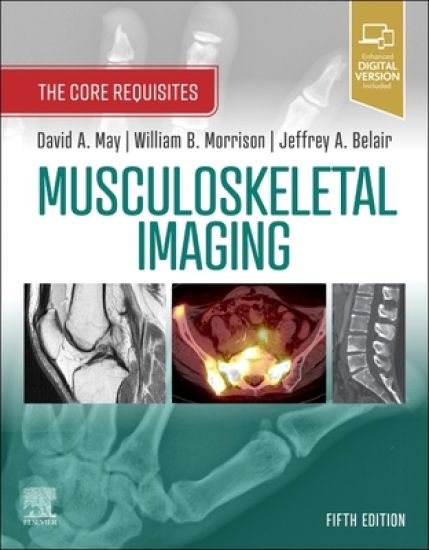
Musculoskeletal Imaging
David A. May; William B. Morrison; Jeffrey A. Belair
Elsevier - Health Sciences Division
2021
nidottu
Focusing on high-yield information, Musculoskeletal Imaging: The Core Requisites, 5th edition emphasizes the basics to help you establish a foundational understanding of musculoskeletal imaging during rotations, prepare for the core and certifying exams, refresh your knowledge of key concepts, and learn strategies to provide "value added? reports to referring clinicians. This completely rewritten and reorganized edition emphasizes the essential knowledge you need in an easy-to-read format. Emphasizes the essentials in a templated, quick-reference format that includes numerous outlines, tables, pearls, boxed material, and bulleted content for easy reading, reference, and recall. Prioritizes and explains the key information that you will be tested on to help you efficiently and effectively prepare for board exams. Helps you build and solidify core knowledge to prepare you for clinical practice with critical, up-to-date information on sports injuries and other trauma, joint diseases, musculoskeletal tumors and infection, bone marrow imaging, pediatric conditions, and basic image-guided musculoskeletal procedures. Includes sample report templates and numerous tips on effective communication of imaging findings. Features more than 1,200 high-quality images spanning the diagnosis of conditions and diseases of the musculoskeletal system. All imaging modalities are covered, including MRI, ultrasound, CT, radiography, and nuclear medicine. Published as part of the newly reimagined Core Requisites series, an update to the popular Requisites series aimed at radiology trainees and today’s busy clinicians. Enhanced eBook version included with purchase. Your enhanced eBook allows you to access all of the text, figures, and references from the book on a variety of devices.

Principles of CASE Tool Integration
Alan W. Brown; David J. Carney; Edwin J. Morris; Dennis B. Smith; Paul F. Zarrella
Oxford University Press Inc
1994
sidottu
Computer Aided Software Engineering tools typically support individual users in the automation of some task within a software development process. Used this way, CASE tools have undoubtedly helped many organisations in their efforts to develop better quality software to budget, within precedented time scales. This book will address the increasing activity within the software engineering community for automated support in the software development process. The authors integrate CASE tools into the overall software life cycle with emphasis on the following factors: scale=size and complexity; lack of maturity=limited expertise; diversity=many classes of users; technology base=extended operating system.

Seeing and Knowing
Blundell Geoffrey; Christopher Chippindale; Clottes Jean; Conkey Margaret W.; Edward B. Eastwood; Francis Julie E.; Helskog Knut; Imogene L. Lim; Loendorf Lawrence L.; Johannes Loubser; David Morris; Sven Ouzman; Neil Price; Saetersdal Tore; Benjamin Smith; Patricia Vinnicombe; Eva Walderhaug; Walker Nick; Whitley David S.
Wits University Press
2010
nidottu
This collection focuses on David Lewis-Williams and the extent of his personal impact on the field of rock art research. It is largely through his work that San rock art has come to be understood so well, as a complex symbolic and metaphoric representation of San religious beliefs and practices. The purpose of this volume is to demonstrate the depth and wide geographical impact of Lewis-Williams' contribution, with particular emphasis on the use of theory and methodology drawn from ethnography that he has used with inspirational effect in understanding the meaning and context of rock art in various parts of the world. Seeing and Knowing explores how best archaeologists study rock art when there exist ethnographic or ethno - historic bases of insight, and how they study rock art when there do not appear to exist ethnographic or ethnohistoric bases of insight - in short, how to understand and learn from rock art with and without ethnography. Because many of the chapters are based on solid fieldwork and ethnographic research, they offer a new body of work that provides the evidence for differentiation between knowing and simply seeing.



David Brown Milne (1882 - 1953) was one of the great artists of his generation in North America, according to the American art critic Clement Greenberg, who compared Milne with John Marin and Marsden Hartley. This comprehensive and fully illustrated Catalogue Raisonné of Milne's paintings is the first catalogue on this scale to be published for any Canadian artist, and it will be a standard for many years to come. The nearly three thousand paintings in oil and watercolour that David Milne produced in his long career are presented here in chronological order. There are also two hundred large-format colour reproducitons of his work. Milne has long been a favourite of artists, art historians, curators, and collectors, and his high intelligence and fine sensibility are evident on every page of this remarkable work. Over a span of more than fifty years Milne devoted himself to painting and also to writing about painting - assessing his achievements against his goals, analysing aesthetic problems, describing a sequence or process, illuminating the origins of his inspiration. He wrote many hundreds of pages of notes, letters, and autobiographical accounts, most of them directly or indirectly about his art. Substantial quotations from his writings make the Catalogue Raisonné a highly readable reference work. Each entry in the catalogue contains a black-and-white reproduction of the work, the basic information about the medium, size, and date, its full provenance and exhibition history, all printed references to it, a complete list of the documents in which it is referred to, and supplementary information, such as comments by the authors, related drawings, and cross-references, as appropriate. Short essays introduce each period of Milne's life, providing useful biographical details and information on the paintings and their subsequent history. The Catalogue Raisonné also contains the major lists of paintings prepared by Milne over the years, key documents for any study of his work. There is a list of nearly six hundred exhibitions in which his work appeared with full details and a 1600-item bibliography. A comprehensive title index is also included.

David B didn't want to go home to Comfy Cove. He wanted to stay up late, like the big boats. As day turned to night, David B sang, "chug-chug-chug" in the moonlight. When the moon set he remembered a tale of boat-eating rocks that would come to life on moonlit nights. In the dark, he hears something. It's not the scary rocks. It's something else