Kirjahaku
Etsi kirjoja tekijän nimen, kirjan nimen tai ISBN:n perusteella.
1000 tulosta hakusanalla David B. Williams
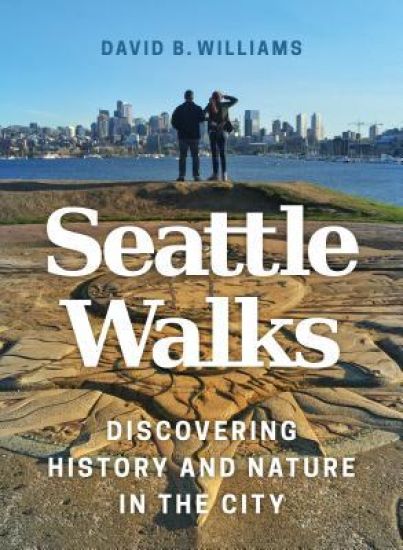
Seattle is often listed as one of the most walkable cities in the United States. With its beautiful scenery, miles of non-motorized trails, and year-round access, Seattle is an ideal place to explore on foot.In Seattle Walks, David B. Williams weaves together the history, natural history, and architecture of Seattle to paint a complex, nuanced, and fascinating story. He shows us Seattle in a new light and gives us an appreciation of how the city has changed over time, how the past has influenced the present, and how nature is all around us—even in our urban landscape.These walks vary in length and topography and cover both well-known and surprising parts of the city. While most are loops, there are a few one-way adventures with an easy return via public transportation. Ranging along trails and sidewalks, the walks lead to panoramic views, intimate hideaways, architectural gems, and beautiful greenways. With Williams as your knowledgeable and entertaining guide, encounter a new way to experience Seattle.A Michael J. Repass Book
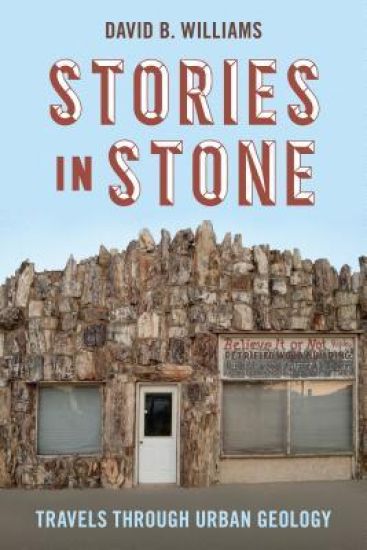
Most people do not think to observe geology from the sidewalks of a major city, but all David B. Williams has to do is look at building stone in any urban center to find a range of rocks equal to any assembled by plate tectonics. In Stories in Stone, he takes you on explorations to find 3.5-billion-year-old rock that looks like swirled pink-and-black taffy, a gas station made of petrified wood, and a Florida fort that has withstood three hundred years of attacks and hurricanes, despite being made of a stone that has the consistency of a granola bar.Williams also weaves in the cultural history of stone, explaining why a white fossil-rich limestone from Indiana became the only building stone used in all fifty states; how in 1825, the construction of the Bunker Hill Monument led to America's first commercial railroad; and why when the same kind of marble used by Michelangelo clad a Chicago skyscraper it warped so much after nineteen years that all 44,000 panels of it had to be replaced. This love letter to building stone brings to life the geology you can see in the structures of every city.
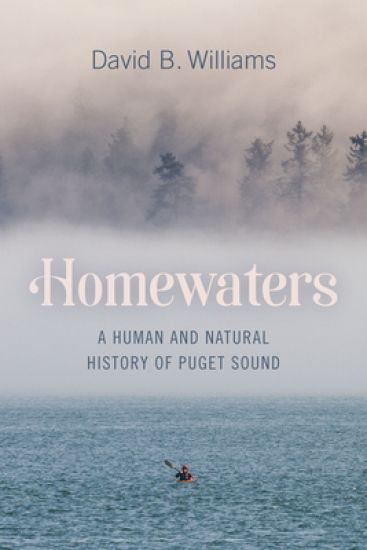
An intimate biography of place and an urgent call to conservationNot far from Seattle skyscrapers live 150-year-old clams, more than 250 species of fish, and underwater kelp forests as complex as any terrestrial ecosystem. For millennia, vibrant Coast Salish communities have lived beside these waters dense with nutrient-rich foods, with cultures intertwined through exchanges across the waterways. Transformed by settlement and resource extraction, Puget Sound and its future health now depend on a better understanding of the region’s ecological complexities.Focusing on the area south of Port Townsend and between the Cascade and Olympic mountains, Williams uncovers human and natural histories in, on, and around the Sound. In conversations with archaeologists, biologists, and tribal authorities, Williams traces how generations of humans have interacted with such species as geoducks, salmon, orcas, rockfish, and herring. He sheds light on how warfare shaped development and how people have moved across this maritime highway, in canoes, the mosquito fleet, and today’s ferry system. The book also takes an unflinching look at how the Sound’s ecosystems have suffered from human behavior, including pollution, habitat destruction, and the effects of climate change.Witty, graceful, and deeply informed, Homewaters weaves history and science into a fascinating and hopeful narrative, one that will introduce newcomers to the astonishing life that inhabits the Sound and offers longtime residents new insight into and appreciation of the waters they call home.A Michael J. Repass Book
An intimate biography of place and an urgent call to conservationNot far from Seattle skyscrapers live 150-year-old clams, more than 250 species of fish, and underwater kelp forests as complex as any terrestrial ecosystem. For millennia, vibrant Coast Salish communities have lived beside these waters dense with nutrient-rich foods, with cultures intertwined through exchanges across the waterways. Transformed by settlement and resource extraction, Puget Sound and its future health now depend on a better understanding of the region's ecological complexities.Focusing on the area south of Port Townsend and between the Cascade and Olympic mountains, Williams uncovers human and natural histories in, on, and around the Sound. In conversations with archaeologists, biologists, and tribal authorities, Williams traces how generations of humans have interacted with such species as geoducks, salmon, orcas, rockfish, and herring. He sheds light on how warfare shaped development and how people have moved across this maritime highway, in canoes, the mosquito fleet, and today's ferry system. The book also takes an unflinching look at how the Sound's ecosystems have suffered from human behavior, including pollution, habitat destruction, and the effects of climate change.Witty, graceful, and deeply informed, Homewaters weaves history and science into a fascinating and hopeful narrative, one that will introduce newcomers to the astonishing life that inhabits the Sound and offers longtime residents new insight into and appreciation of the waters they call home.A Michael J. Repass Book
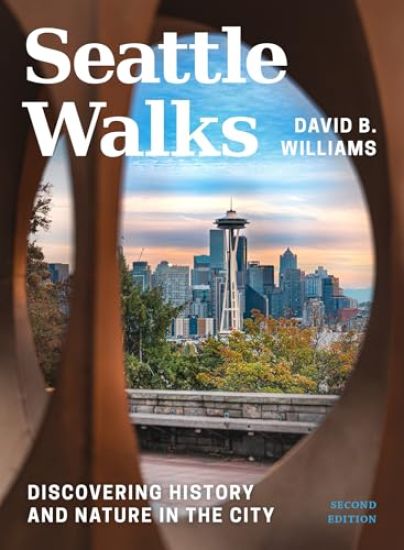
Seattle Walks: Discovering History and Nature in the City
David B. Williams
UNIVERSITY OF WASHINGTON PRESS
2025
nidottu
An updated and expanded new edition of the definitive walking guide to Seattle One of America's most walkable cities, Seattle rewards urban trekkers with expansive scenery and architectural and historical riches. The second edition of this acclaimed guidebook offers eighteen walks chosen for interest and easy accessibility. Williams's compelling stories bring the city to life, revealing often-overlooked details of Seattle's past and present.This guide includes: - easy to follow maps- in-depth descriptions of places tied to map locations- sidebars with additional fun facts and advice on side trips- new walks that focus on the city's social justice historyExtensively revised and illustrated with full-color maps and photographs, this new edition of Seattle Walks is an invitation to lace up your shoes and embark on some unforgettable urban adventures.Seattle Walks was made possible in part by a grant from the Michael J. Repass Fund for Northwest Writers.
Residents and visitors in today's Seattle would barely recognize the landscape that its founding settlers first encountered. As the city grew, its leaders and inhabitants dramatically altered its topography to accommodate their changing visions. In Too High and Too Steep, David B. Williams uses his deep knowledge of Seattle, scientific background, and extensive research and interviews to illuminate the physical challenges and sometimes startling hubris of these large-scale transformations, from the filling in of the Duwamish tideflats to the massive regrading project that pared down Denny Hill.In the course of telling this fascinating story, Williams helps readers find visible traces of the city's former landscape and better understand Seattle as a place that has been radically reshaped.Watch the trailer: https://www.youtube.com/watch?v=af51FU8hHLIToo High and Too Steep was made possible in part by a grant from 4Culture's Heritage Program.
Naturalist and Seattle native David Williams offers his original perspectives on the wonder and resilience of nature in and around the Northwest's greatest population center. Illustrated by hand-drawn maps, Williams's writings are interesting, intelligent, and challenging at a personal level. He approaches the notion that his beloved city, as hip and urbane as it is, remains a wild place on the Northwest landscape-in the quarried rock of the historical buildings, in the branches of a pocket-sized city park, in the twists and turns of a stream that has been abused by polluters, hedged in by lawns, and buried under expressways. And yet it is a living thing, worthy of rescue. Williams looks beyond the skyline, beyond the postcard views of the Emerald City, and into its wild heart. Praise for The Seattle Street-Smart Naturalist: Like suddenly acquiring X-ray vision . . . Who knew that there was so much fascinating natural history crawling, flying, sprouting, flowing, drizzling, cawing, accreting, and sliding within the city limits of Seattle? Every page, every paragraph of Williams's book brought me revelations-not to mention the sheer pleasure of keeping company with such a sharp and enthusiastic writer. - David Laskin Author of The Children's Blizzard and Braving the Elements A passion for nature and the love of a chosen city combine seamlessly in David Williams's sharp-eyed ramble through Seattle. These beautifully told "field notes" of this inspired urban naturalist bring to life our streets and hills, our downtown edifices and suburban green pockets, on levels infinitely more profound than the everyday. - Ivan Doig Author of This House of Sky Raised in Seattle, David Williams is a general naturalist with a bachelor's degree in geology. As a Park Ranger and educator, he has taught natural history both in the field and in the classroom and has written widely on the topic for the last decade. He has written for Sunset, the Seattle Times, High Country News, National Parks, and Geotimes. Other books include A Naturalist's Guide to Canyon Country and Grand Views of Canyon Country, and he has contributed to Insight Guides: Seattle and Caves, Cliffs, and Canyons.
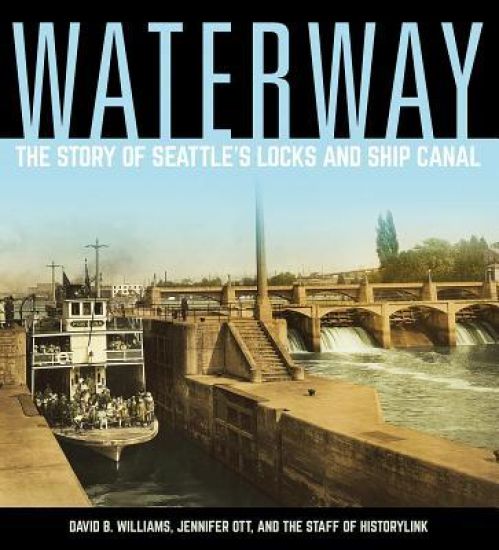
Seattle's Locks and Ship Canal
David B. Williams; Jennifer Ott
UNIVERSITY OF WASHINGTON PRESS
2026
pokkari
Transmission Electron Microscopy
David B. Williams; C. Barry Carter
Springer-Verlag New York Inc.
2009
sidottu
This groundbreaking text has been established as the market leader throughout the world. Profusely illustrated, Transmission Electron Microscopy: A Textbook for Materials Science provides the necessary instructions for successful hands-on application of this versatile materials characterization technique. For this first new edition in 12 years, many sections have been completely rewritten with all others revised and updated. The new edition also includes an extensive collection of questions for the student, providing approximately 800 self-assessment questions and over 400 questions that are suitable for homework assignment. Four-color illustrations throughout also enhance the new edition. Praise for the first edition: `The best textbook for this audience available.' – American Scientist `Ideally suited to the needs of a graduate level course. It is hard to imagine this book not fulfilling most of the requirements of a text for such a course.' – Microscope `This book is written in such a comprehensive manner that it is understandable to all people who are trained in physical science and it will be useful both for the expert as well as the student.' – Micron `The book answers nearly any question - be it instrumental, practical, or theoretical - either directly or with an appropriate reference...This book provides a basic, clear-cut presentation of how transmission electron microscopes should be used and of how this depends specifically on one's specific undergoing project.' – MRS Bulletin, May 1998 `The only complete text now available which includes all the remarkable advances made in the field of TEM in the past 30-40 years....The authors can be proud of an enormous task, very well done.' – from the Foreword by Professor Gareth Thomas, University of California, Berkeley
Transmission Electron Microscopy
David B. Williams; C. Barry Carter
Springer-Verlag New York Inc.
2009
nidottu
This groundbreaking text has been established as the market leader throughout the world. Profusely illustrated, Transmission Electron Microscopy: A Textbook for Materials Science provides the necessary instructions for successful hands-on application of this versatile materials characterization technique. For this first new edition in 12 years, many sections have been completely rewritten with all others revised and updated. The new edition also includes an extensive collection of questions for the student, providing approximately 800 self-assessment questions and over 400 questions that are suitable for homework assignment. Four-color illustrations throughout also enhance the new edition. Praise for the first edition: `The best textbook for this audience available.' – American Scientist `Ideally suited to the needs of a graduate level course. It is hard to imagine this book not fulfilling most of the requirements of a text for such a course.' – Microscope `This book is written in such a comprehensive manner that it is understandable to all people who are trained in physical science and it will be useful both for the expert as well as the student.' – Micron `The book answers nearly any question - be it instrumental, practical, or theoretical - either directly or with an appropriate reference...This book provides a basic, clear-cut presentation of how transmission electron microscopes should be used and of how this depends specifically on one's specific undergoing project.' – MRS Bulletin, May 1998 `The only complete text now available which includes all the remarkable advances made in the field of TEM in the past 30-40 years....The authors can be proud of an enormous task, very well done.' – from the Foreword by Professor Gareth Thomas, University of California, Berkeley
Why does a city surrounded by water need another waterway? Find out what drove Seattle's civic leaders to pursue the dream of a Lake Washington Ship Canal for more than sixty years and what role it has played in the region's development over the past century. Historians Jennifer Ott and David B. Williams, author of Too High and Too Steep: Reshaping Seattle's Topography, explore how industry, transportation, and the very character of the city and surrounding region developed in response to the economic and environmental changes brought by Seattle's canal and locks.
POD 01 The World-Thinker and Other StoriesThis volume might have been titled "The Early Jack Vance", as it features stories from the first dozen years of Vance's career, when his major outlet was pulp magazines. In these stories, Vance already displays the lively imagination and mastery of the English language that came to characterize his entire career.Among the fifteen stories are these: The World-Thinker, Vance's first published story, features two types who would recur often in Vance's writing: the assured and competent hero, and the feisty, equally-competent heroine. They deal with an entity who, like Vance himself, creates fully-formed worlds at will.I'll Build Your Dream Castle is the first occurrence of a theme that also would appear again: the tension between those who buy and those who sell; in this case, houses.DP was written shortly after World War II, when refugees and victims of the carnage and upheaval were constantly in the news. Here, the 'displaced persons' are a hominid species driven from their homes by geological catastrophe.Seven Exits from Bocz is also informed by the horrors of the second War.The Foreword to this volume is written by Vance scholar David B. Williams, who presents a thorough overview of Vance's entire career, from the promising beginnings presented here, to the masterpieces that would earn him the SFWA Grandmaster award in 1997 and a place in the Science Fiction Hall of Fame.The World-Thinker and Other Stories is Volume 1 of the Spatterlight Press Signature Series.Released in the centenary of the author's birth, this handsome new collectionis based upon the prestigious Vance Integral Edition. Select volumes enjoyup-to-date maps, and many are graced with freshly-written forewords contributedby a distinguished group of authors. Each book bears a facsimile of theauthor's signature and a previously-unpublished photograph, chosen from family archives for the period the book was written. These uniquefeatures will be appreciated by all, from seasoned Vance collector to new reader sampling the spectrum of this author's influential work forthe first time. - John Vance II
Investigation into basic and advanced peptide design, synthesis, evaluation and utilization. New therapeutic approaches from experimental systems.
The Design of Approximation Algorithms
David P. Williamson; David B. Shmoys
Cambridge University Press
2011
sidottu
Discrete optimization problems are everywhere, from traditional operations research planning (scheduling, facility location and network design); to computer science databases; to advertising issues in viral marketing. Yet most such problems are NP-hard; unless P = NP, there are no efficient algorithms to find optimal solutions. This book shows how to design approximation algorithms: efficient algorithms that find provably near-optimal solutions. The book is organized around central algorithmic techniques for designing approximation algorithms, including greedy and local search algorithms, dynamic programming, linear and semidefinite programming, and randomization. Each chapter in the first section is devoted to a single algorithmic technique applied to several different problems, with more sophisticated treatment in the second section. The book also covers methods for proving that optimization problems are hard to approximate. Designed as a textbook for graduate-level algorithm courses, it will also serve as a reference for researchers interested in the heuristic solution of discrete optimization problems.
The Proceedings of the Unitarian Historical Society V13, Part 2, 1961
David B. Parke; Conrad Wright; George H. Williams
Literary Licensing, LLC
2011
nidottu