Kirjojen hintavertailu. Mukana 11 244 527 kirjaa ja 12 kauppaa.

Kirjahaku

Etsi kirjoja tekijän nimen, kirjan nimen tai ISBN:n perusteella.

1000 tulosta hakusanalla David C. Cassidy

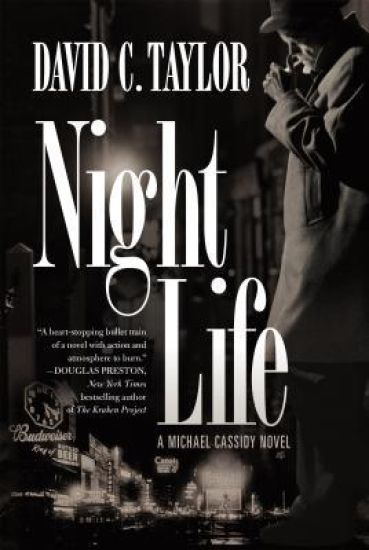
Night Life: A Michael Cassidy Novel
David C. Taylor's Night Life, a 2016 Mystery Writers of America Edgar Award Nominee for Best Novel, takes us back to New York City in 1954.The Cold War is heating up. Senator Joe McCarthy is running a witch hunt for Communists in America. The newly formed CIA is fighting a turf battle with the FBI to see who will be the primary US intelligence agency. And the bodies of murdered young men are turning up in the city.Michael Cassidy has an unusual background for a New York cop. His father, a refugee from Eastern Europe, is a successful Broadway producer. His godfather is Frank Costello, a Mafia boss. Cassidy also has an unusual way of going about the business of being a cop-maybe that's why he threw a fellow officer out a third story window of the Cortland Hotel.Cassidy is assigned to the case of Alexander Ingram, a Broadway chorus dancer found tortured and dead in his apartment in Hell's Kitchen. Complications grow as other young men are murdered one after the other. And why are the FBI, the CIA, and the Mafia interested in the death of a Broadway gypsy?Meanwhile, a mysterious, beautiful woman moves into Cassidy's building in Greenwich Village. Is Dylan McCue a lover or an enemy? Cassidy is plagued by nightmares-dreams that sometimes become reality. And he has been dreaming that someone is coming to kill him.
J. Robert Oppenheimer

J. Robert Oppenheimer

David C. Cassidy

Pi Pr
2004
sidottu
How did a gentle liberal humanist become responsible for the creation of the first real weapon of mass destruction? How could a brilliant mind like his virtually found "scientific militarism" and then let it destroy him? Cassidy opens up a life story that is emblematic of the transformation of America over the last three generations.
A Short History of Physics in the American Century

A Short History of Physics in the American Century

David C. Cassidy

Harvard University Press
2013
nidottu
As the twentieth century drew to a close, computers, the Internet, and nanotechnology were central to modern American life. Yet the advances in physics underlying these applications are poorly understood and widely underappreciated by U.S. citizens today. In this concise overview, David C. Cassidy sharpens our perspective on modern physics by viewing this foundational science through the lens of America's engagement with the political events of a tumultuous century.American physics first stirred in the 1890s-around the time x-rays and radioactivity were discovered in Germany-with the founding of graduate schools on the German model. Yet American research lagged behind the great European laboratories until highly effective domestic policies, together with the exodus of physicists from fascist countries, brought the nation into the first ranks of world research in the 1930s. The creation of the atomic bomb and radar during World War II ensured lavish government support for particle physics, along with computation, solid-state physics, and military communication. These advances facilitated space exploration and led to the global expansion of the Internet.Well into the 1960s, physicists bolstered the United States' international status, and the nation repaid the favor through massive outlays of federal, military, and philanthropic funding. But gradually America relinquished its postwar commitment to scientific leadership, and the nation found itself struggling to maintain a competitive edge in science education and research. Today, American physicists, relying primarily on industrial funding, must compete with smaller, scrappier nations intent on writing their own brief history of physics in the twenty-first century.
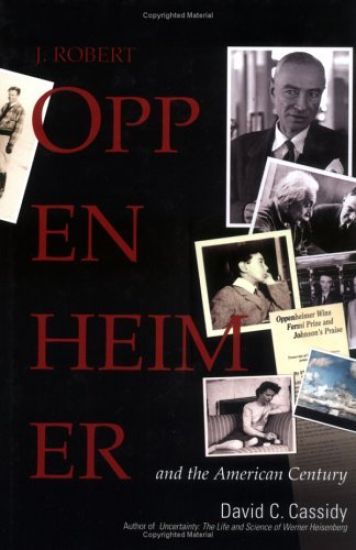
J. Robert Oppenheimer and the American Century

J. Robert Oppenheimer and the American Century

David C. Cassidy

Johns Hopkins University Press
2009
pokkari
David C. Cassidy's celebrated biography is more than the life story of J. Robert Oppenheimer, the brilliant physicist who served as scientific director for the Manhattan Project. It also tells the hidden story of the political and social forces that shaped the world in the 20th century, when the rise of American science contributed mightily to the country's emergence as a dominant power in world affairs. Cassidy explores that strong relationship in the captivating story of the rise and fall of one of America's greatest scientists. As head of the Manhattan Project, Oppenheimer led the country's successful effort to build the first atom bomb during World War II. In 1954 the government-with the United States embroiled in the Cold War-stripped him of his security clearance amid allegations that he consorted with communists. In rich detail Cassidy places this personal story of public disgrace within the larger narrative of the rise of science in America.
Beyond Uncertainty

Beyond Uncertainty

David C. Cassidy

Bellevue Literary Press
2010
pokkari
"A fascinating, well-documented biography." --New York Times Book Review "A monumental effort." --New York Review of Books "An excellent piece of science writing...Cassidy does not so much exculpate Heisenberg as explain him, with a transparency that makes this biography a pleasure to read." --Los Angeles Times "Cassidy has written the definitive biography of a great and tragic physicist." --Richard Rhodes, author of the Pulitzer Prize--winning The Making of the Atomic Bomb Since the fall of the Soviet Union, long-suppressed information has emerged on Werner Heisenberg's role in the Nazi atomic bomb project. In Beyond Uncertainty, Cassidy interprets this and other previously unknown material within the context of his vast research and tackles the vexing questions of a scientist's personal responsibility and guilt when serving an abhorrent military regime. David C. Cassidy is the author of Beyond Uncertainty: Heisenberg, Quantum Physics, and the Bomb; A Short History of Physics in the American Century; J. Robert Oppenheimer and the American Century; and Einstein and Our World. He is the recipient of the Abraham Pais Prize for History of Physics from the American Physical Society, the Science Writing Award from the American Institute of Physics, the Pfizer Award from the History of Science Society, and an honorary doctorate from Purdue University. Dr. Cassidy is Professor of Natural Sciences at Hofstra University and resides in Bay Shore, New York.
Farm Hall and the German Atomic Project of World War II

Farm Hall and the German Atomic Project of World War II

David C. Cassidy

Springer International Publishing AG
2017
sidottu
This gripping book brings back to life the events surrounding the internment of ten German Nuclear Scientists immediately after World War II. It is also an "eye-witness" account of the dawning of the nuclear age, with the dialogue and narrative spanning the period before, during and after atomic bombs were dropped on Japan at the end of the war. This pivotal historical episode is conveyed, along with the emotions as well as the facts, through drama, historical narrative, and photographs of the captive German nuclear scientists - who included Werner Heisenberg, Otto Hahn, and Max von Laue. The unique story that unfolds in the play is based on secretly recorded transcripts of the scientists’ actual conversations at Farm Hall, together with related documents and photographs.
Farm Hall and the German Atomic Project of World War II

Farm Hall and the German Atomic Project of World War II

David C. Cassidy

Springer International Publishing AG
2018
nidottu
This gripping book brings back to life the events surrounding the internment of ten German Nuclear Scientists immediately after World War II. It is also an "eye-witness" account of the dawning of the nuclear age, with the dialogue and narrative spanning the period before, during and after atomic bombs were dropped on Japan at the end of the war. This pivotal historical episode is conveyed, along with the emotions as well as the facts, through drama, historical narrative, and photographs of the captive German nuclear scientists - who included Werner Heisenberg, Otto Hahn, and Max von Laue. The unique story that unfolds in the play is based on secretly recorded transcripts of the scientists’ actual conversations at Farm Hall, together with related documents and photographs.
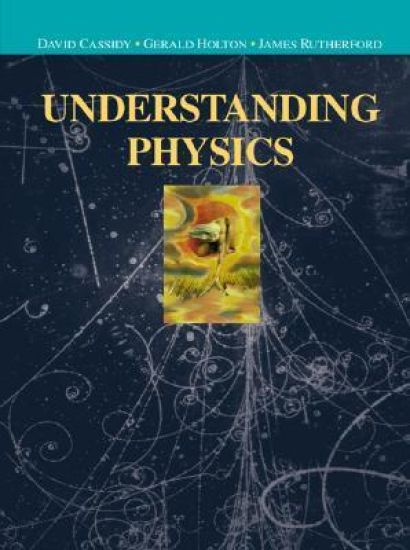
Understanding Physics

Understanding Physics

David C. Cassidy; Gerald Holton; F. James Rutherford

Springer-Verlag New York Inc.
2002
sidottu
Understanding Physics provides a thorough grounding in contemporary physics while placing physics into its social and historical context. Based in large part on the highly respected Project Physics Course developed by two of the authors, it also integrates the results of recent pedagogical research. The text thus: - teaches about the basic phenomena in the physical world and the concepts developed to explain them - shows that science is a rational human endeavor with a long and continuing tradition, involving many different cultures and people - develops facility in critical thinking, reasoned argumentation, evaluation of evidence, mathematical modeling, and ethical values The treatment emphasizes not only what we know but also how we know it, why we believe it, and what effects that knowledge has: - Why do we believe the Earth and planets revolve around the Sun? - Why do we believe that matter is made of atoms? - How do relativity theory and quantum mechanics alter our conception of Nature and in what ways do they leave the classical concepts unchanged? - What impact does the knowledge of finite energy resources have on our society? - How have applications of fundamental science (such as the steam engine, the laser, the electric generator, the transistor) affected our lives? - How does the evidence for non-scientific ideas, such as UFOs, ESP, and the like, differ from the evidence for accepted scientific results?
Understanding Physics

Understanding Physics

David C. Cassidy; Gerald Holton; F. James Rutherford

Springer-Verlag New York Inc.
2013
nidottu
Understanding Physics provides a thorough grounding in contemporary physics while placing physics into its social and historical context. Based in large part on the highly respected Project Physics Course developed by two of the authors, it also integrates the results of recent pedagogical research. The text thus: - teaches about the basic phenomena in the physical world and the concepts developed to explain them - shows that science is a rational human endeavor with a long and continuing tradition, involving many different cultures and people - develops facility in critical thinking, reasoned argumentation, evaluation of evidence, mathematical modeling, and ethical values The treatment emphasizes not only what we know but also how we know it, why we believe it, and what effects that knowledge has: - Why do we believe the Earth and planets revolve around the Sun? - Why do we believe that matter is made of atoms? - How do relativity theory and quantum mechanics alter our conception of Nature and in what ways do they leave the classical concepts unchanged? - What impact does the knowledge of finite energy resources have on our society? - How have applications of fundamental science (such as the steam engine, the laser, the electric generator, the transistor) affected our lives? - How does the evidence for non-scientific ideas, such as UFOs, ESP, and the like, differ from the evidence for accepted scientific results?
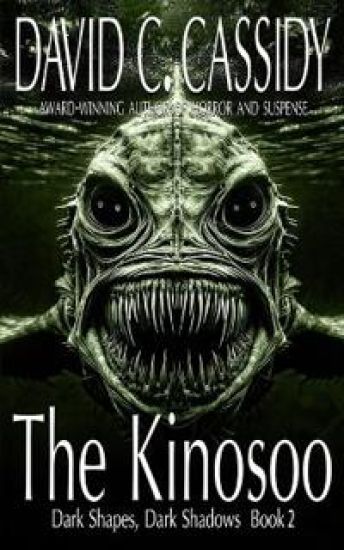
The Kinosoo

The Kinosoo

David C Cassidy

Library and Archives Canada
2024
pokkari
Real legend. Real monster. Real nightmare. Recently widowed with two young children, Joel Carter uproots his family and returns to his quiet hometown of Cold Lake to start over. But his new country life in the Northern Alberta wilderness isn't the breath of fresh air that it should be. The dreary woods behind his home are eerily silent, not a bird or an animal in sight; the knobby trees are diseased, twisted, and ugly. And when he encounters a dark, foul-smelling pond that has seemingly appeared out of nowhere, a freak accident leaves him possessed by the mysterious powers of an impossible sea monster-what he had always believed was just an old Cree legend. He soon discovers that the "Kinosoo" is not only real, but far more menacing than the creature of lore-and far more terrifying than he could ever imagine: He's become a deadly pawn to its will, a will fueled by insatiable hunger. And now that it has him, no one is safe from its lust for live meat ... not even his children. "Grabbed me by the throat and didn't let go."★★★★★ - Amazon Reviewer If you're a fan of legendary creatures like the Loch Ness Monster-and grisly tales of underwater nightmares you'd not like to meet-you'll love The Kinosoo. Don't miss this chilling twist on the real-life legend of Cold Lake's monster of the deep, from award-winning author David C. Cassidy. Get The Kinosoo today and discover the astonishing secret of the horror that lurks below. The BUZZ "A twisted, horrifying tale that takes hold of you, and you won't want to put it down "★★★★★ - Amazon Reviewer David C. Cassidy is an award-winning author, the twisted mind behind several chilling books of horror and suspense. If you're a fan of Stephen King, Dean Koontz, or Clive Barker and love horror with unforgettable characters in epic stories that draw you in and won't let go-stories that haunt you long after the final page-you won't want to miss his incredibly rich storytelling.
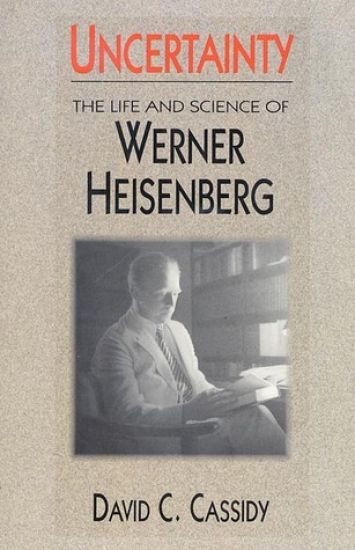
Uncertainty

Uncertainty

Cassidy David C.

Macmillan Learning
1994
nidottu
David Cassidy's portrait of this brilliant, ambitious and controversial scientist is the definitive Heisenberg biography. "An absorbing new biography of Werner Heisenberg ..." The Sunday Telegraph "Uncertainty is an exquisite book." Nature "...well balanced and exciting reading. Uncertainty is an excellent work which combines meticulous scholarship with a presentation freed of intellectual jargon and unnecessary scientific details. I see its merits first of all in its comprehensiveness and accuracy, and next in its success in recreating the personal drama of one of the greatest and most influential scientists of this century." Times HigherEducation Supplement
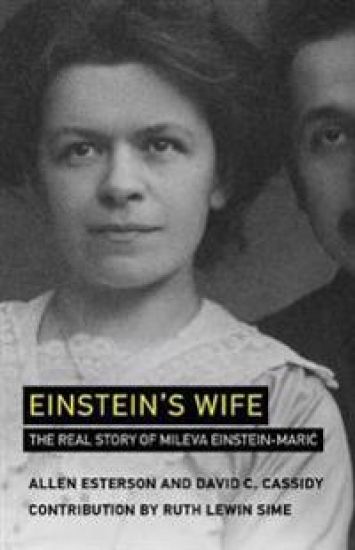
Einstein's Wife

Einstein's Wife

Allen Esterson; David C. Cassidy

MIT Press
2020
pokkari
Was Einstein's first wife his uncredited coauthor, unpaid assistant, or his unacknowledged helpmeet? The real "Mileva Story."Albert Einstein's first wife, Mileva Einstein-Maric, was forgotten for decades. When a trove of correspondence between them beginning in their student days was discovered in 1986, her story began to be told. Some of the tellers of the "Mileva Story" made startling claims: that she was a brilliant mathematician who surpassed her husband, and that she made uncredited contributions to his most celebrated papers in 1905, including his paper on special relativity. This book, based on extensive historical research, uncovers the real "Mileva Story." Mileva was one of the few women of her era to pursue higher education in science; she and Einstein were students together at the Zurich Polytechnic. Mileva's ambitions for a science career, however, suffered a series of setbacks-failed diploma examinations, a disagreement with her doctoral dissertation adviser, an out-of-wedlock pregnancy by Einstein. She and Einstein married in 1903 and had two sons, but the marriage failed. Was Mileva her husband's uncredited coauthor, unpaid assistant, or his essential helpmeet? It's tempting to believe that she was her husband's secret collaborator, but the authors of Einstein's Wife look at the actual evidence, and a chapter by Ruth Lewin Sime offers important historical context. The story they tell is that of a brave and determined young woman who struggled against a variety of obstacles at a time when science was not very welcoming to women.
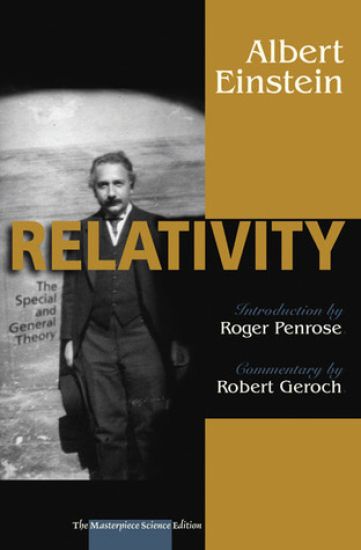
Relativity

Relativity

Albert Einstein; Penrose Roger; Geroch Robert; David C. Cassidy

Pi Press
2005
sidottu
Robert Geroch builds on Einstein's work with commentary that addresses the ideas at the heart of the theory, bringing a modern understanding of relativity to the text. He elucidates how special relativity is a reconciliation of the contradictions between the nature of light and the principle of relativity; he expands on Einstein's treatment of the geometry of space-time and the fundamental notion of an "event"; he explains in detail, but without technical language, the equivalence of inertial and gravitational mass, a cornerstone of general relativity.
Tales from the Canyons of the Damned 31

Tales from the Canyons of the Damned 31

Hunter C. Eden; D. K. Cassidy; David Alan Jones

Holt Smith Ltd
2019
nidottu
This thirty-first issue of Tales from the Canyons of the Damned consists of five sharp, suspenseful, thought provoking short stories-each from a different featured master of speculative fiction.Fortune Cookies by Hunter C. EdenThat Time of Year by D.K. CassidyThe Pairing Witch by David Alan JonesSimilar by Holly Heisey#Eddie_and_June by Daniel Arthur SmithTales from the Canyons of the Damned (canyonsofthedamned.com) is a dark science fiction, horror, & slipstream magazine we've been working on since 2015. What is Dark Science Fiction and Horror? Think of it as a literary Twilight Zone, Night Gallery, or Outer Limits, it's Netflix's Black Mirror and Amazon's Electric Dreams in the short story format. And it's a bargain. Each monthly issue has three-to-five sharp, suspenseful, satirical tales from today's top speculative fiction writers.These are Dark Sci Fi Slipstream Tales like you've never read before.
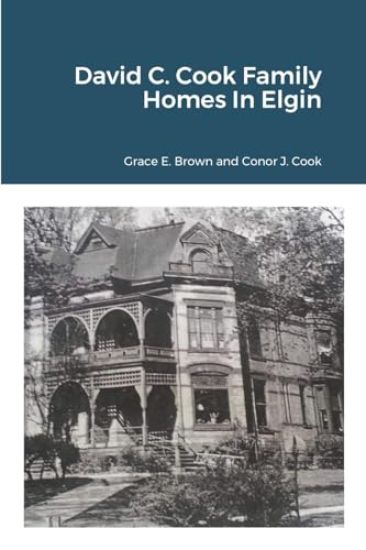
David C. Cook Family Homes In Elgin

David C. Cook Family Homes In Elgin

Grace E Brown; Conor J Cook

Lulu.com
2021
pokkari
In July 2021 I met with the authors of this unique volume - Conor Cook and Grace Brown. This was an unusual interview with a pair of authors. We met in the home of my son, Bruce Cook and reminisced over extracts from historical collections about homes of the David C. Cook family - my father David C. Cook III, my Grandfather David C. Cook II, and my Great Grandfather - David C. Cook I -often called "The Friend of the Sunday School." Now, to be honest, Conor and Grace are my grandchildren, and I love their talent for writing. And, while we got together to share historical vignettes, I should mention that we also enjoyed my son's barbeque cooking and a plate of cookies just prepared by his wife and my daughter, Helen Brown. And, thanks to my wife, Mary Homeier Cook, for suggesting this book.