Kirjojen hintavertailu. Mukana 11 244 527 kirjaa ja 12 kauppaa.

Kirjahaku

Etsi kirjoja tekijän nimen, kirjan nimen tai ISBN:n perusteella.

1000 tulosta hakusanalla David C. Mohrmann

Water Falling: Stories for Travelers

Water Falling: Stories for Travelers

David C. Mohrmann

Wildwinds Publishing
2018
nidottu
A person can hop from place to place and never move a psychic inch. Traveling insists that we stay open to the world, and open means vulnerable. FALLING WATER is a journey to many different countries: The United States, Mexico, Guatemala, Chile (Easter Island), Thailand, Laos, and India. Like the travelers in these stories, readers will find surprises along the way. Among other things, there are sacred monkeys, sacrificial goats, wild dogs, and wolves. There are gypsies and gangsters; ancient ruins and temples; a soul cave, a holy mountain, and the threat of vengeful gods. But for every curse there is a blessing. For every pinch of fear, a hand of hope. From beginning to end, this is a voyage of the mind in search of heart and spirit. Travel is a journey through alternate realities, where borders blur and our experience depends on how we define it. FALLING WATER contains dreamlike scenarios with complex characters. There are engaging storylines, mystical encounters, and an absence of clear conclusions. As with dreams, the significance of these stories is not in the destinations, but in who you are as you approach the journey. -Will Phillips, author of Every Dreamer's Handbook David Mohrmann lives in Northern California, much of the time in his own backyard, where he also does a lot of traveling. His first novel (XOCOMIL...The Winds of Atitl n) was published in 2016.

David C. Cook Family Homes In Elgin

David C. Cook Family Homes In Elgin

Grace E Brown; Conor J Cook

Lulu.com
2021
pokkari
In July 2021 I met with the authors of this unique volume - Conor Cook and Grace Brown. This was an unusual interview with a pair of authors. We met in the home of my son, Bruce Cook and reminisced over extracts from historical collections about homes of the David C. Cook family - my father David C. Cook III, my Grandfather David C. Cook II, and my Great Grandfather - David C. Cook I -often called "The Friend of the Sunday School." Now, to be honest, Conor and Grace are my grandchildren, and I love their talent for writing. And, while we got together to share historical vignettes, I should mention that we also enjoyed my son's barbeque cooking and a plate of cookies just prepared by his wife and my daughter, Helen Brown. And, thanks to my wife, Mary Homeier Cook, for suggesting this book.
An Analysis of David C. Kang's China Rising

An Analysis of David C. Kang's China Rising

Matteo Dian

Macat International Limited
2017
nidottu
A critical analysis of David C. Kang’s China Rising, which is a fine example of an author making use of creative thinking skills to reach a conclusion that flies in the face of traditional thinking.The conventional view that the book opposed, known in international relations as ‘realism,’ was that the rise of any new global power results in global or regional instability. As such, China’s development as a world economic powerhouse worried mainstream western geopolitical scholars, whose concerns were based on the realist assumption that individual countries will inevitably compete for dominance. Evaluating these arguments, and finding both their relevance and adequacy wanting, Kang instead turned traditional thinking on its head by looking at Asian history without preconceptions, and with analytical open-mindedness.Producing several novel explanations for existing evidence, Kang concludes that China’s neighbors do not want to compete with it in the way that realist interpretations predict. Rather than creating instability by jockeying for position, he argues, surrounding countries are happy for China to be acknowledged as a leader, believing that its dominant position will stabilize Asia, and give the whole region more of a hand in international relations. Though critics have taken issue with Kang’s conclusions, his paradigm-shifting approach is nevertheless an excellent example of developing fresh new conclusions through creative thinking.
Fifty-five Years of the David C. Cook Publishing Company
In early 1970's Bruce L. Cook, eldest son of David C. III, was given 16 typewritten pages by Earl Heindel. It was explained that he had acted as informal historian for the company and wanted his history to be given to a family member so it would not be lost. Now that Earl is gone and the main offices of the company have moved away from Elgin, Bruce wanted to make this history (and a few images) available to the many former employees and their families who retired and/or remained in Elgin. The text is supplemented with an index (including many employee names) and photos. Many current and former employees will enjoy Earl's treasure trove of memories.
Broderick: The Life and Death of David C. Broderick

Broderick: The Life and Death of David C. Broderick

James Emmett Thompson

Createspace Independent Publishing Platform
2017
nidottu
More than any other man, United States Senator David Broderick was the man responsible for keeping California from seceding at the outbreak of the Civil War. Broderick was a political enigma, a contradiction. In New York in the 1840s, he was, in turn, an apprentice stonemason, a volunteer fireman, and the keeper of a saloon that was a meeting place for political radicals. Following the gold rush to San Francisco in 1849, Broderick became the first leader of the California state senate. He stood up for the rights of the common people, the city's Irish and German immigrants. With their support, he built a political machine powerful enough to topple William McKendree Gwin, the leader of the Chivalry, the aristocratic transplanted Southern gentlemen who dominated California politics in the years before the Civil War. As a politician, Broderick was thoroughly corrupt. He sold political offices, demanded kickbacks from aspiring candidates, and employed a gang of toughs to battle his opponents, enforce party discipline, and stuff ballot boxes. San Francisco's Committee of Vigilance of 1856 exiled his goons. However, in 1857, the resilient Broderick still had enough clout to convince the state legislature to elect him to the Senate of the United States. But David Broderick was much more than just another corrupt politician. He was also a man of courage and principle. Broderick was on the right side of the defining social issue of his day, human slavery, which he saw as an immoral, cruel anachronism. Things came to a head over the admission of Kansas in the late 1850s, when the President, James Buchanan, and his powerful supporters, tried to use the Lecompton constitution to force slavery down the throats of the unwilling settlers of Kansas Territory. Broderick was so outspoken in his opposition that by 1859, he found himself in the cross hairs of fire eaters, men like California's Chief Justice, David S. Terry, who were willing to gun down anybody who spoke out against the extension of slavery. These men came to believe that David Broderick had to be silenced if California were to follow their dream and secede from the Union.
The Reminiscences of Vice Adm. David C. Richardson, USN (Ret.)
After growing up in Mississippi, Richardson attended the Naval Academy, where he was on the boxing team. Following his graduation in 1936, he served as a junior officer in the battleship USS Tennessee (BB-43), and was on board when she went aground in San Francisco in 1937. He completed flight training in 1940 and reported to Fighting Squadron Five; the squadron was at times in USS Saratoga (CV-3), USS Ranger (CV-4), USS Yorktown (CV-5), and USS Wasp (CV-7). He flew F3Fs and F4Fs, including combat in the latter during the Guadalcanal campaign in 1942. Later in the war he was involved in tactical aviation training in Florida and carrier group readiness training in Hawaii. After the war Richardson studied at the Royal Navy Staff College in London, later at the U.S. Naval War College, where he helped write analyses of wartime battles. He commanded Carrier Air Group 13 in the USS Princeton (CV-37), helped plan for the NATO military structure, and then was XO of the escort carrier USS Badoeng Strait (CVE-116) off Korea. After duty in aviation planning for ComAirPac and OP-05, he was on the CinCSouth staff in Naples, then commanded the oiler USS Cimarron (AO-22) and ASW carrier USS Hornet (CVS-12). He had a tour from 1961 to 1964 in the OP-06 organization in OpNav, then served as Commander Fleet Air Norfolk during his first flag tour. In 1966 Admiral David McDonald, the CNO, chose Richardson to command Task Force 77 during carrier air strikes against North Vietnam. In that billet, Richardson did much to integrate intelligence, planning, and operations. After a tour as Assistant DCNO (Air), he served as Commander Sixth Fleet in the Mediterranean, 1968-70. That tour was notable for Richardson's role in creating the Ocean Surveillance Information System to monitor Soviet naval operations. His final active tour was as Deputy CinCPacFlt prior to his retirement in 1972. Since that time he has remained quite active in various roles in connection with the naval intelligence community.
The Reminiscences of Vice Adm. David C. Richardson, USN (Ret.)
After growing up in Mississippi, Richardson attended the Naval Academy, where he was on the boxing team. Following his graduation in 1936, he served as a junior officer in the battleship USS Tennessee (BB-43), and was on board when she went aground in San Francisco in 1937. He completed flight training in 1940 and reported to Fighting Squadron Five; the squadron was at times in USS Saratoga (CV-3), USS Ranger (CV-4), USS Yorktown (CV-5), and USS Wasp (CV-7). He flew F3Fs and F4Fs, including combat in the latter during the Guadalcanal campaign in 1942. Later in the war he was involved in tactical aviation training in Florida and carrier group readiness training in Hawaii. After the war Richardson studied at the Royal Navy Staff College in London, later at the U.S. Naval War College, where he helped write analyses of wartime battles. He commanded Carrier Air Group 13 in the USS Princeton (CV-37), helped plan for the NATO military structure, and then was XO of the escort carrier USS Badoeng Strait (CVE-116) off Korea. After duty in aviation planning for ComAirPac and OP-05, he was on the CinCSouth staff in Naples, then commanded the oiler USS Cimarron (AO-22) and ASW carrier USS Hornet (CVS-12). He had a tour from 1961 to 1964 in the OP-06 organization in OpNav, then served as Commander Fleet Air Norfolk during his first flag tour. In 1966 Admiral David McDonald, the CNO, chose Richardson to command Task Force 77 during carrier air strikes against North Vietnam. In that billet, Richardson did much to integrate intelligence, planning, and operations. After a tour as Assistant DCNO (Air), he served as Commander Sixth Fleet in the Mediterranean, 1968-70. That tour was notable for Richardson's role in creating the Ocean Surveillance Information System to monitor Soviet naval operations. His final active tour was as Deputy CinCPacFlt prior to his retirement in 1972. Since that time he has remained quite active in various roles in connection with the naval intelligence community.
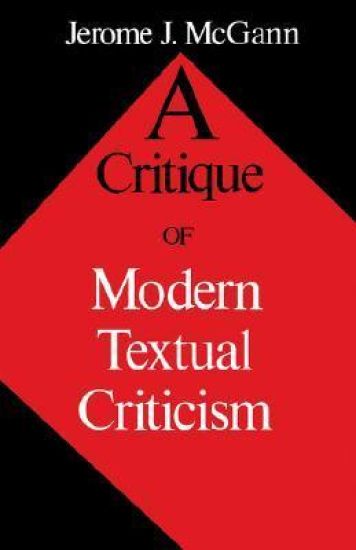
A Critique of Modern Textual Criticism, Foreword by David C Greetham
This work initiated a major shift in literary theory and method when it was first published in 1983. Starting from a critical inquiry into certain specialised issues in the practice of editing, "A Critique of Modern Textual Criticism" gradually unfolds an argument for a general revaluation of the grounds of literary study as a whole. McGann's point of departure is the controversy he opens with the once-dominant line of traditional textual and editorial scholarships as it evolved through the fundamental work of W.W. Greg, Fredson Bowers and G. Thomas Transelle. In departing from the canonical approach to the technical question of copy-text, McGann argues that theory of text must ground itself in a recovery of the entire productive and reproductive history of the text. His book proposes combining literary criticism and bibliographical scholarship with social, institutional and collaborative models of creation and production. Although focused on cases located in the past 200 years, "A Critique of Modern Textual Criticism" has had a wide-ranging influence on the scholarship of all literary periods. It is one of the seminal works of modern textual theory.
Does David Still Play Before You?

Does David Still Play Before You?

David C. Jacobson

Wayne State University Press
1997
sidottu
Exploring the ways that contemporary Israeli poets have made use of images from the Bible in their poetry, this work features close readings of 50 poems from poets such as Amir Gilboa, T. Carmi and Nathan Yonathan. They are presented in their original Hebrew and in English translation.
The Book of David

The Book of David

David C Sharp

Page Publishing, Inc.
2021
pokkari
From the late 1970s to the early 1980s, I committed my thoughts to paper almost daily. This period started with my self-separation from both my birth families and commenced with my becoming a registered nurse after graduating from the nursing program at the City College of San Francisco.Although I have shared some of what I wrote with a few people, I never wrote anything with the intention of anyone else ever seeing it.I recently rediscovered, after about forty years, what I had written and felt that others might benefit from the thoughts I had once committed to paper. So whoever you are and wherever you may be, may these thoughts help you get from where you are to where you want to be.
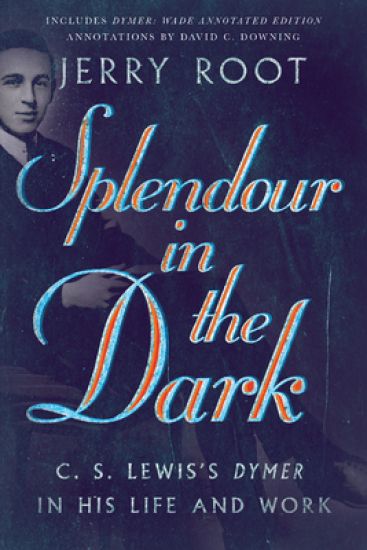
Splendour in the Dark – C. S. Lewis`s Dymer in His Life and Work
Several years before he converted to Christianity, C. S. Lewis published a narrative poem, Dymer, under the pseudonym Clive Hamilton. Later, of course, Lewis became well known for his beloved imaginative stories, such as The Chronicles of Narnia and Till We Have Faces, as well as his ability to defend and articulate the faith in works such as Mere Christianity. But what about his literary work before his conversion? In this Hansen Lectureship volume, Jerry Root contends that Lewis's early poem Dymer can not only shed light on the development of Lewis's literary skills but also offer a glimpse of what was to come in his intellectual and spiritual growth—a "splendour in the dark," to borrow one of Lewis's own lines from the poem. Under Root's careful analysis, Dymer becomes a way to understand both Lewis's change of mind as well as the way in which each of us is led on a journey of faith. This volume also includes the complete text of Dymer with annotations from David C. Downing, co-director of the Marion E. Wade Center. Based on the annual lecture series hosted at Wheaton College's Marion E. Wade Center, volumes in the Hansen Lectureship Series reflect on the imaginative work and lasting influence of seven British authors: Owen Barfield, G. K. Chesterton, C. S. Lewis, George MacDonald, Dorothy L. Sayers, J. R. R. Tolkien, and Charles Williams.