Kirjojen hintavertailu. Mukana 11 238 394 kirjaa ja 12 kauppaa.

Kirjahaku

Etsi kirjoja tekijän nimen, kirjan nimen tai ISBN:n perusteella.

1000 tulosta hakusanalla David H. Price

Johannes Reuchlin and the Campaign to Destroy Jewish Books

Johannes Reuchlin and the Campaign to Destroy Jewish Books

David H. Price

Oxford University Press Inc
2011
sidottu
This study reconstructs the history of a significant crisis in Christian-Jewish relations: the attempt to confiscate and destroy all Jewish books in Renaissance Germany. This unprecedented effort to end the practice of Judaism throughout the empire was challenged by Jewish communities and also, in an unexpected move, by Johannes Reuchlin (1455-1522), the founder of Christian Hebrew studies. Reuchlin had revolutionized the Christian study of the Bible with his Hebrew grammar. In 1510 he published an extensive, impassioned, and successful defense of Jewish writings and Jewish legal rights against the book pogrom, later acknowledged by Josel of Rosheim, the leader of German Jewry, as a ''miracle within a miracle.'' The fury that greeted Reuchlin's defense of Judaism resulted in a protracted heresy trial that polarized Europe, ultimately fostering a receptive environment for the nascent Reformation movement. The legal and theological battle over charges that Reuchlin's opinions were "impermissibly favorable to Jews," a conflict that elicited intervention on both sides from the most powerful political and intellectual leaders throughout Renaissance Europe, formed a new context for Christian reflection on the status of Judaism. David Price offers insight into important new Christian discourses on Judaism and anti-Semitism that emerged from the clash of Renaissance humanism with this potent anti-Jewish campaign, as well as an innovative analysis of Luther's virulent anti-Semitism in the context and aftermath of the Reuchlin Affair. His book is a valuable contribution to study of an important and complex development in European history: Christians acquiring accurate knowledge of Judaism and its history.

Defending Judaism

Defending Judaism

David H. Price

OXFORD UNIVERSITY PRESS INC
2025
sidottu
Defending Judaism: Jewish Writing and Religious Toleration in Early Modern Europe explores the decisive contributions of Jewish writers to the expansion of religious toleration during the period 1600-1789. A key breakthrough for this development was the emergence of charismatic Jewish scholars who galvanized Christian audiences, garnering sufficiently broad recognition as trusted authorities that they were able to improve public perceptions of Judaism and, in some cases, motivate liberalization of governmental policies. They were Jewish experts whom Christians judged worthy of cultivating and whose writings became central elements in the larger Christian discourse on Judaism and toleration. Educated Christians not only listened to these Jewish voices but also began to amplify their perspectives. The resulting harmony, audible in a new collaborative Christian-Jewish discourse, had a significant impact on the expansion of religious toleration. The book describes how successful Jewish writers from Leon Modena to Moses Mendelssohn wrote works addressed to Gentile readers to foster new understandings of the integrity of Judaism and the value of religious toleration. This study underscores the pivotal contributions of Jewish and Christian thinkers, working in dialogue with one another, to counter antisemitic stereotypes through rational defenses of Judaism. These interactions, despite challenges, advanced cultural appreciation, and modern perceptions of Judaism as a religion of reason, tolerance, and ethical universalism, supporting the trajectory of Jewish emancipation in Europe.
Johannes Reuchlin and the Campaign to Destroy Jewish Books

Johannes Reuchlin and the Campaign to Destroy Jewish Books

David H. Price

Oxford University Press Inc
2013
nidottu
The early sixteenth century saw a major crisis in Christian-Jewish relations: the attempt to confiscate and destroy every Jewish book in Germany. This unprecedented effort to end the practice of Judaism throughout the empire was challenged by Jewish communities, and, unexpectedly, by Johannes Reuchlin (1455-1522), the founder of Christian Hebrew studies. In 1510, Reuchlin wrote an extensive, impassioned, and ultimately successful defense of Jewish writings and legal rights, a stunning intervention later acknowledged by a Jewish leader as a ''miracle within a miracle.'' The fury that greeted Reuchlin's defense of Judaism resulted in a protracted heresy trial that polarized Europe. The decade-long controversy promoted acceptance of humanist culture in northern Europe and, in several key settings, created an environment that was receptive to the nascent Reformation movement. The legal and theological battles over charges that Reuchlin's positions were "impermissibly favorable to Jews," a conflict that elicited intervention on both sides from the most powerful political and intellectual leaders in Renaissance Europe, formed a new context for Christian reflection on Judaism. David H. Price offers insight into important Christian discourses on Judaism and anti-Semitism that emerged from the clash of Renaissance humanism with this potent anti-Jewish campaign, as well as an innovative analysis of Luther's virulent anti-Semitism in the context and aftermath of the Reuchlin Affair. This book is a valuable contribution to study of an important and complex development in European history: Christians acquiring accurate knowledge of Judaism and its history.

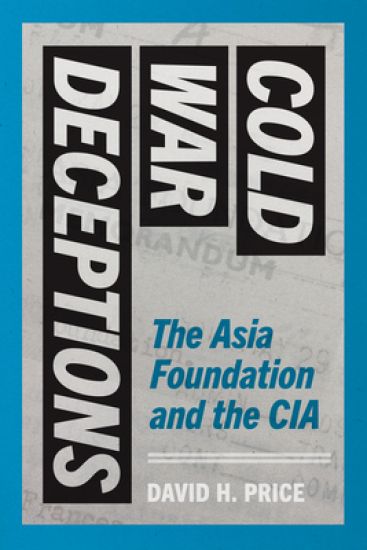
Cold War Deceptions

Cold War Deceptions

David H. Price

UNIVERSITY OF WASHINGTON PRESS
2024
sidottu
Investigates how the CIA tried to influence scholars and governmentsDuring the early Cold War, the Central Intelligence Agency created dozens of funding fronts to support work that aligned with CIA goals, from clandestine operations and research to liberal anticommunist programs. While investigative journalists and congressional inquiries exposed many of these fronts, little is known about their daily internal workings. With a specific focus on the 1950s and 1960s Asia Foundation, Cold War Deceptions provides a rare view into the bureaucratic functioning of a covert operation in which most employees did not know they were working for the CIA. Drawing on the foundation's extensive surviving archival records and thousands of pages of declassified CIA documents, David H. Price examines how the foundation, secretly created and funded by the CIA, tried to shape Asian political, economic, intellectual, and cultural developments during the early years of the Cold War. Uncovering how unwitting scholars were used to support pro-American and anticommunist positions, Price considers how political forces shaped disciplinary knowledge and how these past events connect to the present.
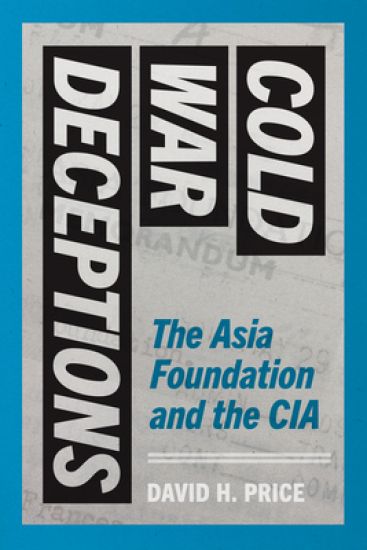
Cold War Deceptions

Cold War Deceptions

David H. Price

UNIVERSITY OF WASHINGTON PRESS
2024
pokkari
Investigates how the CIA tried to influence scholars and governmentsDuring the early Cold War, the Central Intelligence Agency created dozens of funding fronts to support work that aligned with CIA goals, from clandestine operations and research to liberal anticommunist programs. While investigative journalists and congressional inquiries exposed many of these fronts, little is known about their daily internal workings. With a specific focus on the 1950s and 1960s Asia Foundation, Cold War Deceptions provides a rare view into the bureaucratic functioning of a covert operation in which most employees did not know they were working for the CIA. Drawing on the foundation's extensive surviving archival records and thousands of pages of declassified CIA documents, David H. Price examines how the foundation, secretly created and funded by the CIA, tried to shape Asian political, economic, intellectual, and cultural developments during the early years of the Cold War. Uncovering how unwitting scholars were used to support pro-American and anticommunist positions, Price considers how political forces shaped disciplinary knowledge and how these past events connect to the present.
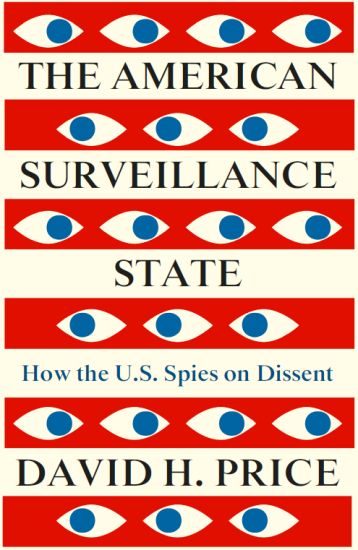
The American Surveillance State

The American Surveillance State

David H. Price

PLUTO PRESS
2022
pokkari
When the possibility of wiretapping first became known to Americans they were outraged. Now, in our post 9/11 world, it’s accepted that corporations are vested with human rights, and government agencies and corporations use computers to monitor our private lives. David H. Price pulls back the curtain to reveal how the FBI and other government agencies have always functioned as the secret police of American capitalism up to today, where they luxuriate in a near-limitless NSA surveillance of all. Price looks through a roster of campaigns by law enforcement, intelligence agencies and corporations to understand how we got here. Starting with J. Edgar Hoover and the early FBI’s alignment with business, his access to 15,000 pages of never-before-seen FBI files shines a light on the surveillance of Edward Said, Andre Gunder Frank and Alexander Cockburn, Native American communists and progressive factory owners. Price uncovers patterns of FBI monitoring and harassing of activists and public figures, providing the vital means for us to understanding how these new frightening surveillance operations are weaponised by powerful governmental agencies that remain largely shrouded in secrecy.
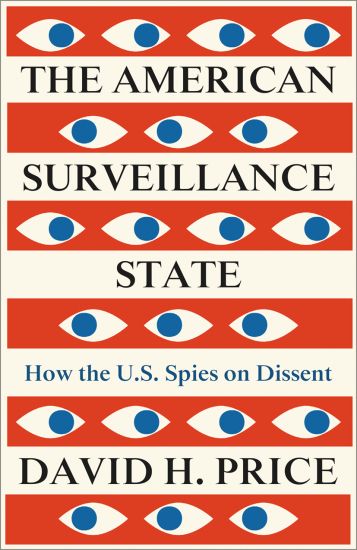
The American Surveillance State

The American Surveillance State

David H. Price

PLUTO PRESS
2022
sidottu
When the possibility of wiretapping first became known to Americans they were outraged. Now, in our post 9/11 world, it’s accepted that corporations are vested with human rights, and government agencies and corporations use computers to monitor our private lives. David H. Price pulls back the curtain to reveal how the FBI and other government agencies have always functioned as the secret police of American capitalism up to today, where they luxuriate in a near-limitless NSA surveillance of all. Price looks through a roster of campaigns by law enforcement, intelligence agencies and corporations to understand how we got here. Starting with J. Edgar Hoover and the early FBI’s alignment with business, his access to 15,000 pages of never-before-seen FBI files shines a light on the surveillance of Edward Said, Andre Gunder Frank and Alexander Cockburn, Native American communists and progressive factory owners. Price uncovers patterns of FBI monitoring and harassing of activists and public figures, providing the vital means for us to understanding how these new frightening surveillance operations are weaponised by powerful governmental agencies that remain largely shrouded in secrecy.
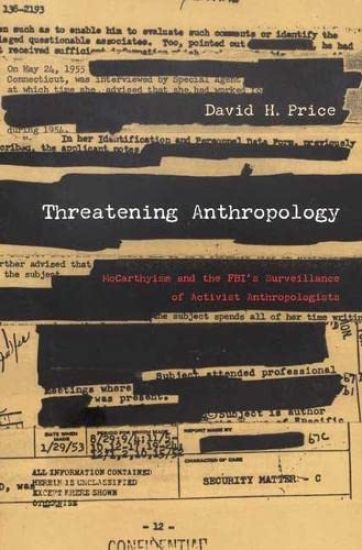
Threatening Anthropology

Threatening Anthropology

David H. Price

Duke University Press
2004
sidottu
A vital reminder of the importance of academic freedom, Threatening Anthropology offers a meticulously detailed account of how U.S. Cold War surveillance damaged the field of anthropology. David H. Price reveals how dozens of activist anthropologists were publicly and privately persecuted during the Red Scares of the 1940s and 1950s. He shows that it was not Communist Party membership or Marxist beliefs that attracted the most intense scrutiny from the fbi and congressional committees but rather social activism, particularly for racial justice. Demonstrating that the fbi’s focus on anthropologists lessened as activist work and Marxist analysis in the field tapered off, Price argues that the impact of McCarthyism on anthropology extended far beyond the lives of those who lost their jobs. Its messages of fear and censorship had a pervasive chilling effect on anthropological investigation. As critiques that might attract government attention were abandoned, scholarship was curtailed.Price draws on extensive archival research including correspondence, oral histories, published sources, court hearings, and more than 30,000 pages of fbi and government memorandums released to him under the Freedom of Information Act. He describes government monitoring of activism and leftist thought on college campuses, the surveillance of specific anthropologists, and the disturbing failure of the academic community-including the American Anthropological Association-to challenge the witch hunts. Today the “war on terror” is invoked to license the government’s renewed monitoring of academic work, and it is increasingly difficult for researchers to access government documents, as Price reveals in the appendix describing his wrangling with Freedom of Information Act requests. A disquieting chronicle of censorship and its consequences in the past, Threatening Anthropology is an impassioned cautionary tale for the present.
Threatening Anthropology

Threatening Anthropology

David H. Price

Duke University Press
2004
pokkari
A vital reminder of the importance of academic freedom, Threatening Anthropology offers a meticulously detailed account of how U.S. Cold War surveillance damaged the field of anthropology. David H. Price reveals how dozens of activist anthropologists were publicly and privately persecuted during the Red Scares of the 1940s and 1950s. He shows that it was not Communist Party membership or Marxist beliefs that attracted the most intense scrutiny from the fbi and congressional committees but rather social activism, particularly for racial justice. Demonstrating that the fbi’s focus on anthropologists lessened as activist work and Marxist analysis in the field tapered off, Price argues that the impact of McCarthyism on anthropology extended far beyond the lives of those who lost their jobs. Its messages of fear and censorship had a pervasive chilling effect on anthropological investigation. As critiques that might attract government attention were abandoned, scholarship was curtailed.Price draws on extensive archival research including correspondence, oral histories, published sources, court hearings, and more than 30,000 pages of fbi and government memorandums released to him under the Freedom of Information Act. He describes government monitoring of activism and leftist thought on college campuses, the surveillance of specific anthropologists, and the disturbing failure of the academic community-including the American Anthropological Association-to challenge the witch hunts. Today the “war on terror” is invoked to license the government’s renewed monitoring of academic work, and it is increasingly difficult for researchers to access government documents, as Price reveals in the appendix describing his wrangling with Freedom of Information Act requests. A disquieting chronicle of censorship and its consequences in the past, Threatening Anthropology is an impassioned cautionary tale for the present.
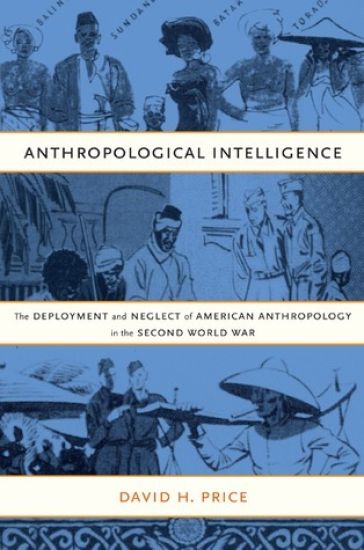
Anthropological Intelligence

Anthropological Intelligence

David H. Price

Duke University Press
2008
sidottu
By the time the United States officially entered World War II, more than half of American anthropologists were using their professional knowledge and skills to advance the war effort. The range of their war-related work was extraordinary. They helped gather military intelligence, pinpointed possible social weaknesses in enemy nations, and contributed to the army’s regional Pocket Guide booklets. They worked for dozens of government agencies, including the Office of Strategic Services (OSS) and the Office of War Information. At a moment when social scientists are once again being asked to assist in military and intelligence work, David H. Price examines anthropologists’ little-known contributions to the Second World War. Anthropological Intelligence is based on interviews with anthropologists as well as extensive archival research involving many Freedom of Information Act requests. Price looks at the role played by the two primary U.S. anthropological organizations, the American Anthropological Association and the Society for Applied Anthropology (which was formed in 1941), in facilitating the application of anthropological methods to the problems of war. He chronicles specific projects undertaken on behalf of government agencies, including an analysis of the social effects of postwar migration, the design and implementation of OSS counterinsurgency campaigns, and the study of Japanese social structures to help tailor American propaganda efforts. Price discusses anthropologists’ work in internment camps, their collection of intelligence in Central and South America for the FBI’s Special Intelligence Service, and their help forming foreign language programs to assist soldiers and intelligence agents. Evaluating the ethical implications of anthropological contributions to World War II, Price suggests that by the time the Cold War began, the profession had set a dangerous precedent regarding what it would be willing to do on behalf of the U.S. government.
Anthropological Intelligence

Anthropological Intelligence

David H. Price

Duke University Press
2008
pokkari
By the time the United States officially entered World War II, more than half of American anthropologists were using their professional knowledge and skills to advance the war effort. The range of their war-related work was extraordinary. They helped gather military intelligence, pinpointed possible social weaknesses in enemy nations, and contributed to the army’s regional Pocket Guide booklets. They worked for dozens of government agencies, including the Office of Strategic Services (OSS) and the Office of War Information. At a moment when social scientists are once again being asked to assist in military and intelligence work, David H. Price examines anthropologists’ little-known contributions to the Second World War. Anthropological Intelligence is based on interviews with anthropologists as well as extensive archival research involving many Freedom of Information Act requests. Price looks at the role played by the two primary U.S. anthropological organizations, the American Anthropological Association and the Society for Applied Anthropology (which was formed in 1941), in facilitating the application of anthropological methods to the problems of war. He chronicles specific projects undertaken on behalf of government agencies, including an analysis of the social effects of postwar migration, the design and implementation of OSS counterinsurgency campaigns, and the study of Japanese social structures to help tailor American propaganda efforts. Price discusses anthropologists’ work in internment camps, their collection of intelligence in Central and South America for the FBI’s Special Intelligence Service, and their help forming foreign language programs to assist soldiers and intelligence agents. Evaluating the ethical implications of anthropological contributions to World War II, Price suggests that by the time the Cold War began, the profession had set a dangerous precedent regarding what it would be willing to do on behalf of the U.S. government.
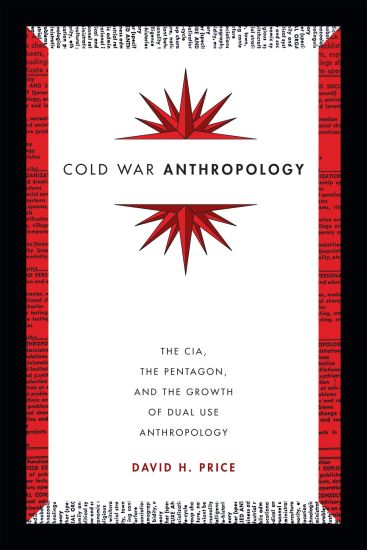
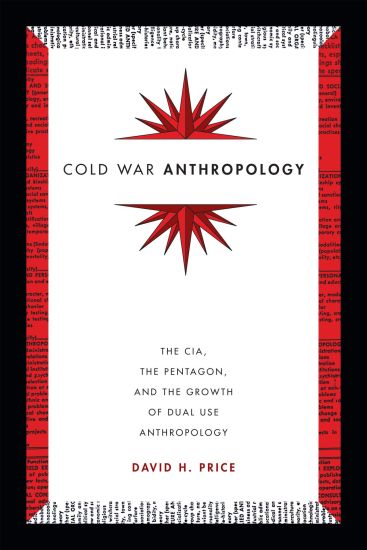
Cold War Anthropology

Cold War Anthropology

David H. Price

Duke University Press
2016
sidottu
In Cold War Anthropology, David H. Price offers a provocative account of the profound influence that the American security state has had on the field of anthropology since the Second World War. Using a wealth of information unearthed in CIA, FBI, and military records, he maps out the intricate connections between academia and the intelligence community and the strategic use of anthropological research to further the goals of the American military complex. The rise of area studies programs, funded both openly and covertly by government agencies, encouraged anthropologists to produce work that had intellectual value within the field while also shaping global counterinsurgency and development programs that furthered America’s Cold War objectives. Ultimately, the moral issues raised by these activities prompted the American Anthropological Association to establish its first ethics code. Price concludes by comparing Cold War-era anthropology to the anthropological expertise deployed by the military in the post-9/11 era.
Cold War Anthropology

Cold War Anthropology

David H. Price

Duke University Press
2016
pokkari
In Cold War Anthropology, David H. Price offers a provocative account of the profound influence that the American security state has had on the field of anthropology since the Second World War. Using a wealth of information unearthed in CIA, FBI, and military records, he maps out the intricate connections between academia and the intelligence community and the strategic use of anthropological research to further the goals of the American military complex. The rise of area studies programs, funded both openly and covertly by government agencies, encouraged anthropologists to produce work that had intellectual value within the field while also shaping global counterinsurgency and development programs that furthered America’s Cold War objectives. Ultimately, the moral issues raised by these activities prompted the American Anthropological Association to establish its first ethics code. Price concludes by comparing Cold War-era anthropology to the anthropological expertise deployed by the military in the post-9/11 era.
Complete Jewish Bible: An English Version by David H. Stern - Giant Print
Now, the most widely used Messianic Jewish Bible around the world, has updated text with introductions added to each book, written from a biblically Jewish perspective. The CJB is a unified Jewish book, a version for Jews and non-Jews alike; to connect Jews with the Jewishness of the Messiah, and non-Jews with their Jewish roots. Names and terms are returned to their original Hebrew and presented in easy-to-understand transliterations, enabling the reader to say them the way Yeshua (Jesus
Complete Jewish Bible: An English Version by David H. Stern - Updated
Now, the most widely used Messianic Jewish Bible around the world, has updated text with introductions added to each book, written from a biblically Jewish perspective. The CJB is a unified Jewish book, a version for Jews and non-Jews alike; to connect Jews with the Jewishness of the Messiah, and non-Jews with their Jewish roots. Names and terms are returned to their original Hebrew and presented in easy-to-understand transliterations, enabling the reader to say them the way Yeshua (Jesus
Jewish New Testament: By David H. Stern, Updated

Jewish New Testament: By David H. Stern, Updated

David H. Stern

Messianic Jewish Publishers
2023
sidottu
Why is this New Testament different from all other New Testaments? Because the Jewish New Testament expresses its original and essential Jewishness. The New Testament is a Jewish book--by Jews, mostly about Jews, and for Jews as well as Gentiles. Its central figure, the Messiah Yeshua (Jesus), was and is a Jew.Vicarious atonement, salvation, immersion (baptism), the new covenant and the very concept of a Messiah are all Jewish. In sum, the New Testament is built upon and completes the Hebrew Scriptures. The Jewish New Testament brings out Jewishness in three ways: - Cosmetically--by using neutral terms and Hebrew names: "execution-stake," not "cross"; "Ya'akov," not "James." - Culturally and Religiously--by highlighting Jewish features: "Chanukkah," not "the feast of dedication"; "tzitzit," not "fringe." - Theologically--by correcting mistranslations resulting from anti-Jewish theological bias; for example, at Romans 10:4 the Messiah is "the goal at which the Torah aims," not "the end of the law." Freshly rendered from the original Greek into enjoyable modern English by a Messianic Jew (a Jew who honors Yeshua as the Messiah of Israel), the "Jewish New Testament" challenges Jews to understand that Yeshua is a friend to every Jewish heart and the New Testament a Jewish book filled with truths to be accepted and acted upon. At the same time, while reaffirming the equality of Gentiles and Jews in the Messianic Community, it challenges Christians to acknowledge the Jewishness of their faith and their oneness with the Jewish people.
Jewish New Testament Commentary: A Companion Volume to the Jewish New Testament by David H. Stern
This updated companion volume to the Jewish New Testament enhances Bible study. Passages and expressions are explained in their original cultural context, the way 1st century Jewish writers meant for them to be understood Over fifteen years of research and study went into the JNTC to make the New Testament more meaningful