Kirjahaku
Etsi kirjoja tekijän nimen, kirjan nimen tai ISBN:n perusteella.
1000 tulosta hakusanalla David Hendry; Jennifer Castle; Michael Clements
Concise, engaging, and highly intuitive—this accessible guide equips you with an understanding of all the basic principles of forecasting Making accurate predictions about the economy has always been difficult, as F. A. Hayek noted when accepting his Nobel Prize in economics, but today forecasters have to contend with increasing complexity and unpredictable feedback loops. In this accessible and engaging guide, David Hendry, Michael Clements, and Jennifer Castle provide a concise and highly intuitive overview of the process and problems of forecasting. They explain forecasting concepts including how to evaluate forecasts, how to respond to forecast failures, and the challenges of forecasting accurately in a rapidly changing world. Topics covered include: What is a forecast? How are forecasts judged? And how can forecast failure be avoided? Concepts are illustrated using real-world examples including financial crises, the uncertainty of Brexit, and the Federal Reserve’s record on forecasting. This is an ideal introduction for university students studying forecasting, practitioners new to the field and for general readers interested in how economists forecast.
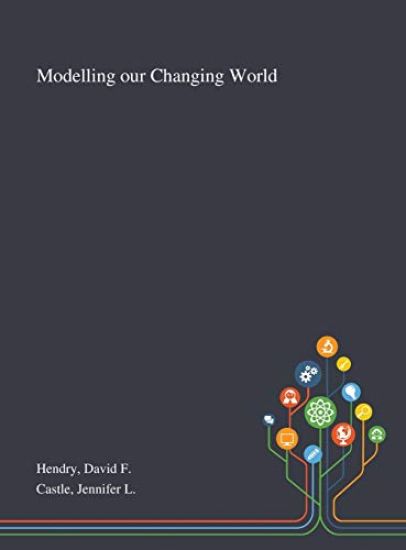
Modelling Our Changing World
David F Hendry; Jennifer L Castle
Saint Philip Street Press
2020
pokkari
This open access book focuses on the concepts, tools and techniques needed to successfully model ever-changing time-series data. It emphasizes the need for general models to account for the complexities of the modern world and how these can be applied to a range of issues facing Earth, from modelling volcanic eruptions, carbon dioxide emissions and global temperatures, to modelling unemployment rates, wage inflation and population growth. Except where otherwise noted, this book is licensed under a Creative Commons Attribution 4.0 International License. To view a copy of this licence, visit http: //creativecommons.org/licenses/by/4.0. This work was published by Saint Philip Street Press pursuant to a Creative Commons license permitting commercial use. All rights not granted by the work's license are retained by the author or authors.
Modelling Our Changing World
David F Hendry; Jennifer L Castle
Saint Philip Street Press
2020
sidottu
This open access book focuses on the concepts, tools and techniques needed to successfully model ever-changing time-series data. It emphasizes the need for general models to account for the complexities of the modern world and how these can be applied to a range of issues facing Earth, from modelling volcanic eruptions, carbon dioxide emissions and global temperatures, to modelling unemployment rates, wage inflation and population growth. Except where otherwise noted, this book is licensed under a Creative Commons Attribution 4.0 International License. To view a copy of this licence, visit http: //creativecommons.org/licenses/by/4.0. This work was published by Saint Philip Street Press pursuant to a Creative Commons license permitting commercial use. All rights not granted by the work's license are retained by the author or authors.
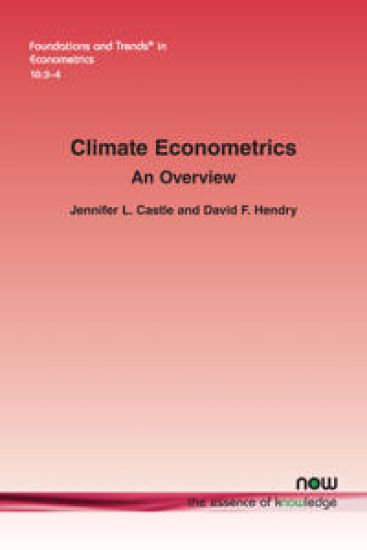
Climate Econometrics: An Overview provides a review of the research in this new and growing field. The structure of the monograph is as follows: First, section 2 describes econometric methods for empirical climate modeling that can account for wide-sense non-stationarity, namely both stochastic trends and location shifts, with possibly large outliers, as well as dynamics and non-linearities. Section 3 considers hazards confronting empirical modeling of nonstationary time-series data using an example where a counter-intuitive finding is hard to resolve. The framework has a clear subject-matter theory, so is not mere 'data mining', yet the empirical result flatly contradicts the well-based theory. Section 4 provides a brief excursion into climate science, mainly concerned with the composition of the Earth's atmosphere and the role of CO2 as a greenhouse gas. Section 5 considers the consequences, both good and bad, of the Industrial Revolution raising living standards beyond the wildest dreams of those living in the 17th century, but leading to dangerous levels of CO2 emissions from using fossil fuels and consider applications of climate econometrics against that background. Section 6 illustrates the approach by modeling past climate variability over the Ice Ages. Section 7 models UK annual CO2 emissions over 1860-2017 to walk through the stages of modeling empirical time series that manifest all the problems of wide-sense non-stationarity. Section 8 concludes and summarizes a number of other empirical applications.
Modelling our Changing World
Jennifer L. Castle; David F. Hendry
Springer Nature Switzerland AG
2019
sidottu
This open access book focuses on the concepts, tools and techniques needed to successfully model ever-changing time-series data. It emphasizes the need for general models to account for the complexities of the modern world and how these can be applied to a range of issues facing Earth, from modelling volcanic eruptions, carbon dioxide emissions and global temperatures, to modelling unemployment rates, wage inflation and population growth.Except where otherwise noted, this book is licensed under a Creative Commons Attribution 4.0 International License. To view a copy of this licence, visit http://creativecommons.org/licenses/by/4.0.
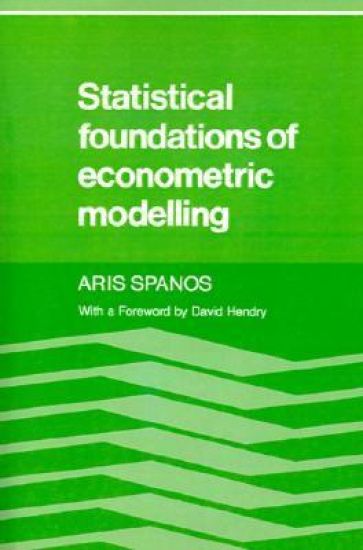
Statistical Foundations of Econometric Modelling
Aris Spanos; David Hendry
Cambridge University Press
1986
pokkari
This textbook provides an ideal introduction to econometrics through a grounding in probability theory and statistical inference.
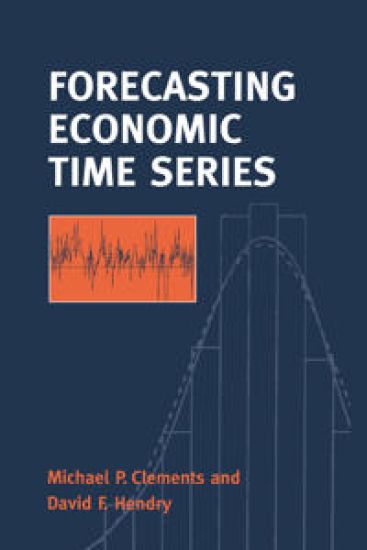
Forecasting Economic Time Series
Michael Clements; David Hendry
Cambridge University Press
1998
sidottu
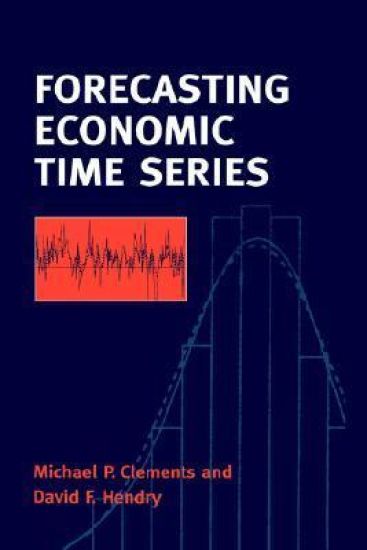
This book provides a formal analysis of the models, procedures, and measures of economic forecasting with a view to improving forecasting practice. David Hendry and Michael Clements base the analyses on assumptions pertinent to the economies to be forecast, viz. a non-constant, evolving economic system, and econometric models whose form and structure are unknown a priori. The authors find that conclusions which can be established formally for constant-parameter stationary processes and correctly-specified models often do not hold when unrealistic assumptions are relaxed. Despite the difficulty of proceeding formally when models are mis-specified in unknown ways for non-stationary processes that are subject to structural breaks, Hendry and Clements show that significant insights can be gleaned. For example, a formal taxonomy of forecasting errors can be developed, the role of causal information clarified, intercept corrections re-established as a method for achieving robustness against forms of structural change, and measures of forecast accuracy re-interpreted.
Forecasting Economic Time Series
Michael Clements; David Hendry
Cambridge University Press
1998
pokkari
This book provides a formal analysis of the models, procedures, and measures of economic forecasting with a view to improving forecasting practice. David Hendry and Michael Clements base the analyses on assumptions pertinent to the economies to be forecast, viz. a non-constant, evolving economic system, and econometric models whose form and structure are unknown a priori. The authors find that conclusions which can be established formally for constant-parameter stationary processes and correctly-specified models often do not hold when unrealistic assumptions are relaxed. Despite the difficulty of proceeding formally when models are mis-specified in unknown ways for non-stationary processes that are subject to structural breaks, Hendry and Clements show that significant insights can be gleaned. For example, a formal taxonomy of forecasting errors can be developed, the role of causal information clarified, intercept corrections re-established as a method for achieving robustness against forms of structural change, and measures of forecast accuracy re-interpreted.
Co-integration, Error Correction, and the Econometric Analysis of Non-Stationary Data
Anindya Banerjee; Juan J. Dolado; John W. Galbraith; David Hendry
Clarendon Press
1993
nidottu
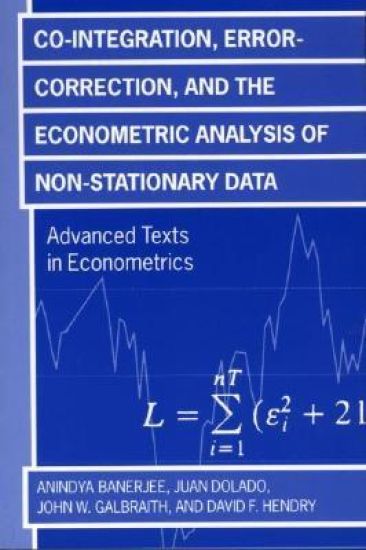
This book provides a wide-ranging account of the literature on co-integration and the modelling of integrated processes (those which accumulate the effects of past shocks). Data series which display integrated behaviour are common in economics, although techniques appropriate to analysing such data are of recent origin and there are few existing expositions of the literature. This book focuses on the exploration of relationships among integrated data series and the exploitation of these relationships in dynamic econometric modelling. The concepts of co-integration and error-correction models are fundamental components of the modelling strategy. This area of time-series econometrics has grown in importance over the past decade and is of interest to econometric theorists and applied econometricians alike. By explaining the important concepts informally, but also presenting them formally, the book bridges the gap between purely descriptive and purely theoretical accounts of the literature. The asymptotic theory of integrated processes is described and the tools provided by this theory are used to develop the distributions of estimators and test statistics. Practical modelling advice, and the use of techniques for systems estimation, are also emphasized. A knowledge of econometrics, statistics, and matrix algebra at the level of a final-year undergraduate or first-year undergraduate course in econometrics is sufficient for most of the book. Other mathematical tools are described as they occur.
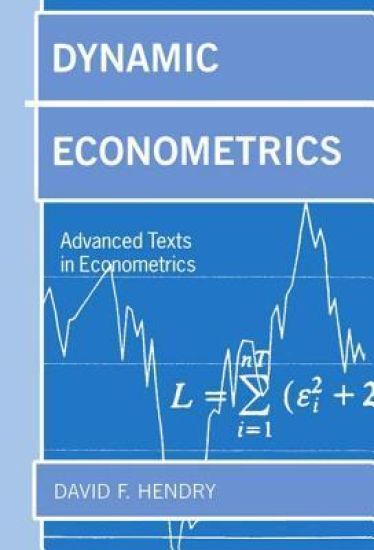
This book confronts the practical problems of modelling aggregate time series data, in a systematic and intergrated framework. The main problem in econometric modelling of time series is discovering sustainable and interpretable relationships between observed economic variables. The primary aim of this book is to develop an operational econometric approach which allows constructive modelling. Professor Hendry deals with methodological issues (model discovery, data mining, and progressive research strategies); with major tools for modelling (recursive methods, encompassing, super exogeneity, invariance tests); and with practical problems (collinearity, heteroscedasticity, and measurement errors). He also includes an extensive study of US money demand. The book is self-contained, with the technical background covered in appendices. It is thus suitable for first year graduate students, and includes solved examples and exercises to facilitate its use in teaching.
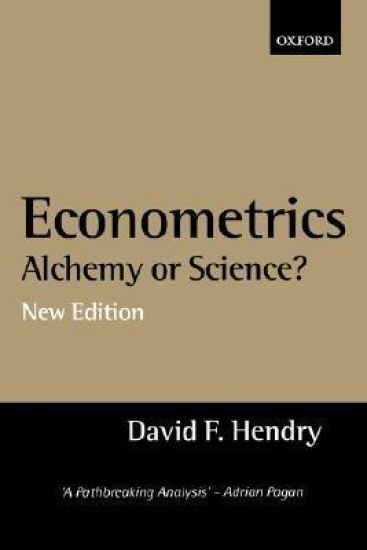
"Econometrics: Alchemy or Science?" analyses the effectiveness and validity of applying econometric methods to economic time series. The methodological dispute is long-standing, and no claim can be made for a single valid method, but recent results on the theory and practice of model selection bid fair to resolve many of the contentious issues. The book presents criticisms and evaluations of competing approaches, based on theoretical economic and econometric analyses, empirical applications, and Monte Carlo simulations, which interact to determine best practice. It explains the evolution of an approach to econometric modelling founded in careful statistical analyses of the available data, using economic theory to guide the general model specification. From a strong foundation in the theory of reduction, via a range of applied and simulation studies, it demonstrates that general-to-specific procedures have excellent properties. The book is divided into four Parts: Routes and Route Maps; Empirical Modelling Strategies; Formalization; and Retrospect and Prospect. A short preamble to each chapter sketches the salient themes, links to earlier and later developments, and the lessons learnt or missed at the time. A sequence of detailed empirical studies of consumers' expenditure and money demand illustrate most facets of the approach. Material new to this revised edition describes recent major advances in computer-automated model selection, embodied in the powerful new software program PcGets, which establish the operational success of the modelling strategy.
The Foundations of Econometric Analysis
David F. Hendry; Mary S. Morgan
Cambridge University Press
1995
sidottu
In this compelling 1995 book, David Hendry and Mary Morgan bring together the classic papers of the pioneer econometricians. Together, these papers form the foundations of econometric thought. They are essential reading for anyone seeking to understand the aims, method and methodology of econometrics and the development of this statistical approach in economics. However, because they are technically straightforward, the book is also accessible to students and non-specialists. An editorial commentary places the readings in their historical context and indicates the continuing relevance of these early, yet highly sophisticated, works for current econometric analysis. While this book provides a companion volume to Mary Morgan's acclaimed The History of Econometric Ideas, the editors' commentary both adds to that earlier volume and also provides a stand-alone and synthetic account of the development of econometrics.
The Foundations of Econometric Analysis
David F. Hendry; Mary S. Morgan
Cambridge University Press
1997
pokkari
In this compelling 1995 book, David Hendry and Mary Morgan bring together the classic papers of the pioneer econometricians. Together, these papers form the foundations of econometric thought. They are essential reading for anyone seeking to understand the aims, method and methodology of econometrics and the development of this statistical approach in economics. However, because they are technically straightforward, the book is also accessible to students and non-specialists. An editorial commentary places the readings in their historical context and indicates the continuing relevance of these early, yet highly sophisticated, works for current econometric analysis. While this book provides a companion volume to Mary Morgan's acclaimed The History of Econometric Ideas, the editors' commentary both adds to that earlier volume and also provides a stand-alone and synthetic account of the development of econometrics.
Econometric Modeling provides a new and stimulating introduction to econometrics, focusing on modeling. The key issue confronting empirical economics is to establish sustainable relationships that are both supported by data and interpretable from economic theory. The unified likelihood-based approach of this book gives students the required statistical foundations of estimation and inference, and leads to a thorough understanding of econometric techniques. David Hendry and Bent Nielsen introduce modeling for a range of situations, including binary data sets, multiple regression, and cointegrated systems. In each setting, a statistical model is constructed to explain the observed variation in the data, with estimation and inference based on the likelihood function. Substantive issues are always addressed, showing how both statistical and economic assumptions can be tested and empirical results interpreted. Important empirical problems such as structural breaks, forecasting, and model selection are covered, and Monte Carlo simulation is explained and applied. Econometric Modeling is a self-contained introduction for advanced undergraduate or graduate students. Throughout, data illustrate and motivate the approach, and are available for computer-based teaching. Technical issues from probability theory and statistical theory are introduced only as needed. Nevertheless, the approach is rigorous, emphasizing the coherent formulation, estimation, and evaluation of econometric models relevant for empirical research.
Loito and the Lioness: How the Masai and the lions became friends
Birgit Hendry; David Read
Createspace Independent Publishing Platform
2012
nidottu
Namasi, the shoe maker: How the Ndorobo are cleverer than the Masai
Birgit Hendry; David Read
Createspace Independent Publishing Platform
2012
nidottu
Rain God of the Wambulu: An authentic Mbulu Legend
Birgit Hendry; David Read
Createspace Independent Publishing Platform
2012
nidottu
Using our moral and technical imaginations to create responsible innovations: theory, method, and applications for value sensitive design.Implantable medical devices and human dignity. Private and secure access to information. Engineering projects that transform the Earth. Multigenerational information systems for international justice. How should designers, engineers, architects, policy makers, and others design such technology? Who should be involved and what values are implicated? In Value Sensitive Design, Batya Friedman and David Hendry describe how both moral and technical imagination can be brought to bear on the design of technology. With value sensitive design, under development for more than two decades, Friedman and Hendry bring together theory, methods, and applications for a design process that engages human values at every stage.After presenting the theoretical foundations of value sensitive design, which lead to a deep rethinking of technical design, Friedman and Hendry explain seventeen methods, including stakeholder analysis, value scenarios, and multilifespan timelines. Following this, experts from ten application domains report on value sensitive design practice. Finally, Friedman and Hendry explore such open questions as the need for deeper investigation of indirect stakeholders and further method development.This definitive account of the state of the art in value sensitive design is an essential resource for designers and researchers working in academia and industry, students in design and computer science, and anyone working at the intersection of technology and society.
A new edition of the definitive guide to value sensitive design--chock full of theory, design methods, and hands-on studios and applications for practice. In the midst of technological, environmental, and social turmoil, engineers, policymakers, and designers of all kinds seek approaches to responsible innovation, approaches that foreground human values. How do we make good on responsible AI and social media? On sustainable agriculture, energy, healthcare, and transportation systems? How do we develop inclusive and constructive tech policy? Value sensitive design offers a comprehensive approach for making progress on society's toughest engineering and technical design problems, including practical methods for catalyzing and strengthening designers' moral and technical imaginations. The second edition of Value Sensitive Design: Shaping Technology with Moral Imagination by Batya Friedman and David Hendry expands upon the first and includes 40% new material, including: 8 new hands-on instructional studios: for professional development and classroom use that provide practical experience with value sensitive design methods and skills 16 Envisioning Cards from the full toolkit: used throughout the instructional studios 5 new methods: Data statements; Diverse voices; Values hierarchy; Metaphor Cards; and Security Cards (22 total methods) 3 new application domains: Bias in computing and information systems; Materials and imagination; and Tech policy (13 total application domains) New theory about value sensitive design as a formative theory and new explication of the tripartite methodology in terms of robots in healthcare
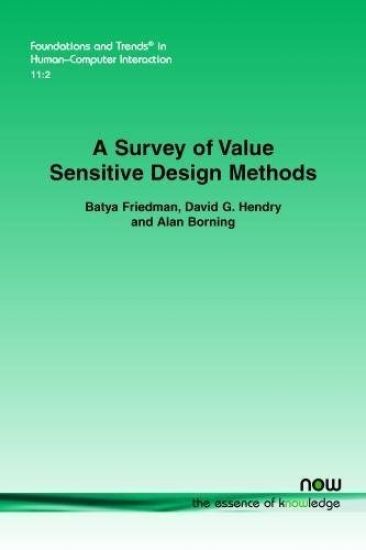
A Survey of Value Sensitive Design Methods
Batya Friedman; David G. Hendry; Alan Borning
now publishers Inc
2017
nidottu
Value sensitive design is a theoretically grounded approach to the design of technology that accounts for human values in a principled and systematic manner throughout the design process. A Survey of Value Sensitive Design Methods looks at 14 value sensitive design methods, each of which is honed to the investigation of values in technology, serving such purposes as stakeholder identification and legitimation, value representation and elicitation, and values analysis. While presented individually, the methods are intended to be integrated in a robust value sensitive design process. A Survey of Value Sensitive Design Methods begins with a summary of value sensitive design methodology and theoretical constructs. Having introduced the 14 methods, it turns to a broader discussion of value sensitive design practice, focusing on some methodological strategies and heuristics to support skillful value sensitive design practice. Following the broad discussion of practice, it illustrates one method in action—value scenarios—providing details on its range of purposes and contexts. It concludes with reflections on core characteristics of value sensitive design methods, and heuristics for methodological innovation.