

Kirjahaku
Etsi kirjoja tekijän nimen, kirjan nimen tai ISBN:n perusteella.
1000 tulosta hakusanalla David Holbrook


Never before published in the United States, David Holbrook's study offers the sort of common sense all too uncommon in this area of study. His essential premise is that sex has become converted from an instrument for the expression of happiness and affection into an end unto itself. In the search for sexual liberation, all that has been accomplished is the mechanization of sexuality and the destruction of the full range of emotions that nourish the human search for social and biological meaning. Sex and Dehumanization is one of those rare books that will immediately strike the reader as part of the common wisdom that has somehow been lost in a search for the pleasure principle unhinged from other values and goals.During the past quarter century, Holbrook argues, not only has the concept of sex become increasingly separated from the rest of existence, but sex casualties have increased disastrously. The spread of AIDS has brought an ominous and deadly manifestation of this thesis into the human equation, yet at the same tune the response to this menace has been nothing short of manic denial. A similar picture emerges in less deadly forms. Whatever statistics one examines, whether those of sexual activity among young children, abortion, or sexual disease, one finds a grim antidote to any hopes of progress in the sphere of human dealings with the sexual. Holbrook locates many of the problems involved in this separation of sex and affection in the emergence of the idea that our lives are governed by impersonal forces beyond human control.Sex and Dehumanization is in the great tradition of social history and psychiatric analysis. Robert Nye, writing in the Scotsman, says that "Holbrook's diagnosis of our unease should be attentively studied by all who really care about sex and love and the responsibility of freedom." Gabriel Pearson, in the Guardian echoes this sentiment, adding that "never has such a secular ethic been so firmly and urgently and usefully stated." And John Rex sees the book "as containing the germs of important and central moral discussion."
Llareggub Revisited: Dylan Thomas and the State of Modern Poetry
David Holbrook
Hassell Street Press
2021
sidottu
This work has been selected by scholars as being culturally important and is part of the knowledge base of civilization as we know it.This work is in the public domain in the United States of America, and possibly other nations. Within the United States, you may freely copy and distribute this work, as no entity (individual or corporate) has a copyright on the body of the work.Scholars believe, and we concur, that this work is important enough to be preserved, reproduced, and made generally available to the public. To ensure a quality reading experience, this work has been proofread and republished using a format that seamlessly blends the original graphical elements with text in an easy-to-read typeface.We appreciate your support of the preservation process, and thank you for being an important part of keeping this knowledge alive and relevant.
Llareggub Revisited: Dylan Thomas and the State of Modern Poetry
David Holbrook
Hassell Street Press
2021
nidottu
This work has been selected by scholars as being culturally important and is part of the knowledge base of civilization as we know it.This work is in the public domain in the United States of America, and possibly other nations. Within the United States, you may freely copy and distribute this work, as no entity (individual or corporate) has a copyright on the body of the work.Scholars believe, and we concur, that this work is important enough to be preserved, reproduced, and made generally available to the public. To ensure a quality reading experience, this work has been proofread and republished using a format that seamlessly blends the original graphical elements with text in an easy-to-read typeface.We appreciate your support of the preservation process, and thank you for being an important part of keeping this knowledge alive and relevant.

Never before published in the United States, David Holbrook's study offers the sort of common sense all too uncommon in this area of study. His essential premise is that sex has become converted from an instrument for the expression of happiness and affection into an end unto itself. In the search for sexual liberation, all that has been accomplished is the mechanization of sexuality and the destruction of the full range of emotions that nourish the human search for social and biological meaning. Sex and Dehumanization is one of those rare books that will immediately strike the reader as part of the common wisdom that has somehow been lost in a search for the pleasure principle unhinged from other values and goals.During the past quarter century, Holbrook argues, not only has the concept of sex become increasingly separated from the rest of existence, but sex casualties have increased disastrously. The spread of AIDS has brought an ominous and deadly manifestation of this thesis into the human equation, yet at the same tune the response to this menace has been nothing short of manic denial. A similar picture emerges in less deadly forms. Whatever statistics one examines, whether those of sexual activity among young children, abortion, or sexual disease, one finds a grim antidote to any hopes of progress in the sphere of human dealings with the sexual. Holbrook locates many of the problems involved in this separation of sex and affection in the emergence of the idea that our lives are governed by impersonal forces beyond human control.Sex and Dehumanization is in the great tradition of social history and psychiatric analysis. Robert Nye, writing in the Scotsman, says that "Holbrook's diagnosis of our unease should be attentively studied by all who really care about sex and love and the responsibility of freedom." Gabriel Pearson, in the Guardian echoes this sentiment, adding that "never has such a secular ethic been so firmly and urgently and usefully stated." And John Rex sees the book "as containing the germs of important and central moral discussion."

Admirers of the work of Sylvia Plath will welcome this new paperback edition of a study, first published by The Athlone Press in 1976, which provides coherent and persuasive readings of her poetry. Drawing upon the traditional skills of the literary critic, David Holbrook also deploys the illumination of both psychoanalysis and phenomenology in a pioneering work of literary, individual and cultural interpretation.
Mr Holbrook here offers a new interpretation of Dylan Thomas which seeks, by uncovering the roots of his predicament as man and artist, to show what is of lasting value in his achievement. This undertaking involves the consideration of some profound questions of human personality and of human creativity and its denial.

Follows a young Cambridge undergraduate from his call-up in 1942, through training as a tank officer, the landings in Normandy, and his command of a Sherman tank in the vicious post - D-Day battles to his eventual return. This work gives an first-hand account of the effect of military service, culminating in battle, death and injury.

Originally published in 1967, this book is David Holbrook's plea for a fresh approach to English in secondary schools.
The Panorama Of Creation As Presented In Genesis
David Leverett Holbrook
Hutson Street Press
2025
sidottu
The Panorama Of Creation As Presented In Genesis
David Leverett Holbrook
Hutson Street Press
2025
pokkari
How successful is Dickens in his portrayal of women? Dickens has been represented (along with William Blake and D.H. Lawrence) as one who championed the life of the emotions often associated with the "feminine." Yet some of his most important heroines are totally submissive and docile. Dickens, of course, had to accept the conventions of his time. It is obvious, argues Holbrook, that Dickens idealized the father-daughter relationship, and indeed, any such relationship that was unsexual, like that of Tom Pinch and his sister?but why? Why, for example, is the image of woman so often associated with death, as in Great Expectations? Dickens's own struggles over relationships with women have been documented, but much less has been said about the unconscious elements behind these problems. Using recent developements in psychoanalytic object-relations theory, David Holbrook offers new insight into the way in which the novels of Dickens?particularly Bleak House, Little Dorrit, and Great Expectations?both uphold emotional needs and at the same time represent the limits of his view of women and that of his time.

How successful is Dickens in his portrayal of women? Dickens has been represented (along with William Blake and D.H. Lawrence) as one who championed the life of the emotions often associated with the "feminine." Yet some of his most important heroines are totally submissive and docile. Dickens, of course, had to accept the conventions of his time. It is obvious, argues Holbrook, that Dickens idealized the father-daughter relationship, and indeed, any such relationship that was unsexual, like that of Tom Pinch and his sister?but why? Why, for example, is the image of woman so often associated with death, as in Great Expectations? Dickens's own struggles over relationships with women have been documented, but much less has been said about the unconscious elements behind these problems. Using recent developements in psychoanalytic object-relations theory, David Holbrook offers new insight into the way in which the novels of Dickens?particularly Bleak House, Little Dorrit, and Great Expectations?both uphold emotional needs and at the same time represent the limits of his view of women and that of his time.
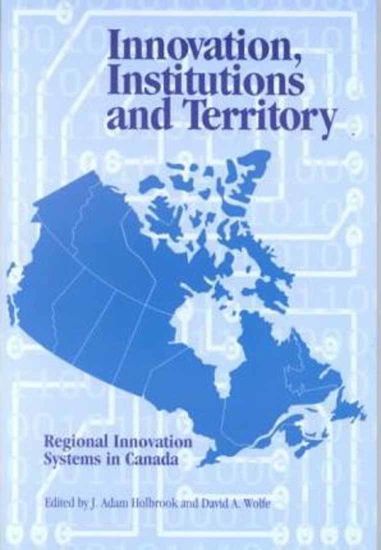
Innovation, Institutions and Territory
Adam Holbrook; David A. Wolfe
Queen's University
2000
nidottu
Concerns over Canada's ability to compete in the global economy persist despite its relatively improved economic performance in recent years. The key to success in this global economy lies in our capacity to innovate - the ability to develop new, or significantly improved, services, products, production techniques, or management methods - and the capacity to sustain those innovations. The challenge of competing in a global, knowledge-based economy accentuates our need to understand how the innovation process operates in the context of Canada's diverse regional economies. Attempts to understand the nature of the innovation process, and to develop policy to support it, which are exclusively at the national level may founder on this problem of diversity. Policy and analysis in Canada, based on an innovation systems approach, must take into account the economic and social differences among the regions. infrastructure, a factor that strongly influences the innovative potential of regions across the country. Finally, case studies focusing on Quebec and British Columbia provide a detailed picture of the strengths and gaps of individual regional innovation systems. Written by members of the Innovation Systems Research Network (ISRN), a cross-national network of regionally oriented researchers, Innovation, Institutions and Territory provides useful insights for scholars and for policymakers at the federal, provincial, and subregional levels. Contributors include Frederic Allaert (Minolta, France), Tomas G. Bas, Robert Dalpe (Montreal), Sophie D'Amours (Laval), Jerome Doutriaux (Ottawa), Adam Holbrook, Lindsay Hughes, Marie-Pierre Ippersiel (CIRST), Rejean Landry (Laval), Candace Morrison, Richard Nimijean (RQSI and PRIME), Jorge Niosi (UQAM), Tim Padmore (UBC), Diane Poulin (Laval), David Rolland (UQAM), Udo Staber (New Brunswick), Diane-Gabrielle Tremblay (UQAM), and David A. Wolfe.

Workplace Violence
Christina M. Holbrook; David E. Bixler; Eugene A. Rugala; Carri Casteel
Routledge
2020
nidottu
Workplace Violence: Issues in Threat Management defines what workplace violence is, delves into the myths and realities surrounding the topic and provides readers with the latest statistics, thinking, and strategies in the prevention of workplace violence. The authors, who themselves have implemented successful workplace violence protection programs, guide novice and experienced practitioners alike in the development of their own programs.

Workplace Violence
Christina M. Holbrook; David E. Bixler; Eugene A. Rugala; Carri Casteel
Productivity Press
2018
sidottu
Workplace Violence: Issues in Threat Management defines what workplace violence is, delves into the myths and realities surrounding the topic and provides readers with the latest statistics, thinking, and strategies in the prevention of workplace violence. The authors, who themselves have implemented successful workplace violence protection programs, guide novice and experienced practitioners alike in the development of their own programs.
From Promise Keepers founder Bill McCartney, Sold Out is a roadmap describing how to live a disciplined life with eternal values in mind. By tapping into God's transforming power, men can become man enough to make a difference in this world. Includes insights on marriage and relationships from his wife, Lyndi McCartney.

Early Cenozoic Vertebrates in the Red Conglomerate at Guanajuato, Mexico: Smithsonian Miscellaneous Collections, V123, No. 7
Carl Fries Jr; Claude William Hibbard; David Hosbrook Dunkle
Literary Licensing, LLC
2012
nidottu
Grazed Pastures & Surface Water Quality
Richard W McDowell; David J Houlbrooke; Richard W Muirhead; Karin Muller; Mark Shepherd; Steve P Cuttle
Nova Science Publishers Inc
2008
sidottu
This book covers the subject of grasslands used for grazing livestock. Grasslands can be split into improved and unimproved pastures (also a sub-set of rangelands). Land used for livestock industries occupy 70% agricultural land and about 40% of total land and produce 40% of agricultural gross domestic product (FAO, 2005; Steinfeld et al., 2006). Increasing populations and incomes, coupled with a change in diets and urbanisation in the developing world, is enhancing demand for pasture-based products (Devine, 2003; Schmidhuber and Shetty, 2005). For example, milk and meat production is predicted to double to just over 1 billion tonnes of milk and 465 million tonnes of meat by 2050 (Steinfeld et al., 2006). To meet these demands most effort will go into intensification of improved pastures, which translates into high stocking densities supported by large inputs of fertilisers, feed supplements and energy.