Kirjojen hintavertailu. Mukana 11 244 527 kirjaa ja 12 kauppaa.

Kirjahaku

Etsi kirjoja tekijän nimen, kirjan nimen tai ISBN:n perusteella.

1000 tulosta hakusanalla David Hume

David Hume

David Hume

Phillipson Nicholas

Penguin Books Ltd
2011
pokkari
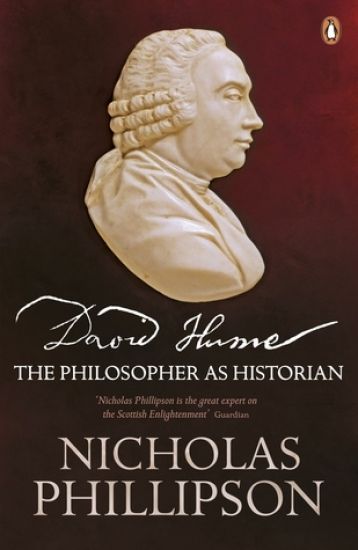
A giant of the eighteenth-century Enlightenment, David Hume was one of the most important philosophers ever to write in English. He was also a brilliant historian. In this succinct study, Nicholas Phillipson shows how Hume freed history from religion and politics. As a philosopher, Hume sought a way of seeing the world and pursuing happiness independently of a belief in God. His groundbreaking approach applied the same outlook to Britain's history, showing how the past was shaped solely through human choices and actions. In this analysis of Hume's life and works, from his university days in Edinburgh to the rapturous reception of his History of England, Nicholas Phillipson reveals the gradual process by which one of the greatest Western philosophers turned himself into one of the greatest historians of Britain. In doing so, he shows us how revolutionary Hume was, and why his ideas still matter today.
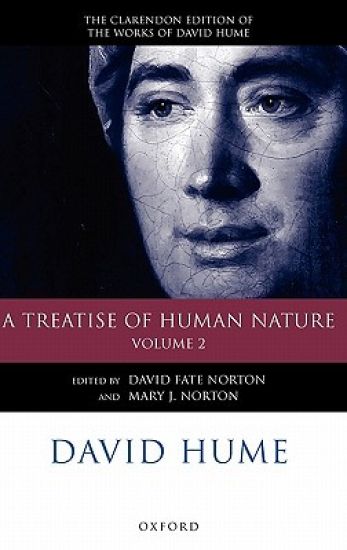
David Hume: A Treatise of Human Nature

David Hume: A Treatise of Human Nature

David Hume

Clarendon Press
2007
sidottu
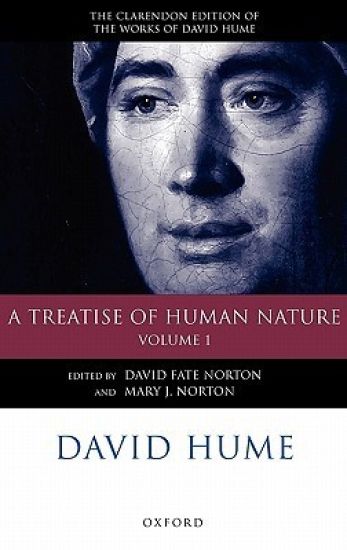
David and Mary Norton present the definitive scholarly edition of one of the greatest philosophical works ever written. This first volume contains the critical text of David Hume's Treatise of Human Nature (1739/40), followed by the short Abstract (1740) in which Hume set out the key arguments of the larger work; the volume concludes with A Letter from a Gentleman to his Friend in Edinburgh (1745), Hume's defence of the Treatise when it was under attack from ministers seeking to prevent Hume's appointment as Professor of Moral Philosophy at the University of Edinburgh.
David Hume: A Treatise of Human Nature

David Hume: A Treatise of Human Nature

David Hume

Clarendon Press
2007
sidottu
David and Mary Norton present the definitive scholarly edition of one of the greatest philosophical works ever written. This second volume begins with their 'Historical Account' of the Treatise, an account that runs from the beginnings of the work to the period immediately following Hume's death in 1776, followed by an account of the Nortons' editorial procedures and policies and a record of the differences between the first-edition text of the Treatise and the critical text that follows. The volume continues with an extensive set of 'Editors' Annotations', intended to illuminate (though not intepret) Hume's texts; a four-part bibliography of materials cited in both volumes; and a comprehensive index.
David Hume

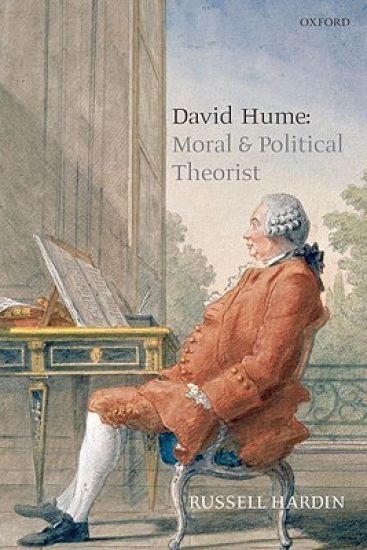
David Hume

Russell Hardin

Oxford University Press
2009
nidottu
Russell Hardin presents a new explication of David Hume's moral and political theory. With Hume, he holds that our normative views can be scientifically explained but they cannot be justified as true. Hume argued for the psychological basis of such views. In particular, he argued for sympathy as the mirroring of the psychological sensations and emotions of others. By placing Hume in the developing tradition of social science, as a strong forerunner of his younger friend Adam Smith, Hardin demonstrates Hume's strong strategic sense, his nascent utilitarianism, his powerful theory of convention as a main source of social and political order, and his recognition of moral and political theory as a single enterprise.
David Hume

David Hume

Schmidt Claudia M.

Pennsylvania State University Press
2003
sidottu
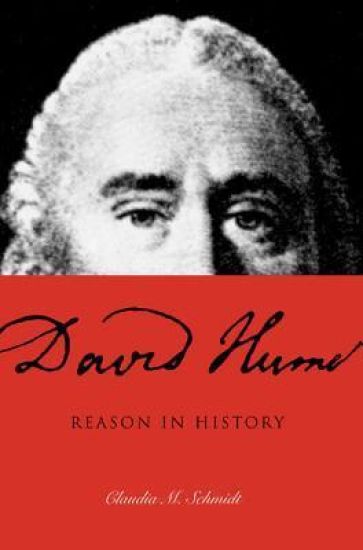
In his seminal Philosophy of David Hume (1941), Norman Kemp Smith called for a study of Hume "in all his manifold activities: as philosopher, as political theorist, as economist, as historian, and as man of letters," indicating that "Hume's philosophy, as the attitude of mind that found for itself these various forms of expression, will then have been presented, adequately and in due perspective, for the first time." Claudia Schmidt seeks to address this long-standing need in Hume scholarship. Against the charges that Hume holds no consistent philosophical position, offers no constructive account of rationality, and sees no positive relation between philosophy and other areas of inquiry, Schmidt argues for the overall coherence of Hume's thought as a study of "reason in history." She develops this interpretation by tracing Hume's constructive account of human cognition and its historical dimension as a unifying theme across the full range of his writings. Hume, she shows, provides a positive account of the ways in which our concepts, beliefs, emotions, and standards of judgment in different areas of inquiry are shaped by experience, both in the personal history of the individual and in the life of a community. This book is valuable at many levels: for students, as an introduction to Hume's writings and issues in their interpretation; for Hume specialists, as a unified and intriguing interpretation of his thought; for philosophers generally, as a synthesis of recent developments in Hume scholarship; and for scholars in other disciplines, as a guide to Hume's contributions to their own fields.
David Hume

David Hume

Claudia M. Schmidt

Pennsylvania State University Press
2003
pokkari
In his seminal Philosophy of David Hume (1941), Norman Kemp Smith called for a study of Hume "in all his manifold activities: as philosopher, as political theorist, as economist, as historian, and as man of letters," indicating that "Hume's philosophy, as the attitude of mind that found for itself these various forms of expression, will then have been presented, adequately and in due perspective, for the first time." Claudia Schmidt seeks to address this long-standing need in Hume scholarship. Against the charges that Hume holds no consistent philosophical position, offers no constructive account of rationality, and sees no positive relation between philosophy and other areas of inquiry, Schmidt argues for the overall coherence of Hume's thought as a study of "reason in history." She develops this interpretation by tracing Hume's constructive account of human cognition and its historical dimension as a unifying theme across the full range of his writings. Hume, she shows, provides a positive account of the ways in which our concepts, beliefs, emotions, and standards of judgment in different areas of inquiry are shaped by experience, both in the personal history of the individual and in the life of a community. This book is valuable at many levels: for students, as an introduction to Hume's writings and issues in their interpretation; for Hume specialists, as a unified and intriguing interpretation of his thought; for philosophers generally, as a synthesis of recent developments in Hume scholarship; and for scholars in other disciplines, as a guide to Hume's contributions to their own fields.
David Hume

David Hume

Mark G. Spencer

Pennsylvania State University Press
2013
sidottu
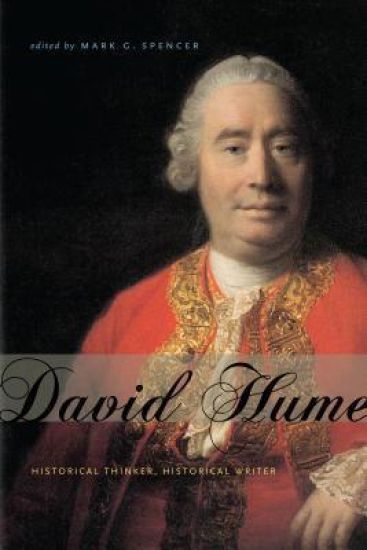
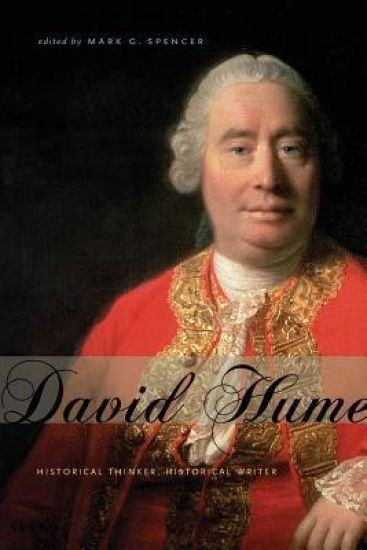
This volume provides a new and nuanced appreciation of David Hume as a historian. Gone for good are the days when one can offhandedly assert, as R. G. Collingwood once did, that Hume “deserted philosophical studies in favour of historical” ones. History and philosophy are commensurate in Hume’s thought and works from the beginning to the end. Only by recognizing this can we begin to make sense of Hume’s canon as a whole and see clearly his many contributions to fields we now recognize as the distinct disciplines of history, philosophy, political science, economics, literature, religious studies, and much else besides. Casting their individual beams of light on various nooks and crannies of Hume’s historical thought and writing, the book’s contributors illuminate the whole in a way that would not be possible from the perspective of a single-authored study.Aside from the editor, the contributors are David Allan, M. A. Box, Timothy M. Costelloe, Roger L. Emerson, Jennifer Herdt, Philip Hicks, Douglas Long, Claudia M. Schmidt, Michael Silverthorne, Jeffrey M. Suderman, Mark R. M. Towsey, and F. L. van Holthoon.
David Hume

David Hume

Mark G. Spencer

Pennsylvania State University Press
2015
pokkari
This volume provides a new and nuanced appreciation of David Hume as a historian. Gone for good are the days when one can offhandedly assert, as R. G. Collingwood once did, that Hume “deserted philosophical studies in favour of historical” ones. History and philosophy are commensurate in Hume’s thought and works from the beginning to the end. Only by recognizing this can we begin to make sense of Hume’s canon as a whole and see clearly his many contributions to fields we now recognize as the distinct disciplines of history, philosophy, political science, economics, literature, religious studies, and much else besides. Casting their individual beams of light on various nooks and crannies of Hume’s historical thought and writing, the book’s contributors illuminate the whole in a way that would not be possible from the perspective of a single-authored study.Aside from the editor, the contributors are David Allan, M. A. Box, Timothy M. Costelloe, Roger L. Emerson, Jennifer Herdt, Philip Hicks, Douglas Long, Claudia M. Schmidt, Michael Silverthorne, Jeffrey M. Suderman, Mark R. M. Towsey, and F. L. van Holthoon.
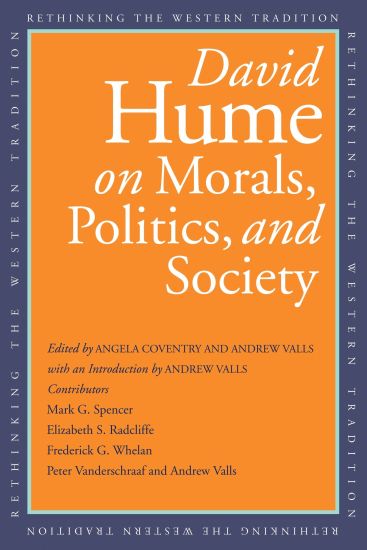
David Hume on Morals, Politics, and Society

David Hume on Morals, Politics, and Society

David Hume

Yale University Press
2019
pokkari
A compact and accessible edition of Hume’s political and moral writings with essays by a distinguished set of contributors A key figure of the Scottish Enlightenment, David Hume was a major influence on thinkers ranging from Kant and Schopenhauer to Einstein and Popper, and his writings continue to be deeply relevant today. With four essays by leading Hume scholars exploring his complex intellectual legacy, this volume presents an overview of Hume’s moral, political, and social philosophy. Editors Angela Coventry and Andrew Valls bring together a selection of writings from Hume’s most important works, with contributors placing them in their appropriate context and offering a lively discourse on the relevance of Hume’s thought to contemporary subjects like reason’s dependence on emotion and the importance of social convention in political and economic behavior. Perfect for classroom use, this volume is an invaluable companion for anyone studying an important thinker who advanced the development of moral philosophy, economics, cognitive science, and many other fields of the Western tradition.
David Hume
These volumes bring together for the first time some of the most important research on the philosophy of David Hume. Hume wrote on a large variety of philosophic topics, and many of these are addressed in these volumes. The volumes cover the following areas: Volume 1 - Epistemology, Reason; Volume 2 - Induction, Scepticism; Volume 3 - External World, Causality Naturalism, Mental Activity, Ontology, Personal Identity and the Self, Space and Time; Volume 4 - Ethics, Passions, Sympathy, Is/Ought; Volume 5 - Religion; Volume 6 - Politics, Economics, Justice and Miracles, as well as some miscellaneous topics. Papers have been selected for their clarity, their high quality, their originality and their lasting significance. An extensive selected bibliography is included in each volume: bibliographic material is listed according to the topics covered in the particular volume.
David Hume

David Hume

Richard Whatmore

Ashgate Publishing Limited
2013
sidottu
This volume on Hume's politics brings together essays that have been formative of the scholarly and more general debate about Hume's political thought. Unlike many theorists who express their thought in terms of system, Hume uses the incidental genre of the essay as the vehicle for his writing and his mode of presentation is a reflection, indeed an expression, of his belief in the limited power of reason to give any over-all shape to human life. Hume's politics are particularly suited for discussion of a wide range of view-points. The possibilities of seeing in Hume both the conservative and the liberal are pursued along with Hume's sophisticated analysis of party-politics. His acute and pioneering theorisation of perhaps the most central issue for 18th-century political observers, that of commerce and politics, is brought out in the context of his ideas of the international order. His fundamental theory of justice is discussed in its connection with law, property and government.
David Hume

David Hume

Laurence Bongie

Liberty Fund Inc
2000
sidottu
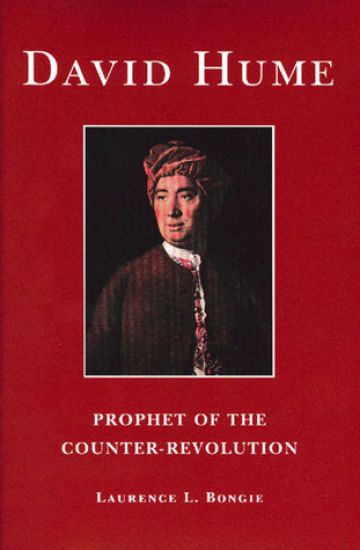
Though Edmund Burke is usually identified as the first to articulate the principles of a modern conservative political tradition, he was actually preceded by a Scotsman who is better known for espousing a brilliant concept of scepticism. David Hume was undoubtedly the eighteenth-century British writer whose works were most widely known and acclaimed on the Continent during the later Enlightenment period. Hume's impact (in France) was of undeniable importance, greater even for a time than the related influence of Burke, although it represents a contribution to French counter-revolutionary thought which, unlike that of Burke, has been almost totally ignored by historians to this day.