Kirjojen hintavertailu. Mukana 11 244 527 kirjaa ja 12 kauppaa.

Kirjahaku

Etsi kirjoja tekijän nimen, kirjan nimen tai ISBN:n perusteella.

1000 tulosta hakusanalla David J. Chalmers

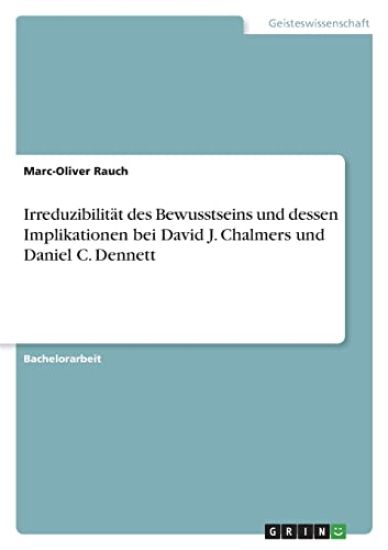
Irreduzibilität des Bewusstseins und dessen Implikationen bei David J. Chalmers und Daniel C. Dennett
Bachelorarbeit aus dem Jahr 2021 im Fachbereich Philosophie - Philosophie der Gegenwart, Note: 1,7, Ludwig-Maximilians-Universit t M nchen (Fakult t f r Philosophie), Sprache: Deutsch, Abstract: Die Frage nach dem Wesen des Bewusstseins ist eine der zentralen und auch verbl ffendsten Fragen der Menschheit, die wahrscheinlich seit der Zeit gestellt wird, als der Geist im Menschen erwacht ist und nach Erkenntnis rief. In der t glichen Erfahrung ist das Bewusstsein allgegenw rtig und subjektive Erlebnisse sind auf so einer direkten Art und Weise gegeben, dass niemand unter normalen Umst nden deren Existenz in Frage stellen w rde. Die Neurowissenschaften versuchen seit langer Zeit erfolglos, ein Korrelat des Bewusstseins im menschlichen Gehirn zu finden, und es ist fraglich, ob das jemals gelingen kann. Ren Descartes, sah das Bewusstsein gar nicht im Gehirn verortet, sondern postulierte eine res cogitans, eine eigene Substanz des denkenden Geistes, unabh ngig von der res extensa, der K rperwelt. David J. Chalmers, mit dessen 1996 erschienenen Buch "The Conscious Mind - In Search of a Fundamental Theory" diese Bachelorarbeit sich haupts chlich besch ftigt, fragt nach dem subjektiven Charakter des Bewusstseins und dessen Status in einer vor allem naturwissenschaftlich, physikalisch gepr gten Welt. Im Verlauf dieser Arbeit wird sich zeigen, dass die Existenz des Bewusstseins von Chalmers nicht in Frage gestellt wird, aber es schwierig ist, Bewusstsein zu fassen, da es eben nicht aus der Perspektive der dritten Person erkl rt werden kann. Mit Hilfe u. a. des Zombiearguments zeigt er, dass consciousness nicht global logisch ber dem Physikalischen superveniert, nicht auf das Physikalische reduzierbar ist und das der Physikalismus falsch ist. Er beschreibt einen "Naturalistic dualism", einen speziellen Eigenschaftsdualismus der consciousness als grundlegendes Prinzip "over and above" des Physikalismus betrachtet. Die Darstellung von David Chalmers negativer Theorie im Te
Reality+

Reality+

David J. Chalmers

PENGUIN BOOKS LTD
2023
pokkari
From one of our leading thinkers, a dazzling philosophical journey through virtual worldsIn the coming decades, the technology that enables virtual and augmented reality will improve beyond recognition. Within a century, world-renowned philosopher David J. Chalmers predicts, we will have virtual worlds that are impossible to distinguish from non-virtual worlds. But is virtual reality just escapism? In a highly original work of 'technophilosophy', Chalmers argues categorically, no: virtual reality is genuine reality. Virtual worlds are not second-class worlds. We can live a meaningful life in virtual reality - and increasingly, we will.What is reality, anyway? How can we lead a good life? Is there a god? How do we know there's an external world - and how do we know we're not living in a computer simulation? In Reality+, Chalmers conducts a grand tour of philosophy, using cutting-edge technology to provide invigorating new answers to age-old questions.Drawing on examples from pop culture, literature and film that help bring philosophical issues to life, Reality+ is a mind-bending journey through virtual worlds, illuminating the nature of reality and our place within it.
Philosophy of Mind

Philosophy of Mind

David J. Chalmers

Oxford University Press Inc
2021
nidottu
Philosophy of Mind: Classical and Contemporary Readings is a grand tour of writings on the perplexing questions about the nature of the mind. The most comprehensive and best-selling collection of its kind, the book includes selections that range from the classical contributions of Descartes to the leading edge of contemporary debates. Extensive sections cover foundational issues, the nature of consciousness, and the nature of mental content. Three of the selections are published for the first time, while many other articles have been revised especially for this volume. Each section opens with an introduction by the editor.
The Conscious Mind

The Conscious Mind

David J. Chalmers

Oxford University Press Inc
1998
nidottu
What is consciousness? How do physical processes in the brain give rise to the self-aware mind and to feelings as profoundly varied as love or hate, aesthetic pleasure or spiritual yearning? David J. Chalmers unveils a major new theory of consciousness, one that rejects the prevailing reductionist trend of science, while offering provocative insights into the relationship between mind and brain. Writing in a thought-provoking style, Chalmers proposes that conscious experience must be understood as an irreducible entity similar to such physical properties as time, mass, and space that exists at a fundamental level and cannot be understood as the sum of its parts. Engaging and penetrating, this book adds a fresh new perspective to the subject that is sure to spark debate about our understanding of the mind for years to come.
The Character of Consciousness

The Character of Consciousness

David J. Chalmers

Oxford University Press Inc
2010
sidottu
What is consciousness? How does the subjective character of consciousness fit into an objective world? How can there be a science of consciousness? In this sequel to his groundbreaking and controversial The Conscious Mind, David Chalmers develops a unified framework that addresses these questions and many others. Starting with a statement of the "hard problem" of consciousness, Chalmers builds a positive framework for the science of consciousness and a nonreductive vision of the metaphysics of consciousness. He replies to many critics of The Conscious Mind, and then develops a positive theory in new directions. The book includes original accounts of how we think and know about consciousness, of the unity of consciousness, and of how consciousness relates to the external world. Along the way, Chalmers develops many provocative ideas: the "consciousness meter", the Garden of Eden as a model of perceptual experience, and The Matrix as a guide to the deepest philosophical problems about consciousness and the external world. This book will be required reading for anyone interested in the problems of mind, brain, consciousness, and reality.
The Character of Consciousness

The Character of Consciousness

David J. Chalmers

Oxford University Press Inc
2010
nidottu
What is consciousness? How does the subjective character of consciousness fit into an objective world? How can there be a science of consciousness? In this sequel to his groundbreaking and controversial The Conscious Mind, David Chalmers develops a unified framework that addresses these questions and many others. Starting with a statement of the "hard problem" of consciousness, Chalmers builds a positive framework for the science of consciousness and a nonreductive vision of the metaphysics of consciousness. He replies to many critics of The Conscious Mind, and then develops a positive theory in new directions. The book includes original accounts of how we think and know about consciousness, of the unity of consciousness, and of how consciousness relates to the external world. Along the way, Chalmers develops many provocative ideas: the "consciousness meter", the Garden of Eden as a model of perceptual experience, and The Matrix as a guide to the deepest philosophical problems about consciousness and the external world. This book will be required reading for anyone interested in the problems of mind, brain, consciousness, and reality.
Constructing the World

Constructing the World

David J. Chalmers

Oxford University Press
2012
sidottu
David Chalmers develops a picture of reality on which all truths can be derived from a limited class of basic truths. The picture is inspired by Rudolf Carnap's construction of the world in Der Logische Aufbau Der Welt. Carnap's Aufbau is often seen as a noble failure, but Chalmers argues that a version of the project can succeed. With the right basic elements and the right derivation relation, we can indeed construct the world. The focal point of Chalmers' project is scrutability: the thesis that ideal reasoning from a limited class of basic truths yields all truths about the world. Chalmers first argues for the scrutability thesis and then considers how small the base can be. The result is a framework in "metaphysical epistemology": epistemology in service of a global picture of the world. The scrutability framework has ramifications throughout philosophy. Using it, Chalmers defends a broadly Fregean approach to meaning, argues for an internalist approach to the contents of thought, and rebuts W.V. Quine's arguments against the analytic and the a priori. He also uses scrutability to analyze the unity of science, to defend a sort of conceptual metaphysics, and to mount a structuralist response to skepticism. Based on Chalmers's 2010 John Locke lectures, Constructing the World opens up debate on central philosophical issues concerning knowledge, language, mind, and reality.
Constructing the World

Constructing the World

David J. Chalmers

Oxford University Press
2014
nidottu
David J. Chalmers constructs a highly ambitious and original picture of the world, from a few basic elements. He develops and extends Rudolf Carnap's attempt to do the same in Der Logische Aufbau Der Welt (1928). Carnap gave a blueprint for describing the entire world using a limited vocabulary, so that all truths about the world could be derived from that description--but his Aufbau is often seen as a noble failure. In Constructing the World, Chalmers argues that something like the Aufbau project can succeed. With the right vocabulary and the right derivation relation, we can indeed construct the world. The focal point of Chalmers's project is scrutability: roughly, the thesis that ideal reasoning from a limited class of basic truths yields all truths about the world. Chalmers first argues for the scrutability thesis and then considers how small the base can be. All this can be seen as a project in metaphysical epistemology: epistemology in service of a global picture of the world and of our conception thereof. The scrutability framework has ramifications throughout philosophy. Using it, Chalmers defends a broadly Fregean approach to meaning, argues for an internalist approach to the contents of thought, and rebuts W. V. Quine's arguments against the analytic and the a priori. He also uses scrutability to analyze the unity of science, to defend a conceptual approach to metaphysics, and to mount a structuralist response to skepticism. Based on Chalmers's 2010 John Locke lectures, Constructing the World opens up debate on central areas of philosophy including philosophy of language, consciousness, knowledge, and reality. This major work by a leading philosopher will appeal to philosophers in all areas.
Reality+: Virtual Worlds and the Problems of Philosophy

Reality+: Virtual Worlds and the Problems of Philosophy

David J. Chalmers

W. W. Norton Company
2022
sidottu
Virtual reality is genuine reality; that's the central thesis of Reality+. In a highly original work of "technophilosophy," David J. Chalmers gives a compelling analysis of our technological future. He argues that virtual worlds are not second-class worlds, and that we can live a meaningful life in virtual reality. We may even be in a virtual world already.Along the way, Chalmers conducts a grand tour of big ideas in philosophy and science. He uses virtual reality technology to offer a new perspective on long-established philosophical questions. How do we know that there's an external world? Is there a god? What is the nature of reality? What's the relation between mind and body? How can we lead a good life? All of these questions are illuminated or transformed by Chalmers' mind-bending analysis.Studded with illustrations that bring philosophical issues to life, Reality+ is a major statement that will shape discussion of philosophy, science, and technology for years to come.
Reality+: Virtual Worlds and the Problems of Philosophy

Reality+: Virtual Worlds and the Problems of Philosophy

David J. Chalmers

W. W. Norton Company
2023
nidottu
Virtual reality is genuine reality; that's the central thesis of Reality+. In a highly original work of "technophilosophy," David J. Chalmers gives a compelling analysis of our technological future. He argues that virtual worlds are not second-class worlds, and that we can live a meaningful life in virtual reality. We may even be in a virtual world already.Along the way, Chalmers conducts a grand tour of big ideas in philosophy and science. He uses virtual reality technology to offer a new perspective on long-established philosophical questions. How do we know that there's an external world? Is there a god? What is the nature of reality? What's the relation between mind and body? How can we lead a good life? All of these questions are illuminated or transformed by Chalmers' mind-bending analysis.Studded with illustrations that bring philosophical issues to life, Reality+ is a major statement that will shape discussion of philosophy, science, and technology for years to come.
Virtuella världar : filosofiska problem

Virtuella världar : filosofiska problem

David J. Chalmers

Fri Tanke
2023
sidottu
Vi kan ännu inte ta på en virtuell yta, smaka på en virtuell dryck eller känna en virtuell doft. Men enligt filosofen David Chalmers utvecklas tekniken så fort att det inom ett århundrade knappt kommer att vara möjligt att skilja mellan det virtuella och det verkliga.Vad är egentligen verkligt? Kan det finnas medvetande i en digital värld? Kan vi undgå att luras av deepfakes? Leder förstärkt verklighet till alternativa fakta? Är det möjligt att leva ett gott liv i en virtuell värld?I Virtuella världar formulerar David Chalmers de avgörande filosofiska frågorna för vår omvälvande tid – då världen som vi känner den är på väg att försvinna, och nya världar är på väg att ta form.
The Conscious Mind

The Conscious Mind

Chalmers David J.

OXFORD UNIVERSITY PRESS INC
1996
sidottu
What is consciousness? How do physical processes in the brain give rise to the self-aware mind and to feelings as profoundly varied as love or hate, aesthetic pleasure or spiritual yearning? These questions today are among the most hotly debated issues among scientists and philosophers, and we have seen in recent years superb volumes by such eminent figures as Francis Crick, Daniel C. Dennett, Gerald Edelman, and Roger Penrose, all firing volleys in what has come to be called the consciousness wars. Now, in The Conscious Mind, philosopher David J. Chalmers offers a cogent analysis of this heated debate as he unveils a major new theory of consciousness, one that rejects the prevailing reductionist trend of science, while offering provocative insights into the relationship between mind and brain. Writing in a rigorous, thought-provoking style, the author takes us on a far-reaching tour through the philosophical ramifications of consciousness. Chalmers convincingly reveals how contemporary cognitive science and neurobiology have failed to explain how and why mental events emerge from physiological occurrences in the brain. He proposes instead that conscious experience must be understood in an entirely new light - as an irreducible entity (similar to such physical properties as time, mass, and space) that exists at a fundamental level and cannot be understood as the sum of its parts. And after suggesting some intriguing possibilities about the structure and laws of conscious experience, he details how his unique reinterpretation of the mind could be the focus of a new science. Throughout the book, Chalmers provides fascinating thought experiments that trenchantly illustrate his ideas. For example, in exploring the notion that consciousness could be experienced by machines as well as humans, Chalmers asks us to imagine a thinking brain in which neurons are slowly replaced by silicon chips that precisely duplicate their functions - as the neurons are replaced, will consciousness gradually fade away? The book also features thoughtful discussions of how the author's theories might be practically applied to subjects as diverse as artificial intelligence and the interpretation of quantum mechanics. All of us have pondered the nature and meaning of consciousness. Engaging and penetrating, The Conscious Mind adds a fresh new perspective to the subject that is sure to spark debate about our understanding of the mind for years to come.
Word And Work Of David J. Lewis

Word And Work Of David J. Lewis

David J Lewis

Palala Press
2018
pokkari
This work has been selected by scholars as being culturally important, and is part of the knowledge base of civilization as we know it. This work was reproduced from the original artifact, and remains as true to the original work as possible. Therefore, you will see the original copyright references, library stamps (as most of these works have been housed in our most important libraries around the world), and other notations in the work.This work is in the public domain in the United States of America, and possibly other nations. Within the United States, you may freely copy and distribute this work, as no entity (individual or corporate) has a copyright on the body of the work.As a reproduction of a historical artifact, this work may contain missing or blurred pages, poor pictures, errant marks, etc. Scholars believe, and we concur, that this work is important enough to be preserved, reproduced, and made generally available to the public. We appreciate your support of the preservation process, and thank you for being an important part of keeping this knowledge alive and relevant.
David J. Fairhead Presents Fiends of the Flesh

David J. Fairhead Presents Fiends of the Flesh

Jon Towers; Nelson Pyles; Michelle Bowser

Createspace Independent Publishing Platform
2017
nidottu
Combine horror with pitch dark emotion and human drama. Fiends of the Flesh will fit the needs of the thrill seeker inside us all that is looking for a new ride into the void of frenzied fear. You are officially welcome on a journey through an incredible gathering of fiends telling their tales in this anthology currently residing in your fingers. This veritable smorgasbord of stories will convalesce your hunger for terror; ranging from assassins to aliens, ghosts to gangsters, monsters to maniacs: A compilation of creepy tales to keep your blood and imagination racing till you get to the final pages. What better temptation is there but to flick that page to get your final answers, only to start a new stroll into a fresh and welcoming black tunnel?Dare we say that there are some heartwarming moments that appeal to our human side while delving into these nightmarish scenarios? Sometimes there is nowhere or nobody to turn to when the lights go out. So take this handbook (so to speak) with you into the night and be prepared rather than scared of the unknown. You see, we are the Fiends of the Flesh, and we know what frightens you or in some cases, entices you to open that doorway that leads to sites beyond comprehension.We invite you to a chuckle or two of course. Humor and horror have been known to cross similar paths when the outrageous becomes something tangible.Overall, find your comfy corner of the universe and enjoy tales from Burning Bulb veterans like Rich Bottles Jr., Nelson W. Pyles, Jon Towers, David J. Fairhead, Michelle Bowser, Solon Tsangaras and Paul Wargelin. Then you will also get into the minds of newcomers to the Burning Bulb arena; M.K. Oster, James Castiglione, and Bill Smith.In the end, we are all Fiends of the Flesh. So open up.
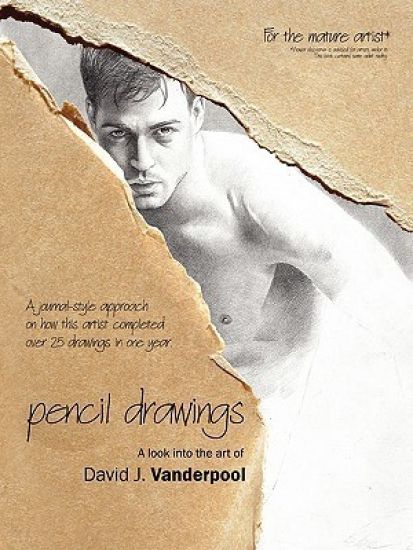
Pencil Drawings - A Look into the Art of David J. Vanderpool
Starting off with the artist's top winning pencil drawings from 2010 through 2012, this autobiography style book allows the reader an opportunity to not only learn the process it took to complete most of his drawings (created between 2008-2013) which are shown within these pages, but offers a personal look into who the artist is as a man. From portraits to figure drawings, David J. Vanderpool shares how simple pencil lines can be used to create masterfully crafted drawings - all while working through obstacles he would later encounter as an artist. Proving that art isn't always about who the artist is, but rather who catches his attention at that moment. Closing with several fan-favorite drawings from his other top selling books, this book offers his most completed works to date. VIEWER DISCRETION IS ADVISED: This book contains adult male nudity. NOTICE: This book is not a "how-to book" but rather as one review noted, "An Art Exhibit And Fan Book". The inside pages are not glossy.
Collector's Edition Pencil Drawings - A Look into the Art of David J. Vanderpool
Starting off with the artist's top winning pencil drawings from 2010 through 2012, this autobiography style book allows the reader an opportunity to not only learn the process it took to complete most of his drawings created since 2008, but offers a personal look into who the artist is as a man. From portraits to figure drawings, David J. Vanderpool shares how simple pencil lines can be used to create masterfully crafted drawings - all while working through obstacles he would later encounter as an artist. Proving that "art isn't always about who the artist is, but rather who catches his attention at that moment". Although the drawings are created using black and white graphite, the pages here are full color glossy. Making the perfect Collector's Edition, as it picks up where the first edition left off and sharing many of his drawings created up until summer of 2016. VIEWER DISCRETION IS ADVISED: This book contains adult male nudity.