Kirjojen hintavertailu. Mukana 11 244 527 kirjaa ja 12 kauppaa.

Kirjahaku

Etsi kirjoja tekijän nimen, kirjan nimen tai ISBN:n perusteella.

1000 tulosta hakusanalla David L. Preston

Braddock's Defeat

Braddock's Defeat

David L. Preston

Oxford University Press Inc
2018
nidottu
On July 9, 1755, British regulars and American colonial troops under the command of General Edward Braddock, commander in chief of the British Army in North America, were attacked by French and Native American forces shortly after crossing the Monongahela River and while making their way to besiege Fort Duquesne in the Ohio Valley, a few miles from what is now Pittsburgh. The long line of red-coated troops struggled to maintain cohesion and discipline as Indian warriors quickly outflanked them and used the dense cover of the woods to masterful and lethal effect. Within hours, a powerful British army was routed, its commander mortally wounded, and two-thirds of its forces casualties in one the worst disasters in military history. David Preston's gripping and immersive account of Braddock's Defeat, also known as the Battle of the Monongahela, is the most authoritative ever written. Using untapped sources and collections, Preston offers a reinterpretation of Braddock's Expedition in 1754 and 1755, one that does full justice to its remarkable achievements. Braddock had rapidly advanced his army to the cusp of victory, overcoming uncooperative colonial governments and seemingly insurmountable logistical challenges, while managing to carve a road through the formidable Appalachian Mountains. That road would play a major role in America's expansion westward in the years ahead and stand as one of the expedition's most significant legacies. The causes of Braddock's Defeat are debated to this day. Preston's work challenges the stale portrait of an arrogant European officer who refused to adapt to military and political conditions in the New World and the first to show fully how the French and Indian coalition achieved victory through effective diplomacy, tactics, and leadership. New documents reveal that the French Canadian commander, a seasoned veteran named Captain Beaujeu, planned the attack on the British column with great skill, and that his Native allies were more disciplined than the British regulars on the field. Braddock's Defeat establishes beyond question its profoundly pivotal nature for Indian, French Canadian, and British peoples in the eighteenth century. The disaster altered the balance of power in America, and escalated the fighting into a global conflict known as the Seven Years' War. Those who were there, including George Washington, Thomas Gage, Horatio Gates, Charles Lee, and Daniel Morgan, never forgot its lessons, and brought them to bear when they fought again-whether as enemies or allies-two decades hence. The campaign had awakened many British Americans to their provincial status in the empire, spawning ideas of American identity and anticipating the social and political divisions that would erupt in the American Revolution.

Braddock's Defeat

Braddock's Defeat

David L. Preston

Oxford University Press Inc
2015
sidottu
On July 9, 1755, British and colonial troops under the command of General Edward Braddock suffered a crushing defeat to French and Native American enemy forces. The Battle of the Monongahela altered the trajectory of the Seven Years' War in America, greatly escalating the war and inexorably defining its military and political character. The Monongahela was an unprecedented rout of a modern and powerful British army by a predominantly Indian force, and as David Preston shows in this gripping new account, no other battle before 1775 had such a searing effect on the colonial British world. The culmination of a failed attempt to capture Fort Duquesne from the French, Braddock's Defeat was a pivotal moment in American and world history, ranking with the destruction of Varus's legions in the Teutoburg Forest, Noche Triste, St. Clair's Defeat, and the Little Bighorn as examples of imperial forces falling to indigenous foes. While the defeat is often said to have been caused by blundering and arrogance on the part of Braddock, Preston argues that this myth has depreciated the victory that Indian and French forces won by their superior discipline, tactical decisions, and leadership. The French Canadian officer Captain Beaujeu had greater tactical skill, better reconnaissance, and a battle plan that he effectively coordinated with Indian allies who brilliantly executed it, Preston shows. The Indians were the most effective and disciplined troops on the field on that decisive July day, especially in comparison to Braddock's poorly trained, amalgamated, and ultimately undisciplined Regulars. Reframing our understanding of the superiority of the French and Indian alliance, Preston also explores the long shadow cast by Braddock's Defeat over the 18th century and the American Revolution. The campaign had been an awakening to empire for many British Americans, spawning a sustained discourse on American identity and anticipating many of the empire's political and social divisions that became wider and deeper by the outbreak of the Revolution. It was the defining generational experience for many of British and American officers, including George Washington, Thomas Gage, and Horatio Gates, who carried their veteran experiences from the Seven Years' War forward into American Revolution. Rooted in extensive fieldwork on the campaign's geography and terrain and presenting an abundance of new evidence, Braddock's Defeat presents the fullest account yet of this defining moment in early American history.
The Social Organization of Zen Practice

The Social Organization of Zen Practice

David L. Preston

Cambridge University Press
2012
pokkari
This book, first published in 1998, provides both a first-hand account and a theoretical analysis of the way an American Zen community works. The form Zen practice takes in the United States is described in detail through close study of two Zen groups in southern California. Preston leads readers through the buildings and grounds of a Zen residential community and introduces them to the main forms of Zen practice, paying special attention to the styles and implications of meditation. The book's second half develops a theory of the nature of religious reality as it is shared by Zen practitioners. Preston attempts to explain how this reality - based on a group's ethnography yet at the same time transcending it - relates to meditation and other elements of Zen practice by drawing on the notions of ritual, practice, emotions, and the unconscious found in the writings of Pierre Bourdieu, Randall Collins, Erving Goffman and Emile Durkheim.
The Social Organization of Zen Practice

The Social Organization of Zen Practice

David L. Preston

Cambridge University Press
1988
sidottu
This book, first published in 1998, provides both a first-hand account and a theoretical analysis of the way an American Zen community works. The form Zen practice takes in the United States is described in detail through close study of two Zen groups in southern California. Preston leads readers through the buildings and grounds of a Zen residential community and introduces them to the main forms of Zen practice, paying special attention to the styles and implications of meditation. The book's second half develops a theory of the nature of religious reality as it is shared by Zen practitioners. Preston attempts to explain how this reality - based on a group's ethnography yet at the same time transcending it - relates to meditation and other elements of Zen practice by drawing on the notions of ritual, practice, emotions, and the unconscious found in the writings of Pierre Bourdieu, Randall Collins, Erving Goffman and Emile Durkheim.
The Texture of Contact

The Texture of Contact

David L. Preston

University of Nebraska Press
2009
sidottu
The Texture of Contact is a landmark study of Iroquois and European communities and coexistence in eastern North America before the American Revolution. David L. Preston details the ways in which European and Iroquois settlers on the frontiers creatively adapted to each other's presence, weaving webs of mutually beneficial social, economic, and religious relationships that sustained the peace for most of the eighteenth century. Drawing on a wealth of previously unexamined archival research, Preston describes everyday encounters between Europeans and Indians along the frontiers of the Iroquois Confederacy in the St. Lawrence, Mohawk, Susquehanna, and Ohio valleys. Homesteads, taverns, gristmills, churches, and markets were frequent sites of intercultural exchange and negotiation. Complex diplomatic and trading relationships developed as a result of European and Iroquois settlers bartering material goods. Innovative land-sharing arrangements included the common practice of Euroamerican farmers living as tenants of the Mohawks, sometimes for decades. This study reveals that the everyday lives of Indians and Europeans were far more complex and harmonious than past histories have suggested. Preston's nuanced comparisons between various settlements also reveal the reasons why peace endured in the Mohawk and St. Lawrence valleys while warfare erupted in the Susquehanna and Ohio valleys. One of the most comprehensive studies of eighteenth-century Iroquois history, The Texture of Contact broadens our understanding of eastern North America's frontiers and the key role that the Iroquois played in shaping that world.

The Texture of Contact

The Texture of Contact

David L. Preston

University of Nebraska Press
2012
pokkari
The Texture of Contact is a landmark study of Iroquois and European communities and coexistence in eastern North America before the American Revolution. David L. Preston details the ways in which European and Iroquois settlers on the frontiers creatively adapted to each other's presence, weaving webs of mutually beneficial social, economic, and religious relationships that sustained the peace for most of the eighteenth century. Drawing on a wealth of previously unexamined archival research, Preston describes everyday encounters between Europeans and Indians along the frontiers of the Iroquois Confederacy in the St. Lawrence, Mohawk, Susquehanna, and Ohio valleys. Homesteads, taverns, gristmills, churches, and markets were frequent sites of intercultural exchange and negotiation. Complex diplomatic and trading relationships developed as a result of European and Iroquois settlers bartering material goods. Innovative land-sharing arrangements included the common practice of Euroamerican farmers living as tenants of the Mohawks, sometimes for decades. This study reveals that the everyday lives of Indians and Europeans were far more complex and harmonious than past histories have suggested. Preston's nuanced comparisons between various settlements also reveal the reasons why peace endured in the Mohawk and St. Lawrence valleys while warfare erupted in the Susquehanna and Ohio valleys. One of the most comprehensive studies of eighteenth-century Iroquois history, The Texture of Contact broadens our understanding of eastern North America's frontiers and the key role that the Iroquois played in shaping that world.
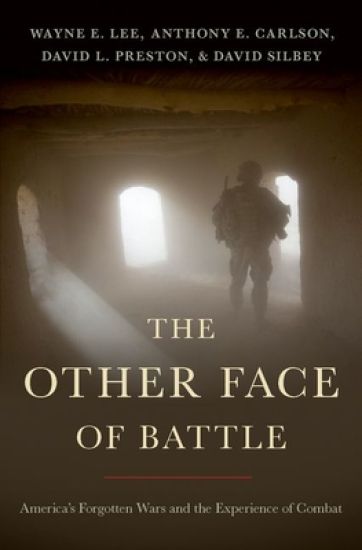
The Other Face of Battle

The Other Face of Battle

Wayne E. Lee; Anthony E. Carlson; David L. Preston; David Silbey

Oxford University Press Inc
2021
sidottu
Taking its title from The Face of Battle, John Keegan's canonical book on the nature of warfare, The Other Face of Battle illuminates the American experience of fighting in “irregular” and “intercultural” wars over the centuries. Sometimes known as “forgotten” wars, in part because they lacked triumphant clarity, they are the focus of the book. David Preston, David Silbey, and Anthony Carlson focus on, respectively, the Battle of Monongahela (1755), the Battle of Manila (1898), and the Battle of Makuan, Afghanistan (2020)--conflicts in which American soldiers were forced to engage in “irregular” warfare, confronting an enemy entirely alien to them. This enemy rejected the Western conventions of warfare and defined success and failure-victory and defeat-in entirely different ways. Symmetry of any kind is lost. Here was not ennobling engagement but atrocity, unanticipated insurgencies, and strategic stalemate. War is always hell. These wars, however, profoundly undermined any sense of purpose or proportion. Nightmarish and existentially bewildering, they nonetheless characterize how Americans have experienced combat and what its effects have been. They are therefore worth comparing for what they hold in common as well as what they reveal about our attitude toward war itself. The Other Face of Battle reminds us that “irregular” or “asymmetrical” warfare is now not the exception but the rule. Understanding its roots seems more crucial than ever.
Distant Drums: The Poetic Writings of David L. Weeks

Distant Drums: The Poetic Writings of David L. Weeks

David L. Weeks

Conquering Lion Enterprise
2021
nidottu
Our gift of creativity and mastery of the written and spoken word binds Us by duty to share with the world what GOD inspires in Us. After an overlong hiatus, David L. Weeks returns with a new book of original poems, entitled DISTANT DRUMS The collection represents the culmination of an over thirty-five-year poetry writing journey...conscious, inspirational, spiritual, love, and erotic poems-raw, explicit, uncensored. Featuring never-before-shared poems like, Bring Back The Old Days, Make Love To You, When The Sun Sets. And fan favorites such as Jazz, Back To The Still Waters, Purple, Light Your Fire, Feel My Nature Rise, La Boriqua, You Cannot Wear My Crown, and many more. The book's cover evokes memories of David's days as a youth. Reminiscent of artistic designs of reggae albums of the '70s and' 80s...like Journey To Addis, Uprising, The Harder They Come, and Man In The Hills, to name a few. Imagine "Distant Drums" lying on your coffee table, not just a book but also a visual work of art. It's One Book You Can Judge By Its Cover "In African culture and tradition, one of the ancient functions of The Drums was to send messages, sometimes across great Distances. Today, drums still hold profound, spiritual, and venerable importance in the African way of life-on the continent and the diaspora. It is within this Ancient Tradition that David presents this book of Messages. Distant Drums "Conquering Lion Enterprise, Publishing.2021
David L. DeLaney's Pawns

David L. DeLaney's Pawns

David DeLaney

AuthorHouse
2005
pokkari
With the country on the brink of World War III, a new president takes office to put forth new changes in military policies. Due to these policies and lack of health benefits General Holland dies. These changes have affected all branches of the armed forces and country as a whole. And at the rate things are going the military will soon no longer comply with their Commander and Chief. Four army rangers couldn't stand by and see everything they believe that was good and honorable, be shoved aside, because of Congress' approval of the President's Bill. That's when they took matters into their own hands. Some might call it treason; whereas, others might call it patriotism. You decide.
An Appeal From David L. Childs ... to the Abolitionists ..

An Appeal From David L. Childs ... to the Abolitionists ..

David Lee [From Old Catalog] Childs

Sagwan Press
2018
pokkari
This work has been selected by scholars as being culturally important, and is part of the knowledge base of civilization as we know it. This work was reproduced from the original artifact, and remains as true to the original work as possible. Therefore, you will see the original copyright references, library stamps (as most of these works have been housed in our most important libraries around the world), and other notations in the work.This work is in the public domain in the United States of America, and possibly other nations. Within the United States, you may freely copy and distribute this work, as no entity (individual or corporate) has a copyright on the body of the work.As a reproduction of a historical artifact, this work may contain missing or blurred pages, poor pictures, errant marks, etc. Scholars believe, and we concur, that this work is important enough to be preserved, reproduced, and made generally available to the public. We appreciate your support of the preservation process, and thank you for being an important part of keeping this knowledge alive and relevant.
L'oeuvre de David l'Invincible et la transmission de la pensée grecque dans la tradition arménienne et syriaque
David, a member of the Platonic school in Alexandria in the sixth century, is credited with several commentaries on Aristotle’s logic: those commentaries, and their Armenian translations, form the subject of this book. An introduction, which discusses David and his place in the Greek and the Armenian traditions, is followed by a series of studies of the relations between the Greek texts and their Armenian translations: the aims are, first, to assess the value of the translations for the constitution of the original Greek, and secondly, to consider the ways in which the Armenian translations adapted the texts to suit their new readership. More generally, the book is concerned with the ways in which Greek thought was exported abroad—to Armenia and to Syria: it is required reading for anyone who is interested in the circulation of ideas between east and west. Contributors include: Sen Arevshatyan, Jonathan Barnes, Valentina Calzolari, Henri Hugonnard-Roche, Gohar Muradyan, Michael Papazian, Manea Shirinian, Clive Sweeting, Albert Stepanyan, Aram Topchyan.
The Collected Sermons of David Bartlett

The Collected Sermons of David Bartlett

David L Bartlett; Leonora Tubbs Tisdale

Westminster John Knox Press
2020
sidottu
This collection of fifty-two sermons shows beloved New Testament scholar David Bartlett at his best. Bartlett, who died in 2017, spent his career teaching and mentoring preachers at The University of Chicago Divinity School, Yale Divinity School, Union Presbyterian Seminary, and Columbia Theological Seminary, as well as serving as a pastor in American Baptist churches. Thus, he has generations of friends and former students who knew him for his quick wit, passion for justice, and deep knowledge of the Bible. Those traits show through in these sermons. As Nora Tisdale says in the foreword: "All of the sermons in this volume give witness to David's passion for preaching that is solidly grounded in the biblical text. Most of them actually begin, as Karl Barth urged preachers to begin, with the biblical text. If they don't begin there, they always get there fairly quickly. And David's interpretations of texts often surprise the reader with their freshness and clarity." In addition to individual sermons, several multiweek sermon series, including a series on Who Is Jesus? and Great Words of the Faith, are included.