Kirjojen hintavertailu. Mukana 11 244 527 kirjaa ja 12 kauppaa.

Kirjahaku

Etsi kirjoja tekijän nimen, kirjan nimen tai ISBN:n perusteella.

1000 tulosta hakusanalla David M. Harland

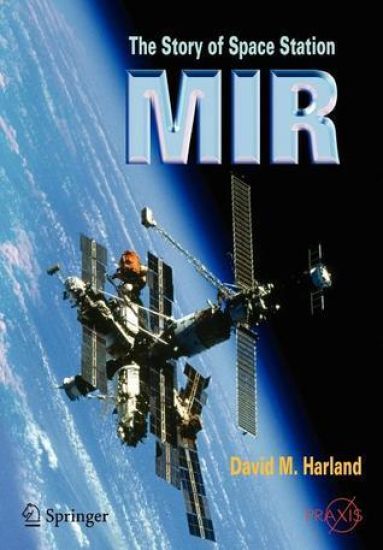
The Story of Space Station Mir

The Story of Space Station Mir

David M. Harland

Springer-Verlag New York Inc.
2005
nidottu
This successor edition picks up the story where the first edition left off in 1997, and runs through to Mir’s de-orbiting in March 2001, providing the definitive account of the Mir Space Station. The book reviews the origins of the Soviet space station programme, in particular the highly successful Salyuts 6 and 7, describes Mir’s structure, environment, power supply and maneuvering systems, and provides a comprehensive account of how it was assembled and how it operated in orbit. Tells how the Soviet Union's experience with a succession of Salyut space stations led to the development of Mir, which was assembled in space, piece by piece, between 1982 and 1996 and became an international research laboratory whose technology went on to form the 'core modules' of the International Space Station.
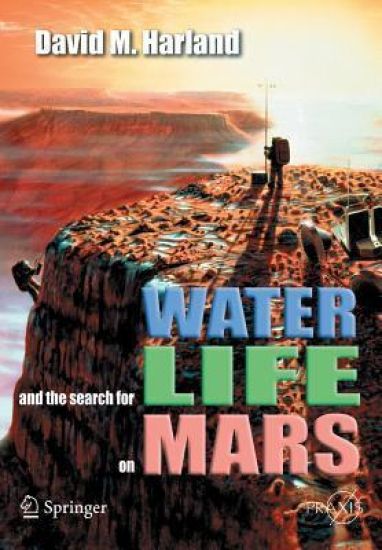
Water and the Search for Life on Mars

Water and the Search for Life on Mars

David M. Harland

Springer-Verlag New York Inc.
2005
nidottu
Mars has long been believed to have been cold, dead and dry for aeons, but there is now striking new proof that not only was Mars a relatively warm and wet place in geologically recent times, but that even today there are vast reserves of water frozen beneath the planet’s surface. As well as casting fascinating new insights into Mars’ past, this discovery is also forcing a complete rethink about the mechanisms of global planetary change and the possibility that there is microbial life on Mars. David Harland considers the issue of life on Mars in parallel with the origin of life on Earth. At the time the Viking instruments were designed, it was thought that all terrestrial life ultimately derived its energy from sunlight, and that the earliest form of life was the cyanobacteria with chlorophyll for photosynthesis. It was assumed the same would be the case on Mars and that microbial life would be on or near the surface that the Vikings had sampled. In parallel with these NASA projects, the European Space Agency developed the Mars Express remote-sensing orbiter, which has detected traces of methane that may have been released by microbes. If microbial life is found on Mars, will it be based on DNA? Will this indicate that life developed independently? Or that it has characteristics in common with the most ancient forms of terrestrial life? If life is found on two planets in the same planetary system, this would favour the panspermia hypothesis. And if martian life is radically different, then in light of the discovery of planetary systems around other stars, this would, as remarked by Philip Morrison of MIT, "transform life from the status of a miracle to that of a statistic". These are all questions that the exploration of Mars for life are aimed to answer.
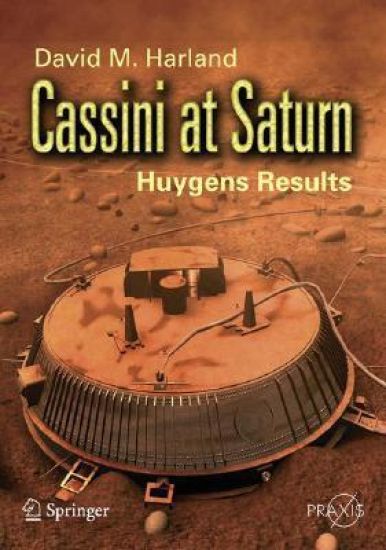
Cassini at Saturn

Cassini at Saturn

David M. Harland

Springer-Verlag New York Inc.
2007
nidottu
Cassini At Saturn – Huygens Results brings the story of the Cassini-Huygens mission and their joint exploration of the Saturnian system right up to date. Cassini entered orbit around Saturn June 2004 so this update includes 8 months of scientific data available for review, including the most spectacular images of Saturn, its rings and satellites ever obtained by a space mission. As the Cassini spacecraft approached its destination in spring 2004, the quality of the images already being returned by the spacecraft clearly demonstrated the spectacular nature of the close-range views that will be obtained. The book contains a 16-page colour section, comprising a carefully chosen selection of the most stunning images to be released during the spacecraft’s initial period of operation. The Huygens craft, released by Cassini, parachuted through the clouds of Saturn’s largest moon, Titan, in January 2005. David Harland tells the exciting story of the this craft’s journey to the surface of one of the most enigmatic bodies on the Solar System, the only moon to have a dense atmosphere and possibly lakes of liquid gas at -190ºC on its surface. Titan is considered to be an early Earth in deep freeze, possibly with the building blocks of life in its atmosphere. There will undoubtedly be enormous interest in the first results and images of Titan’s surface, and this book is the first incisive summary of this groundbreaking material.
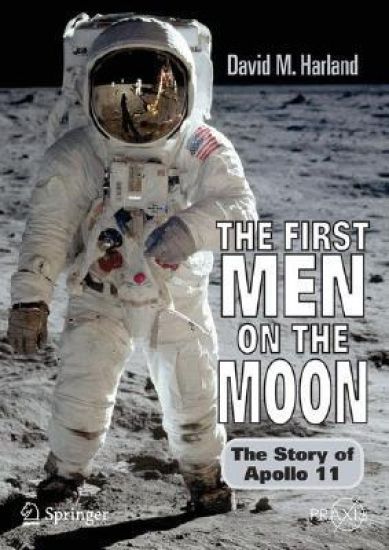
The First Men on the Moon

The First Men on the Moon

David M. Harland

Springer-Verlag New York Inc.
2006
nidottu
On 12 April 1961 Yuri Gagarin became the first man to orbit the Earth. One month later, President John F. Kennedy challenged the American nation to land a man on the Moon before the decade was out. On 16 July 1969, Neil Armstrong, Michael Collins and Buzz Aldrin set off in Apollo 11 to attempt this audacious mission, and succeeded magnificently. This book tells the story of Apollo 11, starting with crew selection and training, the choice of the landing site, and the assembly of the space vehicle, then a detailed account of the mission, featuring the lunar landing and moonwalk, and a review of how our knowledge of the Moon's history was revolutionised as a result. The story is enlivened by dialogue between the astronauts in space and the flight controllers in Mission Control.
NASA's Moon Program

NASA's Moon Program

David M. Harland

Springer-Verlag New York Inc.
2009
nidottu
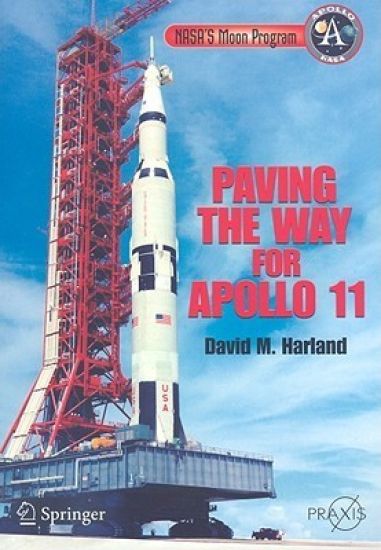
In 'Paving the Way for Apollo 11' David Harland explains the lure of the Moon to classical philosophers, astronomers, and geologists, and how NASA set out to investigate the Moon in preparation for a manned lunar landing mission. It focuses particularly on the Lunar Orbiter and Surveyor missions.
Exploring the Moon

Exploring the Moon

David M. Harland

Springer-Verlag New York Inc.
2008
nidottu
David Harland opens with a review of the robotic probes, namely the Rangers which returned television before crashing into the Moon, the Surveyors which 'soft landed' in order to investigate the nature of the surface, and the Lunar Orbiters which mapped prospective Apollo landing sites. He then outlines the historic landing by Apollo 11 in terms of what was discovered, and how over the next several missions the program was progressively geared up to enable the final three missions each to spend three days on comprehensive geological investigations. He concludes with a review of the robotic spacecraft that made remote-sensing observations of the Moon. Although aimed at the enthusiast, and can be read as an adventure in exploration, the book develops the scientific theme of lunar geology, and therefore will be of use as background reading for undergraduate students of planetary sciences. In addition, with the prospect of a resumption of human missions, it will help journalists understand what Apollo achieved after the 'flags and footprints' of the Apollo 11 landing in July 1969 and will commemorate the fortieth anniversary of that momentous event.
Apollo 12 - On the Ocean of Storms

Apollo 12 - On the Ocean of Storms

David M. Harland

Praxis
2011
nidottu
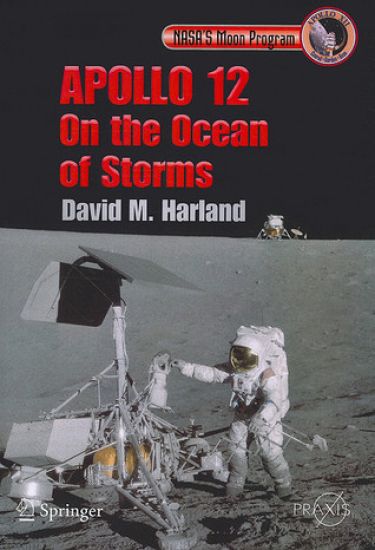
In July 1969 the ‘amiable strangers’ that made up the crew of the historic Apollo 11 flight successfully achieved the first manned lunar landing. Several months later, three close friends set off on an even more challenging mission. Free of the burden of making history, the Apollo 12 astronauts were determined to really enjoy their experience while taking care of business. This is the story of their mission, told largely in their own words. Their exploits and accomplishments showed how conservative the inaugural mission had been. With its two moonwalks, deployment of the first geophysical station on the Moon, and geological sampling, Apollo 12 did what many had hoped would be achieved by the first men to land on the Moon. The Apollo 12 mission also spectacularly demonstrated the precision landing capability required for success in future lunar surface explorations. In addition to official documents, published prior to and after the mission, APOLLO 12 – ON THE OCEAN OF STORMS draws on the flight transcript and post-mission debriefing to recreate the drama.
Jupiter Odyssey

Jupiter Odyssey

David M. Harland

Springer London Ltd
2000
nidottu
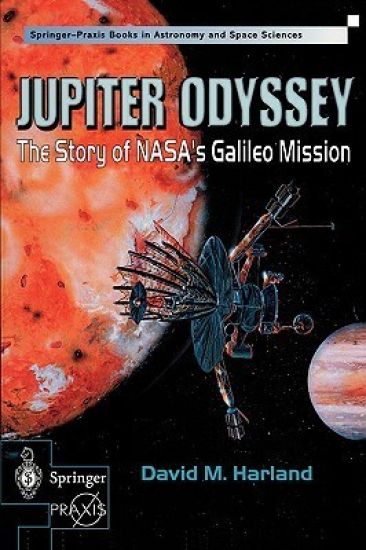
Focusing on the Galileo Mission, the story will relate this remarkable spacecraft's protracted gestation and the ordeal of its long haul out to Jupiter and its ultimate triumph: 5 years exploration within the Jovian system. The story spans a full quarter of a century, drawing on the press conferences, technical papers and essays of engineers and scientists involved in the mission which provide a real sense of participation as the discoveries poured in - it will bring the mission of the Galileo spacecraft to life and provide a more engaging account than would simply be achieved by recounting scientific results. The book will conclude with a snapshot "look ahead" into the Cassini flyby of Jupiter in December 2000 shortly after publication - the book released to coincide with this media event.
The Earth in Context

The Earth in Context

David M. Harland

Springer London Ltd
2001
nidottu
The Earth in Context: A Guide to the Solar System tells a tale of scientific discovery, with two interwoven strands - one tracing the development of understanding the Earth's geological history, and the other placing this in the context of processes at work on the other planets of the solar system. Although planetology is assigned half of the text, the primary focus of the book is the Earth. It is discussed in two parts, the first summing up our knowledge of the Earth as it is today and the other considering it as it was long ago.
Mission to Saturn

Mission to Saturn

David M. Harland

Springer London Ltd
2002
nidottu
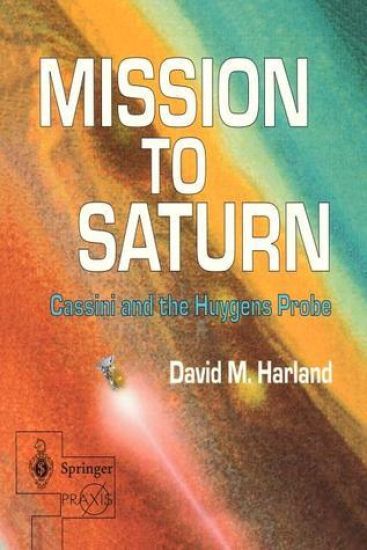
Saturn is back in the news! The Cassini/Huygens spacecraft, a joint venture by NASA and the European Space Agency, is on its way to Saturn, where it will arrive in July 2004. During 2005 it will explore beneath the clouds of Titan, Saturn's largest moon and potential home for extraterrestrial life. Written by an established space historian and experienced author, Mission To Saturn - Cassini and the Huygens Probe is an up-to-date and timely review of our knowledge of Saturn and its enigmatic moon, Titan, on which the Huygens probe will land to search for prebiotic chemistry or even life. It explains how the mission was planned, how it will operate and, as the spacecraft nears its target, puts into context the discoveries that are sure to follow from this once-in-a-lifetime mission.
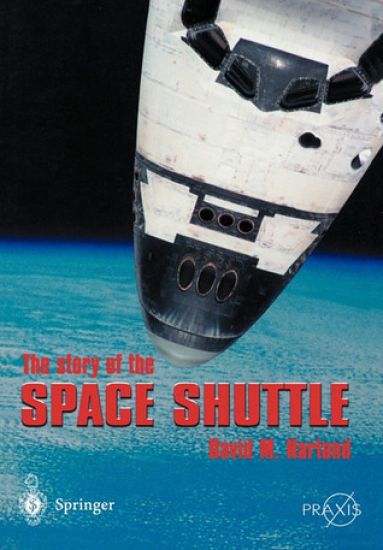
The Story of the Space Shuttle

The Story of the Space Shuttle

David M. Harland

Springer London Ltd
2004
nidottu
In spite of the Challenger and Columbia disasters, the US Space Shuttle, which entered service in 1981, remains the most successful spacecraft ever developed. Conceived and designed as a reusable spacecraft to provide cheap access to low Earth orbit, and to supersede expendable launch vehicles, serving as the National Space Transportation System, it now coexists with a new range of commercial rockets. David Harland’s definitive work on the Space Shuttle explains the scientific contribution the Space Shuttle has made to the international space programme, detailing missions to Mir, Hubble and more recently its role in the assembly of the International Space Station. This substantial revision to existing chapters and extension of ‘The Space Shuttle’, following the loss of Columbia, will include a comprehensive account of the run-up to resumption of operations and conclude with a chapter beyond the Shuttle, looking at possible future concepts for a partly or totally reusable space vehicle which are being considered to replace the Shuttle.
Space Systems Failures

Space Systems Failures

David M. Harland; Ralph Lorenz

Springer-Verlag New York Inc.
2005
nidottu
In the 1960s and 1970s deep space missions were dispatched in pairs in case one was lost in launch or failed during its journey. Following the triumphs of the Viking landings on Mars in 1976 and both Voyagers spacecraft successfully surveying the outer giant planets of the Solar System, it was decided by NASA to cut costs and send out just a single probe. Although Magellan successfully mapped Venus by radar, it suffered from problems during the flight. Then came the loss of Mars Observer, whose engine exploded as it was preparing to enter Mars’ orbit because it was using technology designed for Earth’s satellites and the engine was not suited to spending several months in space. Later came the high-profile losses of Mars Climate Observer and Mars Polar Lander - a consequence of the faster, better, cheaper philosophy introduced by Dan Goldin in 1993. Even the highly successful Galileo mission suffered a major setback when its high-gain antenna (also based on satellite mission suffered a major setback when its high-gain antenna (also based on satellite communication technology) failed to deploy fully, greatly diminishing the craft’s radio transmission capabilities, forcing the ground crew to re-programme the on-board computer to enable it to fulfil its mission and provide stunning images of Jupiter and its moons. In Space Systems Failures, David Harland (here working with co-author Ralph Lorenz) describes the many quite fascinating tales of woe involving failures of rockets, satellites and deep space missions in his inimitable style, providing a unique insight into the trials and tribulations of exploration at the high frontier.
Space Exploration 2008

Space Exploration 2008

David M. Harland; Brian Harvey

Springer-Verlag New York Inc.
2007
nidottu
The aim of the Space Exploration annuals is to provide a yearly update on recent space launches, missions and results, to be published every September. The annual will cover space exploration from a variety of angles, looking back at past missions, reviewing those currently under way and detailing those planned for the future, and encompassing both manned and unmanned spaceflight. The invited contributions, authored by leading figures in astronomy and space exploration and which make up the bulk of the annual each year, will cover a variety of topics and are written to appeal to a wide readership. One feature introduced in the first volume ‘Solar System Log’ featuring the very latest in the exploration of the planets, their moons and small Solar System bodies, will be retained for Space Exploration 2008, and will comprise seven chapters. In addition, there will be a special additional section entitled, ‘Return to the Moon’ containing three chapters.
Creating the International Space Station

Creating the International Space Station

David M. Harland; John E. Catchpole

Springer London Ltd
2002
nidottu
Creating the International Space Station' will be the first comprehensive review of the historical background, rationale behind, and events leading to the construction and commissioning of the ISS. The authors describe the orbital assembly of the ISS on a flight-by-flight basis, listing all the experiments planned in the various laboratory modules and explain their objectives. They also provide an account of the long-term stresses and strains of building the ISS on the US/Russia relationship, especially after 1997. By offering a comprehensive mix of operational work, microgravity science and future plans, the book should satisfy both the space enthusiast, eager for a detailed review of the missions, and the specialist wishing to read about the science research programme.
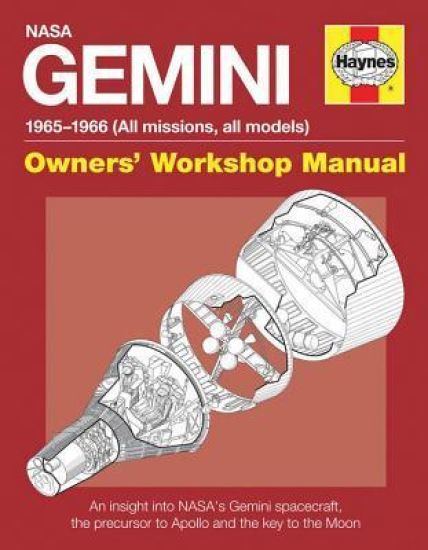
Gemini Manual

Gemini Manual

David Woods; David M Harland

J H Haynes Co Ltd
2014
sidottu
NASA Gemini Owners' Workshop Manual 1965-1966 (all missions, all models) An insight into NASA's Gemini spacecraft, the precursor to Apollo and the key to the Moon. David Woods and David M. Harland NASA's Gemini space flight programme followed on from the pioneering Mercury missions which put the first US astronauts into space. The Gemini spacecraft was an agile flying machine for fighter pilots, which gave the US the tool it needed to fly into space, and in doing so prepared NASA to travel to the Moon. In a breathless series of 10 manned flights spread across only 20 months of 1965 and 1966, Gemini propelled NASA from being a tentative, inexperienced space agency to a tough, competent and confident organisation that could send astronauts to another world. This Manual celebrates this important spacecraft with a thorough look at the technologies and techniques that were developed for the programme during its heyday.
The Hubble Space Telescope

The Hubble Space Telescope

David J. Shayler; David M. Harland

Praxis
2015
nidottu
The highly successful Hubble Space Telescope was meant to change our view and understanding of the universe. Within weeks of its launch in 1990, however, the space community was shocked to find out that the primary mirror of the telescope was flawed. It was only the skills of scientists and engineers on the ground and the daring talents of astronauts sent to service the telescope in December 1993 that saved the mission.For over two decades NASA had developed the capabilities to service a payload in orbit. This involved numerous studies and the creation of a ground-based infrastructure to support the challenging missions. Unique tools and EVA hardware supported the skills developed in crew training that then enabled astronauts to complete a demanding series of spacewalks.Drawing upon first hand interviews with those closely involved in the project over thirty years ago this story explains the development of the servicing mission concept and the hurdles that had to be overcome to not only launch the telescope but also to mount the first servicing mission – a mission that restored the telescope to full working order three years after its launch, saved the reputation of NASA, and truly opened a new age in understanding of our place in space.This is not just a tale of space age technology, astronauts and astronomy. It is also a story of an audacious scientific vision, and the human ingenuity and determination to overcome all obstacles to make it possible. Hubble Space Telescope: From Concept to Success is a story of an international partnership, dedicated teamwork and a perfect blend of human and robotic space operations that will inspire people of all ages. The subsequent servicing missions that enabled the telescope to continue its scientific program beyond its 25th year in orbit are described in a companion volume Enhancing Hubble’s Vision: Servicing a National Treasure.
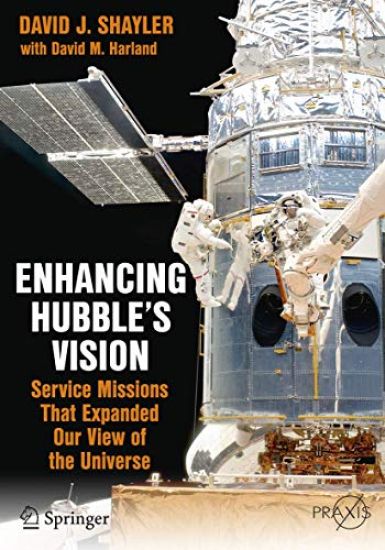
Enhancing Hubble's Vision

Enhancing Hubble's Vision

David J. Shayler; David M. Harland

Springer International Publishing AG
2015
nidottu
This book tells the story of the four missions to maintain Hubble's successful operation. Between 1997 and 2009 these repaired, serviced and upgraded the instruments on the telescope to maintain its state-of-the-art capabilities. It draws on first hand interviews with those closely involved in the project. The spacewalking skills and experiences gained from maintaining and upgrading Hubble had direct application to the construction of the International Space Station and help with its maintenance. These skills can be applied to future human and robotic satellite servicing and maintenance activities as well, not only in Earth orbit but at locations deeper in space.A companion to this book, The Hubble Space Telescope: From Concept to Success, relates the events of the Telescope’s launch in 1990 and its rough start, after a 20-year struggle to place a large optical telescope in orbit. Originally intended to operate for fifteen years, Hubble has just passed its 25th anniversary, and there is every expectation that it will survive for thirty years. Despite its early problems, the Hubble Space Telescope has become a lasting legacy of the Space Shuttle program, and indeed is a national treasure.
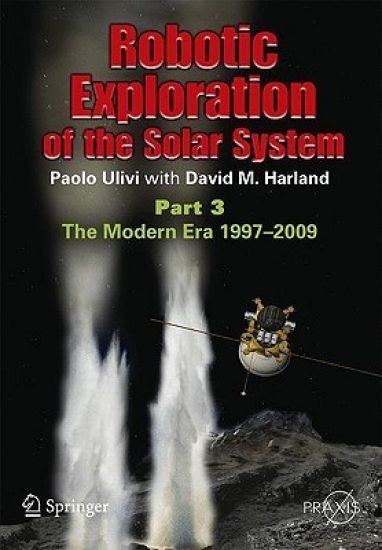
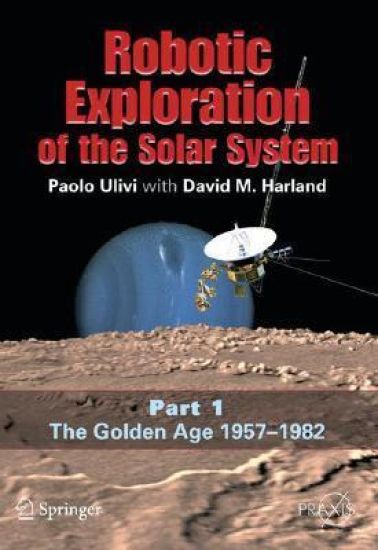
Robotic Exploration of the Solar System

Robotic Exploration of the Solar System

Paolo Ulivi; David M. Harland

Springer-Verlag New York Inc.
2012
nidottu
Paolo Ulivi and David Harland provide in Robotic Exploration of the Solar System a detailed history of unmanned missions of exploration of our Solar System. The subject is treated from an engineering and scientific standpoint. Technical descriptions of the spacecraft, of their mission designs and of instrumentations are provided. Scientific results are discussed in considerable depth, together with details of mission management. The project will deliver four volumes totaling over 2,000 pages that will provide comprehensive coverage of the topic with thousands of references to the professional literature that should make it the 'first port of call' for people seeking information on the topic. The books will cover missions from the 1950s until the present day, and some of the latest missions and their results will appear in a popular science book for the first time.
Robotic Exploration of the Solar System

Robotic Exploration of the Solar System

Paolo Ulivi; David M. Harland

Springer-Verlag New York Inc.
2007
nidottu
Paolo Ulivi and David Harland provide in Robotic Exploration of the Solar System a detailed history of unmanned missions of exploration of our Solar System. As in their previous book Lunar Exploration, the subject will be treated wherever possible from an engineering and scientific standpoint. Technical descriptions of the spacecraft, of their mission designs and of instrumentations will be provided. Scientific results will be discussed in considerable depth, together with details of mission management. The book will be comprehensive, covering missions and results from the 1950s until the present day, and some of the latest missions and their results will appear in a popular science book for the first time. The authors will also cover many unflown missions, providing an indication of the ideas that proved to be unfulfilled at the time but which may still be proven and useful in the future. The project will deliver three volumes totaling over 1000 pages, providing comprehensive coverage of the topic.
Robotic Exploration of the Solar System

Robotic Exploration of the Solar System

Paolo Ulivi; David M. Harland

Springer-Verlag New York Inc.
2008
nidottu
Paolo Ulivi and David Harland provide in "Robotic Exploration of the Solar System" a detailed history of unmanned missions of exploration of our Solar System As in their previous book Lunar Exploration, the subject will be treated wherever possible from an engineering and scientific standpoint. Technical descriptions of the spacecraft, of their mission designs and of instrumentations will be provided. Scientific results will be discussed in considerable depth, together with details of mission management. The books will cover missions from the 1950s until the present day, and some of the latest missions and their results will appear in a popular science book for the first time. The authors will also cover many unflown projects, providing an indication of the ideas that proved to be unfulfilled at the time but which may still be proven and useful in the future. Just like Lunar Exploration, these books will use sources only recently made available on the Soviet space program, in addition to some obscure and rarely used references on the European space program. The project will deliver three volumes totaling over 1000 pages that will provide comprehensive coverage of the topic with thousands of references to the professional literature that should make it the 'first port of call' for people seeking information on the topic.