Kirjojen hintavertailu. Mukana 11 238 005 kirjaa ja 12 kauppaa.

Kirjahaku

Etsi kirjoja tekijän nimen, kirjan nimen tai ISBN:n perusteella.

1000 tulosta hakusanalla David P. Silcox

David B. Milne

David B. Milne

David Milne; David P. Silcox

University of Toronto Press
1998
sidottu
David Brown Milne (1882 - 1953) was one of the great artists of his generation in North America, according to the American art critic Clement Greenberg, who compared Milne with John Marin and Marsden Hartley. This comprehensive and fully illustrated Catalogue Raisonné of Milne's paintings is the first catalogue on this scale to be published for any Canadian artist, and it will be a standard for many years to come. The nearly three thousand paintings in oil and watercolour that David Milne produced in his long career are presented here in chronological order. There are also two hundred large-format colour reproducitons of his work. Milne has long been a favourite of artists, art historians, curators, and collectors, and his high intelligence and fine sensibility are evident on every page of this remarkable work. Over a span of more than fifty years Milne devoted himself to painting and also to writing about painting - assessing his achievements against his goals, analysing aesthetic problems, describing a sequence or process, illuminating the origins of his inspiration. He wrote many hundreds of pages of notes, letters, and autobiographical accounts, most of them directly or indirectly about his art. Substantial quotations from his writings make the Catalogue Raisonné a highly readable reference work. Each entry in the catalogue contains a black-and-white reproduction of the work, the basic information about the medium, size, and date, its full provenance and exhibition history, all printed references to it, a complete list of the documents in which it is referred to, and supplementary information, such as comments by the authors, related drawings, and cross-references, as appropriate. Short essays introduce each period of Milne's life, providing useful biographical details and information on the paintings and their subsequent history. The Catalogue Raisonné also contains the major lists of paintings prepared by Milne over the years, key documents for any study of his work. There is a list of nearly six hundred exhibitions in which his work appeared with full details and a 1600-item bibliography. A comprehensive title index is also included.
Painting Place

Painting Place

David P. Silcox

University of Toronto Press
2021
pokkari
This lavishly illustrated study tells the remarkable story of the work of one of Canada's great artists. David B. Milne (1882–1953) left rural Ontario for New York City in 1903. After training at the Art Students' League, he emerged as an exceptional modernist, one of the "American extremists" whose work was well-represented at the famous 1913 Armory Show and won a major prize at the 1915 Panama-Pacific Exposition. Milne's studio at 42nd Street and Fifth Avenue was a regular forum for artists to debate art and aesthetics. In 1916 Milne moved to Boston Corners, in upstate New York, devoting his whole time to painting. As he wandered over the years to the deserted battlefields of France and Belgium, to the Adirondacks, then back to Canada – Temagami, Palgrave, Muskoka, Toronto, Uxbridge, and Baptiste Lake – his work continued to evolve and change. Critics and other artists hailed him as one of the most original, intelligent, and innovative artists in Canada. His work is in the British Museum, the Museum of Modern Art, and public galleries in Canada. Silcox's biography, based on many years of research for the Milne Catalogue Raisonné, has been described as "a near-perfect dialectic between biography and aesthetic analysis."It stands both as a definitive study of Milne and as a model for future biographies of Canadian artists. This gorgeous book, in a large format with 190 images in colour and 240 black-and-white illustrations throughout, will astonish and delight all those interested in art history, and in the life of a unique individual.
Tom Thomson

Tom Thomson

David P. Silcox

Firefly Books Ltd
2002
pokkari
Tom Thomson stands as the most important artist in Canadian history. A forerunner of the Group of Seven, Thomson crated paintings that shaped the way Canadian view their land. Although he died before he was forty, Thomson's compelling works ignited a powerful national art movement and created lasting icons for a young country. His mysterious death continues to stir speculation and spin off theories but he emotional response to his paintings is stronger than ever. This illustrated introduction to Thomson will provide all the background and insight readers need to appreciate his work. Sections include: Thomson's childhood on a farm near Owen Sound; and his early years; his career as a commercial artist; the influence of Lawren Harris and J.E.H. Macdonald; his increasing fame as an artist; his discovery of Algonquin Park and the mystery surrounding his death.
The Group of Seven And Tom Thomson

The Group of Seven And Tom Thomson

David P. Silcox

Firefly Books Ltd
2006
sidottu
This compact edition is identical to Silcox's 2003 award winning bestseller. The book is a comprehensive study of the famous Canadian art movement, its time, 400 full colour artworks are organised by region and theme, each group introduced by an essay. At a critical time in Canada's history, the Group of Seven revolutionised the country's appreciation of itself by celebrating Canada as a wild and beautiful land. These paintings of the wilderness evoke the same response in viewers today as they did when first exhibited. The Group of Seven and Tom Thomson includes many never-before reproduced paintings and presents the most complete and extensive collection of these artists' works ever published. The 400 paintings and drawings reveal the remarkable genius of all 10 painters who at some point were part of the movement. Tom Thomson, who died before the Group was established, was always present in the public mind. Included are works by: Frank Carmichael, Frank Johnston, A.J. Casson, Arthur Lismer, Le Moine FitzGerald, I.E.H. MacDonald, Lawren Harris, Tom Thomson, Edwin Holgate, F.H. Varley, A.Y. Jackson.The artwork is organised by the various regions of Canada, with additional sections on the war years and still-life paintings. Introductory essays provide a context for a greater understanding and appreciation of Canada's most celebrated artists.
The Group of Seven and Tom Thomson

The Group of Seven and Tom Thomson

David P. Silcox

Firefly Books Ltd
2011
pokkari
At a critical time in Canada's history, the Group of Seven revolutionized the country's appreciation of itself by celebrating Canada as a wild and beautiful land. These paintings of the wilderness evoke the same response in viewers today as they did when first exhibited. Now in paperback, The Group of Seven and Tom Thomson is even more affordable than the celebrated original hardback edition. This award-winning bestseller includes many never-before reproduced paintings and presents the most complete and extensive collection of these artists' works ever published. The 400 paintings and drawings reveal the remarkable genius of all 10 painters who, at some point, were part of the movement. Tom Thomson, who died before the Group was established, was always present in the public mind. Included are works by: Frank Carmichael; Frank Johnston; A.J. Casson; Arthur Lismer; Le Moine FitzGerald; A.Y. Jackson; J.E.H. MacDonald; Lawren Harris; Tom Thomson; Edwin Holgate; F.H. Varley. The artwork is organized by the various regions of Canada, with additional sections on the war years and still-life paintings. Introductory essays provide a context for a greater understanding and appreciation of Canada's most celebrated artists.
History of Davis Islands: David P. Davis and the Story of a Landmark Tampa Neighborhood
Tampa's Davis Islands has long been among the most desirable places to live on Florida's west coast. Created by David P. Davis during the 1920s Florida land boom, the project made him wildly rich and nationally famous. He followed up Davis Islands with a subdivision twice its size in St. Augustine, which he named Davis Shores. Davis sold his Tampa development in August 1926 but slipped into debt and died under mysterious circumstances while en route to Europe aboard a luxury liner in the early hours of October 13, 1926. Though he did not live to see it, work on Davis Islands continued, and the development ultimately became a huge success. Join author Rodney Kite-Powell as he examines the history of one of Florida's most famous neighborhoods.
Pourquoi Plus de Traitements Contre Le Vih/Sida Au Sud?
Au debut des annees 2000, la communaute internationale s''engage en faveur d''une generalisation des traitements contre le VIH/sida dans les pays en developpement. Cet engagement moral, politique et economique ne va pourtant pas de soi et doit s''analyser comme une construction sociale repondant a la question: Pourquoi plus de traitements contre le sida dans les pays en developpement? Il s''agit ici de faire ressortir les problemes poses par un acces generalise. Pour cela, nous avons precise les conditions d''emergence et de legitimite de cet acces sur la scene internationale. Cette perspective historique est necessaire a la comprehension des modalites pratiques de mise en uvre. Trois problemes cles sont analyses: les droits de la propriete intellectuelle dans la mondialisation, les types de financement et leurs implications, et l''equite comme critere des politiques d''acces. Les reponses a ces problemes sont intimement liees aux representations du developpement. Ainsi, apres avoir fait apparaitre ces representations derriere les solutions proposees, nous nous sommes focalises sur celles presentant les meilleurs criteres de perennite pour ces "traitements a vie."
Biotechnology

Biotechnology

David P. Clark; Nanette J. Pazdernik

Academic Cell
2015
sidottu
Biotechnology, Second Edition approaches modern biotechnology from a molecular basis, which has grown out of increasing biochemical understanding of genetics and physiology. Using straightforward, less-technical jargon, Clark and Pazdernik introduce each chapter with basic concepts that develop into more specific and detailed applications. This up-to-date text covers a wide realm of topics including forensics, bioethics, and nanobiotechnology using colorful illustrations and concise applications. In addition, the book integrates recent, relevant primary research articles for each chapter, which are presented on an accompanying website. The articles demonstrate key concepts or applications of the concepts presented in the chapter, which allows the reader to see how the foundational knowledge in this textbook bridges into primary research. This book helps readers understand what molecular biotechnology actually is as a scientific discipline, how research in this area is conducted, and how this technology may impact the future.
Molecular Biology

Molecular Biology

David P. Clark; Nanette J. Pazdernik; Michelle R. McGehee

Academic Cell
2018
sidottu
Molecular Biology, Third Edition, provides a thoroughly revised, invaluable resource for college and university students in the life sciences, medicine and related fields. This esteemed text continues to meet the needs of students and professors by offering new chapters on RNA, genome defense, and epigenetics, along with expanded coverage of RNAi, CRISPR, and more ensuring topical content for a new class of students. This volume effectively introduces basic concepts that are followed by more specific applications as the text evolves.Moreover, as part of the Academic Cell line of textbooks, this book contains research passages that shine a spotlight on current experimental work reported in Cell Press articles. These articles form the basis of case studies found in the associated online study guide that is designed to tie current topics to the scientific community.
Threats

Threats

David P. Barash

Oxford University Press Inc
2020
sidottu
"It's a rare author who can combine literary erudition and an easy fluency of style together with expert knowledge of psychology and evolutionary biology. David Barash adds to all this a far-seeing wisdom and a humane decency that shines through on every page. The concluding section on the senseless and dangerous futility of nuclear deterrence theory is an irrefutable tour de force which should be read by every politician and senior military officer. If only!" -- Richard Dawkins From hurricanes and avalanches to diseases and car crashes, threats are everywhere. Beyond objective threats like these, there are also subjective ones: situations in which individuals threaten each other or feel threatened by society. Animals, too, make substantial use of threats. Evolution manipulates threats like these in surprising ways, leading us to question the ethics of honest versus dishonest communication. Rarely acknowledged--and yet crucially important--is the fact that humans, animals, and even plants don't only employ threats, they often respond with counter-threats that ultimately make things worse. By exploring the dynamic of threat and counter-threat, this book expands on many fraught human situations, including the fear of death, of strangers, and of "the other." Each of these leads to unique challenges, such as the specter of eternal damnation, the murderous culture of guns and capital punishment, and the emergence of right-wing nationalist populism. Most worrisome is the illusory security of deterrence, the idea that we can use the threat of nuclear war to prevent nuclear war! Threats are so widespread that we often don't realize how deeply they are ingrained in our minds or how profoundly and counter-productively they operate. Animals, humans, societies, and even countries internalize threats, behind which lie a myriad of intriguing questions: How do we know when to take a threat seriously? When do threats make things worse? Can they make things better? What can we do to use them wisely rather than destructively? In a comprehensive exploration into questions like these, noted scientist David P. Barash explains some of the most important characteristics of life as we know it.
Out of Eden: The Surprising Consequences of Polygamy
In this changing world of what is socially and politically "correct," polygamy is perhaps the last great taboo. Over the last thousand years, monogamy - at least in name - has been the default setting for coupledom and procreation in the Western world. And yet, throughout history, there have been inklings that "one-man, one-woman" is an uncomfortable institution for human beings. The consistently high rate of marital "cheating" by both sexes, plus the persistent interest in a variety of sexual partners - on the part of women as well as men - suggest strongly that monogamy isn't easy, and certainly isn't "natural," for either sex. Esteemed writer and evolutionary biologist David P. Barash tackles this uncomfortable finding: that humans are actually biologically and anthropologically inclined toward polygamy. Drawing on decades of research, Barash presents a remarkable array of scientific evidence from evolutionary biology and cross-cultural studies that guide the reader through the hidden impacts of polygamy on such crucial behavior as violence, parenting, sexual preferences, adultery and efforts at monogamy itself, along with mind-bending speculation about the possible role of our polygamous predisposition when it comes to human genius, homosexuality and even monotheism. But take heart, monogamists Although our species has long been "out of Eden," this fascinating read is ultimately reassuring that "biology is not destiny."
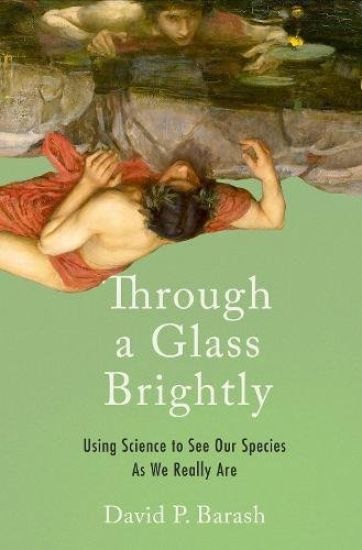
Through a Glass Brightly

Through a Glass Brightly

David P. Barash

Oxford University Press Inc
2018
sidottu
Human beings have long seen themselves as the center of the universe, the apple of God's eye, specially-created creatures who are somehow above and beyond the natural world. This viewpoint - a persistent paradigm of our own unique self-importance - is as dangerous as it is false. In Through a Glass Brightly, noted scientist David P. Barash explores the process by which science has, throughout time, cut humanity "down to size," and how humanity has responded. A good paradigm is a tough thing to lose, especially when its replacement leaves us feeling more vulnerable and less special. And yet, as science has progressed, we find ourselves - like it or not - bereft of many of our most cherished beliefs, confronting an array of paradigms lost. Barash models his argument around a set of "old" and "new" paradigms that define humanity's place in the universe. This new set of paradigms range from provocative revelations as to whether human beings are well designed, whether the universe has somehow been established with our species in mind (the so-called anthropic principle), whether life itself is inherently fragile, and whether Homo sapiens might someday be genetically combined with other species (and what that would mean for our self-image). Rather than seeing ourselves through a glass darkly, science enables us to perceive our strengths and weaknesses brightly and accurately at last, so that paradigms lost becomes wisdom gained. The result is a bracing, remarkably hopeful view of who we really are.
Wall Street Polices Itself

Wall Street Polices Itself

David P. McCaffrey; David W. Hart

Oxford University Press Inc
1998
sidottu
This book explains how the self regulatory system for U.S. securities firms works with three tiers of supervision. Overseeing the whole system is the U.S. Securities and Exchange Commission, which directly supervises the self-regulatory organizations such as the New York Stock Exchange and the National Association of Securities Dealers. In turn, these self-regulatory organizations oversee the broker-dealers who conduct the daily business of buying and selling securities. The system relies heavily on the firms' internal supervisory systems to prevent violations of securities laws, since they are in the best position to track their own internal activities. Firms may be fined, or subject to even more stringent penalties, if their supervisory systems fail. This book is an in-depth examination of how this regulatory system works, the types of regulatory problems with which broker-dealer firms must deal, why some firms have more problems than others, and what the experience with the system suggests about ways of improving self regulatory systems generally.