Kristin Andrews; Gary Comstock; Crozier G.K.D.; Sue Donaldson; Andrew Fenton; Tyler John; L. Syd M Johnson; Robert Jones; Will Kymlicka; Letitia Meynell; Nathan Nobis; David Pena-Guzman; Jeff Sebo
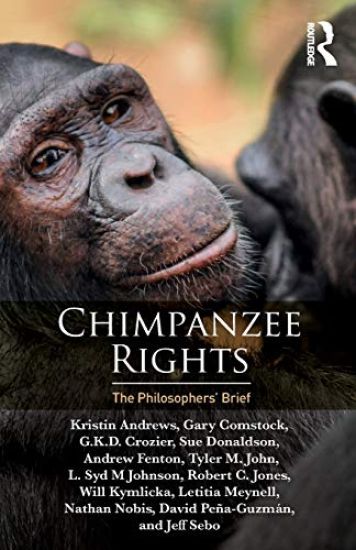
Since 2013, an organization called the Nonhuman Rights Project has brought before the New York State courts an unusual request—asking for habeas corpus hearings to determine whether Kiko and Tommy, two captive chimpanzees, should be considered legal persons with the fundamental right to bodily liberty.While the courts have agreed that chimpanzees share emotional, behavioural, and cognitive similarities with humans, they have denied that chimpanzees are persons on superficial and sometimes conflicting grounds. Consequently, Kiko and Tommy remain confined as legal "things" with no rights. The major moral and legal question remains unanswered: are chimpanzees mere "things", as the law currently sees them, or can they be "persons" possessing fundamental rights?In Chimpanzee Rights: The Philosophers’ Brief, a group of renowned philosophers considers these questions. Carefully and clearly, they examine the four lines of reasoning the courts have used to deny chimpanzee personhood: species, contract, community, and capacities. None of these, they argue, merits disqualifying chimpanzees from personhood. The authors conclude that when judges face the choice between seeing Kiko and Tommy as things and seeing them as persons—the only options under current law—they should conclude that Kiko and Tommy are persons who should therefore be protected from unlawful confinement "in keeping with the best philosophical standards of rational judgment and ethical standards of justice."Chimpanzee Rights: The Philosophers’ Brief—an extended version of the amicus brief submitted to the New York Court of Appeals in Kiko’s and Tommy’s cases—goes to the heart of fundamental issues concerning animal rights, personhood, and the question of human and nonhuman nature. It is essential reading for anyone interested in these issues.
Kristin Andrews; Gary Comstock; Crozier G.K.D.; Sue Donaldson; Andrew Fenton; Tyler John; L. Syd M Johnson; Robert Jones; Will Kymlicka; Letitia Meynell; Nathan Nobis; David Pena-Guzman; Jeff Sebo
Since 2013, an organization called the Nonhuman Rights Project has brought before the New York State courts an unusual request—asking for habeas corpus hearings to determine whether Kiko and Tommy, two captive chimpanzees, should be considered legal persons with the fundamental right to bodily liberty.While the courts have agreed that chimpanzees share emotional, behavioural, and cognitive similarities with humans, they have denied that chimpanzees are persons on superficial and sometimes conflicting grounds. Consequently, Kiko and Tommy remain confined as legal "things" with no rights. The major moral and legal question remains unanswered: are chimpanzees mere "things", as the law currently sees them, or can they be "persons" possessing fundamental rights?In Chimpanzee Rights: The Philosophers’ Brief, a group of renowned philosophers considers these questions. Carefully and clearly, they examine the four lines of reasoning the courts have used to deny chimpanzee personhood: species, contract, community, and capacities. None of these, they argue, merits disqualifying chimpanzees from personhood. The authors conclude that when judges face the choice between seeing Kiko and Tommy as things and seeing them as persons—the only options under current law—they should conclude that Kiko and Tommy are persons who should therefore be protected from unlawful confinement "in keeping with the best philosophical standards of rational judgment and ethical standards of justice."Chimpanzee Rights: The Philosophers’ Brief—an extended version of the amicus brief submitted to the New York Court of Appeals in Kiko’s and Tommy’s cases—goes to the heart of fundamental issues concerning animal rights, personhood, and the question of human and nonhuman nature. It is essential reading for anyone interested in these issues.
The question is why is America out of all the other countries so obsessed over sex? Through my travels all over the world it seems America has the most pornography and sex boutiques out of any other country. Why is this? This brings the question should prostitution be legal? Why do over 50% of gay and straight couples cheat? This book my views on sex and why is it such a big deal?
Title: Two Bannatyne Garlands from Abbotsford i.e. "Captain Ward and the Rainbow," and "The Reiver's Penance." By R. Surtees. With an introductory notice by Sir Walter Scott. Edited by D. L., i.e. David Laing].Publisher: British Library, Historical Print EditionsThe British Library is the national library of the United Kingdom. It is one of the world's largest research libraries holding over 150 million items in all known languages and formats: books, journals, newspapers, sound recordings, patents, maps, stamps, prints and much more. Its collections include around 14 million books, along with substantial additional collections of manuscripts and historical items dating back as far as 300 BC.The FICTION & PROSE LITERATURE collection includes books from the British Library digitised by Microsoft. The collection provides readers with a perspective of the world from some of the 18th and 19th century's most talented writers. Written for a range of audiences, these works are a treasure for any curious reader looking to see the world through the eyes of ages past. Beyond the main body of works the collection also includes song-books, comedy, and works of satire. ++++The below data was compiled from various identification fields in the bibliographic record of this title. This data is provided as an additional tool in helping to insure edition identification: ++++ British Library Anonymous; Laing, David; 1848. 2 pt.; 8 . 11601.ddd.12.
David Matzko McCarthy’s Death Penalty and Discipleship is a faith formation resource to help communities and individuals reflect more deeply on capital punishment. It incorporates Scripture, Catholic social teaching, and contemporary issues that focus on the meaning of God’s self-giving in Jesus Christ and the implications of God’s redemptive work in our lives. McCarthy shows how the church’s stance against the death penalty fits with Scripture, even passages such as “an eye for an eye...” (Lev 24:19-20); he attends to the teachings of Jesus and draws out themes of restorative justice; and he concludes by locating work to end the death penalty within St. John Paul II’s call for a new evangelization. God loves the world and gives himself to the world, and we are called to share God’s justice and mercy with others. In this insightful and challenging resource, McCarthy encourages us to follow the call of Pope Francis to live out the love and mercy of God for all the world.
This monograph considers the correlation between the relative success of retributive penal policies in English-speaking liberal democracies since the 1970s, and the practical evidence of increasingly excessive reliance on the penal State in those jurisdictions. It sets out three key arguments. First, that increasingly excessive conditions in England and Wales over the last three decades represent a failure of retributive theory. Second, that the penal minimalist cause cannot do without retributive proportionality, at least in comparison to the limiting principles espoused by rehabilitation, restorative justice and penal abolitionism. Third, that another retributivism is therefore necessary if we are to confront penal excess. The monograph offers a sketch of this new approach, ‘late retributivism’, as both a theory of punishment and of minimalist political action, within a democratic society. Centrally, criminal punishment is approached as both a political act and a policy choice. Consequently, penal theorists must take account of contemporary political contexts in designing and advocating for their theories. Although this inquiry focuses primarily on England and Wales, its models of retributivism and of academic contribution to democratic penal policy-making are relevant to other jurisdictions, too.
This monograph considers the correlation between the relative success of retributive penal policies in English-speaking liberal democracies since the 1970s, and the practical evidence of increasingly excessive reliance on the penal State in those jurisdictions.It sets out three key arguments. First, that increasingly excessive conditions in England and Wales over the last three decades represent a failure of retributive theory. Second, that the penal minimalist cause cannot do without retributive proportionality, at least in comparison to the limiting principles espoused by rehabilitation, restorative justice and penal abolitionism. Third, that another retributivism is therefore necessary if we are to confront penal excess. The monograph offers a sketch of this new approach, ‘late retributivism’, as both a theory of punishment and of minimalist political action, within a democratic society.Centrally, criminal punishment is approached as both a political act and a policy choice. Consequently, penal theorists must take account of contemporary political contexts in designing and advocating for their theories. Although this inquiry focuses primarily on England and Wales, its models of retributivism and of academic contribution to democratic penal policy-making are relevant to other jurisdictions, too.













![Two Bannatyne Garlands from Abbotsford [I.E. "Captain Ward and the Rainbow," and "The Reiver's Penance." by R. Surtees. with an Introductory Notice by Sir Walter Scott. Edited by D. L., i.e. David Laing].](/covers/9781241568801.jpg)