Kirjojen hintavertailu. Mukana 11 213 693 kirjaa ja 12 kauppaa.

Kirjahaku

Etsi kirjoja tekijän nimen, kirjan nimen tai ISBN:n perusteella.

1000 tulosta hakusanalla David R. Mares

Violent Peace

Violent Peace

David R. Mares

Columbia University Press
2001
sidottu
When is military force an acceptable tool of foreign policy? Why do democracies use force against each other? David R. Mares argues that the key factors influencing political leaders in all types of polities are the costs to their constituencies of using force and whether the leader can survive their displeasure if the costs exceed what they are willing to pay. Violent Peace proposes a conceptual scheme for analyzing militarized conflict and supports this framework with evidence from the history of Latin America. His model has greater explanatory power when applied to this conflict-ridden region than a model emphasizing U.S. power, levels of democracy, or the balance of power. Mares takes conflict as a given in international relations but does not believe that large-scale violence must inevitably result, arguing that it is the management of conflict, and not necessarily its resolution, that should be the focus of students, scholars, and practitioners of international relations. Mares argues that deterrence represents the key to conflict management by directly affecting the costs of using force. Conflicts escalate to violence when leaders ignore the requisites for credible and ongoing deterrence. Successful deterrence, he suggests, lies in a strategy that combines diplomatic and military incentives, allowing competition among heterogenous states to be managed in a way that minimizes conflict and maximizes cooperation.

Violent Peace

Violent Peace

David R. Mares

Columbia University Press
2001
pokkari
When is military force an acceptable tool of foreign policy? Why do democracies use force against each other? David R. Mares argues that the key factors influencing political leaders in all types of polities are the costs to their constituencies of using force and whether the leader can survive their displeasure if the costs exceed what they are willing to pay. Violent Peace proposes a conceptual scheme for analyzing militarized conflict and supports this framework with evidence from the history of Latin America. His model has greater explanatory power when applied to this conflict-ridden region than a model emphasizing U.S. power, levels of democracy, or the balance of power. Mares takes conflict as a given in international relations but does not believe that large-scale violence must inevitably result, arguing that it is the management of conflict, and not necessarily its resolution, that should be the focus of students, scholars, and practitioners of international relations. Mares argues that deterrence represents the key to conflict management by directly affecting the costs of using force. Conflicts escalate to violence when leaders ignore the requisites for credible and ongoing deterrence. Successful deterrence, he suggests, lies in a strategy that combines diplomatic and military incentives, allowing competition among heterogenous states to be managed in a way that minimizes conflict and maximizes cooperation.

Resource Nationalism and Energy Policy

Resource Nationalism and Energy Policy

David R. Mares

Columbia University Press
2022
sidottu
It is widely thought that state ownership of natural resources, oil and natural gas in particular, causes countries to fall under the sway of the “resource curse.” In such cases, governments allegedly display “resource nationalism,” which destabilizes the economy, society, and politics. In this book, David R. Mares dispels these beliefs and develops a powerful new account of the relationship between state resource ownership and energy policy.Mares examines variations in energy policy across a wide range of countries, underscoring the fact that in most of the world outside the United States, subsoil natural resources are owned by the state. He considers the history of Latin American oil and gas policies and provides an in-depth analysis of Venezuela from 1989 to 2016—before, during, and after the presidency of Hugo Chávez. Mares demonstrates that the key factors that influence energy policy are the inclusiveness of the political system, the level of competitiveness within policy making, and the characteristics of individual leaders. Domestic politics, not state ownership, determines the effectiveness and efficiency of energy policies: the “resource curse” is avoidable. Drawing on these findings, Mares reconceptualizes resource nationalism, arguing that government intervention into resource extraction is legitimate as long as the benefits are shared through the provision of public goods. Featuring a sophisticated grasp of both Latin American politics and energy policy, this book sheds new light on why some governments are responsible stewards of natural resources while others appropriate national wealth for partisan or private benefit.
Resource Nationalism and Energy Policy

Resource Nationalism and Energy Policy

David R. Mares

Columbia University Press
2022
pokkari
It is widely thought that state ownership of natural resources, oil and natural gas in particular, causes countries to fall under the sway of the “resource curse.” In such cases, governments allegedly display “resource nationalism,” which destabilizes the economy, society, and politics. In this book, David R. Mares dispels these beliefs and develops a powerful new account of the relationship between state resource ownership and energy policy.Mares examines variations in energy policy across a wide range of countries, underscoring the fact that in most of the world outside the United States, subsoil natural resources are owned by the state. He considers the history of Latin American oil and gas policies and provides an in-depth analysis of Venezuela from 1989 to 2016—before, during, and after the presidency of Hugo Chávez. Mares demonstrates that the key factors that influence energy policy are the inclusiveness of the political system, the level of competitiveness within policy making, and the characteristics of individual leaders. Domestic politics, not state ownership, determines the effectiveness and efficiency of energy policies: the “resource curse” is avoidable. Drawing on these findings, Mares reconceptualizes resource nationalism, arguing that government intervention into resource extraction is legitimate as long as the benefits are shared through the provision of public goods. Featuring a sophisticated grasp of both Latin American politics and energy policy, this book sheds new light on why some governments are responsible stewards of natural resources while others appropriate national wealth for partisan or private benefit.
Latin America and the Illusion of Peace
This book explores interstate conflict and its dynamics in the context of Latin America’s contemporary conflict management experience. The myth of Latin America as a region of peace means that each time the use of force rises to the level of global attention (e.g., Ecuador-Peru 1995 or Colombia-Ecuador 2008) analysts and the press ask, "how could that happen here?" Yet the official uses of military force in interstate relations are significantly more prevalent than most analysts within and outside the region understand, and the region is facing new and potentially destabilizing challenges. It is the contention of this book that mitigating the threat raised by militarized interstate relations requires understanding the various ways in which military force can be employed short of war; this in turn requires illuminating the decision making process that produces militarization of a disagreement, considering options for dissuading the decision makers from choosing to militarize and limiting escalations when militarization does occur.
Latin America and the Illusion of Peace
This book explores interstate conflict and its dynamics in the context of Latin America‘s contemporary conflict management experience. The myth of Latin America as a region of peace means that each time the use of force rises to the level of global attention (e.g., Ecuador-Peru 1995 or Colombia-Ecuador 2008) analysts and the press ask, "how could that happen here?" Yet the official uses of military force in interstate relations are significantly more prevalent than most analysts within and outside the region understand, and the region is facing new and potentially destabilizing challenges. It is the contention of this book that mitigating the threat raised by militarized interstate relations requires understanding the various ways in which military force can be employed short of war; this in turn requires illuminating the decision making process that produces militarization of a disagreement, considering options for dissuading the decision makers from choosing to militarize and limiting escalations when militarization does occur.
Drug Wars and Coffeehouses

Drug Wars and Coffeehouses

David R. Mares

CQ Press
2005
nidottu
An international policy issue awash in myths, moral inconsistencies, social prejudices, and political rhetoric, it’s no wonder students find the international drug trade an alluring topic to study and discuss. With his brief and engaging new book, David Mares explores the reasons why there is so much disagreement among nations about which policies are most appropriate to address drug production, distribution, and trade. From the more tolerant "coffee house" style policies of the Netherlands which focus on public health concerns, to the United States’ just-say-no "drug war" approach, nations frame and seek to resolve these issues in very different ways and with different levels of success. This variation creates a host of global cooperation and policy coordination problems, making Drug Wars and Coffee Houses an ideal supplement for giving students an opportunity to apply the larger themes of any political economy course to a substantive policy area.A compelling framework—focusing on political economic ideas and analysis—shows students how leaders and policymakers need to understand the drug trade as a full-blown commodity system if they are to impact its different segments. As he discusses drug production, consumption, distribution, and money laundering, Mares carefully shows what insights micro political economic, realist, constructivist, and social deviant perspectives each bring to bear on the problem. And, through the book’s use of extended case studies, this text offers students an inside look at a complex and fascinating policy area, from Sweden’s attempts to enforce drug-war style policies, to the UK’s movement towards decriminalization, to the responses of such international organizations as the United Nations and the European Union. A comprehensive bibliography of websites, articles, and book length studies point to further research on the topic, while class-tested research and study questions for each chapter will jumpstart class discussions and projects.
Power, Institutions, and Leadership in War and Peace

Power, Institutions, and Leadership in War and Peace

David R. Mares; David Scott Palmer

University of Texas Press
2012
nidottu
In January 1995, fighting broke out between Ecuadorian and Peruvian military forces in a remote section of the Amazon. It took more than three years and the interplay of multiple actors and factors to achieve a definitive peace agreement, thus ending what had been the region's oldest unresolved border dispute. This conflict and its resolution provide insights about other unresolved and/or disputed land and sea boundaries which involve almost every country in the Western Hemisphere. Drawing on extensive field research at the time of the dispute and during its aftermath, including interviews with high-ranking diplomats and military officials, Power, Institutions, and Leadership in War and Peace is the first book-length study to relate this complex border dispute and its resolution to broader theories of conflict. The findings emphasize an emerging leadership approach in which individuals are not mere captives of power and institutions. In addition, the authors illuminate an overlap in national and international arenas in shaping effective articulation, perception, and selection of policy. In the “new” democratic Latin America that emerged in the late 1970s through the early 1990s, historical memory remains influential in shaping the context of disputes, in spite of presumed U.S. post–Cold War influence. This study offers important, broader perspectives on a hemisphere still rife with boundary disputes as a rising number of people and products (including arms) pass through these borderlands.
United States and Chile

United States and Chile

David R. Mares; Francisco Rojas Aravena

Routledge
2001
sidottu
The United States and Chile is the ideal introduction to U.S.- Chilean relations. From our strained Cold War relations and the Allende assassination to current democratic and economic development, senior scholars Mares and Aravena deftly trace the path of the relationship from early partners, through tense Cold War stand-offs, to the slowly warming relations of the present. The authors include information on General Augusto Pinochet's human rights violations, his current prosecution for them, and the United State's complicity in bringing him to power. Chile is only just now recovering from decades of political instability and government abuses, and this volume provides a thorough look back, and an informed vision of the future.
United States and Chile

United States and Chile

David R. Mares; Francisco Rojas Aravena

Routledge
2001
nidottu
The United States and Chile is the ideal introduction to U.S.- Chilean relations. From our strained Cold War relations and the Allende assassination to current democratic and economic development, senior scholars Mares and Aravena deftly trace the path of the relationship from early partners, through tense Cold War stand-offs, to the slowly warming relations of the present. The authors include information on General Augusto Pinochet's human rights violations, his current prosecution for them, and the United State's complicity in bringing him to power. Chile is only just now recovering from decades of political instability and government abuses, and this volume provides a thorough look back, and an informed vision of the future.
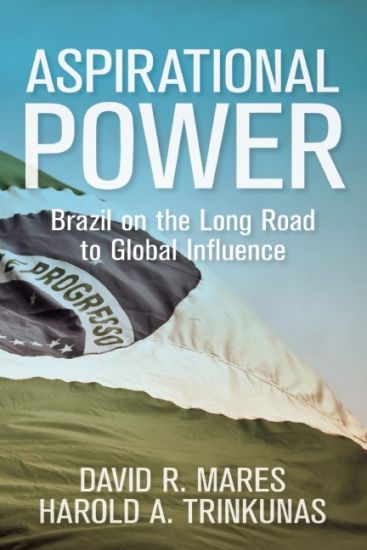
Aspirational Power

Aspirational Power

David R. Mares; Harold A. Trinkunas

Brookings Institution
2016
sidottu
"As the largest country in South America by land mass and population, Brazil has been marked since its’ independence by a belief that it has a potential to be more than merely a very large country. Set apart from the rest of the hemisphere by culture, language and history, Brazil has also been viewed by its neighbors as a potential great power, and at times, a threat. But even though domestic aspirations and foreign perceptions have held out the prospect for Brazil becoming a major power, the country has lacked the capabilities – particularly on the military and economic dimensions – to pursue a traditional path to greatness.Aspirational Power examines Brazil as a rising power. It explains Brazil’s predilection for soft power through a historical analysis of Brazil’s three previous attempts to achieve major power status, each of which shaped its present strategy. Though Brazil’s efforts to rise have fallen short it will continue to try to overcome the obstacles to its rise, whether those obstacles are domestic or international."
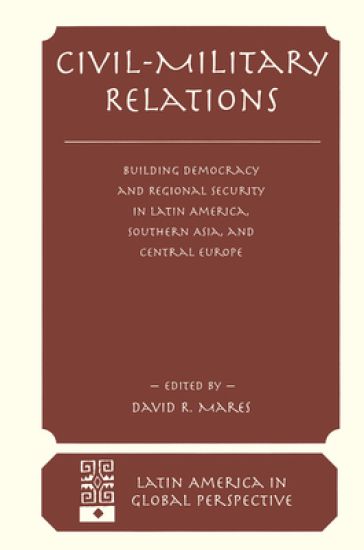
Civil-military Relations

Civil-military Relations

David R Mares

Routledge
2019
sidottu
This book analyses the normative and institutional aspects of the civil-military relationship to demonstrate that it is the politics of the relationship rather than its form that influences the likelihood of democracy and regional peace. It is useful for policymakers, academics, and general readers.
Civil-military Relations

Civil-military Relations

David R Mares

Westview Press Inc
1999
nidottu
This book analyses the normative and institutional aspects of the civil-military relationship to demonstrate that it is the politics of the relationship rather than its form that influences the likelihood of democracy and regional peace. It is useful for policymakers, academics, and general readers.
Dissolving the Ego, Realizing the Self: Contemplations from the Teachings of David R. Hawkins, M.D., Ph.D.
Realize your true potential, dissolve the ego limitations, learn how to master your emotions, and awaken your inner genius with this groundbreaking self-development book from renowned psychiatrist, clinician, and spiritual teacher, David R. Hawkins, M.D., Ph.D.How does one traverse the spiritual landscape to move beyond suffering to experience the peace and love of God, to transcend illusion and realize the state of enlightenment? In this collection of inspiring passages from Dr. David R. Hawkins's work, you'll learn the illusory nature of the personal self (identification of the ego/mind) and the direct pathways to transcend the ego/mind's trappings. "I consider myself a student of David Hawkins and return to his books and work time and time again. His wisdom deeply resonates with my lived experiences; he is often able to beautifully articulate what I cannot put into words." - Vex King This pocket edition is designed especially for today's spiritual student on the go, to inspire contemplation and reflection during a break at work, while hiking in the woods, during a quiet coffee-shop moment, on an airplane, with a partner--in whatever environment one finds oneself.Dissolving the Ego, Realizing the Self is a reliable companion on your quest toward higher truth. Dr. David Hawkins takes you on an enlightening journey of understanding the intricate workings of the mind and ego, culminating in a groundbreaking explanation of consciousness. You'll learn how to: - Master your emotions with practical strategies and insights.- Attract positivity and abundance in your life.- Harness your personal power without resorting to force.- Heal the mind and soul for a healthier, happier existence. This motivational book seamlessly merges spirituality, psychology, and business principles, making it an essential read for anyone interested in philosophy, human behavior, leadership, and success. Experience a paradigm shift in your journey towards self-realization by immersing yourself in the wisdom of Dr. David Hawkins. Allow your consciousness to soar as you step towards a more enlightened and fulfilling life.
Daily Reflections from Dr. David R. Hawkins: 365 Contemplations on Surrender, Healing, and Consciousness
A collection of 365 insightful quotes from best-selling author and consciousness researcher Dr. David R. Hawkins to guide readers on the path to enlightenment. This collection of inspiring quotes from world-renowned consciousness researcher and mystic Dr. David R. Hawkins can help readers elevate their level of consciousness. In doing so, they will explore ways to understand truth, raise their awareness, and find enlightenment and infinite peace. Readers will engage with some of Dr. Hawkins's most profound insights from his classic works, such as: To best serve the world, seek enlightenment and transcend illusions rather than contribute to them.Success comes about automatically from knowing where to look. Not what to look for, but where to look. We do not look at what we have, nor at what we do, but at what we are. Once we find within ourselves what we've been searching for, we won't have to bother looking "out there."We can't own that which is great within ourselves unless we learn to recognize it in others.Peace comes with total inner surrender to what is.By continuously letting go, it is possible to stay in that state of freedom. Feelings come and go, and eventually you realize that you are not your feelings, but that the real "you" is merely witnessing them.
The Wisdom of Dr. David R. Hawkins

The Wisdom of Dr. David R. Hawkins

David R. Hawkins

HAY HOUSE UK LTD
2022
nidottu
Prepare to step off the ego path onto a more rewarding, fulfilling and service-oriented journey of enlightenment.Praised by Mother Teresa and Dr Wayne Dyer for his breakthrough research and innovative teachings on the human mind, Dr David Hawkins took our understanding of spiritual truth and enlightenment to an entirely new level. A nationally renowned psychiatrist, physician, researcher, spiritual teacher and lecturer, Dr Hawkins was the founding director of the Institute for Spiritual Research Incorporated and the founder of the path of devotional non-duality. During his life, he devoted almost three full decades to understanding the potential of the human spirit. His exhaustive research led to techniques anyone can use to elevate their quality of life. In this book, adapted from Dr Hawkins’ many lectures, interviews and audio programmes, readers will be brought to higher levels of awareness, control and understanding. This book includes 10 volumes of Dr Hawkins’ core teachings that are most beneficial and relevant to today’s world, including his Map of Consciousness® calibration process.The Wisdom of Dr David R. Hawkins also includes one of Dr Hawkins’ last lectures on the most valuable qualities for a spiritual seeker.‘This book is a unique and wonderful resource of teachings from Dr Hawkins…. You might imagine that you are sitting there in his audience – listening and watching, laughing and receiving.’From the Foreword by Fran Grace PhD
Daily Reflections from Dr. David R. Hawkins

Daily Reflections from Dr. David R. Hawkins

David R. Hawkins

HAY HOUSE UK LTD
2022
nidottu
A collection of 365 insightful quotes from best-selling author and consciousness researcher Dr. David R. Hawkins to guide readers on the path to enlightenment.This collection of inspiring quotes from world-renowned consciousness researcher and mystic Dr. David R. Hawkins can help readers elevate their level of consciousness. In doing so, they will explore ways to understand truth, raise their awareness, and find enlightenment and infinite peace.Readers will engage with some of Dr. Hawkins's most profound insights from his classic works, such as:To best serve the world, seek enlightenment and transcend illusions rather than contribute to them.Success comes about automatically from knowing where to look. Not what to look for, but where to look. We do not look at what we have, nor at what we do, but at what we are. Once we find within ourselves what we've been searching for, we won't have to bother looking "out there."We can't own that which is great within ourselves unless we learn to recognize it in others.Peace comes with total inner surrender to what is.By continuously letting go, it is possible to stay in that state of freedom. Feelings come and go, and eventually you realize that you are not your feelings, but that the real "you" is merely witnessing them.