In its ascent to becoming a top-20 city, Charlotte, North Carolina, has demolished one-by-one a greater proportion of its historic buildings than were lost to Chicago in the great Chicago Fire or to San Francisco in the 1906 earthquake.Through photographs and brief essays, 100 Lost Architectural Treasures of Old Charlotte brings back 100 buildings that came and went as Charlotte's population burgeoned from being the nation's 60th largest city in 1970 to being the 17th largest city now. Viewing this cavalcade of lost architectural treasures provides context for the industrial and sociological forces that powered this remarkable, still-growing city to its present heights.Seeing Charlotte's past through pictures of Old Charlotte's lost buildings helps explain the Charlotte Paradox - how did Charlotte become a highly successful city while lacking an obvious geographic reason for its success? Whether the reason was gold mining, textile manufacturing, interstate banking, or connecting the world as an airline hub, the common thread is Charlotte's serial reinvention of itself in each new era. Seeing the city develop over the decades, as these photographs portray, illuminates that history and helps us to understand it.
What kind of a divorce lawyer writes a book to encourage people not to get divorced? David W. Erdman has been consulted as a divorce lawyer in 5,000 marriages. This book, "The Ten Commandments of Marriage," reveals marriage-saving lessons learned from those clients that will make a positive difference in your marriage. Erdman's sensitive understanding of all points of view in a divorce-the husband's, the wife's, and the child's-provides a unique outline for you and your spouse to strengthen a great marriage or revive a troubled one. If you and your spouse read this book, most likely you'll never need to meet with a divorce lawyer.
Now that I am eighty years old, I feel that I have learned a few things about living. Honesty: A person's word is his/her honor. There are times when it is tempting to tell a falsehood, but if the truth is found out, the trust of another person is likely to be lost, and it may not ever be regained. However, one should not be brutally honest if it will hurt someone unnecessarily, and there are times when a little blarney adds zest to a conversation and a relationship. Appreciation and Compliments: All of us have a need to feel worthwhile and of some importance, and honest compliments foster those feelings. Compliments don't have to be about big things. They can be about little things: "You look very nice." "The dinner was really good." Thank you's, both written and oral, are important. On the other hand, slurs cast a dark shadow on the speaker as well as on the one being talked about. Outlook: It is more enjoyable to be with someone who has a pleasant outlook than with someone who has a negative one. Sarcasm: Should be used sparingly, if at all. It has a cutting edge which tends to be hurtful. Graciousness: There are many definitions for graciousness, but the one I like best is that it is that quality which, simply, makes another person comfortable. It is the quality which is entailed in all of the above suggestions. My father-in-law, Dr. Tom Hawkins, was a wise man. He said, "Don't take yourself too seriously, and let your friends fight your battles for you." Doing nice things for others brings happiness, so be kind, and, if you want to have friends, be one.
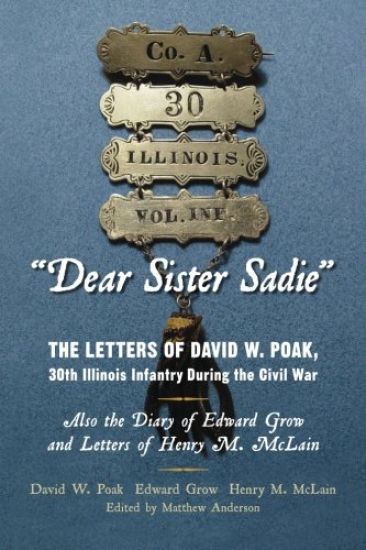
The letters and diaries of three civil war soldiers from the 30th Illinois Infantry during the Civil War. These writings give insight to what a soldier that served with this regiment experienced from the letters they wrote home and the diaries that was written as a personal record of their experience. David W. Poak was well educated and quite literate, Edward Grow and even more so Henry McLain wrote the words as they sounded to them. I tried to keep their spelling and punctuation as close to their written text as possible so the reader can get a better feel for the soldier himself.This is a book for those who are familiar with the Civil War and are looking to expand their knowledge from the soldier's perspective."Sister Sadie" or "Dear Sister" was how David Watson Poak usually addressed his many letters to Sarah J. Poak during his Civil War service with Company A, 30th Illinois Infantry. D. W. Poak was born and raised in Mt. Jackson, Lawrence Co., Pennsylvania, which was a small farming community in the mid-nineteenth century. He and his sister Sadie were the only children born to John Poak and Sarah Duff Poak. Their mother died in 1847. and the father married Emeline McCurley and they had two daughters, Ella and Nancy. His sister Sadie was born in 1841, David was born 1842, Ella in 1854 and Nancy 1859. Sometime around 1858-9 David W. Poak moved to Millersburg, Mercer County, Illinois along with another dozen or so residents of Lawrence County, PA. Mercer County was a thriving area of Illinois at the time, and towns like Aledo, the county seat, Millersburg, Keithsburg, New Boston, Viola and others were growing In Millersburg his occupation was a teacher, and he did this until the call came for volunteers from the state of Illinois to suppress the rebellion. So on August 12, 1861 David W. Poak enlisted into Co. A, 30th Illinois Volunteer Infantry as a Sergeant. The enlistment record says Poak was twenty years old, five foot five and a quarter inches tall, fair complexion, blue eyes, and had sandy colored hair. During the conflict on January 33, 1863 he would rise to the rank of 1st Lieutenant. During the Battle of Atlanta on July 22nd, 1864 he became acting adjutant and received the Seventeenth Corp Silver Medal of Honor for bravery. After the war, David Poak returned to Millersburg, IL, then moved to the newly incorporated town of Pleasanton, Linn County, Kansas. There he became a school director on February 19, 1870 and was elected Pleasanton's first mayor on October 25th, 1870. In 1872 he is listed as cashier for the Fannin County Bank in Bonham, Fannin County, Texas. In the 1876-77 City Directory for Sherman, TX his occupation is listed as vice-president of the Bank of Sherman, Grayson Co., TX. Sometime afterwards he went back to his home in Mt. Jackson, PA. His obituary on page one of the New Castle Courant, dated April 4th, 1879, stated that David W. Poak died "last week" (March 27th, 1879) at his home of consumption and is buried at the Westfield Presbyterian Church Cemetery. As for his sister Sarah J Polk, she married James Hayes October 26th, 1893. She died in 1919 and is also buried at the Westfield Presbyterian Church Cemetery.
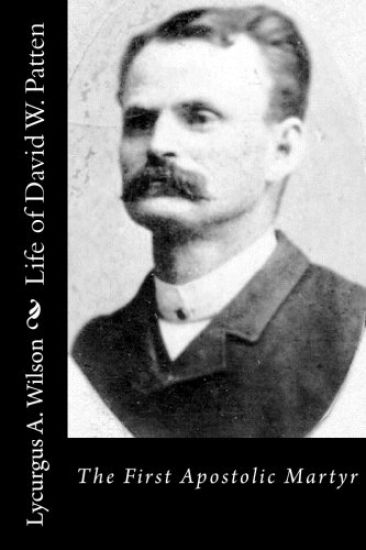
Life of David W. Patten, the First Apostolic Martyr, has been acknowledged as a major work throughout human history, and we have taken precautions to assure its preservation by republishing this book in a modern manner for both present and future generations. This book has been completely retyped, revised, and reformatted. The text is readable and clear because these books are not created from scanned copies.
"Life of David W. Patten" is a biographical account written through Lycurgus A. Wilson, losing mild at the compelling and regularly unnoticed lifestyles of David W. Patten, a distinguished parent inside the early history of The Church of Jesus Christ of Latter-day Saints (LDS Church). Wilson's work offers an insightful exploration of Patten's life, faith, and contributions to the improvement of Mormonism. David W. Patten, a member of the original Quorum of the Twelve Apostles inside the LDS Church, played a critical role inside the church's early years. Wilson's biography delves into Patten's conversion to the faith, his missionary efforts, and his unwavering commitment to the principles of Mormonism, even in the face of persecution and hassle. One of the highlights of the book is its detailed account of Patten's participation in vast activities, inclusive of the Zion's Camp expedition and the early days of the Kirtland Temple. Patten's devotion to Joseph Smith, his leadership in the church, and his ultimate martyrdom in the course of the Missouri struggle are vital themes in the biography. "Life of David W. Patten" serves as a valuable historical aid, providing readers with a deeper information of the demanding situations and triumphs experienced via early Latter-day Saints.
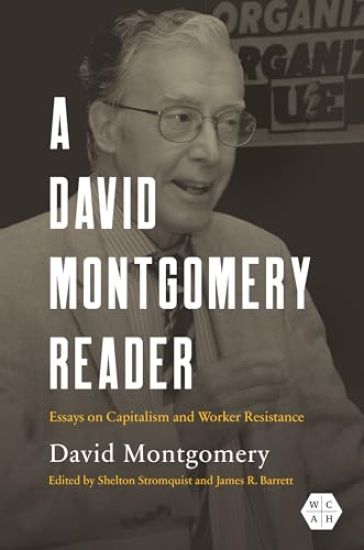
A foundational figure in modern labor history, David Montgomery both redefined and reoriented the field. This collection of Montgomery’s most important published and unpublished articles and essays draws from the historian’s entire five-decade career. Taken together, the writings trace the development of Montgomery’s distinct voice and approach while providing a crucial window into an era that changed the ways scholars and the public understood working people’s place in American history. Three overarching themes and methods emerge from these essays: that class provided a rich reservoir of ideas and strategies for workers to build movements aimed at claiming their democratic rights; that capital endured with the power to manage the contours of economic life and the capacities of the state but that workers repeatedly and creatively mounted challenges to the terms of life and work dictated by capital; and that Montgomery’s method grounded his gritty empiricism and the conceptual richness of his analysis in the intimate social relations of production and of community, neighborhood, and family life.
A foundational figure in modern labor history, David Montgomery both redefined and reoriented the field. This collection of Montgomery’s most important published and unpublished articles and essays draws from the historian’s entire five-decade career. Taken together, the writings trace the development of Montgomery’s distinct voice and approach while providing a crucial window into an era that changed the ways scholars and the public understood working people’s place in American history. Three overarching themes and methods emerge from these essays: that class provided a rich reservoir of ideas and strategies for workers to build movements aimed at claiming their democratic rights; that capital endured with the power to manage the contours of economic life and the capacities of the state but that workers repeatedly and creatively mounted challenges to the terms of life and work dictated by capital; and that Montgomery’s method grounded his gritty empiricism and the conceptual richness of his analysis in the intimate social relations of production and of community, neighborhood, and family life.