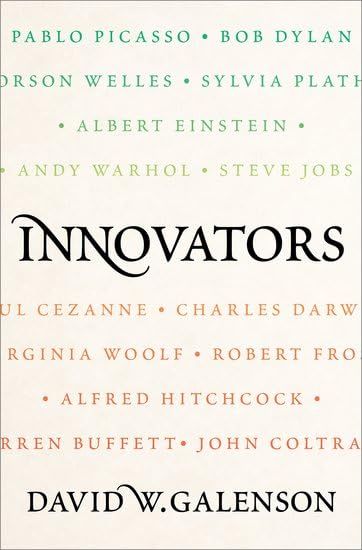
When in their lives are innovators most creative, and why? This book summarizes more than two decades of research prompted by this question. The result is an authoritative statement of a new unified theory of creativity, that overturns both popular and scholarly beliefs about the sources of human inventiveness. David Galenson shows that there are two distinctly different kinds of creativity in virtually every discipline. They result from very different goals and methods, and each produces a specific pattern of discovery over the life cycle. Conceptual innovators make bold leaps to formulate new ideas. The most radical conceptual innovations are made by brash young geniuses, who often lose their creativity thereafter. Great conceptual innovators analyzed in this book include Pablo Picasso, Albert Einstein, Orson Welles, Sylvia Plath, Andy Warhol, Bob Dylan, and Steve Jobs. Experimental innovators make discoveries gradually and unobtrusively, through careful observation and generalization. They gain knowledge over time, and make their greatest contributions late in their lives. Great experimental innovators considered in this book include Paul Cezanne, Charles Darwin, Virginia Woolf, Robert Frost, Alfed Hitchcock, John Coltrane, and Warren Buffett. From analysis of the careers of scores of artists, scholars, and entrepreneurs, this book provides a new understanding of the creative processes of great innovators, and reveals the systematic patterns that underlie the two life cycles of creativity. It will be of interest to anyone who seeks a deeper understanding of the sources of human creativity.
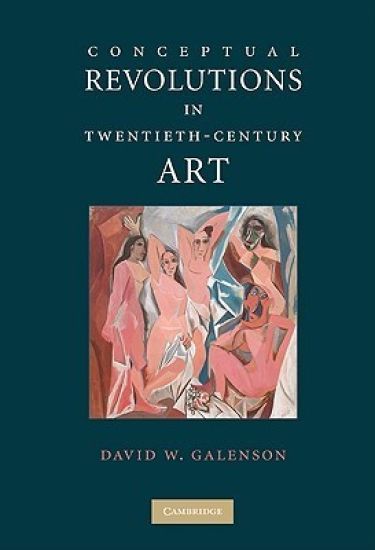
From Picasso's Cubism and Duchamp's readymades to Warhol's silkscreens and Smithson's earthworks, the art of the twentieth century broke completely with earlier artistic traditions. A basic change in the market for advanced art produced a heightened demand for innovation, and young conceptual innovators – from Picasso and Duchamp to Rauschenberg and Warhol to Cindy Sherman and Damien Hirst – responded not only by creating dozens of new forms of art, but also by behaving in ways that would have been incomprehensible to their predecessors. Conceptual Revolutions in Twentieth-Century Art presents the first systematic analysis of the reasons for this discontinuity. David W. Galenson, whose earlier research has changed our understanding of creativity, combines social scientific methods with qualitative analysis to produce a fundamentally new interpretation of modern art that will give readers a far deeper appreciation of the art of the past century, and of today, than is available elsewhere.
White servitude was one of the major institutions in the economy and society of early colonial British America. In fact more than half of all the white immigrants to the British colonies sold themselves into bondage for a period of years in order to migrate to the New World. Professor Galenson's study of the system of indentured servitude analyses rigourously the composition of this labour force and provides a quantitative description of the demographic, social and economic characteristics of more than 20,000 indentured immigrants. The author examines the interactions between indentured, free and slave labour and provides a framework for analysing why black slavery prevailed over white servitude in the British West Indies and the southern mainland colonies and why both types of bound labour declined to insignificance in the northern colonies of the mainland.
The explosive growth of the Atlantic slave trade in the second half of the seventeenth century made the international trade in Africans one of the world’s largest industries. This book explores the operation of that industry in the late seventeenth and early eighteenth centuries, focusing on the market behaviour of the Royal African Company - the largest English company engaged in the slave trade - and the sugar planters of the Caribbean, who were the trade’s principal customers in English America. A richly detailed portrayal of the slave trade to English America emerges, one that shows it to have been a highly competitive and efficient transatlantic market. In revealing the existence of sophisticated and complex market behaviour in this early period of black slavery in the New World, the book adds to our understanding of the development of large-scale competitive markets, as well as to our knowledge of the efficiency of resource allocation in early English America.
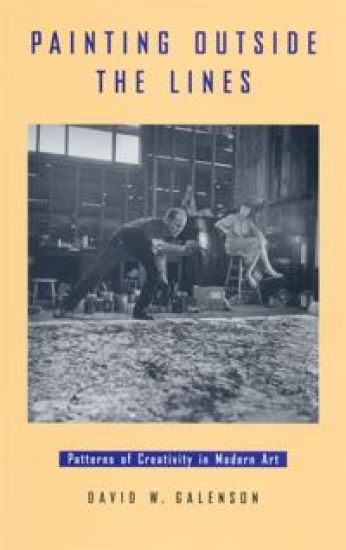
Why have some great modern artists—including Picasso—produced their most important work early in their careers while others—like Cézanne—have done theirs late in life? In a work that brings new insights, and new dimensions, to the history of modern art, David Galenson examines the careers of more than 100 modern painters to disclose a fascinating relationship between age and artistic creativity.Galenson’s analysis of the careers of figures such as Monet, Seurat, Matisse, Pollock, and Jasper Johns reveals two very different methods by which artists have made innovations, each associated with a very different pattern of discovery over the life cycle. Experimental innovators, like Cézanne, work by trial and error, and arrive at their most important contributions gradually. In contrast, Picasso and other conceptual innovators make sudden breakthroughs by formulating new ideas. Consequently, experimental innovators usually make their discoveries late in their lives, whereas conceptual innovators typically peak at an early age.A novel contribution to the history of modern art, both in method and in substance, Painting outside the Lines offers an enlightening glimpse into the relationship between the working methods and the life cycles of modern artists. The book’s explicit use of simple but powerful quantitative techniques allows for systematic generalization about large numbers of artists—and illuminates significant but little understood features of the history of modern art. Pointing to a new and richer understanding of that history, from Impressionism to Abstract Expressionism and beyond, Galenson’s work also has broad implications for future attempts to understand the nature of human creativity in general.
When in their lives do great artists produce their greatest art? Do they strive for creative perfection throughout decades of painstaking and frustrating experimentation, or do they achieve it confidently and decisively, through meticulous planning that yields masterpieces early in their lives? By examining the careers not only of great painters but also of important sculptors, poets, novelists, and movie directors, Old Masters and Young Geniuses offers a profound new understanding of artistic creativity. Using a wide range of evidence, David Galenson demonstrates that there are two fundamentally different approaches to innovation, and that each is associated with a distinct pattern of discovery over a lifetime. Experimental innovators work by trial and error, and arrive at their major contributions gradually, late in life. In contrast, conceptual innovators make sudden breakthroughs by formulating new ideas, usually at an early age. Galenson shows why such artists as Michelangelo, Rembrandt, Cezanne, Jackson Pollock, Virginia Woolf, Robert Frost, and Alfred Hitchcock were experimental old masters, and why Vermeer, van Gogh, Picasso, Herman Melville, James Joyce, Sylvia Plath, and Orson Welles were conceptual young geniuses. He also explains how this changes our understanding of art and its past. Experimental innovators seek, and conceptual innovators find. By illuminating the differences between them, this pioneering book provides vivid new insights into the mysterious processes of human creativity.
From Picasso's Cubism and Duchamp's readymades to Warhol's silkscreens and Smithson's earthworks, the art of the twentieth century broke completely with earlier artistic traditions. A basic change in the market for advanced art produced a heightened demand for innovation, and young conceptual innovators – from Picasso and Duchamp to Rauschenberg and Warhol to Cindy Sherman and Damien Hirst – responded not only by creating dozens of new forms of art, but also by behaving in ways that would have been incomprehensible to their predecessors. Conceptual Revolutions in Twentieth-Century Art presents the first systematic analysis of the reasons for this discontinuity. David W. Galenson, whose earlier research has changed our understanding of creativity, combines social scientific methods with qualitative analysis to produce a fundamentally new interpretation of modern art that will give readers a far deeper appreciation of the art of the past century, and of today, than is available elsewhere.
The new scholarly series, "Van Gogh Studies" offers an international platform for research into nineteenth century, West European art history. The contributions focus on Vincent van Gogh and his contemporaries and are written by internationally acclaimed scholars and provide a richly variegated impression of this area of study. The first issue reveals the diversity of the Eminence grise series. Robert Herbert presents a major study about decorative arts; the nineteenth century French art market and the Salon system is the centrepiece of Robert Jensen and David Galenson's contribution, while Elise Eckermann, June Hargrove and Caroline Boyle-Turner provide remarkable monographs about Gauguin as a painter and sculptor. Joan Greer elucidates in great detail on the publication of Van Gogh's letters in the Flemish journal "Van Nu en Straks" ("Today and Tomorrow") in 1893, while Louis van Tilborgh researches and dates Van Gogh's stay in French painter Fernand Cormon's studio.
Now that I am eighty years old, I feel that I have learned a few things about living. Honesty: A person's word is his/her honor. There are times when it is tempting to tell a falsehood, but if the truth is found out, the trust of another person is likely to be lost, and it may not ever be regained. However, one should not be brutally honest if it will hurt someone unnecessarily, and there are times when a little blarney adds zest to a conversation and a relationship. Appreciation and Compliments: All of us have a need to feel worthwhile and of some importance, and honest compliments foster those feelings. Compliments don't have to be about big things. They can be about little things: "You look very nice." "The dinner was really good." Thank you's, both written and oral, are important. On the other hand, slurs cast a dark shadow on the speaker as well as on the one being talked about. Outlook: It is more enjoyable to be with someone who has a pleasant outlook than with someone who has a negative one. Sarcasm: Should be used sparingly, if at all. It has a cutting edge which tends to be hurtful. Graciousness: There are many definitions for graciousness, but the one I like best is that it is that quality which, simply, makes another person comfortable. It is the quality which is entailed in all of the above suggestions. My father-in-law, Dr. Tom Hawkins, was a wise man. He said, "Don't take yourself too seriously, and let your friends fight your battles for you." Doing nice things for others brings happiness, so be kind, and, if you want to have friends, be one.
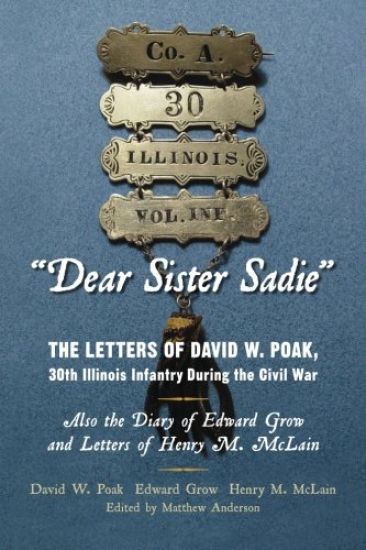
The letters and diaries of three civil war soldiers from the 30th Illinois Infantry during the Civil War. These writings give insight to what a soldier that served with this regiment experienced from the letters they wrote home and the diaries that was written as a personal record of their experience. David W. Poak was well educated and quite literate, Edward Grow and even more so Henry McLain wrote the words as they sounded to them. I tried to keep their spelling and punctuation as close to their written text as possible so the reader can get a better feel for the soldier himself.This is a book for those who are familiar with the Civil War and are looking to expand their knowledge from the soldier's perspective."Sister Sadie" or "Dear Sister" was how David Watson Poak usually addressed his many letters to Sarah J. Poak during his Civil War service with Company A, 30th Illinois Infantry. D. W. Poak was born and raised in Mt. Jackson, Lawrence Co., Pennsylvania, which was a small farming community in the mid-nineteenth century. He and his sister Sadie were the only children born to John Poak and Sarah Duff Poak. Their mother died in 1847. and the father married Emeline McCurley and they had two daughters, Ella and Nancy. His sister Sadie was born in 1841, David was born 1842, Ella in 1854 and Nancy 1859. Sometime around 1858-9 David W. Poak moved to Millersburg, Mercer County, Illinois along with another dozen or so residents of Lawrence County, PA. Mercer County was a thriving area of Illinois at the time, and towns like Aledo, the county seat, Millersburg, Keithsburg, New Boston, Viola and others were growing In Millersburg his occupation was a teacher, and he did this until the call came for volunteers from the state of Illinois to suppress the rebellion. So on August 12, 1861 David W. Poak enlisted into Co. A, 30th Illinois Volunteer Infantry as a Sergeant. The enlistment record says Poak was twenty years old, five foot five and a quarter inches tall, fair complexion, blue eyes, and had sandy colored hair. During the conflict on January 33, 1863 he would rise to the rank of 1st Lieutenant. During the Battle of Atlanta on July 22nd, 1864 he became acting adjutant and received the Seventeenth Corp Silver Medal of Honor for bravery. After the war, David Poak returned to Millersburg, IL, then moved to the newly incorporated town of Pleasanton, Linn County, Kansas. There he became a school director on February 19, 1870 and was elected Pleasanton's first mayor on October 25th, 1870. In 1872 he is listed as cashier for the Fannin County Bank in Bonham, Fannin County, Texas. In the 1876-77 City Directory for Sherman, TX his occupation is listed as vice-president of the Bank of Sherman, Grayson Co., TX. Sometime afterwards he went back to his home in Mt. Jackson, PA. His obituary on page one of the New Castle Courant, dated April 4th, 1879, stated that David W. Poak died "last week" (March 27th, 1879) at his home of consumption and is buried at the Westfield Presbyterian Church Cemetery. As for his sister Sarah J Polk, she married James Hayes October 26th, 1893. She died in 1919 and is also buried at the Westfield Presbyterian Church Cemetery.
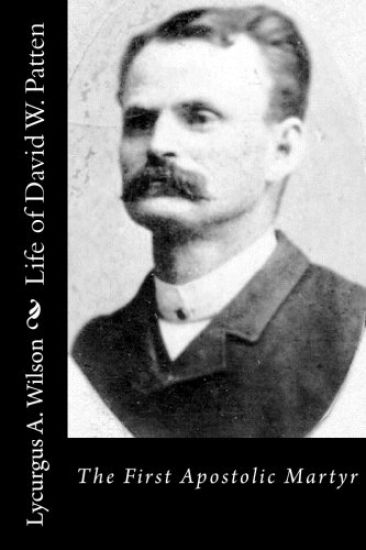
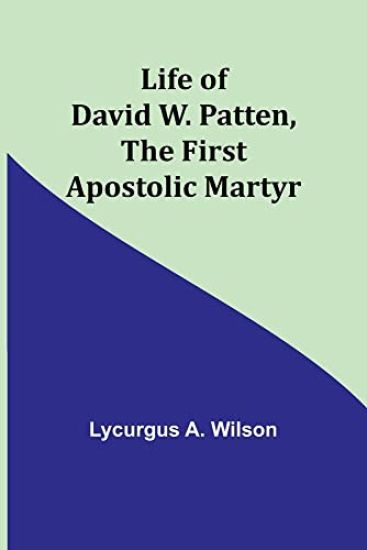
Life of David W. Patten, the First Apostolic Martyr, has been acknowledged as a major work throughout human history, and we have taken precautions to assure its preservation by republishing this book in a modern manner for both present and future generations. This book has been completely retyped, revised, and reformatted. The text is readable and clear because these books are not created from scanned copies.
"Life of David W. Patten" is a biographical account written through Lycurgus A. Wilson, losing mild at the compelling and regularly unnoticed lifestyles of David W. Patten, a distinguished parent inside the early history of The Church of Jesus Christ of Latter-day Saints (LDS Church). Wilson's work offers an insightful exploration of Patten's life, faith, and contributions to the improvement of Mormonism. David W. Patten, a member of the original Quorum of the Twelve Apostles inside the LDS Church, played a critical role inside the church's early years. Wilson's biography delves into Patten's conversion to the faith, his missionary efforts, and his unwavering commitment to the principles of Mormonism, even in the face of persecution and hassle. One of the highlights of the book is its detailed account of Patten's participation in vast activities, inclusive of the Zion's Camp expedition and the early days of the Kirtland Temple. Patten's devotion to Joseph Smith, his leadership in the church, and his ultimate martyrdom in the course of the Missouri struggle are vital themes in the biography. "Life of David W. Patten" serves as a valuable historical aid, providing readers with a deeper information of the demanding situations and triumphs experienced via early Latter-day Saints.