Kirjojen hintavertailu. Mukana 11 241 044 kirjaa ja 12 kauppaa.

Kirjahaku

Etsi kirjoja tekijän nimen, kirjan nimen tai ISBN:n perusteella.

1000 tulosta hakusanalla Derek R. Ford

Politics and Pedagogy in the “Post-Truth” Era

Politics and Pedagogy in the “Post-Truth” Era

Derek R. Ford

Bloomsbury Academic
2018
sidottu
Those who are in shock that truth doesn’t seem to matter in politics miss the mark: politics has never corresponded with the truth. Rather, political struggle is about the formulation and materialization of new truths. The “post-truth” era thus offers an important opportunity to push forward into a different world. Embracing this opportunity, Derek R. Ford articulates a new educational philosophy and praxis that emerges from within the nexus of social theory and political struggle. Blocking together aesthetics, queer theory, urbanism, postmodern philosophy, and radical politics, Ford develops arguments and proposals on key topics ranging from debt and time, to the death drive and forms of political organization. Through forceful yet accessible prose, Ford offers contemporary left politics an imaginative and potent set of educational concepts and practices.
Politics and Pedagogy in the “Post-Truth” Era

Politics and Pedagogy in the “Post-Truth” Era

Derek R. Ford

Bloomsbury Academic
2020
nidottu
Those who are in shock that truth doesn’t seem to matter in politics miss the mark: politics has never corresponded with the truth. Rather, political struggle is about the formulation and materialization of new truths. The “post-truth” era thus offers an important opportunity to push forward into a different world. Embracing this opportunity, Derek R. Ford articulates a new educational philosophy and praxis that emerges from within the nexus of social theory and political struggle. Blocking together aesthetics, queer theory, urbanism, postmodern philosophy, and radical politics, Ford develops arguments and proposals on key topics ranging from debt and time, to the death drive and forms of political organization. Through forceful yet accessible prose, Ford offers contemporary left politics an imaginative and potent set of educational concepts and practices.
Communist Study

Communist Study

Derek R. Ford

Lexington Books
2016
sidottu
Contending that radical politics needs educational theory, Communist Study: Education for the Commons poses a series of educational questions pertinent to revolutionary movements: How can pedagogy bridge the gap between what is and what can be, while respecting the gap and its uncertainty and figurality? How can pedagogy accommodate ambiguity while remaining faithful to the communist project? In answering these questions, educational theorist Derek R. Ford develops a pedagogical constellation that radically opens up what education is and what it can mean for revolutionary struggle. To chart this constellation, Ford takes the reader on a journey that traverses disciplinary and ideological boundaries, innovatively reading theorists as diverse as Agamben, Marx, Lyotard, Butler, and Lenin. Demonstrating that learning is the educational logic that underpins capitalism and democracy, Ford articulates a theory of communist study as an alternative and oppositional logic. Poetic, performative, and provocative, this theory of study is oriented toward what Ford calls “the sublime feeling of being-in-common,” which, as he insists, is always a commonness against.
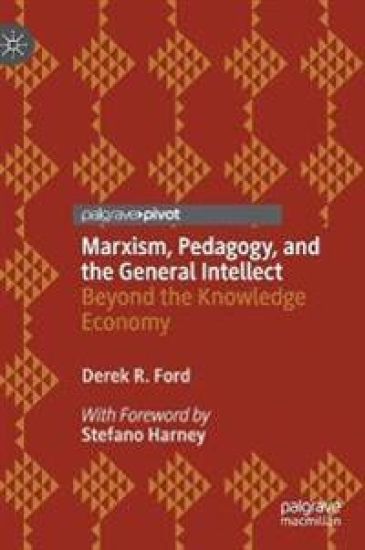
Marxism, Pedagogy, and the General Intellect

Marxism, Pedagogy, and the General Intellect

Derek R. Ford

Springer Nature Switzerland AG
2021
sidottu
This book is the first to articulate and challenge the consensus on the right and left that knowledge is the key to any problem, demonstrating how the left’s embrace of knowledge productivity keeps it trapped within capital’s circuits. As the knowledge economy has forced questions of education to the forefront, the book engages pedagogy as an underlying yet neglected motor of capitalism and its forms of oppression. Most importantly, it assembles new pedagogical resources for responding to the range of injustices that permeate our world. Building on yet critiquing the Marxist notion of the general intellect, Derek R. Ford theorizes stupidity as a necessary alternative pedagogical logic, an anti-value that is infinitely mute and unproductive.
Inhuman Educations: Jean-François Lyotard, Pedagogy, Thought
In the first monograph on Lyotard and education, the author approaches Lyotard's thought as pedagogical in itself. The result is a novel, soft, and accessible study of Lyotard organized around two inhuman educations: that of "the system" and that of "the human." The former enforces an interminable process of development, dialogue and exchange, while the latter finds its force in the mute, secret, opaque, and inarticulable. Threading together a range of Lyotard's work through four pedagogical processes--reading, writing, voicing, and listening--the author insists on the distinct educational logics that can uphold or interrupt different ways of being-together in the world, touching on a range of topics from literacy and aesthetics to time and political-economy. While Inhuman Educations can serve as an introduction to Lyotard's philosophy, it also constitutes a singular, provocative, and fresh take on his thought.
Marx, Capital, and Education

Marx, Capital, and Education

Derek R. Ford; Curry Stephenson Malott

Peter Lang Publishing Inc
2015
nidottu
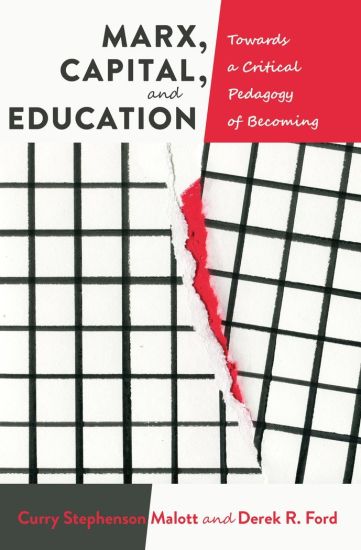
With the contradictions of capitalism heightening and intensifying, and with new social movements spreading across the globe, revolutionary transformation is once again on the agenda. For radicals, the most pressing question is: How can we transform ourselves and our world into something else, something just? In Marx, Capital, and Education, Curry Stephenson Malott and Derek R. Ford develop a «critical pedagogy of becoming» that is concerned with precisely this question. The authors boldly investigate the movement toward communism and the essential role that critical pedagogy can play in this transition. Performing a novel and educational reading of Karl Marx and radical theorists and activists, Malott and Ford present a critical understanding of the past and present, of the underlying logics and (often opaque) forces that determine the world-historical moment. Yet Malott and Ford are equally concerned with examining the specific ways in which we can teach, learn, study, and struggle ourselves beyond capitalism; how we can ultimately overthrow the existing order and institute a new mode of production and set of social relations. This incisive and timely book, penned by two militant teachers, organizers, and academics, reconfigures pedagogy and politics. Educators and organizers alike will find that it provides new ammunition in the struggle for the world that we deserve.
Marx, Capital, and Education

Marx, Capital, and Education

Derek R. Ford; Curry Stephenson Malott

Peter Lang Publishing Inc
2015
sidottu
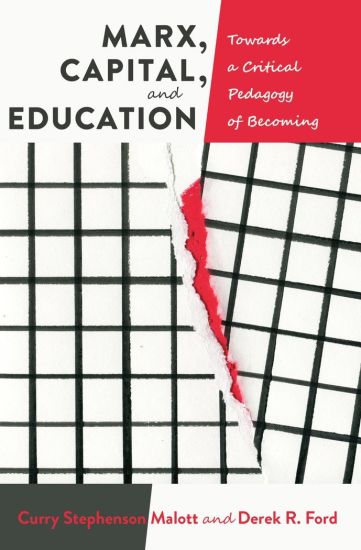
With the contradictions of capitalism heightening and intensifying, and with new social movements spreading across the globe, revolutionary transformation is once again on the agenda. For radicals, the most pressing question is: How can we transform ourselves and our world into something else, something just? In Marx, Capital, and Education, Curry Stephenson Malott and Derek R. Ford develop a «critical pedagogy of becoming» that is concerned with precisely this question. The authors boldly investigate the movement toward communism and the essential role that critical pedagogy can play in this transition. Performing a novel and educational reading of Karl Marx and radical theorists and activists, Malott and Ford present a critical understanding of the past and present, of the underlying logics and (often opaque) forces that determine the world-historical moment. Yet Malott and Ford are equally concerned with examining the specific ways in which we can teach, learn, study, and struggle ourselves beyond capitalism; how we can ultimately overthrow the existing order and institute a new mode of production and set of social relations. This incisive and timely book, penned by two militant teachers, organizers, and academics, reconfigures pedagogy and politics. Educators and organizers alike will find that it provides new ammunition in the struggle for the world that we deserve.
Communist Study

Communist Study

Derek R. Ford; Tyson E. Lewis; Ailish Hopper

BLOOMSBURY PUBLISHING PLC
2022
sidottu
In the second edition of this groundbreaking work, Derek R. Ford contends that radical politics needs educational theory, posing a series of educational questions pertinent to revolutionary movements: How can pedagogy bridge the gap between what is and what can be, while respecting the gap and its uncertainty and contingency? How can pedagogy accommodate ambiguity while remaining faithful to the communist project? In answering these questions, Ford develops a dyanmic pedagogical constellation that radically opens up what education is and what it can mean for revolutionary struggle. In charting this constellation, Ford takes the reader on a journey that traverses disciplinary boundaries, innovatively reading theorists as diverse as Lenin, Agamben, Marx, Lyotard, Althusser, and Butler. Demonstrating how learning underpins capitalism and democracy, Ford articulates a theory of communist study as an alternative and oppositional logic that, perhaps paradoxically, demands the revolutionary reclamation of testing. Poetic, performative, and provocative, communist study is oriented toward what Ford calls “the sublime feeling of being-in-common,” which, as he insists, is always a commonness against.
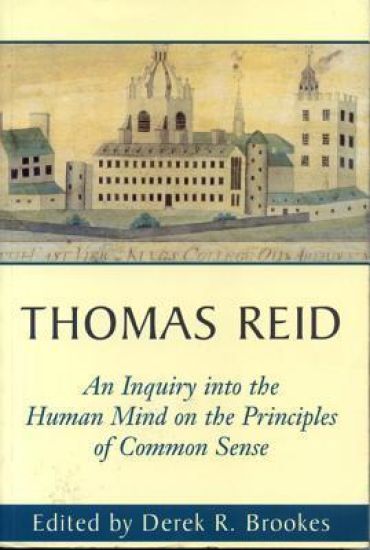
Thomas Reid's An Inquiry into the Human Mind on the Principles of Common Sense
Thomas Reid's Inquiry has long been recognized as a classic philosophical text. Since its first publication in 1764, there have followed no less than forty editions. The proliferation of secondary literature further indicates that Reid's work is flourishing as never before. Yet Reid scholars have been acutely aware of proceeding without the full textual evidence. There exist thousands of unpublished manuscript pages in Reid's hand, many of which relate directly to the composition of Inquiry. Furthermore, no account has been taken of the successive alterations made to the four editions published in Reid's lifetime. The present edition, therefore, aims to present a complete, critically edited text of the Inquiry, accompanied by a judicious selection of manuscript evidence relating to its composition.The volume contains an editor preface presenting the raison d'etre for the edition followed by an introduction giving the central argument of the Inquiry by means of an historical and philosophical account of its formation; an account which also indicates the significance of the MSS contained in the section containing related documents. The critical text is based on the fourth life-time edition (1785), while the textual notes include bibliographical details and allusions, translations, references to secondary literature, and selected passages from Reid's MSS.
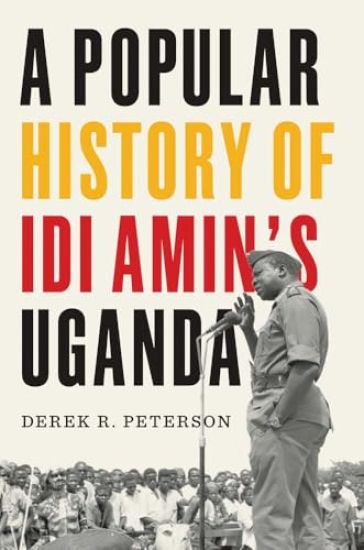
A Popular History of Idi Amin's Uganda

A Popular History of Idi Amin's Uganda

Derek R. Peterson

YALE UNIVERSITY PRESS
2025
sidottu
How Africa’s most notorious tyrant made his oppressive regime seem both necessary and patriotic Idi Amin ruled Uganda between 1971 and 1979, inflicting tremendous violence on the people of the country. How did Amin’s regime survive for eight calamitous years? Drawing on recently uncovered archival material, Derek Peterson reconstructs the political logic of the era, focusing on the ordinary people—civil servants, curators and artists, businesspeople, patriots—who invested their energy and resources in making the government work. Peterson reveals how Amin (1928–2003) led ordinary people to see themselves as front-line soldiers in a global war against imperialism and colonial oppression. They worked tirelessly to ensure that government institutions kept functioning, even as resources dried up and political violence became pervasive. In this case study of how principled, talented, and patriotic people sacrificed themselves in service to a dictator, Peterson provides lessons for our own time.
What's Wrong with Sin

What's Wrong with Sin

Derek R. Nelson

T. T.Clark Ltd
2009
nidottu
This title portrays two primary doctrines of sin, posited in the last half-century, the 'structural sin' type and the 'relational self' type. After an introduction to the current discussion on the doctrine of sin, two nineteenth century rejections of individualistic conceptions of sin are exposited and critiqued. The book concludes with recommendations drawn from the preceding analyses for further understanding of the social dimensions of sin.
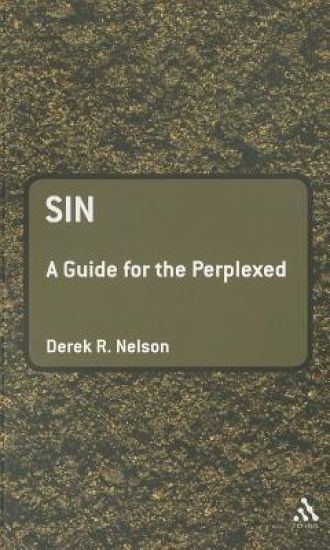
Sin: A Guide for the Perplexed

Sin: A Guide for the Perplexed

Derek R. Nelson

T. T.Clark Ltd
2011
nidottu
This is an upper-level introduction to the doctrine and understanding of sin in modern theology. Christianity concerns itself with salvation. But salvation implies something from which one must be saved, as reconciliation implies an estrangement and redemption a loss. The classical theological symbol naming the problem to which salvation is the solution is sin. Interpreting the meaning of sin, however, has become difficult for two reasons: sin has become a taboo subject in popular discourse, and has acquired an extremely broad meaning in recent theology. "Sin: A Guide for the Perplexed" is intended as a mid-level, comprehensive introduction to the notion of sin and its significance for Christian theology. Nelson situates and interprets biblical material on sin, and then offers a lucid history of the doctrine. He elucidates Augustine's conception of original sin and defends it against its many caricatures. Special attention is paid to sin as an ordinary, yet highly interruptive, phenomenon in the lives of individuals. This is supplemented by a careful look at the non-individualistic dimensions of sin, and an appreciation of how sin relates to other key theological commitments. "Continuum's Guides for the Perplexed" are clear, concise and accessible introductions to thinkers, writers and subjects that students and readers can find especially challenging - or indeed downright bewildering. Concentrating specifically on what it is that makes the subject difficult to grasp, these books explain and explore key themes and ideas, guiding the reader towards a thorough understanding of demanding material.
Sin: A Guide for the Perplexed

Sin: A Guide for the Perplexed

Derek R. Nelson

T. T.Clark Ltd
2011
sidottu
This is an upper-level introduction to the doctrine and understanding of sin in modern theology. Christianity concerns itself with salvation. But salvation implies something from which one must be saved, as reconciliation implies an estrangement and redemption a loss. The classical theological symbol naming the problem to which salvation is the solution is sin. Interpreting the meaning of sin, however, has become difficult for two reasons: sin has become a taboo subject in popular discourse, and has acquired an extremely broad meaning in recent theology. "Sin: A Guide for the Perplexed" is intended as a mid-level, comprehensive introduction to the notion of sin and its significance for Christian theology. Nelson situates and interprets biblical material on sin, and then offers a lucid history of the doctrine. He elucidates Augustine's conception of original sin and defends it against its many caricatures. Special attention is paid to sin as an ordinary, yet highly interruptive, phenomenon in the lives of individuals. This is supplemented by a careful look at the non-individualistic dimensions of sin, and an appreciation of how sin relates to other key theological commitments. "Continuum's Guides for the Perplexed" are clear, concise and accessible introductions to thinkers, writers and subjects that students and readers can find especially challenging - or indeed downright bewildering. Concentrating specifically on what it is that makes the subject difficult to grasp, these books explain and explore key themes and ideas, guiding the reader towards a thorough understanding of demanding material.
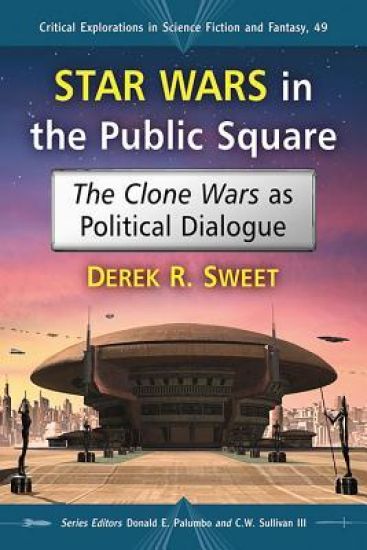
Star Wars in the Public Square

Star Wars in the Public Square

Derek R. Sweet

McFarland Co Inc
2015
pokkari
Speculative science fiction, with its underlying socio-political dialogue, represents an important intersection of popular culture and public discourse. As a pop culture text, the animated series Star Wars: The Clone Wars offers critical commentary on contemporary issues, marking a moment of interplay whereby author and audience come together in what Russian philosopher Mikhail Bakhtin called collaborative meaning making. This book critically examines the series as a voice in the political dialogues concerning human cloning, torture, just war theory, peace and drone warfare.
Creating the American West

Creating the American West

Derek R. Everett

University of Oklahoma Press
2014
sidottu
Boundaries - lines imposed on the landscape - shape our lives, dictating everything from which candidates we vote for to what schools our children attend to the communities with which we identify. In Creating the American West, historian Derek R. Everett examines the function of these internal lines in American history generally and in the West in particular. Drawing lines to create states in the trans-Mississippi West, he points out, imposed a specific form of political organization that made the West truly American.Everett examines how settlers lobbied for boundaries and how politicians imposed them. He examines the origins of boundary-making in the United States from the colonial era through the Louisiana Purchase. Case studies then explore the ethnic, sectional, political, and economic angles of boundaries. Everett first examines the boundaries between Arkansas and its neighboring Native cultures, and the pseudo war between Missouri and Iowa. He then traces the lines splitting the Oregon Country and the states of California and Nevada, and considers the ethnic and political consequences of the boundary between New Mexico and Colorado. He explains the evolution of the line splitting the Dakotas, and concludes with a discussion of ways in which state boundaries can contribute toward new interpretations of borderlands history.A major theme in the history of state boundaries is the question of whether to use geometric or geographic lines - in other words, lines corresponding to parallels and meridians or those fashioned by natural features. With the distribution of western land, Everett shows, geography gave way to geometry and transformed the West. The end of boundary-making in the late nineteenth century is not the end of the story, however. These lines continue to complicate a host of issues including water rights, taxes, political representation, and immigration. Creating the American West shows how the past continues to shape the present.