Kirjojen hintavertailu. Mukana 11 239 951 kirjaa ja 12 kauppaa.

Kirjahaku

Etsi kirjoja tekijän nimen, kirjan nimen tai ISBN:n perusteella.

1000 tulosta hakusanalla Dewei Zhang

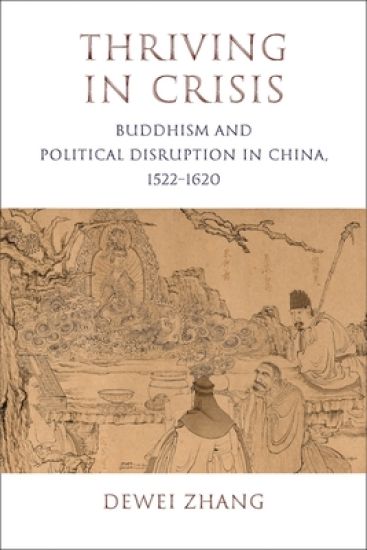
Thriving in Crisis

Thriving in Crisis

Dewei Zhang

Columbia University Press
2020
sidottu
Late imperial Chinese Buddhism was long dismissed as having declined from the glories of Buddhism during the Sui and Tang dynasties (581–907). In recent scholarship, a more nuanced picture of late Ming-era Buddhist renewal has emerged. Yet this alternate conception of the history of Buddhism in China has tended to focus on either doctrinal contributions of individual masters or the roles of local elites in Jiangnan, leaving unsolved broader questions regarding the dynamics and mechanism behind the evolution of Buddhism into the renewal.Thriving in Crisis is a systematic study of the late Ming Buddhist renewal with a focus on the religious and political factors that enabled it to happen. Dewei Zhang explores the history of the boom in enthusiasm for Buddhism in the Jiajing-Wanli era (1522–1620), tracing a pattern of advances and retrenchment at different social levels in varied regions. He reveals that the Buddhist renewal was a dynamic movement that engaged a wide swath of elites, from emperors and empress dowagers to eunuchs and scholar-officials. Drawing on a range of evidence and approaches, Zhang contends that the late Ming renewal was a politically driven exception to a longer-term current of disfavor toward Buddhism and that it failed to establish Buddhism on a foundation solid enough for its future development. A groundbreaking interdisciplinary study, Thriving in Crisis provides a new theoretical framework for understanding the patterns of Buddhist history in China.

Smart Protective Coatings for Corrosion Control

Smart Protective Coatings for Corrosion Control

Lingwei Ma; Dawei Zhang

Wiley-VCH Verlag GmbH
2024
sidottu
Smart Protective Coatings for Corrosion Control Overview of the latest research in advanced coatings for anticorrosion and the development of optimized surfaces with high anticorrosion ability Smart Protective Coatings for Corrosion Control introduces the newest research developments in self-healing coatings, self-reporting coatings, and superhydrophobic coatings, reviewing corrosion processes and strategies, smart coatings for corrosion protection, techniques for synthesizing and applying smart coatings, different kinds of self-healing and self-reporting coatings activated by different environmental stimuli, and current and future trends of protective coatings for automotive, aerospace, marine, nuclear, oil/gas, and military applications. This book also discusses new ideas in the field, such as the combination of self-healing and self-reporting properties, new techniques to study localized microscale electrochemical corrosion behavior, as well as atmospheric corrosion monitor technique to study the real-time protection behavior of coatings in different environments. The processes of coating degradation and metal corrosion are discussed in detail so that non-experts can gain a basic understanding of the corrosion protection techniques. Written by two highly qualified academics with significant research experience in the field, Smart Protective Coatings for Corrosion Control includes information on: Coating preparation, filler preparation, surface characterization, macroscopic and microscopic electrochemical properties, and self-healing performance of self-healing coating systems under different environmental stimuliPhotothermal conversion species such as graphene oxide, titanium nitride, and Fe3O4Different types of corrosion indicators, such as phenolphthalein, sulfosalicylic acid-modified carbon dots, and phenanthrolineHigh-mobility polymer networks that endow a shape memory effect and allow coatings to recover their original shape and barrier propertiesSolutions to three corrosion conditions—room temperature immersion, alternating wet-dry, and outdoor atmospheric exposure conditions Presenting the latest research in the field, Smart Protective Coatings for Corrosion Control is a practical and highly valuable reference on the subject for scientists, researchers, and students in diverse programs of study.
John Dewey, Liang Shuming, and China's Education Reform
This book explores the central question of how to cultivate a continued sense of self in the radically changing Chinese society, a question that is highly related to the current ongoing educational reform. If education cannot respond to the problem of students’ disconnection from the changing society, learning cannot truly happen in school and the reform will fail. Zhang suggests a philosophy of education that highlights the cultivation of students’ unique but inclusive individuality so that students learn how to nurture their own mind in this profoundly changing society rather than becoming empty and lost. The discussion of this proposed question is inspired by the thoughts of the American pragmatist John Dewey and Chinese Confucian scholar Liang Shuming. It is not the author’s intention to have a pure philosophical discussion, but rather to refer to their philosophies to help answer the practical question of cultivating individuality in an educational setting during this period of China’s modern transition.
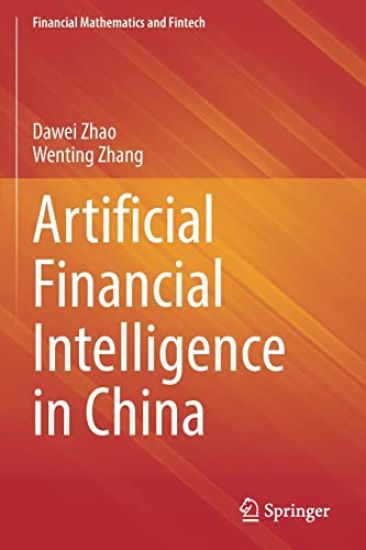
Artificial Financial Intelligence in China

Artificial Financial Intelligence in China

Dawei Zhao; Wenting Zhang

SPRINGER VERLAG, SINGAPORE
2021
sidottu
This book starts from the application scenarios of artificial financial intelligence regulation, commercial banking, wealth management and payments, etc., and makes a detailed study of the main scenarios of the application of China's artificial intelligence in the financial field, and also analysis specific application cases of China.With the popularization of smart phones and the rapid development of e-commerce, mobile payment, big data and other technologies are in the ascendant in China in recent years. In particular, artificial intelligence technologies in the form of facial, speech and semantic recognition are showing preliminary advantages in the field of FinTech, and the future era of Intelligent Finance has quietly come. The Chinese government has clearly put forward "China should rely on a robust cycle of domestic demand and innovation as the main driver of the economy while maintaining foreign markets and investors as a second engine of growth", science and technology innovation is the basic motivation of economic and social cycle, to implement the " dual circulation strategy ", it is necessary to understand the key role of scientific and technological innovation in financial innovation services, and improve financial services must be driven by science and technology. There is a natural relationship between artificial intelligence and financial services, because financial services are credit and information intermediaries, and data is the most critical for finance, while artificial intelligence has a super ability in dealing with complex data. At present, many Chinese Banks have applied artificial intelligence to their daily operations and management, such as accurate customer identification, enhanced process tracking, intelligent marketing, and product process transformation, so as to simplify financial service processes and shorten service cycles. In General, this book both pays attention to practical application and theoretical, which is a useful reference book in theoretical research and practical work, and also helps readers to understand the application of intelligent finance in China.
Artificial Financial Intelligence in China

Artificial Financial Intelligence in China

Dawei Zhao; Wenting Zhang

SPRINGER VERLAG, SINGAPORE
2022
nidottu
This book starts from the application scenarios of artificial financial intelligence regulation, commercial banking, wealth management and payments, etc., and makes a detailed study of the main scenarios of the application of China's artificial intelligence in the financial field, and also analysis specific application cases of China.With the popularization of smart phones and the rapid development of e-commerce, mobile payment, big data and other technologies are in the ascendant in China in recent years. In particular, artificial intelligence technologies in the form of facial, speech and semantic recognition are showing preliminary advantages in the field of FinTech, and the future era of Intelligent Finance has quietly come. The Chinese government has clearly put forward "China should rely on a robust cycle of domestic demand and innovation as the main driver of the economy while maintaining foreign markets and investors as a second engine of growth", science and technology innovation is the basic motivation of economic and social cycle, to implement the " dual circulation strategy ", it is necessary to understand the key role of scientific and technological innovation in financial innovation services, and improve financial services must be driven by science and technology. There is a natural relationship between artificial intelligence and financial services, because financial services are credit and information intermediaries, and data is the most critical for finance, while artificial intelligence has a super ability in dealing with complex data. At present, many Chinese Banks have applied artificial intelligence to their daily operations and management, such as accurate customer identification, enhanced process tracking, intelligent marketing, and product process transformation, so as to simplify financial service processes and shorten service cycles. In General, this book both pays attention to practical application and theoretical, which is a useful reference book in theoretical research and practical work, and also helps readers to understand the application of intelligent finance in China.
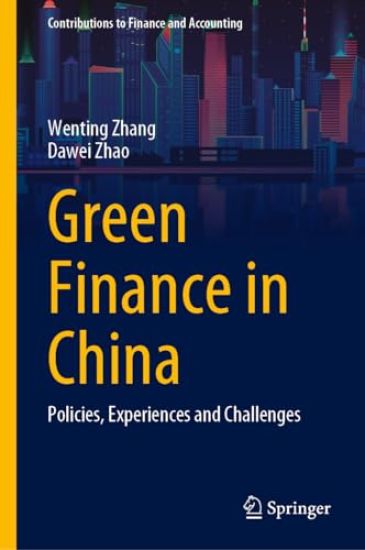
Green Finance in China

Green Finance in China

Wenting Zhang; Dawei Zhao

SPRINGER VERLAG, SINGAPORE
2024
sidottu
This book aims to provide first-hand information for readers concerned with green finance and sustainable development by summarizing the unique features, policies and practical innovations of green finance development in China and hoping to provide China's experience in the development of green finance for more regions. The global economy is currently facing historic opportunities that brings by a new round of technology, energy and industrial revolution. The new growth path of "green and low-carbon" development has become the main direction of the transformation of global economic development. What's China's green finance strategy? How does China deliver on the goal? This book builds an overview of China's green finance and sheds light on sustainable development topics from finance perspective.
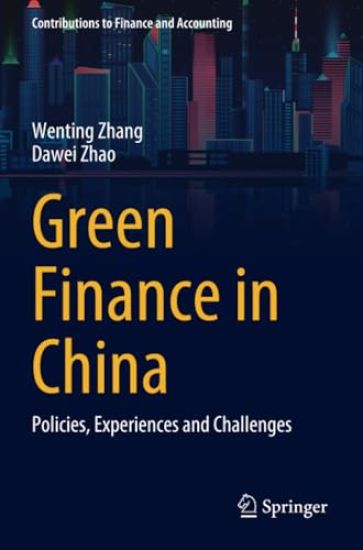
Green Finance in China

Green Finance in China

Wenting Zhang; Dawei Zhao

SPRINGER VERLAG, SINGAPORE
2025
nidottu
This book aims to provide first-hand information for readers concerned with green finance and sustainable development by summarizing the unique features, policies and practical innovations of green finance development in China and hoping to provide China's experience in the development of green finance for more regions. The global economy is currently facing historic opportunities that brings by a new round of technology, energy and industrial revolution. The new growth path of "green and low-carbon" development has become the main direction of the transformation of global economic development. What's China's green finance strategy? How does China deliver on the goal? This book builds an overview of China's green finance and sheds light on sustainable development topics from finance perspective.
Quantum-Inspired Neural Language Representation, Matching and Understanding

Quantum-Inspired Neural Language Representation, Matching and Understanding

Peng Zhang; Hui Gao; Jing Zhang; Dawei Song

Now Publishers Inc
2023
nidottu
The introduction of Quantum Theory (QT) provides a unified mathematical framework for Information Retrieval (IR). Compared with the classical IR framework, the quantum-inspired IR framework is based on user-centered modeling methods to model non-classical cognitive phenomena in human relevance judgment in the IR process. With the increase of data and computing resources, neural IR methods have been applied to the text matching and understanding task of IR. Neural networks have a strong learning ability of effective representation and generalization of matching patterns from raw data. This monograph provides a systematic introduction to quantum-inspired neural IR, including quantum-inspired neural language representation, matching and understanding. The cross-field research on QT, neural network and IR is not only helpful to non-classical phenomena modeling in IR but also to break the theoretical bottleneck of neural networks and design more transparent neural IR models. The authors first introduce the language representation method based on QT. Secondly, they introduce the quantum-inspired text matching and decision making model under neural network that shows its theoretical advantages in document ranking, relevance matching, multimodal IR, and can be integrated with neural network to jointly promote the development of IR. Finally, the latest progress of quantum language understanding is introduced and further topics on QT and language modeling provide readers with more materials for thinking.
Predictive Control

Predictive Control

Yugeng Xi; Dewei Li

John Wiley Sons Inc
2019
sidottu
This book is a comprehensive introduction to model predictive control (MPC), including its basic principles and algorithms, system analysis and design methods, strategy developments and practical applications. The main contents of the book include an overview of the development trajectory and basic principles of MPC, typical MPC algorithms, quantitative analysis of classical MPC systems, design and tuning methods for MPC parameters, constrained multivariable MPC algorithms and online optimization decomposition methods. Readers will then progress to more advanced topics such as nonlinear MPC and its related algorithms, the diversification development of MPC with respect to control structures and optimization strategies, and robust MPC. Finally, applications of MPC and its generalization to optimization-based dynamic problems other than control will be discussed. Systematically introduces fundamental concepts, basic algorithms, and applications of MPCIncludes a comprehensive overview of MPC development, emphasizing recent advances and modern approachesFeatures numerous MPC models and structures, based on rigorous researchBased on the best-selling Chinese edition, which is a key text in China Predictive Control: Fundamentals and Developments is written for advanced undergraduate and graduate students and researchers specializing in control technologies. It is also a useful reference for industry professionals, engineers, and technicians specializing in advanced optimization control technology.
Dewey's New Logic

Dewey's New Logic

Tom Burke

University of Chicago Press
1994
sidottu
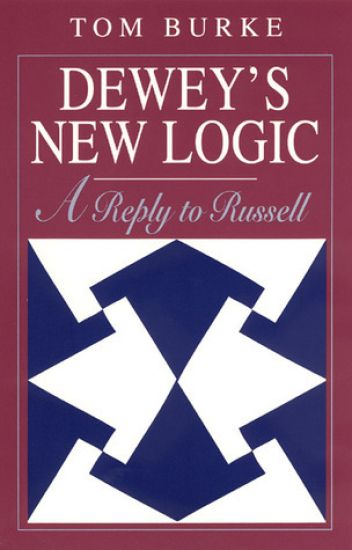
Celebrated for his work in education and pragmatism, John Dewey might have had more of a reputation for his logic had Bertrand Russell not so fervidly attacked him on the subject. This book analyzes the debates between Russell and Dewey that followed the 1938 publication of Dewey's "Logic: The Theory of Inquiry" and argues that, despite Russell's resistance, Dewey's logic has become surprisingly relevant to recent developments in philosophy and cognitive science. Since Dewey's logic focused on natural language in everyday experience, it posed a challenge to the legitimacy of Russell's formal syntactic conception of logic. Tom Burke demonstrates that Russell misunderstood crucial aspects of Dewey's theory - his ideas on propositions, judgments, inquiry, situations, and warranted assertibility - and contends that today logic has progressed beyond Russell and is approaching Dewey's broader perspective. Burke argues that Dewey's logic addresses issues in epistemology, philosophy of language and psychology, computer science and formal semantics in a way that Russellean logic does not.
Dewey's New Logic

Dewey's New Logic

Tom Burke

University of Chicago Press
1998
nidottu
Although John Dewey is celebrated for his work in the philosophy of education and acknowledged as a leading proponent of American pragmatism, he might also have enjoyed more of a reputation for his philosophy of logic had not Bertrand Russell attacked him so fervently on the subject. This text analyzes the debate between John Dewey and Bertrand Russell that followed the 1938 publication of Dewey's "Logic: The Theory in Inquiry". It argues that Russell failed to understand Dewey's logic as Dewey intended and that this logic is relevant to recent developments in philosophy and cognitive science.
Dewey for Artists

Dewey for Artists

Mary Jane Jacob

University of Chicago Press
2018
sidottu
John Dewey is known as a pragmatic philosopher and progressive architect of American educational reform, but some of his most important contributions came in his thinking about art. Dewey argued that there is strong social value to be found in art, and it is artists who often most challenge our preconceived notions. Dewey for Artists shows us how Dewey advocated for an “art of democracy.” Identifying the audience as co-creator of a work of art by virtue of their experience, he made space for public participation. Moreover, he believed that societies only become—and remain—truly democratic if its citizens embrace democracy itself as a creative act, and in this he advocated for the social participation of artists. Throughout the book, Mary Jane Jacob draws on the experiences of contemporary artists who have modeled Dewey’s principles within their practices. We see how their work springs from deeply held values. We see, too, how carefully considered curatorial practice can address the manifold ways in which aesthetic experience happens and, thus, enable viewers to find greater meaning and purpose. And it is this potential of art for self and social realization, Jacob helps us understand, that further ensures Dewey’s legacy—and the culture we live in.
Dewey for Artists

Dewey for Artists

Mary Jane Jacob

University of Chicago Press
2018
nidottu
John Dewey is known as a pragmatic philosopher and progressive architect of American educational reform, but some of his most important contributions came in his thinking about art. Dewey argued that there is strong social value to be found in art, and it is artists who often most challenge our preconceived notions. Dewey for Artists shows us how Dewey advocated for an “art of democracy.” Identifying the audience as co-creator of a work of art by virtue of their experience, he made space for public participation. Moreover, he believed that societies only become—and remain—truly democratic if its citizens embrace democracy itself as a creative act, and in this he advocated for the social participation of artists. Throughout the book, Mary Jane Jacob draws on the experiences of contemporary artists who have modeled Dewey’s principles within their practices. We see how their work springs from deeply held values. We see, too, how carefully considered curatorial practice can address the manifold ways in which aesthetic experience happens and, thus, enable viewers to find greater meaning and purpose. And it is this potential of art for self and social realization, Jacob helps us understand, that further ensures Dewey’s legacy—and the culture we live in.
Dewey and Elvis

Dewey and Elvis

Louis Cantor

University of Illinois Press
2010
nidottu
Beginning in 1949, while Elvis Presley and Sun Records were still virtually unknown--and two full years before Alan Freed famously "discovered" rock 'n' roll - Dewey Phillips brought the budding new music to the Memphis airwaves by playing Howlin' Wolf, B. B. King, and Muddy Waters on his nightly radio show Red, Hot and Blue. The mid-South's most popular white deejay, "Daddy-O-Dewey" soon became part of rock 'n' roll history for being the first major disc jockey to play Elvis Presley and, subsequently, to conduct the first live, on-air interview with the singer. Louis Cantor illuminates Phillips's role in turning a huge white audience on to previously forbidden race music. Phillips's zeal for rhythm and blues legitimized the sound and set the stage for both Elvis's subsequent success and the rock 'n' roll revolution of the 1950s. Using personal interviews, documentary sources, and oral history collections, Cantor presents a personal view of the disc jockey while restoring Phillips's place as an essential figure in rock 'n' roll history.
Dewey for a New Age of Fascism

Dewey for a New Age of Fascism

Nathan Crick

Pennsylvania State University Press
2019
sidottu
During the rise of fascism in the early twentieth century, American philosopher and educational reformer John Dewey argued that the greatest threat to democracy was not a political regime or even an aggressive foreign power but rather a set of dispositions or attitudes. Though not fascist in and of themselves, these habits of thought—rugged individualism and ideological nationalism—lay the foundation for fascism. In this study, Nathan Crick uses Dewey’s social thought and philosophy of education to provide insight into and resources for transforming our present-day politics.Through a close reading of Dewey’s political writings and educational theory, Crick elaborates Dewey’s vision of democratic social life and the education required for its foundation. He shows that for Dewey, communication is essential to cultivating sympathy, intelligence, and creativity—habits of thought that form the core of democratic culture. Crick then lays out a broad curriculum of logic, aesthetics, and rhetoric for inculcating these habits in the classroom, arguing that if we are to meet the challenge of fascism, we must teach these new arts as if our civilization depends on it—because in our new age of politics, it does.Comprehensive and pragmatic, this book presents an experimental model of education that can be applied across the humanities curriculum. It will be of interest to teachers of writing, composition, and rhetoric as well as scholars and students of communication studies, pedagogy, and political theory.
Dewey for a New Age of Fascism

Dewey for a New Age of Fascism

Nathan Crick

Pennsylvania State University Press
2020
pokkari
During the rise of fascism in the early twentieth century, American philosopher and educational reformer John Dewey argued that the greatest threat to democracy was not a political regime or even an aggressive foreign power but rather a set of dispositions or attitudes. Though not fascist in and of themselves, these habits of thought—rugged individualism and ideological nationalism—lay the foundation for fascism. In this study, Nathan Crick uses Dewey’s social thought and philosophy of education to provide insight into and resources for transforming our present-day politics.Through a close reading of Dewey’s political writings and educational theory, Crick elaborates Dewey’s vision of democratic social life and the education required for its foundation. He shows that for Dewey, communication is essential to cultivating sympathy, intelligence, and creativity—habits of thought that form the core of democratic culture. Crick then lays out a broad curriculum of logic, aesthetics, and rhetoric for inculcating these habits in the classroom, arguing that if we are to meet the challenge of fascism, we must teach these new arts as if our civilization depends on it—because in our new age of politics, it does.Comprehensive and pragmatic, this book presents an experimental model of education that can be applied across the humanities curriculum. It will be of interest to teachers of writing, composition, and rhetoric as well as scholars and students of communication studies, pedagogy, and political theory.