

Kirjahaku
Etsi kirjoja tekijän nimen, kirjan nimen tai ISBN:n perusteella.
1000 tulosta hakusanalla Diann C Lloyd

Discovering Yellowstone Wolves: Watcher's Guide
Diann Thompson; James C. Halfpenny
Createspace Independent Publishing Platform
2009
nidottu
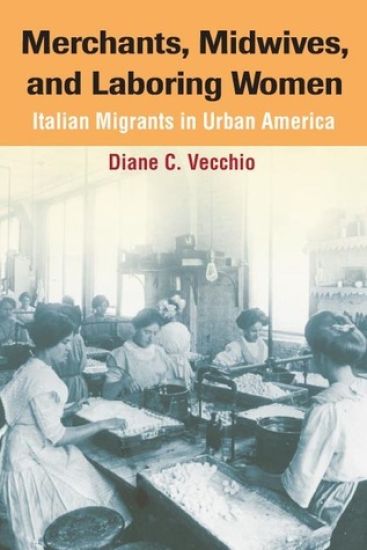
Challenging long-held patriarchal assumptions about Italian women's work in the United States

A dual biography of unruly activism that spans national and racial boundariesDemanding liberation, advocating for the oppressed, and organizing for justice, siblings Mitsuye Yamada (1923–) and Michael Yasutake (1920–2001) rebelled against respectability and assimilation, charting their own paths for what it means to be Nisei. Raised in Seattle and then forcibly removed and detained in the Minidoka concentration camp, their early lives mirrored those of many second-generation Japanese Americans. Yasutake's pacifism endured even with immense pressure to enlist during his confinement and in the years following World War II. His faith-based activism guided him in condemning imperialism and inequality, and he worked tirelessly to free political prisoners and defend human rights. Yamada became an internationally acclaimed feminist poet, professor, and activist who continues to speak out against racism and patriarchy.Weaving together the stories of two distinct but intrinsically connected political lives, Nisei Radicals examines the siblings' half century of dedication to global movements, including multicultural feminism, Puerto Rican independence, Japanese American redress, Indigenous sovereignty, and more. From displacement and invisibility to insurgent mobilization, Yamada and Yasutake rejected stereotypes and fought to dismantle systems of injustice.

A dual biography of unruly activism that spans national and racial boundariesDemanding liberation, advocating for the oppressed, and organizing for justice, siblings Mitsuye Yamada (1923–) and Michael Yasutake (1920–2001) rebelled against respectability and assimilation, charting their own paths for what it means to be Nisei. Raised in Seattle and then forcibly removed and detained in the Minidoka concentration camp, their early lives mirrored those of many second-generation Japanese Americans. Yasutake's pacifism endured even with immense pressure to enlist during his confinement and in the years following World War II. His faith-based activism guided him in condemning imperialism and inequality, and he worked tirelessly to free political prisoners and defend human rights. Yamada became an internationally acclaimed feminist poet, professor, and activist who continues to speak out against racism and patriarchy.Weaving together the stories of two distinct but intrinsically connected political lives, Nisei Radicals examines the siblings' half century of dedication to global movements, including multicultural feminism, Puerto Rican independence, Japanese American redress, Indigenous sovereignty, and more. From displacement and invisibility to insurgent mobilization, Yamada and Yasutake rejected stereotypes and fought to dismantle systems of injustice.

Set in Japanese-occupied Shanghai in 1945, The Frontiers of Love passes effortlessly in and out of Asian and Western fields of reference to explore the issue of cultural identity in a city dominated by Western colonialism. Diana Chang uses psychologial portrayal, historical narrative, and sociological observation to achieve a multidimensional view of a city both Chinese and Western, liberating and oppressive, national and international. As the character Feng observes of Shanghai, "Strictly speaking, it could not be called Chinese, though it was inhabited mostly by Chinese - Chinese who were either wealthy, Westernized, or prayed to a Christian God."

With the North American Free Trade Agreement (NAFTA) looming large and imminent, the authors of this book explore the socio-economic fabric of the U.S.-Mexico border region as a measure of NAFTA’s future. Crisis on the Rio Grande presents the social and economic history, as well as the potential, of the Lower Rio Grande Valley on the Texas-Mexico border. The authors discuss issues of poverty, colonias, the maquiladora industry, border migration, and NAFTA’s potential impact on the economy, infrastructure, and environment of the border region. This timely study will interest economists, policy analysts, U.S.-Mexico border region specialists, and students of the North American Free Trade Agreement.

With the North American Free Trade Agreement (NAFTA) looming large and imminent, this book explores the socio-economic fabric of the U.S.-Mexico border region as a measure of NAFTA's future. It presents the social and economic history of the Lower Rio Grande Valley on the Texas-Mexico border. .
In recent years global trade and telecommunications have rapidly been spreading the influence of large multinational forms of organization. An integral part of this process has been the rise of 'organizational cultures' unique to particular firms. In a world where such cultures are often in conflict with the societies in which they operate how can we understand the workings of cultural patterns and the kinds of transformations they can create? This concise new introductory text provides succint analysis of organizational cultures and types of change they can set in motion. 'culture' is used in an original way to bring together and make sense of cenrtral issues of organizational behaviour. The author explores the way in which forms of culture can influence styles of management, attitudes toward leadership, the level of motivation in the workplace and `hidden agendas' in group dynamics. Organizational Cultures raises the important issue of whether their can be such a thing as a `right decision' for an organization, and brings into focus the major implications and dangers of the growing numbers of supra-national firms both in terms of internal structure and for the context which they function. Throughout, the author succeeds in weaving together behaviour and organization, thus reconciling the traditional divorce between psychology and sociology in the field. Drawing on case studies from Europe, Asia, Africa, Organizational Cultures provides a truly international insight into forms of organizational behaviour. Detailed chapter objectives and summaries are provided to aid progress and self-assessment.
In recent years global trade and telecommunications have rapidly been spreading the influence of large multinational forms of organization. An integral part of this process has been the rise of 'organizational cultures' unique to particular firms. In a world where such cultures are often in conflict with the societies in which they operate how can we understand the workings of cultural patterns and the kinds of transformations they can create? This concise new introductory text provides succint analysis of organizational cultures and types of change they can set in motion. 'culture' is used in an original way to bring together and make sense of cenrtral issues of organizational behaviour. The author explores the way in which forms of culture can influence styles of management, attitudes toward leadership, the level of motivation in the workplace and `hidden agendas' in group dynamics. Organizational Cultures raises the important issue of whether their can be such a thing as a `right decision' for an organization, and brings into focus the major implications and dangers of the growing numbers of supra-national firms both in terms of internal structure and for the context which they function. Throughout, the author succeeds in weaving together behaviour and organization, thus reconciling the traditional divorce between psychology and sociology in the field. Drawing on case studies from Europe, Asia, Africa, Organizational Cultures provides a truly international insight into forms of organizational behaviour. Detailed chapter objectives and summaries are provided to aid progress and self-assessment.

'Religion and politics', as the old saying goes, 'should never be discussed in mixed company.'And yet fostering discussions that cross lines of political difference has long been a central concern of political theorists. More recently, it has also become a cause célèbre for pundits and civic-minded citizens wanting to improve the health of American democracy. But only recently have scholars begun empirical investigations of where and with what consequences people interact with those whose political views differ from their own. Hearing the Other Side examines this theme in the context of the contemporary United States. It is unique in its effort to link political theory with empirical research. Drawing on her empirical work, Mutz suggests that it is doubtful that an extremely activist political culture can also be a heavily deliberative one.
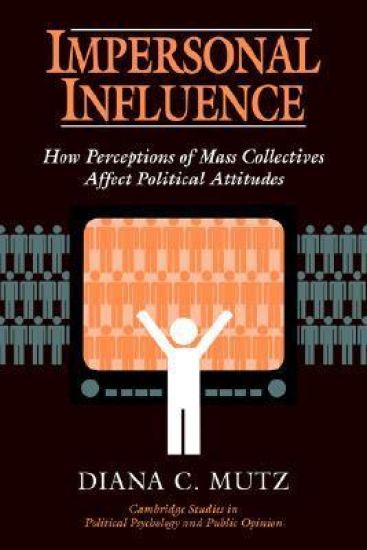
People's perceptions of the attitudes and experiences of mass collectives are an increasingly important force in contemporary political life. In Impersonal Influence, Mutz goes beyond simply providing examples of how impersonal influence matters in the political process to provide a micro-level understanding of why information about distant and impersonal others often influence people's political attitudes and behaviors. Impersonal Influence is worthy of attention both from the standpoint of its impact on contemporary politics, and because of its potential to expand the boundaries of our understanding of social influence processes, and media's relation to them. The book's conclusions do not exonerate media from the effects of inaccurate portrayals of collective experience or opinion, but they suggest that the ways in which people are influenced by these perceptions are in themselves, not so much deleterious to democracy as absolutely necessary to promoting accountability in a large scale society.
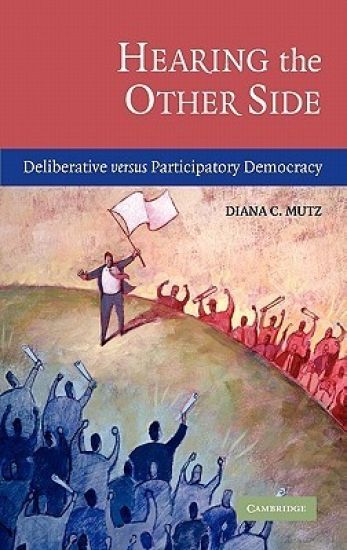
'Religion and politics', as the old saying goes, 'should never be discussed in mixed company.'And yet fostering discussions that cross lines of political difference has long been a central concern of political theorists. More recently, it has also become a cause célèbre for pundits and civic-minded citizens wanting to improve the health of American democracy. But only recently have scholars begun empirical investigations of where and with what consequences people interact with those whose political views differ from their own. Hearing the Other Side examines this theme in the context of the contemporary United States. It is unique in its effort to link political theory with empirical research. Drawing on her empirical work, Mutz suggests that it is doubtful that an extremely activist political culture can also be a heavily deliberative one.

Holly's Big Imagination Is a must-read for children and preschoolers learning to conquer their fear of the dark It is a story about fantasy and discovery, taking the reader on a whimsical bedtime adventure into Holly's imagination. But what appears to unfold in the murkiness of the dim night air isn't at all what Holly expected And what happens next when the light goes back on is thebiggest surprise of all

Holly's Big Imagination Is a must-read for children and preschoolers learning to conquer their fear of the dark It is a story about fantasy and discovery, taking the reader on a whimsical bedtime adventure into Holly's imagination. But what appears to unfold in the murkiness of the dim night air isn't at all what Holly expected And what happens next when the light goes back on is thebiggest surprise of all




Population-based survey experiments have become an invaluable tool for social scientists struggling to generalize laboratory-based results, and for survey researchers besieged by uncertainties about causality. Thanks to technological advances in recent years, experiments can now be administered to random samples of the population to which a theory applies. Yet until now, there was no self-contained resource for social scientists seeking a concise and accessible overview of this methodology, its strengths and weaknesses, and the unique challenges it poses for implementation and analysis. Drawing on examples from across the social sciences, this book covers everything you need to know to plan, implement, and analyze the results of population-based survey experiments. But it is more than just a "how to" manual. This lively book challenges conventional wisdom about internal and external validity, showing why strong causal claims need not come at the expense of external validity, and how it is now possible to execute experiments remotely using large-scale population samples. Designed for social scientists across the disciplines, Population-Based Survey Experiments provides the first complete introduction to this methodology. * Offers the most comprehensive treatment of the subject * Features a wealth of examples and practical advice * Reexamines issues of internal and external validity * Can be used in conjunction with downloadable data from ExperimentCentral.org for design and analysis exercises in the classroom

Americans are disgusted with watching politicians screaming and yelling at one another on television. But does all the noise really make a difference? Drawing on numerous studies, Diana Mutz provides the first comprehensive look at the consequences of in-your-face politics. Her book contradicts the conventional wisdom by documenting both the benefits and the drawbacks of in-your-face media. "In-your-face" politics refers to both the level of incivility and the up-close and personal way that we experience political conflict on television. Just as actual physical closeness intensifies people's emotional reactions to others, the appearance of closeness on a video screen has similar effects. We tend to keep our distance from those with whom we disagree. Modern media, however, puts those we dislike in our faces in a way that intensifies our negative reactions. Mutz finds that incivility is particularly detrimental to facilitating respect for oppositional political viewpoints and to citizens' levels of trust in politicians and the political process. On the positive side, incivility and close-up camera perspectives contribute to making politics more physiologically arousing and entertaining to viewers. This encourages more attention to political programs, stimulates recall of the content, and encourages people to relay content to others. In the end, In-Your-Face Politics demonstrates why political incivility is not easily dismissed as a disservice to democracy--it may even be a necessity in an age with so much competition for citizens' attention.