

Kirjahaku
Etsi kirjoja tekijän nimen, kirjan nimen tai ISBN:n perusteella.
1000 tulosta hakusanalla Donald B Wright


Dr. Walsh's Simple Solutions to Back Pain: New Smyrna Beach Chiropractor Dr. Donald B Walsh reveals simple solutions to treat and prevent back pain.
Donald B. Walsh III
Createspace Independent Publishing Platform
2010
nidottu

Arctic Odyssey: The Life of Rear Admiral Donald B. MacMillan
Everett S. Allen
Literary Licensing, LLC
2011
sidottu
Arctic Odyssey: The Life of Rear Admiral Donald B. MacMillan is a biography written by Everett S. Allen about the life and adventures of Donald B. MacMillan, a renowned explorer and sailor who spent over 50 years exploring the Arctic. The book details MacMillan's childhood in Maine, his early interest in sailing, and his eventual career in the Navy, where he served as a naval officer and Arctic explorer.The book covers MacMillan's many expeditions to the Arctic, including his famous 1913-1917 expedition with Robert E. Peary, where he helped survey the northern coast of Greenland and conducted scientific research. The book also covers MacMillan's later expeditions, including his work with the Inuit people of Labrador and his efforts to promote environmental conservation in the Arctic.Throughout the book, Allen provides a detailed and engaging portrait of MacMillan, highlighting his bravery, intelligence, and dedication to the exploration of the Arctic. The book also includes numerous photographs and illustrations that help bring MacMillan's adventures to life.Overall, Arctic Odyssey: The Life of Rear Admiral Donald B. MacMillan is a fascinating and inspiring account of one man's lifelong passion for exploration and discovery in one of the world's most challenging and beautiful environments.A Biography Of Rear Admiral MacMillan Who Took Part In Peary's North Pole Expedition, 1908-1909, And Who Made Numerous Trips To The Canadian Arctic And Greenland.This scarce antiquarian book is a facsimile reprint of the old original and may contain some imperfections such as library marks and notations. Because we believe this work is culturally important, we have made it available as part of our commitment for protecting, preserving, and promoting the world's literature in affordable, high quality, modern editions, that are true to their original work.

Arctic Odyssey: The Life of Rear Admiral Donald B. MacMillan
Everett S. Allen
Literary Licensing, LLC
2011
nidottu

How Peary Reached the Pole: The Personal Story of His Assistant, Donald B. MacMillan
Donald Baxter MacMillan
Literary Licensing, LLC
2013
sidottu
""How Peary Reached The Pole: The Personal Story Of His Assistant, Donald B. MacMillan"" is a book written by Donald Baxter MacMillan, who was a member of Robert Peary's expedition to the North Pole in 1908-1909. The book is a first-hand account of the journey and the events leading up to Peary's successful attainment of the North Pole. MacMillan provides a detailed description of the harsh conditions and challenges they faced during the expedition, including the extreme cold, dangerous ice floes, and hostile wildlife. He also shares his personal experiences and observations of Peary's leadership and determination, as well as the relationships and dynamics between the members of the expedition team. The book is a valuable historical record of one of the most significant expeditions in the history of polar exploration and provides insight into the personal experiences of those who were involved in this groundbreaking achievement.Biography Of Robert Edwin Peary And His Successful Attainment Of The North Pole Written By His Assistant Donald Baxter Macmillan.This scarce antiquarian book is a facsimile reprint of the old original and may contain some imperfections such as library marks and notations. Because we believe this work is culturally important, we have made it available as part of our commitment for protecting, preserving, and promoting the world's literature in affordable, high quality, modern editions, that are true to their original work.

How Peary Reached the Pole: The Personal Story of His Assistant, Donald B. MacMillan
Donald Baxter MacMillan
Literary Licensing, LLC
2013
nidottu

"When a Soldier Cries the World Weeps" Poetry: Donald B. Remembers
Ssd CI Katerena Veronica Lovett Mhs
Createspace Independent Publishing Platform
2011
nidottu

An Atlas of Comparative Vertebrate Histology
Donald B. McMillan; Richard James Harris
Academic Press Inc
2018
sidottu
Atlas of Comparative Vertebrate Histology looks at the histology of a wide range of vertebrates, representative of all the major classes and families, with examples ranging from amphioxus to primates. The authors focus their microscope on commonly seen vertebrates as well as ‘non-standard’ species, such as lamprey, hagfish, dogfish, skate, rock bass, cod, river catfish, toad, amphiuma, leopard and bull frog, garter and brown snake, Coturnix quail and cowbird. The study of comparative histology in the vertebrates helps students and researchers alike understand how various groups have addressed similar problems, opening doors to interesting research possibilities. Not all vertebrates follow the mammalian model of tissue and organ structure. When dealing with unique species, we see some structures taken beyond their ‘normal’ function. Comparative histology allows us to understand the structural responses underlying the physiology unique to each vertebrate group.

Horse-and-Buggy Mennonites
Donald B. Kraybill; James P. Hurd
Pennsylvania State University Press
2006
sidottu
On a May Sunday in 1927, progress and tradition collided at the Groffdale Old Order Mennonite Church in eastern Pennsylvania when half the congregation shunned the cup of wine offered by Bishop Moses Horning. The boycott of this holiest of Mennonite customs was in direct response to Horning’s decision to endorse the automobile after years of debate within the church. The resulting schism over opposing views of technology produced the group known as the Wenger Mennonites. In the nearly eighty years since the establishment of this church, the initial group of fifty dissenters has grown to a community of 16,000 Wenger Mennonites. They have large families and typically retain 95 percent or more of their youth. For many years their main community was based in Lancaster County, but in recent decades they have expanded into eight other states, with new communities most recently established in Iowa and Michigan. Despite their continued rejection of modern technology, the Wengers—popularly known as horse-and-buggy Mennonites—continue to thrive on their own terms.In this first-of-its-kind study of the Wenger Mennonites, Kraybill and Hurd—a sociologist and an anthropologist—use cultural analysis to interpret the Wengers both in and outside Pennsylvania. They systematically compare the Wengers with other Mennonite groups as well as with the Amish, showing how relationships with these other groups have had a powerful impact on shaping the identity of the Wenger Mennonites in the Anabaptist world. As Kraybill and Hurd show, the Wengers have learned that it is impossible to maintain a truly static culture, and so examining the ways in which the Wengers cautiously and incrementally adapt to the ever-changing world around them is an invaluable case study of the gradual evolution of religious ritual in the face of modernity.

Horse-and-Buggy Mennonites
Donald B. Kraybill; James P. Hurd
Pennsylvania State University Press
2006
pokkari
On a May Sunday in 1927, progress and tradition collided at the Groffdale Old Order Mennonite Church in eastern Pennsylvania when half the congregation shunned the cup of wine offered by Bishop Moses Horning. The boycott of this holiest of Mennonite customs was in direct response to Horning’s decision to endorse the automobile after years of debate within the church. The resulting schism over opposing views of technology produced the group known as the Wenger Mennonites. In the nearly eighty years since the establishment of this church, the initial group of fifty dissenters has grown to a community of 16,000 Wenger Mennonites. They have large families and typically retain 95 percent or more of their youth. For many years their main community was based in Lancaster County, but in recent decades they have expanded into eight other states, with new communities most recently established in Iowa and Michigan. Despite their continued rejection of modern technology, the Wengers—popularly known as horse-and-buggy Mennonites—continue to thrive on their own terms.In this first-of-its-kind study of the Wenger Mennonites, Kraybill and Hurd—a sociologist and an anthropologist—use cultural analysis to interpret the Wengers both in and outside Pennsylvania. They systematically compare the Wengers with other Mennonite groups as well as with the Amish, showing how relationships with these other groups have had a powerful impact on shaping the identity of the Wenger Mennonites in the Anabaptist world. As Kraybill and Hurd show, the Wengers have learned that it is impossible to maintain a truly static culture, and so examining the ways in which the Wengers cautiously and incrementally adapt to the ever-changing world around them is an invaluable case study of the gradual evolution of religious ritual in the face of modernity.
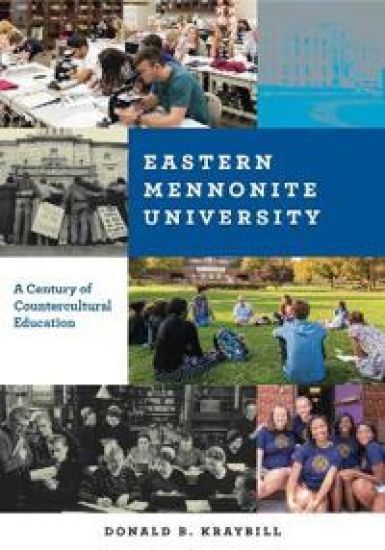
In this unique educational history, Donald B. Kraybill traces the sociocultural transformation of Eastern Mennonite University from a fledgling separatist school founded by white, rural, Germanic Mennonites into a world-engaged institution populated by many faith traditions, cultures, and nationalities.The founding of Eastern Mennonite School, later Eastern Mennonite University, in 1917 came at a pivotal time for the Mennonite community. Industrialization and scientific discovery were rapidly changing the world, and the increasing availability of secular education offered tempting alternatives that threatened the Mennonite way of life. In response, the Eastern Mennonites founded a school that would “uphold the principles of plainness and simplicity,” where youth could learn the Bible and develop skills that would help advance the church. In the latter half of the twentieth century, the university’s identity evolved from separatism to social engagement in the face of churning moral tides and accelerating technology. EMU now defines its mission in terms of service, peacebuilding, and community.Comprehensive and well told by a leading scholar of Anabaptist and Pietist studies, this social history of Eastern Mennonite University reveals how the school has mediated modernity while remaining consistently Mennonite. A must-have for anyone affiliated with EMU, it will appeal especially to sociologists and historians of Anabaptist and Pietist studies and higher education.

Joseph McDonnell started out as a figurative sculptor studying under renowned Yugoslav sculptor Ivan Mestrovic, but his major works vary from stark geometric forms to others more loosely connected. They range in size from small to monumental and include mobiles, wall reliefs, and, more recently, an exquisite series McDonnell calls "Ice Cubes." He has a flawless sense of mass and speace that produces an inner logic in the forms he creates. His work in bronze and granite contains overtones of ancient civilizations and their symbolism deals with the primordial objects of life: the sun, the column, the arch.With an in-depth text by the well-known art critic Donald Kuspit and photographs by world-famous photographer of sculpture David Finn and his granddaughter, Rebecca Binder, this book brings McDonnell's unique vision to life through exquisite detail shots that explore the sculptures from many angles.

The author looks beyond formal criticism to explore how black writers (and by implication all writers) present their views about the world, its society, and our relation to them. Writers included range from Charles W. Chesnutt to Richard Wright and Ralph Ellison.

Proteins in living systems carry out a great variety of specific functions, each of which depends on the precise three-dimensional structure of a particular protein. Proteins are synthesized in the form of a flexible polypeptide chain that is capable of assuming a vast number of configurations; the transformation of this chain into a specific, relatively rigid three-dimensional structure is called folding--a remarkable process of self-organization. It is known that the amino acid sequences of some proteins have sufficient information to determine their three-dimensional structures. There are other proteins whose folding requires additional information beyond that found in the sequence of the mature protein. This book introduces the central problem of folding mechanisms as well as a number of other closely related issues. This book is neither a textbook nor a treatise. Rather, it is an attempt by several investigators to convey the excitement and challenges of those aspects of the folding problem in which they are actively engaged. The contributors give brief introductions to protein folding from the perspectives of molecular architecture, stability and dynamics, phage genetics, DNA exons, general physiology, and natural selection. They point out emerging new directions, including the suggestion of a class of diseases that result from protein folding defects.

Proteins in living systems carry out a great variety of specific functions, each of which depends on the precise three-dimensional structure of a particular protein. Proteins are synthesized in the form of a flexible polypeptide chain that is capable of assuming a vast number of configurations; the transformation of this chain into a specific, relatively rigid three-dimensional structure is called folding--a remarkable process of self-organization. It is known that the amino acid sequences of some proteins have sufficient information to determine their three-dimensional structures. There are other proteins whose folding requires additional information beyond that found in the sequence of the mature protein. This book introduces the central problem of folding mechanisms as well as a number of other closely related issues. This book is neither a textbook nor a treatise. Rather, it is an attempt by several investigators to convey the excitement and challenges of those aspects of the folding problem in which they are actively engaged. The contributors give brief introductions to protein folding from the perspectives of molecular architecture, stability and dynamics, phage genetics, DNA exons, general physiology, and natural selection. They point out emerging new directions, including the suggestion of a class of diseases that result from protein folding defects.

In this fascinating and exciting overview, Donald B. Freeman explores the role of the Pacific Ocean in human history.Covering over one third of the globe, the Pacific Ocean plays a vital role in the lives and fortunes of more than two billion people who live on its rim-lands and islands. It has played a crucial part in shaping the histories of the different Pacific cultures, towards which it has appeared in a variety of different guises. Exploring the ocean’s place in human history, this wide ranging book draws together the long and varied physical, economic, cultural and political history of the Pacific, from Prehistory through to the present day. It takes an interdisciplinary approach to show the changing viewpoints of those who explored, exploited and settled the Pacific, including the inhabitants of its Asian and American rim-lands. The book draws on new research in a variety of areas, such as early Pacific migrations, impacts of European colonization, the effects of climate change, and current economic and political developments. It provides a uniquely broad overview that will be of vital interest to students and to all those with an interest in World History.

In this fascinating and exciting overview, Donald B. Freeman explores the role of the Pacific Ocean in human history.Covering over one third of the globe, the Pacific Ocean plays a vital role in the lives and fortunes of more than two billion people who live on its rim-lands and islands. It has played a crucial part in shaping the histories of the different Pacific cultures, towards which it has appeared in a variety of different guises. Exploring the ocean’s place in human history, this wide ranging book draws together the long and varied physical, economic, cultural and political history of the Pacific, from Prehistory through to the present day. It takes an interdisciplinary approach to show the changing viewpoints of those who explored, exploited and settled the Pacific, including the inhabitants of its Asian and American rim-lands. The book draws on new research in a variety of areas, such as early Pacific migrations, impacts of European colonization, the effects of climate change, and current economic and political developments. It provides a uniquely broad overview that will be of vital interest to students and to all those with an interest in World History.
Drying and Storage Of Grains and Oilseeds
Donald B. Brooker; F.W. Bakker-Arkema; Carl W. Hall
Van Nostrand Reinhold Inc.,U.S.
1992
sidottu
This text and reference discusses the drying of grains, in particular the staple cereals, maize, rice, and wheat, and the oilseeds, soybeans and canola. The basic physical and thermodynamic properties of grain and air are examined, and the theory of the drying process is developed. Design of the optimum operating conditions for on-farm and off-farm dryers are presented. The book is written as an engineering text, but should also prove beneficial to all who are interested in the proper drying and storage of grains. Examples and problems are given in both S.I. and Imperial units.

Amish Grace
Donald B. Kraybill; Steven M. Nolt; David L. Weaver-Zercher
John Wiley Sons Inc
2010
nidottu
Praise for Amish Grace "A story our polarized country needs to hear: It is still grace that saves." ?BILL MOYERS, Public Affairs Television "In a world where repaying evil with evil is almost second nature, the Amish remind us there's a better way. In plain and beautiful prose, Amish Grace recounts the Amish witness and connects it to the heart of their spirituality." ?SISTER HELEN PREJEAN, author, Dead Man Walking "Faced with the notorious Amish aversion to publicity, reporter after reporter turned to the authors...to answer one question: How could the Nickel Mines Amish so readily, so completely, forgive ? While the text provides a detailed account of the tragedy, its beauty lies in its discovery of forgiveness as the crux of Amish culture. Never preachy or treacly, it suggests a larger meditation more than apt in our time." ?Philadelphia Magazine "This balanced presentation . . .blends history, current evaluation of American society, and an examination of what builds community into a seamless story that details the shootings while it probes the religious beliefs that led to such quick forgiving. Recommended." ?Library Journal "Professors Kraybill, Nolt, and Weaver-Zercher have written a superb book?a model of clear, forceful writing about a tragedy and its aftermath. They have an obvious affection for the Amish yet ask tough questions, weigh contradictions, and explore conundrums such as how a loving God could permit schoolgirls to be massacred." ?National Catholic Reporter Visit the authors' Web site at www.amishgrace.com