Kirjojen hintavertailu. Mukana 11 342 296 kirjaa ja 12 kauppaa.

Kirjahaku

Etsi kirjoja tekijän nimen, kirjan nimen tai ISBN:n perusteella.

1000 tulosta hakusanalla Donald C. Robertson

Cricket and the Frog: Music of the Forest

Cricket and the Frog: Music of the Forest

Donald C. Robertson

Amazon publishing direct
2025
nidottu
"In the heart of the forest, a lively frog with a deep, croaky voice and a nimble cricket with a sweet, high chirp dream of creating the most enchanting choir the woods have ever heard. Together, they gather the sounds of rustling leaves, babbling brooks, and the songs of their fellow woodland friends to weave a melody that fills the night air with magic. But their harmony is threatened when Willie-a sly, troublesome creature-sets his sights on disrupting their project. To protect their dream, the frog and the cricket must join forces, blending their talents, courage, and friendship to outwit Willie and keep the music of the forest alive."
Bug Bottoms Creek: Together we are Strong

Bug Bottoms Creek: Together we are Strong

Donald C. Robertson

Amazon publishing direct
2025
nidottu
Deep in the heart of the meadow, where tall blades of grass swayed like emerald towers and the air hummed with life, there thrived a bustling community of insects and bugs of every shape, size, and color. Ants marched in steady lines, beetles polished their shimmering shells, dragonflies darted like jewels through the sunlight, and fireflies lit up the night like living lanterns. Life was good-until the day a terrible enemy cast its shadow over their peaceful home. This was no ordinary threat; it was cunning, relentless, and determined to take control of the meadow. Fear spread quickly through the insect kingdom, but so did determination. The ladybugs offered their keen eyes to spot danger from afar. The bees pledged their strength and strategy, ready to rally the troops. The spiders spun elaborate traps to slow the enemy's advance, while the butterflies carried urgent messages across the meadow. Even the smallest aphids and gnats found ways to contribute, proving that no role was too small when the fate of their home was at stake. For the first time in history, every bug, beetle, and butterfly stood side by side, each bringing their unique gifts and courage to the fight. Together, they would face the greatest challenge their meadow had ever seen-and discover that unity could transform even the tiniest of creatures into heroes.
Africa's Deadliest Conflict

Africa's Deadliest Conflict

Walter C. Soderlund; E. Donald Briggs; Tom Pierre Najem; Blake C. Roberts

Wilfrid Laurier University Press
2012
nidottu
Africa's Deadliest Conflict deals with the complex intersection of the legacy of post-colonial history - a humanitarian crisis of epic proportions - and changing norms of international intervention associated with the idea of human security and the responsibility to protect (R2P). It attempts to explain why, despite a softening of norms related to the sanctity of state sovereignty, the international community dealt so ineffectively with a brutal conflict in the Democratic Republic of the Congo, which between 1997 and 2011 claimed an estimated 5.5 million. In particular, the book focuses on the role of mass media in creating a will to intervene, a role considered by many to be the key to prodding a reluctant international community to action. Included in the book are a primer on Congolese history, a review of United Nations peacekeeping missions in the Congo, and a detailed examination of both US television news and New York Times coverage of the Congo from 1997 through 2008. Separate conclusions are offered with respect to peacekeeping in the Age of R2P and on the role of mass media in both promoting and inhibiting robust international responses to large-scale humanitarian crises.
Philosophical Logic

Philosophical Logic

Robert L. Arrington; Peter M. Burkholder; Shannon Dubose; James W. Dye; James K. Feibleman; Bertrand P. Helm; Max Hocutt; Harold N. Lee; Louise N. Roberts; John C. Sallis; Donald H. Weiss

Kluwer Academic Publishers
1968
nidottu
With this issue we initiate the policy of expanding the scope of Tulane Studies in Philosophy to include, in addition to the work of members of the department, contributions from philosophers who have earned advanced degrees from Tulane and who are now teaching in other colleges and universities. The Editor THE LOGIC OF OUR LANGUAGE ROBERT L. ARRINGTON Wittgenstein wrote in the Tractatus that "logic is not a body of doctrine, but a mirror-image of the world. " 1 In line with his suggestion that a proposition is a 'picture', Wittgenstein argued that propositions 'show' the logical structure of the real. He was insistent, however, that "the apparent logical form of a proposition need not be its real one. " 2 As a result of this we can misunderstand the structure of fact. Philosophical problems arise just when "the logic of our language is mis­ understood. " 3 It is common knowledge that much of this view of logic was rejected by Wittgenstein himself in the Philosophical Investi­ gations. There we are told that language has no ideal or sublime 4 logic which mirrors the structure of the extra-linguistic world. Consequently, inferences from the structure of language to the structure of that extra-linguistic world are invalid. Reality can be 'cut up' in any of a number of ways by language. Wittgenstein adopted a view of philosophy which would render that discipline a non-explanatory, non-critical study of the multiple ways in which language can be used.
The Metaphysics of Donald C. Williams

The Metaphysics of Donald C. Williams

A.R.J. Fisher

Springer International Publishing AG
2025
sidottu
The thesis of this book is that Williams played a key role in the development and revival of analytic metaphysics. This book begins with an account of Williams' approach to philosophy given the rise of realism in the early twentieth century, with a focus on his use of induction and parsimony to argue for metaphysical theses such as metaphysical realism and metaphysical naturalism. It explains his critique of logical positivism and his defence of an empirical conception of metaphysics, which in turn reveals how he took himself to be standing up to rising anti-metaphysical trends. This book then expounds—within the framework of his empirical metaphysics—his one-category trope ontology and its origins, arguing that his systematisation of the concept of an abstract particular (or trope) is his most novel contribution to analytic ontology. This book further presents an original interpretation of his account of concrete objects and abstract universals, engaging with current debates in the metaphysics of properties—sometimes defending Williams, sometimes correcting misinterpretations, sometimes critically reassessing his views. This book also explains his defence of the four-dimensional manifold theory of time and his objections to competing theories such as the growing block theory and presentism (incorporating recently posthumously published work in The Elements and Patterns of Being, ed. A.R.J. Fisher, 2018), with up-to-date references to the latest work in the metaphysics of time. Lastly, this book analyses Williams's influence on later philosophers such as Lewis and Armstrong (and others in Australia), drawing from correspondence between Williams, Lewis, and Armstrong, and evaluates his place in the history of analytic philosophy, concluding that he played a key role in the development and revival of analytic metaphysics.
Selling Hope, Selling Risk

Selling Hope, Selling Risk

Donald C. Langevoort

Oxford University Press Inc
2016
sidottu
In the midst of globalization, technological change and economic anxiety, we have deep doubts about how well that task of investor protection is being performed. In the U.S., the focus is on the Securities & Exchange Commission. Part of the explanation is economic and political: the failure to know the right balance between investor protection and capital formation, and the resulting battle among interest groups over their preferred solutions. This book's main claim, however, is that regulation is also frustrated at nearly every turn by human nature, as exhibited both on the buy-side (investors) and sell-side (corporate executives, bankers, stockbrokers). There is plenty of savvy and guile, but also ample hope, fear, ego, overconfidence, social contagion and the like that persistently filter and distort the messages regulators try to send. This book is the first sustained effort to link the key initiatives of securities regulation with our burgeoning awareness in the social sciences of how people and organizations really behave in economic settings. It examines why corporate fraud occurs and how best to deter it and compensate its victims; the search for an edge via insider trading; the disclosure apparatus and its gatekeepers; sales efforts and manipulation in Ponzi schemes, internet scams, private offerings and crowdfunding; and how this all helps explain the recent global financial crisis. It ends by turning these insights back on the task of regulation itself, and the strategies (and frustrations) of making regulation work in a financial world that is at once increasingly sophisticated yet deeply human and incurably flawed.
A Smoother Pebble

A Smoother Pebble

Donald C. Benson

Oxford University Press Inc
2003
sidottu
This book takes a novel look at the topics of school mathematics--arithmetic, geometry, algebra, and calculus. In this stroll on the mathematical seashore we hope to find, quoting Newton, "...a smoother pebble or a prettier shell than ordinary..." This book assembles a collection of mathematical pebbles that are important as well as beautiful.
Hume's True Scepticism

Hume's True Scepticism

Donald C. Ainslie

Oxford University Press
2017
nidottu
David Hume is famous as a sceptical philosopher but the nature of his scepticism is difficult to pin down. Hume's True Scepticism provides the first sustained interpretation of Part 4 of Book 1 of Hume's Treatise, his deepest engagement with sceptical arguments. Hume notes there that, while reason shows that we ought not to believe the verdicts of reason or the senses, we do so nonetheless. Donald C. Ainslie argues that Hume uses our reactions to the sceptical arguments as evidence in favour of his model of the mind. If we were self-conscious subjects, superintending our rational and sensory beliefs, nothing should stop us from embracing the sceptical conclusions. But instead our minds are bundles of perceptions with our beliefs being generated, not by reflective assent, but by the imagination's association of ideas. We are not forced into the sceptical quagmire. Nonetheless, we can reflect and philosophy uses this capacity to question whether we should believe our instinctive rational and sensory verdicts. It turns out that we cannot answer this question because the reflective investigation of the mind interferes with the associative processes involved in reason and sensation. We thus must accept our rational and sensory capacities without being able to vindicate or undermine them philosophically. Hume's True Scepticism addresses Hume's theory of representation; his criticisms of Locke, Descartes, and other predecessors; his account of the imagination; his understanding of perceptions and sensory belief; and his bundle theory of the mind and his later rejection of it.
The Elements and Patterns of Being

The Elements and Patterns of Being

Donald C. Williams

Oxford University Press
2018
sidottu
The Harvard philosopher Donald C. Williams (1899-1983) was a key figure in the history of analytic philosophy. He played a crucial role in reviving metaphysics at a time when other philosophers ridiculed, criticized, and committed it to the flames. He constructed an explanatorily powerful and parsimonious ontology and cosmology founded on logic, science, and common sense. His most influential articles were on the metaphysics of properties ('The Elements of Being') and the metaphysics of time ('The Sea Fight Tomorrow', 'The Myth of Passage'). His ontology of abstract particulars or tropes and his four-dimensional manifold theory of time remain leading hypotheses in metaphysics. Because of his novel contributions and his defense of metaphysics he made a lasting impact on philosophers of the next generation who in turn believed in the substance of metaphysical inquiry. A. R. J. Fisher brings together Williams's seminal articles in metaphysics along with previously unpublished essays that shed new light on his philosophical outlook and complete his metaphysical vision. This volume, with its comprehensive Introduction, is set to be the definitive source for Williams's work, both for historians of analytic philosophy and for contemporary metaphysicians.
Hume's True Scepticism

Hume's True Scepticism

Donald C. Ainslie

Oxford University Press
2015
sidottu
David Hume is famous as a sceptical philosopher but the nature of his scepticism is difficult to pin down. Hume's True Scepticism provides the first sustained interpretation of Part 4 of Book 1 of Hume's Treatise, his deepest engagement with sceptical arguments. Hume notes there that, while reason shows that we ought not to believe the verdicts of reason or the senses, we do so nonetheless. Donald C. Ainslie argues that Hume uses our reactions to the sceptical arguments as evidence in favour of his model of the mind. If we were self-conscious subjects, superintending our rational and sensory beliefs, nothing should stop us from embracing the sceptical conclusions. But instead our minds are bundles of perceptions with our beliefs being generated, not by reflective assent, but by the imagination's association of ideas. We are not forced into the sceptical quagmire. Nonetheless, we can reflect and philosophy uses this capacity to question whether we should believe our instinctive rational and sensory verdicts. It turns out that we cannot answer this question because the reflective investigation of the mind interferes with the associative processes involved in reason and sensation. We thus must accept our rational and sensory capacities without being able to vindicate or undermine them philosophically. Hume's True Scepticism addresses Hume's theory of representation; his criticisms of Locke, Descartes, and other predecessors; his account of the imagination; his understanding of perceptions and sensory belief; and his bundle theory of the mind and his later rejection of it.
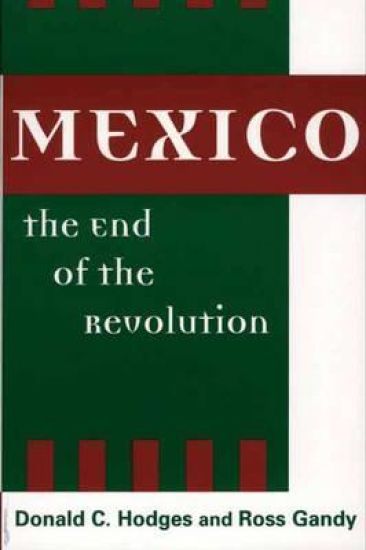
Mexico, the End of the Revolution

Mexico, the End of the Revolution

Donald C. Hodges; Ross Gandy

Praeger Publishers Inc
2001
sidottu
This study reveals how the social pact, formalized during the armed stage of the Mexican Revolution (1910-20) and implemented during the second stage (1920-40), was upset during the third or arrested stage (1940-70) when the bureaucrat-professionals at the helm opted for intensive economic development by taking the capitalist road. Although momentarily revived during yet a fourth stage of revolution (1970-82), this social pact was subsequently betrayed from within by the official party of the Revolution and undermined from without by the operation of economic forces behind the scenes. In this first book on the complete history of the Mexican Revolution, Hodges and Gandy reveal that, along with the end of its social pact, Mexico passed out of its former nationalist and capitalist orbit to enter the new professional societies and global order fathered by the transnationals.From 1920 to 1970, Mexico's bureaucrat-professionals hung onto political power while native capitalists continued to flourish. In response, Mexico's workers and peasants staged strikes against the nationalized sector and fomented guerrilla wars. Concessions were then made to this group until, beginning in 1982, the social pact was again eroded at the expense, not only of the popular sectors, but also of the capitalists. The economic surplus was redistributed away from owners and into the pockets of professionals. That was the Revolution's last gasp before it was officially put to rest in 2000 with the official party's defeat at the polls. Hodges and Gandy challenge the current belief that Mexico's economic system is still capitalist by presenting statistical evidence that shows how the chief beneficiaries of the economy are no longer the providers of capital, but instead the providers of professional services.
Mexico, the End of the Revolution

Mexico, the End of the Revolution

Donald C. Hodges; Ross Gandy

Praeger Publishers Inc
2001
nidottu
This study reveals how the social pact, formalized during the armed stage of the Mexican Revolution (1910-20) and implemented during the second stage (1920-40), was upset during the third or arrested stage (1940-70) when the bureaucrat-professionals at the helm opted for intensive economic development by taking the capitalist road. Although momentarily revived during yet a fourth stage of revolution (1970-82), this social pact was subsequently betrayed from within by the official party of the Revolution and undermined from without by the operation of economic forces behind the scenes. In this first book on the complete history of the Mexican Revolution, Hodges and Gandy reveal that, along with the end of its social pact, Mexico passed out of its former nationalist and capitalist orbit to enter the new professional societies and global order fathered by the transnationals.From 1920 to 1970, Mexico's bureaucrat-professionals hung onto political power while native capitalists continued to flourish. In response, Mexico's workers and peasants staged strikes against the nationalized sector and fomented guerrilla wars. Concessions were then made to this group until, beginning in 1982, the social pact was again eroded at the expense, not only of the popular sectors, but also of the capitalists. The economic surplus was redistributed away from owners and into the pockets of professionals. That was the Revolution's last gasp before it was officially put to rest in 2000 with the official party's defeat at the polls. Hodges and Gandy challenge the current belief that Mexico's economic system is still capitalist by presenting statistical evidence that shows how the chief beneficiaries of the economy are no longer the providers of capital, but instead the providers of professional services.
Sandino's Communism

Sandino's Communism

Donald C. Hodges

University of Texas Press
2014
nidottu
Drawing on previously unknown or unassimilated sources, Donald C. Hodges here presents an entirely new interpretation of the politics and philosophy of Augusto C. Sandino, the intellectual progenitor of Nicaragua's Sandinista revolution.The first part of the book investigates the political sources of Sandino's thought in the works of Babeuf, Buonarroti, Blanqui, Proudhon, Bakunin, Most, Malatesta, Kropotkin, Ricardo Flores MagÓn, and Lenin-a mixed legacy of pre-Marxist and non-Marxist authoritarian and libertarian communists.The second half of the study scrutinizes the philosophy of nature and history that Sandino made his own. Hodges delves deeply into this philosophy as the supreme and final expression of Sandino's communism and traces its sources in the Gnostic and millenarian occult undergrounds. This results in a rich study of the ways in which Sandino's revolutionary communism and communist spirituality intersect-a spiritual politics that Hodges presents as more realistic than the communism of Karl Marx.While accepting the current wisdom that Sandino was a Nicaraguan liberal and social reformer, Hodges also makes a persuasive case that Sandino was first and foremost a communist, although neither of the Marxist nor anarchist variety. He argues that Sandino's eclectic communist spirituality was more of an asset than a liability for understanding the human condition, and that his spiritual politics promises to be more relevant than Marxism-Leninism for the twenty-first century. Indeed, Hodges believes that Sandino's holistic communism embraces both deep ecology and feminist spirituality-a finding that is sure to generate lively and productive debate.
Argentina's "Dirty War"

Argentina's "Dirty War"

Donald C. Hodges

University of Texas Press
1991
pokkari
Argentines ask how their ultracivilized country, reputedly the most European in Latin America, could have relapsed into near-barbarism in the 1970s. This enlightening study seeks to answer that question by reviewing the underlying political events and intellectual foundations of the "dirty war" (1975–1978) and overlapping Military Process (1976–1982). It examines the ideologies and actions of the main protagonists-the armed forces, guerrillas, and organized labor-over time and traces them to their roots.In the most comprehensive treatment of the subject to date, Hodges examines primary materials never seen by other researchers, including clandestinely published guerrilla documents, and interviews important actors in Argentina's political drama. His wide-ranging scholarship traces the origins of the national security and national salvation doctrines to the Spanish Inquisition, sixteenth-century witch hunts, and nineteenth-century reactions to the modernizing ideologies of liberalism, democracy, socialism, and communism.Hodges posits that the "dirty war," Military Process, and revolutionary war to which they responded represented the culmination of social tensions that arose in 1930 with the launching of the Military Era by Argentina's first successful twentieth-century coup. He offers the disquieting hypothesis that as long as the "Argentine Question" remains unsettled the military may intervene again, the resistance movement will remain strong, and violence may continue even under a democratic government.
Mexican Anarchism after the Revolution

Mexican Anarchism after the Revolution

Donald C. Hodges

University of Texas Press
1995
pokkari
Formal anarchist organizations disappeared in Mexico after the 1910 Revolution, but anarchist principles survive in the popular resistance movements against the post-revolutionary governments. In this book, Donald Hodges offers the first comprehensive treatment of the intellectual foundations, history, politics, and strategy of Mexican anarchism since the Revolution.Hodges interviewed leading Mexican anarchists, including Mónico Rodríguez Gómez, and gained access to documents of numerous guerrilla organizations, such as the previously missing "Plan de Cerro Prieto." Using both original and published sources, he shows how the political heirs of Ricardo Flores Magón, Mexico's foremost anarchist, agitated for workers' self-management and agrarian reform under the cover of the Mexican Communist party, how they played an important role in the student rebellion, and how, in the face of a labor movement that has come under government control, anarchism is currently experiencing a rebirth under another name.