Kirjojen hintavertailu. Mukana 11 244 527 kirjaa ja 12 kauppaa.

Kirjahaku

Etsi kirjoja tekijän nimen, kirjan nimen tai ISBN:n perusteella.

1000 tulosta hakusanalla Donald Creighton

Donald Creighton

Donald Creighton

Donald Wright

University of Toronto Press
2015
pokkari
A member of the same intellectual generation as Harold Innis, Northrop Frye, and George Grant, Donald Creighton (1902–1979) was English Canada’s first great historian. The author of eleven books, including The Commercial Empire of the St. Lawrence and a two-volume biography of John A. Macdonald, Creighton wrote history as if it “had happened,” he said, “the day before yesterday.” And as a public intellectual, he advised the prime minister of Canada, the premier of Ontario, and – at least on one occasion – the British government. Yet he was, as Donald Wright shows, also profoundly out of step with his times. As the nation was re-imagined along bilingual and later multicultural lines in the 1960s and 1970s, Creighton defended a British definition of Canada at the same time as he began to fear that he would be remembered only “as a pessimist, a bigot, and a violent Tory partisan.” Through his virtuoso research into Creighton’s own voluminous papers, Wright paints a sensitive portrait of a brilliant but difficult man. Ultimately, Donald Creighton captures the twentieth-century transformation of English Canada through the life and times of one of its leading intellectuals.

Donald Creighton

Donald Creighton

Donald Wright

University of Toronto Press
2015
sidottu
A member of the same intellectual generation as Harold Innis, Northrop Frye, and George Grant, Donald Creighton (1902–1979) was English Canada’s first great historian. The author of eleven books, including The Commercial Empire of the St. Lawrence and a two-volume biography of John A. Macdonald, Creighton wrote history as if it “had happened,” he said, “the day before yesterday.” And as a public intellectual, he advised the prime minister of Canada, the premier of Ontario, and – at least on one occasion – the British government. Yet he was, as Donald Wright shows, also profoundly out of step with his times. As the nation was re-imagined along bilingual and later multicultural lines in the 1960s and 1970s, Creighton defended a British definition of Canada at the same time as he began to fear that he would be remembered only “as a pessimist, a bigot, and a violent Tory partisan.” Through his virtuoso research into Creighton’s own voluminous papers, Wright paints a sensitive portrait of a brilliant but difficult man. Ultimately, Donald Creighton captures the twentieth-century transformation of English Canada through the life and times of one of its leading intellectuals.
John a. Macdonald

John a. Macdonald

Donald Creighton

University of Toronto Press
1998
pokkari
The Dictionary of Canadian Biography calls this work 'probably the greatest Canadian biography yet published in English.' Donald Creighton's two-volume account of Canada's first Prime Minister was originally published in the 1950s as 'John A. Macdonald: The Young Lion' (1952) and 'John A. Macdonald: The Old Chieftain' (1955). Each of the volumes won a Governor General's Literary Award. Creighton's rare combination of rigorous scholarship, magnificent literary style, and romantic and heroic vision gives this work extraordinary power and wide appeal. Sir John A. Macdonald's flamboyant personality dominated Canadian public life from the years preceding Confederation to the end of the nineteenth century, and the political structures and national policies which developed under his leadership continue to shape public issues today. Creighton's first volume takes Macdonald from his childhood and early years as a young lawyer in Kingston, Ontario, through his swift rise in political life to positions of influence, to the great achievement of uniting the colonies of British North America in Confederation. The second volume traces Macdonald's often tumultuous subsequent career in the context of a growing and often recalcitrant nation. He was Prime Minister from 1867 to 1873 and then again from 1878 until his death in June, 1891. The spectacular and evocative epilogues with which Creighton concludes each volume are widely recognized as having a place among the great passages of literary prose. P. B. Waite's introduction to this new one-volume republication provides an illuminating account of the impact that Creighton and his biography of Macdonald had on a whole generation of historians and readers.
The Empire of the St. Lawrence

The Empire of the St. Lawrence

Donald Creighton

University of Toronto Press
2002
pokkari
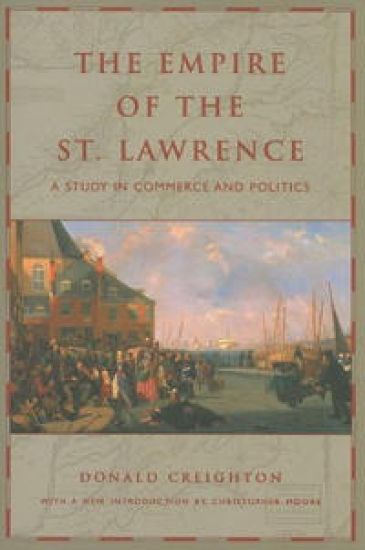
Originally published in 1937 as "The Commercial Empire of the St. Lawrence, 1760-1850" and re-issued in its present form in 1956, Donald Creighton's study of the St. Lawrence became an essential text in Canadian history courses. This, his first book, helped establish Creighton as the foremost English Canadian historian of his generation. In it, he examines the trading system that developed along the St. Lawrence River and he argues that the exploitation of key staple products by colonial merchants along the St. Lawrence River system was key to Canada's economic and national development. Creighton tells the story of the St. Lawrence empire largely from the perspective of these Canadian merchants, who, above all others, struggled to win the territorial empire of the St. Lawrence and to establish the Canadian commercial state. Christopher H. Moore, historian and Governor General Award winner, has written a new introduction to this classic text.
The Story of Canada

The Story of Canada

Donald Creighton

Literary Licensing, LLC
2013
sidottu
""The Story of Canada"" is a comprehensive historical account of Canada, written by renowned Canadian historian Donald Creighton. The book covers the country's history from its earliest Indigenous inhabitants to the present day, exploring the political, social, and economic developments that have shaped Canada into the nation it is today. The book is divided into three parts: the first covers the pre-Confederation era, the second covers the period from Confederation to World War II, and the third covers the post-war period to the present day. Throughout the book, Creighton provides a detailed analysis of key historical events and figures, including the fur trade, the arrival of European settlers, the formation of Confederation, the two World Wars, and the rise of Canadian nationalism. ""The Story of Canada"" is an essential read for anyone interested in Canadian history and the development of this unique and diverse nation.This is a new release of the original 1960 edition.This scarce antiquarian book is a facsimile reprint of the old original and may contain some imperfections such as library marks and notations. Because we believe this work is culturally important, we have made it available as part of our commitment for protecting, preserving, and promoting the world's literature in affordable, high quality, modern editions, that are true to their original work.
The Empire of the St. Lawrence

The Empire of the St. Lawrence

Donald Creighton

University of Toronto Press
2017
pokkari
Originally published in 1937 as "The Commercial Empire of the St. Lawrence, 1760-1850" and re-issued in its present form in 1956, Donald Creighton's study of the St. Lawrence became an essential text in Canadian history courses. This, his first book, helped establish Creighton as the foremost English Canadian historian of his generation. In it, he examines the trading system that developed along the St. Lawrence River and he argues that the exploitation of key staple products by colonial merchants along the St. Lawrence River system was key to Canada's economic and national development. Creighton tells the story of the St. Lawrence empire largely from the perspective of these Canadian merchants, who, above all others, struggled to win the territorial empire of the St. Lawrence and to establish the Canadian commercial state. Christopher H. Moore, historian and Governor General Award winner, has written a new introduction to this classic text.
John a. MacDonald

John a. MacDonald

Donald Creighton

University of Toronto Press
2018
pokkari
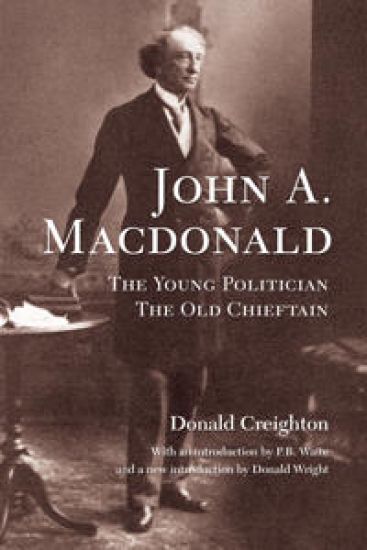
First published in 1952 and 1955, John A. Macdonald: The Young Politician, The Old Chieftain remains a classic in Canadian arts and letters. Described as the greatest biography ever written in Canada, it earned Donald Creighton two Governor General's Awards. In 2013, the Toronto Review of Books recommended it to anyone who wished to become a better Canadian. In this book, Creighton examines the public and private lives of Canada’s first prime minister, his victories and defeats as well as his joys and pains. A gifted writer, Creighton takes the reader back in time, to the nineteenth century, the road to Confederation, and the building of the railway. Along the way, he visits Kingston, Quebec, Charlottetown, Ottawa, and London, following his hero from a few rooms above his father’s shop in Kingston to the corridors of power in England, including the magnificent Highclere Castle where much of the British North America Act was written. This edition includes a new introduction by Creighton's biographer, Donald Wright, and by Peter Waite, Creighton's very first doctoral student.
The Road to Confederation:

The Road to Confederation:

Donald Creighton; Donald Wright

Oxford University Press, Canada
2012
nidottu
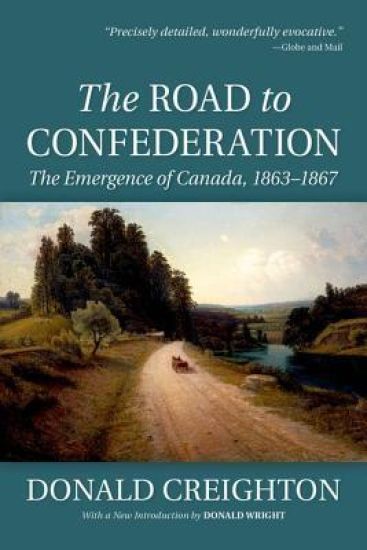
Donald Creighton was for many years one of Canada's foremost historians, a firm believer that history was closer to art than it was to science. Marked by beautiful, carefully crafted prose, The Road to Confederation reflects a style that perhaps no contemporary historian would dare: romantic, suspenseful, fearlessly narrative, and full of unapologetic opinions. If not politically correct and sanitized, it is a fascinating exploration of the personalities, the political logjams, even the debt problems that marked the period leading to Confederation. The book was also, as Donald Wright's excellent introduction argues, haunted by doubt. Not only had Canada failed to live up to Creighton's vision, Creighton himself was writing from the perspective of a rapidly changing country. Quebec was moving towards a liberal, secular, and nationalist identity; English Canada was embracing bilingualism and diversity; debates about nuclear weapons were raging; and living next to the United States was becoming increasingly uneasy. The road was becoming ever less straightforward. In many respects, The Road to Confederation reveals as much about the 1960s as it does the 1860s. Can echoes of Creighton's vision be seen even now, as Canada reinserts "Royal" into its military's name and remains entranced by William and Kate, the Duke and Duchess of Cambridge, and the future of the Royal Family?
My Journey

My Journey

Donald J Crighton

Tellwell Talent
2024
pokkari
A funny and educational look at navigating the complexities of the steps needed to rise through the Canadian ranks from Ordinary Seaman to Master Foreign Going. A Master Foreign Going is the certificate necessary to serve as the captain of any ship anywhere in the world, or from a 400,000 ton supertanker sailing out of the Persian Gulf, to a 100 ton fishing vessel sailing in the North Sea. This is sometimes referred to as a Master Mariner, or MM for short.
Donald

Donald

Eric Martin; Stephen Elliott

McSweeney's Publishing
2011
pokkari
As America's most infamous former Secretary of Defense lies poised to unleash his wistful recollections and rewriting of the war on terror, authors Eric Martin and Stephen Elliott humbly submit their take to the historical record: Donald. What would happen if Donald Rumsfeld, former defense secretary and architect of the war on terror, was abducted at night from his Maryland home, held without charges in his own prison system, denied a trial, and kept in a place where no one could find him, beyond the reach of the law? Donald is a high-wire allegory that answers this question, in equal parts breakneck thriller and gradual descent into madness. But it is also a novel rooted in the harrowing stories of real people caught in America's military campaigns. And while there are those who would try to convince us that war is full of uncertainty--of knowns and unknowns--Donald reminds us that there remain things we know to be wrong.
Donald Davidson

Donald Davidson

Kathrin Gl¨ uer

Oxford University Press Inc
2011
nidottu
Donald Davidson was one of the 20th Century's deepest analytic thinkers. He developed a systematic picture of the human mind and its relation to the world, an original and sustained vision that exerted a shaping influence well beyond analytic philosophy of mind and language. At its center is an idea of minded creatures as essentially rational animals: Rational animals can be interpreted, their behavior can be understood, and the contents of their thoughts are, in principle, open to others. The combination of a rigorous analytic stance with aspects of humanism so distinctive of Davidsonian thought finds its maybe most characteristic expression when this central idea is brought to bear on the relation of the mental to the physical: Davidson defended the irreducibility of its rational nature while acknowledging that the mental is ultimately determined by the physical. Davidson made contributions of lasting importance to a wide range of topics -- from general theory of meaning and content over formal semantics, the theories of truth, explanation, and action, to metaphysics and epistemology. His writings almost entirely consist of short, elegant, and often witty papers. These dense and thematically tightly interwoven essays present a profound challenge to the reader. This book provides a concise, systematic introduction to all the main elements of Davidson's philosophy. It places the theory of meaning and content at the very center of his thought. By using interpretation, and the interpreter, as key ideas it clearly brings out the underlying structure and unified nature of Davidson's work. Kathrin Glüer carefully outlines his principal claims and arguments, and discusses them in some detail. The book thus makes Davidson's thought accessible in its genuine depth, and acquaints the reader with the main lines of discussion surrounding it.
Donald Davidson

Donald Davidson

Kathrin Gl¨ uer

Oxford University Press Inc
2011
sidottu
Donald Davidson was one of the 20th Century's deepest analytic thinkers. He developed a systematic picture of the human mind and its relation to the world, an original and sustained vision that exerted a shaping influence well beyond analytic philosophy of mind and language. At its center is an idea of minded creatures as essentially rational animals: Rational animals can be interpreted, their behavior can be understood, and the contents of their thoughts are, in principle, open to others. The combination of a rigorous analytic stance with aspects of humanism so distinctive of Davidsonian thought finds its maybe most characteristic expression when this central idea is brought to bear on the relation of the mental to the physical: Davidson defended the irreducibility of its rational nature while acknowledging that the mental is ultimately determined by the physical. Davidson made contributions of lasting importance to a wide range of topics -- from general theory of meaning and content over formal semantics, the theories of truth, explanation, and action, to metaphysics and epistemology. His writings almost entirely consist of short, elegant, and often witty papers. These dense and thematically tightly interwoven essays present a profound challenge to the reader. This book provides a concise, systematic introduction to all the main elements of Davidson's philosophy. It places the theory of meaning and content at the very center of his thought. By using interpretation, and the interpreter, as key ideas it clearly brings out the underlying structure and unified nature of Davidson's work. Kathrin Gl¨ uer carefully outlines his principal claims and arguments, and discusses them in some detail. The book thus makes Davidson's thought accessible in its genuine depth, and acquaints the reader with the main lines of discussion surrounding it.
Donald Davidson

Donald Davidson

Ernie Lepore; Kirk Ludwig

Clarendon Press
2007
nidottu
Donald Davidson (1917-2003) was one of the most important philosophers of the late twentieth century. His work on language and the theory of meaning has been particularly influential.Two of the world's leading authorities on Davidson's philosophy, Ernest Lepore and Kirk Ludwig, provide a systematic exposition of his work in this field and of his contributions to philosophy of mind, metaphysics, and epistemology which spring from it. Their second aim is to assess Davidson's program critically, to mark its successes, but also to identify where its ccomplishments fall short of its ambitions, and, since it is an on-going research program, to assess its prospects for the future, and to contribute to the expansion of that program. Criticizing and extending Davidson's thought, as well as providing an introduction to it, Lepore and Ludwig address a broad academic audience. Their work will be of fundamental importance for those who are coming to Davidson's work for the first time; while some philosophical sophistication and training is presupposed, it is accessible both to advanced undergraduates and to graduate students. It will also be welcomed by professional philosophers, linguists, and anyone wishing to assess and understand Davidson's remarkable intellectual legacy.
Donald Davidson's Truth-Theoretic Semantics

Donald Davidson's Truth-Theoretic Semantics

Ernest LePore; Kirk Ludwig

Clarendon Press
2007
sidottu
Ernest Lepore and Kirk Ludwig examine the foundations and applications of Davidson's influential program of truth-theoretic semantics for natural languages. The program uses an axiomatic truth theory for a language, which meets certain constraints, to serve the goals of a compositional meaning theory. Lepore and Ludwig explain and clarify the motivations for the approach, and then consider how to apply the framework to a range of important natural language constructions, including quantifiers, proper names, indexicals, simple and complex demonstratives, quotation, adjectives and adverbs, the simple and perfect tenses, temporal adverbials and temporal quantifiers, tense in sentential complement clauses, attitude and indirect discourse reports, and the problem of interrogative and imperative sentences. They not only discuss Davidson's own contributions to these subjects but consider criticisms, developments, and alternatives as well. They conclude with a discussion of logical form in natural language in light of the approach, the role of the concept of truth in the program, and Davidson's view of it. Anyone working on meaning will find this book invaluable.