Kirjojen hintavertailu. Mukana 11 244 527 kirjaa ja 12 kauppaa.

Kirjahaku

Etsi kirjoja tekijän nimen, kirjan nimen tai ISBN:n perusteella.

1000 tulosta hakusanalla Donald Finnaeus Mayo

Francesca

Francesca

Donald Finnaeus Mayo

Betimes Books
2013
nidottu
It's December 1975 and seventeen-year-old Francesca is about to find out if that which does not kill her will make her strong. Caught in the crossfire of the Indonesian army's brutal invasion of East Timor, she escapes with her life and little else. Arriving on the shores of Indonesian Borneo, she finds herself thrust into an ersatz American small town carved out of the jungle by Constar Oil of Texas.Interwoven in Francesca's journey are a cast of vividly drawn characters - the bored expat brat who befriends her, a divorced fundamentalist missionary bringing Christ to the jungle via Oklahoma, the inept son of a murdered socialist martyr, a former Vietnam War helicopter pilot, an amah who supplements her income turning tricks... Watching over them all is the menacing former Colonel Benny Surikano, Constar's Mr. Fixit to whom everyone turns when they need something.Set against a backdrop of endemic political corruption, moral compromise and the pursuit of oil, Francesca is a passionate story of one woman's struggle against overwhelming odds to shape the country that nearly destroyed her.
Donald

Donald

Eric Martin; Stephen Elliott

McSweeney's Publishing
2011
pokkari
As America's most infamous former Secretary of Defense lies poised to unleash his wistful recollections and rewriting of the war on terror, authors Eric Martin and Stephen Elliott humbly submit their take to the historical record: Donald. What would happen if Donald Rumsfeld, former defense secretary and architect of the war on terror, was abducted at night from his Maryland home, held without charges in his own prison system, denied a trial, and kept in a place where no one could find him, beyond the reach of the law? Donald is a high-wire allegory that answers this question, in equal parts breakneck thriller and gradual descent into madness. But it is also a novel rooted in the harrowing stories of real people caught in America's military campaigns. And while there are those who would try to convince us that war is full of uncertainty--of knowns and unknowns--Donald reminds us that there remain things we know to be wrong.
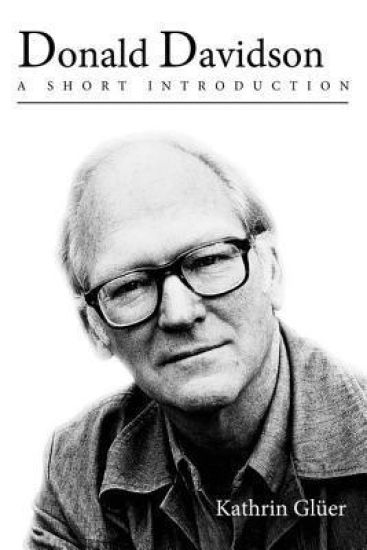
Donald Davidson

Donald Davidson

Kathrin Gl¨ uer

Oxford University Press Inc
2011
nidottu
Donald Davidson was one of the 20th Century's deepest analytic thinkers. He developed a systematic picture of the human mind and its relation to the world, an original and sustained vision that exerted a shaping influence well beyond analytic philosophy of mind and language. At its center is an idea of minded creatures as essentially rational animals: Rational animals can be interpreted, their behavior can be understood, and the contents of their thoughts are, in principle, open to others. The combination of a rigorous analytic stance with aspects of humanism so distinctive of Davidsonian thought finds its maybe most characteristic expression when this central idea is brought to bear on the relation of the mental to the physical: Davidson defended the irreducibility of its rational nature while acknowledging that the mental is ultimately determined by the physical. Davidson made contributions of lasting importance to a wide range of topics -- from general theory of meaning and content over formal semantics, the theories of truth, explanation, and action, to metaphysics and epistemology. His writings almost entirely consist of short, elegant, and often witty papers. These dense and thematically tightly interwoven essays present a profound challenge to the reader. This book provides a concise, systematic introduction to all the main elements of Davidson's philosophy. It places the theory of meaning and content at the very center of his thought. By using interpretation, and the interpreter, as key ideas it clearly brings out the underlying structure and unified nature of Davidson's work. Kathrin Glüer carefully outlines his principal claims and arguments, and discusses them in some detail. The book thus makes Davidson's thought accessible in its genuine depth, and acquaints the reader with the main lines of discussion surrounding it.
Donald Davidson

Donald Davidson

Kathrin Gl¨ uer

Oxford University Press Inc
2011
sidottu
Donald Davidson was one of the 20th Century's deepest analytic thinkers. He developed a systematic picture of the human mind and its relation to the world, an original and sustained vision that exerted a shaping influence well beyond analytic philosophy of mind and language. At its center is an idea of minded creatures as essentially rational animals: Rational animals can be interpreted, their behavior can be understood, and the contents of their thoughts are, in principle, open to others. The combination of a rigorous analytic stance with aspects of humanism so distinctive of Davidsonian thought finds its maybe most characteristic expression when this central idea is brought to bear on the relation of the mental to the physical: Davidson defended the irreducibility of its rational nature while acknowledging that the mental is ultimately determined by the physical. Davidson made contributions of lasting importance to a wide range of topics -- from general theory of meaning and content over formal semantics, the theories of truth, explanation, and action, to metaphysics and epistemology. His writings almost entirely consist of short, elegant, and often witty papers. These dense and thematically tightly interwoven essays present a profound challenge to the reader. This book provides a concise, systematic introduction to all the main elements of Davidson's philosophy. It places the theory of meaning and content at the very center of his thought. By using interpretation, and the interpreter, as key ideas it clearly brings out the underlying structure and unified nature of Davidson's work. Kathrin Gl¨ uer carefully outlines his principal claims and arguments, and discusses them in some detail. The book thus makes Davidson's thought accessible in its genuine depth, and acquaints the reader with the main lines of discussion surrounding it.
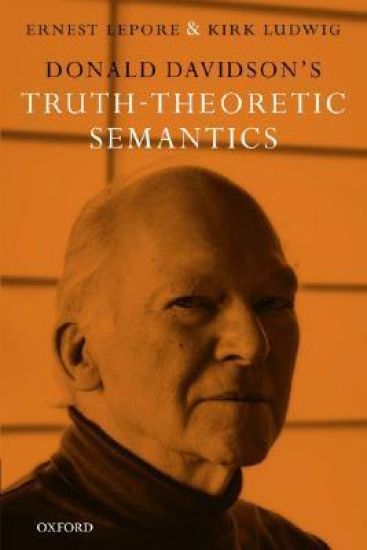
Donald Davidson

Donald Davidson

Ernie Lepore; Kirk Ludwig

Clarendon Press
2007
nidottu
Donald Davidson (1917-2003) was one of the most important philosophers of the late twentieth century. His work on language and the theory of meaning has been particularly influential.Two of the world's leading authorities on Davidson's philosophy, Ernest Lepore and Kirk Ludwig, provide a systematic exposition of his work in this field and of his contributions to philosophy of mind, metaphysics, and epistemology which spring from it. Their second aim is to assess Davidson's program critically, to mark its successes, but also to identify where its ccomplishments fall short of its ambitions, and, since it is an on-going research program, to assess its prospects for the future, and to contribute to the expansion of that program. Criticizing and extending Davidson's thought, as well as providing an introduction to it, Lepore and Ludwig address a broad academic audience. Their work will be of fundamental importance for those who are coming to Davidson's work for the first time; while some philosophical sophistication and training is presupposed, it is accessible both to advanced undergraduates and to graduate students. It will also be welcomed by professional philosophers, linguists, and anyone wishing to assess and understand Davidson's remarkable intellectual legacy.
Donald Davidson's Truth-Theoretic Semantics

Donald Davidson's Truth-Theoretic Semantics

Ernest LePore; Kirk Ludwig

Clarendon Press
2007
sidottu
Ernest Lepore and Kirk Ludwig examine the foundations and applications of Davidson's influential program of truth-theoretic semantics for natural languages. The program uses an axiomatic truth theory for a language, which meets certain constraints, to serve the goals of a compositional meaning theory. Lepore and Ludwig explain and clarify the motivations for the approach, and then consider how to apply the framework to a range of important natural language constructions, including quantifiers, proper names, indexicals, simple and complex demonstratives, quotation, adjectives and adverbs, the simple and perfect tenses, temporal adverbials and temporal quantifiers, tense in sentential complement clauses, attitude and indirect discourse reports, and the problem of interrogative and imperative sentences. They not only discuss Davidson's own contributions to these subjects but consider criticisms, developments, and alternatives as well. They conclude with a discussion of logical form in natural language in light of the approach, the role of the concept of truth in the program, and Davidson's view of it. Anyone working on meaning will find this book invaluable.
Donald Davidson's Truth-Theoretic Semantics

Donald Davidson's Truth-Theoretic Semantics

Ernest LePore; Kirk Ludwig

Oxford University Press
2009
nidottu
Ernest Lepore and Kirk Ludwig examine the foundations and applications of Davidson's influential program of truth-theoretic semantics for natural languages. The program uses an axiomatic truth theory for a language, which meets certain constraints, to serve the goals of a compositional meaning theory. Lepore and Ludwig explain and clarify the motivations for the approach, and then consider how to apply the framework to a range of important natural language constructions, including quantifiers, proper names, indexicals, simple and complex demonstratives, quotation, adjectives and adverbs, the simple and perfect tenses, temporal adverbials and temporal quantifiers, tense in sentential complement clauses, attitude and indirect discourse reports, and the problem of interrogative and imperative sentences. They not only discuss Davidson's own contributions to these subjects but consider criticisms, developments, and alternatives as well. They conclude with a discussion of logical form in natural language in light of the approach, the role of the concept of truth in the program, and Davidson's view of it. Anyone working on meaning will find this book invaluable.
Donald Michie: machine intelligence, biology and more

Donald Michie: machine intelligence, biology and more

Ashwin Srinivasan

Oxford University Press
2009
sidottu
Donald Michie was an extraordinary character. In a scientific career that spanned nearly 65 years, he was the pioneer in several fields including computing, mouse embryology, transplantation biology, and machine intelligence. Tragically, he died in a car crash in 2007. Here, Ashwin Srinivasan presents a varied collection of Michie's writings, from Colossus and computers to mouse genetics and politics. Srinivasan, a computer scientist and grand-student of Donald Michie, introduces each section and brings together an engaging collection of lively essays, revealing Michie's remarkable personality and painting a picture of his life and interests.
Donald Davidson on Truth, Meaning, and the Mental

Donald Davidson on Truth, Meaning, and the Mental

Gerhard Preyer

Oxford University Press
2012
sidottu
The analysis of the connections between truth, meaning, thought, and action poses a major philosophical challenge--one that Donald Davidson addressed by establishing a unified theory of language and mind. This volume offers a reappraisal of Davidson's intellectual legacy. Twelve specially written essays by leading philosophers in the field illuminate a range of enduring philosophical problems, and engage in particular with Ernie Lepore and Kirk Ludwig's interpretation of Davidson's philosophy. The collection affirms Davidson's continuing influence on the study of language, mind, and action, and offers a variety of new perspectives on his work.
Donald Judd

Donald Judd

Annie Ochmanek; Alex Kitnick

MIT Press
2021
nidottu
Donald Judd (1928-1994) is one of the most influential American artists of the postwar era. Beginning in the 1960s, he developed new ideas about art-in both his works and writings-that challenged many of modernism's core tenets by resisting the categories of painting and sculpture. Judd described this work as "specific objects." Critics labeled it minimalism. Perhaps because Judd's own critical writings provide a discursive framework for his work, some of the monographic essays on his work are not widely known. This volume collects critical and scholarly writings on Judd, examining his work as both artist and critic.
Donald Judd

Donald Judd

David Raskin

Yale University Press
2017
pokkari
This pioneering book, the first monograph devoted to Donald Judd, addresses the whole breadth of Judd’s practices. Drawing on documents found in nearly twenty archives, David Raskin explains why some of Judd’s works of art seem startlingly ephemeral while others remain insistently physical. In the process of answering this previously perplexing question, Raskin traces Judd’s principles from his beginnings as an art critic through his fabulous installations and designs in Marfa, Texas. He discusses Judd’s early important paintings and idiosyncratic red objects, as well as the three-dimensional works that are celebrated throughout the world. He also examines Judd’s commitment to empirical values and his political activism, and concludes by considering the importance of Judd’s example for recent art. Ultimately, Raskin develops a picture of Judd as never before seen: he shows us an artist who asserted his individuality with spare designs; who found spiritual values in plywood, Plexiglas, and industrial production; who refused to distinguish between thinking and feeling while asserting that science marked the limits of knowledge; who claimed that his art provided intuitions of morality but not a specific set of tenets; and who worked for political causes that were neither left nor right.
Donald Windham

Donald Windham

Bruce Kellner

Greenwood Press
1991
sidottu
Bruce Kellner worked directly from the collection of often-overlooked novelist Donald Windham to produce this reference work. Entries on books, pamphlets, articles and criticism provided a comprehensive record of Windham's literary development, critical reception, failures, and achievements. According to Kellner, the public has yet to fully embrace the quiet eloquence of Windham's work; like authors Herman Melville and Gertrude Stein, he may be vindicated by time.Kellner introduces the bio-bibliography with a discussion of Donald Windham's background, writing style, and reception by publishers and readers. He likens Windham's subtle style to E.M. Forster, and he suggests that America's action-oriented culture lacks patience for Windham's offerings, which are homosexual but not erotic, Southern but not gothic. The book, which includes an addendum to the introduction by Windham himself, is divided into five parts: Books and Pamphlets, Books and Pamphlets with Contributions, Contributions to Periodicals, Ephemera, and Criticism and Biography. This book is valuable to students, scholars, and general audiences of literature.
Donald Davie

Donald Davie

Stuart Wright

Greenwood Press
1991
sidottu
This annotated bibliography provides the first comprehensive listing of the works of Donald Davie, an internationally known British poet and critic who has become a part of America's academic and literary scene. Complete and authoritative, it contains materials obtained directly from Davie between 1981 and 1988.Listings are organized in sections according to chronology and type of publication. The contents of separate publications are supplied, and reprints and collections as well as initial publications are noted. Interviews with Davie and works containing his published comments are included. The final section covers commercially produced recordings and a videotape of Davie reading from his work. This annotated checklist will be of interest to Davie's readers and to scholars of contemporary criticism and poetry.
Children Want to Write: Donald Graves and the Revolution in Children's Writing
Children Want to Write is a collection of Donald Graves most significant writings paired with video that illuminates his research and his inspiring work with teachers. See the earliest documented use of invented spelling, the earliest attempts to guide young children through a writing process, the earliest conferences. This collection allows you to see this revolutionary shift in writing instruction-with its emphasis on observation, reflection, and approaching children as writers. Heinemann is honored to have been Don's publishing partner for more than three decades and over more than a dozen books-to have watched his research and vision become not only a classroom reality but the core of our publishing philosophy. His influence is so vast that we will meet him again and again on the pages of every book and resource we publish. His spirit pervades each of our books-in the conviction that children want to write and read if given the chance; in the flourishing of the workshop model of instruction that he pioneered; and in his abiding faith in teachers' ability to make sound instructional decisions.
Donald Trump: An Unenlightened Person
Donald Trump is an unenlightened human being who shows no interest in spirituality. He is a vain and thoughtless person who is only interested in himself. Despite his wealth and status, he has no desire to help others, especially if they are disadvantaged or poor. His whole life has been about accumulating properties, seducing women and seeking power to control everything around him. He has no compassion and is devoid of any integrity or responsibility in his actions and words.
Donald W. Winnicott

Donald W. Winnicott

Laura Dethiville

Routledge
2019
sidottu
Winnicott was continually innovating, inventing, and proposing unexpected solutions in his analytical work whenever he noticed that clinical experience "didn't stick to the theory". This approach can make his work seem rather diffuse, with concepts that are sometimes confusing and needing to be clarified. Laura Dethiville has taken on the task of re-evaluating and explaining the principal rudiments of his theories, such as the transitional object, the self, the false self, the importance of environment, and dissociation. She also reveals how Winnicott showed himself to be a forerunner in the care of symptomatic illness in our society, including his innovative treatment of loss of identity, anorexia or bulimia, delinquency, psychosomatic illness, and school disorders. In this book the author has succeeded in avoiding psychoanalytic jargon and, although initially aimed at psychoanalysts, it is also accessible for educators, child carers, paediatricians, and to all those interested in early childhood, the constitution of the psyche, and the constitution of the interpersonal link.
Donald W. Winnicott and the History of the Present
In November 2015, The Winnicott Trust held a major conference in London to celebrate the forthcoming publication of the Collected Works of D. W. Winnicott. Most of the papers given then now constitute the chapters in this book. It not only reflects the ongoing contemporary relevance of Winnicott's work, clinical and theoretical, but these chapters demonstrate the aliveness of Winnicott's contribution as present day practitioners and academics use his ideas in their own way. The chapters range from accounts of the early developmental processes and relationships (Roussillon, Murray), the psychoanalytic setting (Bolognini, Bonaminio, Fabozzi, Joyce, Hopkins) creativity and the arts (Wright, Robinson), Winnicott in the outside world (Kahr, Karpf), to the challenge to the psychoanalytic paradigm that Winnicott's ideas constitute (Loparic).