Kirjojen hintavertailu. Mukana 11 213 693 kirjaa ja 11 kauppaa.

Kirjahaku

Etsi kirjoja tekijän nimen, kirjan nimen tai ISBN:n perusteella.

1000 tulosta hakusanalla Donald L. Fixico

Chitto Harjo

Chitto Harjo

Donald L. Fixico

YALE UNIVERSITY PRESS
2025
sidottu
How a Mvskoke traditionalist leader forged a movement to resist the division of tribal lands and keep his people on the everlasting Medicine Way Chitto Harjo (“Crazy Snake”) had several names—Wilson Jones, Bill Jones, Bill Harjo, Bill Snake—and people called him many things: troublemaker, rebellion leader, uncivilized Indian, martyr, murderer. Many called him crazy for fighting against progress and for his commitment to traditions that they believed were outdated and dying out. Yet in the eyes of many Mvskokes and traditionalists of other nations, he was a hero, a defender of the old ways, a Native patriot, and a leader of the Medicine Way. These traditionalists believed in the Mvskoke worldview, which has inspired the Mvskokes and other Southeastern peoples to carry on their traditions as they have done for hundreds of years. In this engaging account, historian Donald L. Fixico tells the story of the Mvskoke people and their fight for survival and unity amid enduring tensions between white “civilization” and traditional culture. A personal story that begins with Fixico attending a Green Corn Ceremony with his father and young son, this engrossing narrative integrates traditional knowledge with historical method to present an Indigenous perspective on Mvskoke and Native American history.
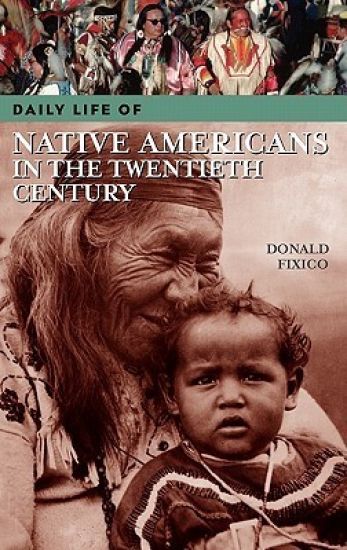
Daily Life of Native Americans in the Twentieth Century
Donald Fixico, one of the foremost scholars on Native Americans, details the day-to-day lives of these indigenous people in the 20th century. As they moved from living among tribes in the early 1900s to the cities of mainstream America after WWI and WWII, many Native Americans grappled with being both Indian and American. Through the decades they have learned to embrace a bi-cultural existence that continues today. In fourteen chapters, Fixico highlights the similarities and differences that have affected the generations growing up in 20th-century America. Chapters include details of daily life such as education; leisure activities & sports; reservation life; spirituality, rituals & customs; health, medicine & cures; urban life; women's roles & family; bingos, casinos & gaming. Greenwood's Daily Life through History series looks at the everyday lives of common people. This book explores the lives of Native Americans and provides a basis for further research. Black and white photographs, maps and charts are interspersed throughout the text to assist readers. Reference features include a timeline of historic events, sources for further reading, glossary of terms, bibliography and index.
Bureau of Indian Affairs

Bureau of Indian Affairs

Donald L. Fixico

Greenwood Press
2012
sidottu
From 19th-century trade agreements and treatments to 21st-century reparations, this volume tells the story of the federal agency that shapes and enforces U.S. policy toward Native Americans.Bureau of Indian Affairs tells the fascinating and important story of an agency that currently oversees U.S. policies affecting over 584 recognized tribes, over 326 federally reserved lands, and over 5 million Native American residents.Written by one of our foremost Native American scholars, this insider's view of the Bureau of Indian Affairs looks at the policies and the personalities that shaped its history, and by extension, nearly two centuries of government-tribal relations. Coverage includes the agency's forerunners and founding, the years of relocation and outright war, the movement to encourage Indian urbanization and assimilation, and the civil rights era surge of Indian activism. A concluding chapter looks at the modern BIA and its role in everything from land allotments and Indian boarding schools to tribal self-government, mineral rights, and the rise of the Indian gaming industry.
Call for Change

Call for Change

Donald L. Fixico

University of Nebraska Press
2013
sidottu
For too many years, the academic discipline of history has ignored American Indians or lacked the kind of open-minded thinking necessary to truly understand them. Most historians remain oriented toward the American experience at the expense of the Native experience. As a result, both the status and the quality of Native American history have suffered and remain marginalized within the discipline. In this impassioned work, noted historian Donald L. Fixico challenges academic historians—and everyone else—to change this way of thinking. Fixico argues that the current discipline and practice of American Indian history are insensitive to and inconsistent with Native people's traditions, understandings, and ways of thinking about their own history. In Call for Change, Fixico suggests how the discipline of history can improve by reconsidering its approach to Native peoples. He offers the "Medicine Way" as a paradigm to see both history and the current world through a Native lens. This new approach paves the way for historians to better understand Native peoples and their communities through the eyes and experiences of Indians, thus reflecting an insightful indigenous historical ethos and reality.
That's What They Used to Say

That's What They Used to Say

Donald L. Fixico

University of Oklahoma Press
2017
sidottu
As a child growing up in rural Oklahoma, Donald Fixico often heard ""hvmakimata"" - ""that's what they used to say"" - a phrase Mvskoke Creeks and Seminoles use to end stories. In his latest work, Fixico, who is Shawnee, Sac and Fox, Mvskoke Creek, and Seminole, invites readers into his own oral tradition to learn how storytelling, legends and prophecies, and oral histories and creation myths knit together to explain the Indian world. Interweaving the storytelling and traditions of his ancestors, Fixico conveys the richness and importance of oral culture in Native communities and demonstrates the power of the spoken word to bring past and present together, creating a shared reality both immediate and historical for Native peoples. Fixico's stories conjure war heroes and ghosts, inspire fear and laughter, explain the past, and foresee the future - and through them he skillfully connects personal, familial, tribal, and Native history. Oral tradition, Fixico affirms, at once reflects and creates the unique internal reality of each Native community. Stories possess spiritual energy, and by summoning this energy, storytellers bring their communities together. Sharing these stories, and the larger story of where they come from and how they work, ""That's What They Used to Say"" offers readers rare insight into the oral traditions at the very heart of Native cultures, in all of their rich and infinitely complex permutations.
That's What They Used to Say

That's What They Used to Say

Donald L. Fixico

UNIVERSITY OF OKLAHOMA PRESS
2023
nidottu
As a child growing up in rural Oklahoma, Donald Fixico often heard “hvmakimata”—“that’s what they used to say”—a phrase Mvskoke Creeks and Seminoles use to end stories. In his latest work, Fixico, who is Shawnee, Sac and Fox, Mvskoke Creek, and Seminole, invites readers into his own oral tradition to learn how storytelling, legends and prophecies, and oral histories and creation myths knit together to explain the Indian world. Interweaving the storytelling and traditions of his ancestors, Fixico conveys the richness and importance of oral culture in Native communities and demonstrates the power of the spoken word to bring past and present together, creating a shared reality both immediate and historical for Native peoples. Fixico’s stories conjure war heroes and ghosts, inspire fear and laughter, explain the past, and foresee the future—and through them he skillfully connects personal, familial, tribal, and Native history. Oral tradition, Fixico affirms, at once reflects and creates the unique internal reality of each Native community. Stories possess spiritual energy, and by summoning this energy, storytellers bring their communities together. Sharing these stories, and the larger story of where they come from and how they work, “That’s What They Used to Say” offers readers rare insight into the oral traditions at the very heart of Native cultures, in all of their rich and infinitely complex permutations.
The State of Sequoyah

The State of Sequoyah

Donald L. Fixico

UNIVERSITY OF OKLAHOMA PRESS
2024
sidottu
Few people today know that the forty-sixth state could have been Sequoyah, not Oklahoma. The Five Tribes of Indian Territory gathered in 1905 to form their own, Indian-led state. Leaders of the Cherokees, Chickasaws, Choctaws, Muscogees, and Seminoles drafted a constitution, which eligible voters then ratified. In the end, Congress denied their request, but the movement that fueled their efforts transcends that single defeat. Researched and interpreted by distinguished Native historian Donald L. Fixico, this book tells the remarkable story of how the state of Sequoyah movement unfolded and the extent to which it remains alive today. Fixico tells how the Five Nations, after removal to the west, negotiated treaties with the U.S. government and lobbied Congress to allow them to retain communal control of their lands as sovereign nations. In the wake of the Civil War, while a dozen bills in Congress proposed changing the status of Indian Territory, the Five Tribes sought strength in unity. The Boomer movement and seven land dispensations—beginning with the famous run of 1889—nevertheless eroded their borders and threatened their cultural and political autonomy. President Theodore Roosevelt ultimately declared his support for the merging of Indian Territory with Oklahoma Territory, paving the way for Oklahoma statehood in 1907—and shattering the state of Sequoyah dream. Yet the Five Tribes persevered. Fixico concludes his narrative by highlighting recent U.S. Supreme Court decisions, most notably McGirt v. Oklahoma (2020), that have reaffirmed the sovereignty of Indian nations over their lands and people—a principal inherent in the Sequoyah movement. Did the story end in 1907? Could the Five Tribes revive their plan for separate statehood? Fixico leaves the reader to ponder this intriguing possibility.
The Lighthorse Police

The Lighthorse Police

Donald L. Fixico

UNIVERSITY OF OKLAHOMA PRESS
2026
sidottu
Long before Oklahoma became a state in 1907, cattle rustlers, horse thieves, and other criminals saw the land as a place to exploit resources and evade capture. But in the heyday of the outlaw era after the Civil War, Indigenous police officers—mounted Cherokee, Choctaw, Chickasaw, Muscogee, and Seminole Lighthorse units—brought them to justice. In The Lighthorse Police, Donald L. Fixico weaves a lively history of these Five Tribes’ law enforcement organizations as he explores their origin, operation, and survival from the late eighteenth century to the present. Fixico begins by delving into the Five Tribes’ systems of justice prior to removal to Indian Territory in the 1830s, and their shift from adhering to clan-based law to national laws. He traces the Cherokees’ and Choctaws’ creation of constitutions and lighthorse units as expressions of tribal sovereignty prior to removal, and the Chickasaws’, Muscogees’, and Seminoles’ development of these after removal. In detailing the decades that followed, he draws on the stories of individual lighthorsemen to paint a compelling portrait of territorial violence and justice. In tandem with his exploration of tribal justice, Fixico investigates “white justice” in the region after the Civil War. This justice was delivered by federal marshals like Fort Smith’s infamous “hanging judge,” Isaac Parker, and their deputies. Fixico demonstrates how federal and Native officers clashed and ultimately worked together to catch criminals. After statehood, the lighthorse fell into disuse, but the organizations resurged in the 1970s. Today, lighthorse officers drive modern patrol cars to protect their communities. In its exploration of law and order from an Indigenous perspective, The Lighthorse Police tells a broader story about sovereignty and violence, Indigenous justice and white justice, and the camaraderie and pride shared by law enforcers across time.
Indian Resilience and Rebuilding

Indian Resilience and Rebuilding

Donald L. Fixico

University of Arizona Press
2013
nidottu
Indian Resilience and Rebuilding provides an Indigenous view of the last one-hundred years of Native history and guides readers through a century of achievements. It examines the progress that Indians have accomplished in rebuilding their nations in the twentieth century, revealing how Native communities adapted to the cultural and economic pressures in modern America. Donald Fixico examines issues like land allotment, the Indian New Deal, termination and relocation, Red Power and self-determination, casino gaming, and repatriation. He applies ethnohistorical analysis and political economic theory to provide a multilayered approach that ultimately shows how Native people reinvented themselves in order to rebuild their nations. Fixico identifies the tools to this empowerment, including education, navigation within cultural systems, modern Indian leadership, and indigenised political economy. He explains how these tools helped Indian communities to rebuild their nations. Fixico constructs an Indigenous paradigm of Native ethos and reality that drives modern Indian political economies heading into the twenty-first century. This illuminating and comprehensive analysis of Native nation’s resilience in the twentieth century demonstrates how Native Americans reinvented themselves, rebuilt their nations, and ultimately became major forces in the United States. Indian Resilience and Rebuilding, redefines how modern American history can and should be told.
The American Indian Mind in a Linear World

The American Indian Mind in a Linear World

Donald L. Fixico

TAYLOR FRANCIS LTD
2024
nidottu
Now in its second edition, The American Indian Mind in a Linear World examines the persistence of Native peoples in retaining their own worldviews, from the pre-Columbian era into the twenty-first century.The book explores the ways in which Indian people who are close to their cultural traditions think in a circular fashion, understand by relying on visual analysis, and make decisions from an Indigenous logic. Yet, Comanches have a different reality from Mohawks, Apache ethos is not like that of the Lakotas, and Indian men and women see things differently. How and why is the Native mind different from the western world? Why have white teachers and missionaries tried to change the minds of Native students? The Indian perspective is not wrong; it is simply different and inclusive, another way of looking at the world and universe. This edition updates the discussion with a new chapter on contemporary American Indian intellectualism and further analysis of the preservation of Indigenous traditional knowledge.Approachable and engaging, this volume is a key resource for students and scholars of Native American and Indigenous studies and Indigenous history.
The American Indian Mind in a Linear World

The American Indian Mind in a Linear World

Donald L. Fixico

TAYLOR FRANCIS LTD
2024
sidottu
Now in its second edition, The American Indian Mind in a Linear World examines the persistence of Native peoples in retaining their own worldviews, from the pre-Columbian era into the twenty-first century.The book explores the ways in which Indian people who are close to their cultural traditions think in a circular fashion, understand by relying on visual analysis, and make decisions from an Indigenous logic. Yet, Comanches have a different reality from Mohawks, Apache ethos is not like that of the Lakotas, and Indian men and women see things differently. How and why is the Native mind different from the western world? Why have white teachers and missionaries tried to change the minds of Native students? The Indian perspective is not wrong; it is simply different and inclusive, another way of looking at the world and universe. This edition updates the discussion with a new chapter on contemporary American Indian intellectualism and further analysis of the preservation of Indigenous traditional knowledge.Approachable and engaging, this volume is a key resource for students and scholars of Native American and Indigenous studies and Indigenous history.
Being Indian and Walking Proud

Being Indian and Walking Proud

Donald L. Fixico

TAYLOR FRANCIS LTD
2024
nidottu
This book explores the identity of American Indians from an Indigenous perspective and how outside influences throughout history, from the arrival of Columbus in 1492 to the twenty-first century, have affected Native people.Non-Native writers, boarding school teachers, movie directors, bureaucrats, churches, and television have all heavily impacted how Indians are viewed in the United States. Drawing on the life experiences of many American Indian men and women, this volume reveals how American Indian identity comprises multiple identities, including the noble savage, wild savage, Hollywood Indian, church-going Indian, rez Indian, urban Indian, Native woman, Indian activist, casino Indian, and tribal leader. Indigenous people, in their own voices, share their experiences of discrimination, being treated as outsiders in their own country, and the intersections of gender, culture, and politics in Indian-white relations. Yet the book also highlights the resilience of being Indian and the pride felt from being a member of a tribe(s), knowing your relatives, and feeling connected to the earth.Being Indian and Walking Proud is a compelling resource for any reader interested in Indigenous history, including students and scholars in Native American and Indigenous studies, anthropology, and American history.
Being Indian and Walking Proud

Being Indian and Walking Proud

Donald L. Fixico

TAYLOR FRANCIS LTD
2024
sidottu
This book explores the identity of American Indians from an Indigenous perspective and how outside influences throughout history, from the arrival of Columbus in 1492 to the twenty-first century, have affected Native people.Non-Native writers, boarding school teachers, movie directors, bureaucrats, churches, and television have all heavily impacted how Indians are viewed in the United States. Drawing on the life experiences of many American Indian men and women, this volume reveals how American Indian identity comprises multiple identities, including the noble savage, wild savage, Hollywood Indian, church-going Indian, rez Indian, urban Indian, Native woman, Indian activist, casino Indian, and tribal leader. Indigenous people, in their own voices, share their experiences of discrimination, being treated as outsiders in their own country, and the intersections of gender, culture, and politics in Indian-white relations. Yet the book also highlights the resilience of being Indian and the pride felt from being a member of a tribe(s), knowing your relatives, and feeling connected to the earth.Being Indian and Walking Proud is a compelling resource for any reader interested in Indigenous history, including students and scholars in Native American and Indigenous studies, anthropology, and American history.
The American Indian Occupation of Alcatraz Island

The American Indian Occupation of Alcatraz Island

Troy R. Johnson; Donald L. Fixico

University of Nebraska Press
2008
pokkari
The occupation of Alcatraz Island by American Indians from November 20, 1969, through June 11, 1971, focused the attention of the world on Native Americans and helped develop pan-Indian activism. In this detailed examination of the takeover, Troy R. Johnson tells the story of those who organized the occupation and those who participated, some by living on the island and others by soliciting donations of money, food, water, clothing, and other necessities.Johnson documents the unrest in the Bay Area urban Indian population that helped spur the takeover and draws on interviews with those involved to describe everyday life on Alcatraz during the nineteen-month occupation. In describing the federal government's reactions as Americans rallied in support of the Indians, he turns to federal government archives and Nixon administration files. The book is a must-read for historians and others interested in the civil rights era, Native American history, and contemporary American Indian issues.
Selected Works of Donald L. Burkholder

Selected Works of Donald L. Burkholder

Springer-Verlag New York Inc.
2011
sidottu
This book chronicles Donald Burkholder's thirty-five year study of martingales and its consequences. Here are some of the highlights.Pioneering work by Burkholder and Donald Austin on the discrete time martingale square function led to Burkholder and Richard Gundy's proof of inequalities comparing the quadratic variations and maximal functions of continuous martingales, inequalities which are now indispensable tools for stochastic analysis. Part of their proof showed how novel distributional inequalities between the maximal function and quadratic variation lead to inequalities for certain integrals of functions of these operators. The argument used in their proof applies widely and is now called the Burkholder-Gundy good lambda method. This uncomplicated and yet extremely elegant technique, which does not involve randomness, has become important in many parts of mathematics.The continuous martingale inequalities were then used by Burkholder, Gundy, and Silverstein to prove the converse of an old and celebrated theorem of Hardy and Littlewood. This paper transformed the theory of Hardy spaces of analytic functions in the unit disc and extended and completed classical results of Marcinkiewicz concerning norms of conjugate functions and Hilbert transforms. While some connections between probability and analytic and harmonic functions had previously been known, this single paper persuaded many analysts to learn probability.These papers together with Burkholder's study of martingale transforms led to major advances in Banach spaces. A simple geometric condition given by Burkholder was shown by Burkholder, Terry McConnell, and Jean Bourgain to characterize those Banach spaces for which the analog of the Hilbert transform retains important properties of the classical Hilbert transform.Techniques involved in Burkholder's usually successful pursuit of best constants in martingale inequalities have become central to extensive recent research into two well- known open problems, one involving the two dimensional Hilbert transform and its connection to quasiconformal mappings and the other a conjecture in the calculus of variations concerning rank-one convex and quasiconvex functions.This book includes reprints of many of Burkholder's papers, together with two commentaries on his work and its continuing impact.
Selected Works of Donald L. Burkholder

Selected Works of Donald L. Burkholder

Springer-Verlag New York Inc.
2016
nidottu
This book chronicles Donald Burkholder's thirty-five year study of martingales and its consequences. Here are some of the highlights.Pioneering work by Burkholder and Donald Austin on the discrete time martingale square function led to Burkholder and Richard Gundy's proof of inequalities comparing the quadratic variations and maximal functions of continuous martingales, inequalities which are now indispensable tools for stochastic analysis. Part of their proof showed how novel distributional inequalities between the maximal function and quadratic variation lead to inequalities for certain integrals of functions of these operators. The argument used in their proof applies widely and is now called the Burkholder-Gundy good lambda method. This uncomplicated and yet extremely elegant technique, which does not involve randomness, has become important in many parts of mathematics.The continuous martingale inequalities were then used by Burkholder, Gundy, and Silverstein to prove the converse of an old and celebrated theorem of Hardy and Littlewood. This paper transformed the theory of Hardy spaces of analytic functions in the unit disc and extended and completed classical results of Marcinkiewicz concerning norms of conjugate functions and Hilbert transforms. While some connections between probability and analytic and harmonic functions had previously been known, this single paper persuaded many analysts to learn probability.These papers together with Burkholder's study of martingale transforms led to major advances in Banach spaces. A simple geometric condition given by Burkholder was shown by Burkholder, Terry McConnell, and Jean Bourgain to characterize those Banach spaces for which the analog of the Hilbert transform retains important properties of the classical Hilbert transform.Techniques involved in Burkholder's usually successful pursuit of best constants in martingale inequalities have become central to extensive recent research into two well- known open problems, one involving the two dimensional Hilbert transform and its connection to quasiconformal mappings and the other a conjecture in the calculus of variations concerning rank-one convex and quasiconvex functions.This book includes reprints of many of Burkholder's papers, together with two commentaries on his work and its continuing impact.
First Readers Anthology: Cursive Edition: Samuel L. Blumenfeld's Phonics Readers for Building Cursive Reading Skills
First Readers Anthology: Cursive Edition is a companion volume to the First Readers Anthology. The contents of the two books are the same except that the regular edition is in Bookman Old Style font, and the new book is in cursive. The Cursive Edition provides students with a uniquely rich opportunity to gain experience reading English sentences, paragraphs, stories, and poems in cursive. Fluency with cursive depends upon providing sufficient experience reading and writing cursive. The First Readers Anthology: Cursive Edition provides ample opportunity to develop high level fluency in reading cursive writing.Parents and teachers concerned about the lack of cursive instruction and students inability to read cursive writing will find First Readers Anthology: Cursive Edition the finest aid available for developing these essential literacy skills.