Kirjojen hintavertailu. Mukana 11 244 527 kirjaa ja 12 kauppaa.

Kirjahaku

Etsi kirjoja tekijän nimen, kirjan nimen tai ISBN:n perusteella.

1000 tulosta hakusanalla Donald Langmead

Willem Marinus Dudok, A Dutch Modernist

Willem Marinus Dudok, A Dutch Modernist

Donald Langmead

Greenwood Press
1996
sidottu
This self-taught Dutch architect was among the most widely copied architects of the 1930s and 1940s. His international influence is all the more amazing when one considers that most of his architecture was built in the provincial town of Hilversum. Travel, word-of-mouth, and literature spread the news of his humane, modern approach to building design. The more than 1,200 bibliographic entries in this work are presented alphabetically by decades and further by genres. Each is summarized, described, and evaluated in the context of a critical overview of Dudok's career. Architectural scholars and students will profit from this comprehensive guide to the international literature on one of the most emulated champions of modern architecture. For too long, much was made in the English-language architectural literature of Germany's pioneer role in developing Modernism. That contribution was undeniably valuable, but the Dutch were unfairly overlooked; however, Dudok's work was not. Hilversum became a magnet for young foreign architects in the 1930s. He cast his spell upon much of continental Europe, the United States and Britain, and throughout the 1940s his style was so widely mimicked that a new adjective was coined: dudoky. This volume will reintroduce the importance of Dudok's work to today's scholars and students.
Dutch Modernism

Dutch Modernism

Donald Langmead

Greenwood Press
1996
sidottu
A critical guide to the English-language literature, Dutch Modernism demonstrates the importance of the Dutch contribution to 20th-century architecture. Holland's valuable role in the creation of modernism (1900-1940) was all but ignored until 30 years ago; it is significant that more than a third of the English-language literature has appeared since 1975. This guide is comprehensive; it summarizes, describes, and evaluates 1,250 references in the light of contemporary theory and practice. This work is of interest to scholars, students, and practitioners.The introduction outlines Holland's unique place in the development of international Modernism, 1900-1940, and explores the phenomenon of its eventual recognition in Britain and the United States. Although not an exhaustive study, this work presents all the areas of study and helpfully evaluates most entries, saving the user time and energy. A number of Dutch publications have been included, some because they are seminal theoretical works and others because they are rich in images. As a guide to English-language sources, Dutch Modernism reaches a wider audience than earlier Dutch and Italian bibliographies.
J.J.P. Oud and the International Style

J.J.P. Oud and the International Style

Donald Langmead

Greenwood Press
1999
sidottu
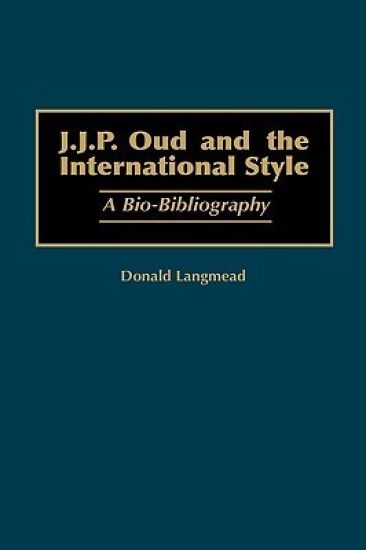
J.J.P. Oud was a famed modern architect; his European contemporaries are Le Corbusier, Walter Gropius, and Ludwig Mies van der Rohe. In Leiden in 1917, Oud, with the Dutch artist Theo van Doesburg and the expatriate Hungarian Vilmos Huszár, and fellow Hollanders Jan Wils and Bart van der Leck formed a collaboration between artists and architects a movement they called De Stijl. The loose knit group slowly disintegrated, but in terms of architectural style the movement sought a unity between art and society that flirted with Constructivism, developed theories of Neoplasticism, and what Oud called Cubism. Although these intellectualized theories seldom resulted in architectural realities, the realized projects were spectacular and they include Oud's director's hut at the Oud-Mathenesse housing development, 1923, and the facade of the Café De Unie, Rotterdam, 1925. This annotated bibliography documents not only the literature on Oud but also Oud's own writings. A biographical essay, this book examines the place afforded Oud in the international literature of architecture and traces his career which spanned fifty-seven years. Architectural students and scholars will benefit from this guide to the major archives, minor collections, and listing of Oud's projects and the books in his own professional library. Bibliographic entries are alphabetically arranged, by books and monographs and by journals, within chronological divisions. Entries are cross-referenced to a works list and index.
The Artists of De Stijl

The Artists of De Stijl

Donald Langmead

Greenwood Press
2000
sidottu
This guide summarizes and evaluates the available literature concerning the Dutch artistic movement De Stijl, which was headed by art critic and painter Theo van Doesburg and was comprised of such architects and artists as J.J.P. Oud, Piet Mondrian, Rovbert van 't Hoff and Georges Vantongerloo. The loose-knit group took its name from the avant garde journal they first published in October 1917: De Stijl (The Style). Although it was limited to Holland, De Stijl promoted ideas about a universal art, combining tenets of theosophy, an holistic view of the oneness of all things, including arts and culture, and socialism. This bibliography examines publications that deal with the movement and with affiliated groups and individual members.Art historians and scholars of modern and of Dutch art and architecture will appreciate this comprehensive tool for further research. Within individual sections for the movement and for its members, entries are chronologically arranged with separate categories for books, monographs and catalogs, and periodicals. A final section analyzes and presents the contents of the journal De Stijl.
Frank Lloyd Wright

Frank Lloyd Wright

Donald Langmead

Praeger Publishers Inc
2003
sidottu
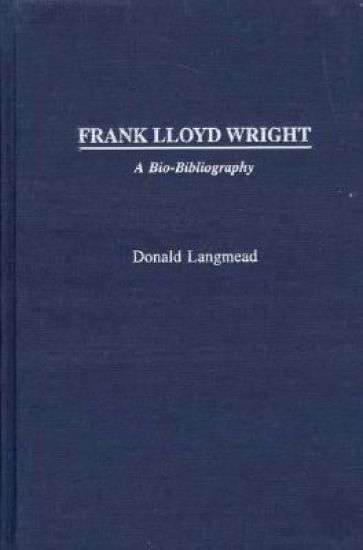
Frank Lloyd Wright is one of the 20th century's best-known architects. Over 40 years after his death, historical and critical comment and debate are increasing and controversy continues to surround him. This volume is a chronologically arranged, annotated bibliography of English- and foreign-language sources including over 3,500 primary entries, with thousands more connected references, presented alphabetically by decades and genres.The book documents not only the literature on Wright from 1886 to the present, but also his own extensive writings. It covers source books, monographs, anthologies, exhibition catalogues, book and exhibition reviews, periodical articles, and obituaries. All references are indexed by personal names, buildings, and projects. There is also a photo-essay comprised entirely of images published here for the first time, and a comprehensive chronology of the architect's life and career, which spanned 70 years and produced about 450 buildings and almost 550 unrealized architectural projects. The book will be of great value to scholars, students, and practitioners.
Maya Lin

Maya Lin

Donald Langmead

Greenwood Press
2011
sidottu
This book provides an informal biography of the wunderkind who became one of America's greatest living artists and most well-known architects.Many are familiar with the art and architectural design work of Maya Lin, but the compelling details of her personal background are less well known. This book not only focuses upon Lin's substantial achievements throughout her life, but also presents Maya Lin's "prehistory," describing family events in China that led to her parents' flight to the United States.Author Donald Langmead guides readers through Lin's ancestry and family connections in precommunist China; her childhood and youth in Athens, Ohio; the story behind the Vietnam Veterans Memorial in Washington, DC; her career after 1982 (by decades); and emphasis on environmental conservation. Written for a young adult and general readership, Maya Lin: A Biography provides an up-to-date description of how she became one of the most famous and respected artists in America.
Makers of 20th-Century Modern Architecture

Makers of 20th-Century Modern Architecture

Donald Leslie Johnson; Donald Langmead

Routledge Member of the Taylor and Francis Group
1997
sidottu
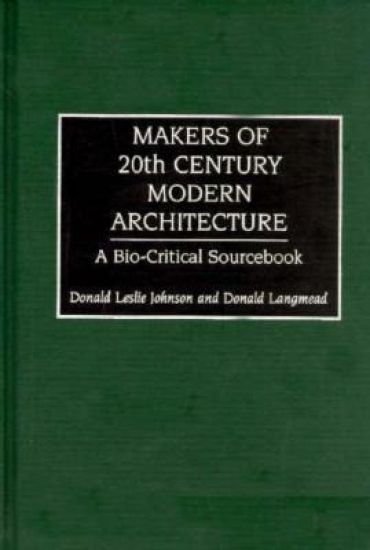
Makers of 20th-Century Modern Architecture is an indispensable reference book for the scholar, student, architect or layman interested in the architects who initiated, developed, or advanced modern architecture. The book is amply illustrated and features the most prominent and influential people in 20th-century modernist architecture including Wright, Eisenman, Mies van der Rohe and Kahn. It describes the milieu in which they practiced their art and directs readers to information on the life and creative activities of these founding architects and their disciples. The profiles of individual architects include critical analysis of their major buildings and projects. Each profile is completed by a comprehensive bibliography.
Makers of 20th Century Modern Architecture

Makers of 20th Century Modern Architecture

Donald L. Johnson; Donald Langmead

Greenwood Press
1997
sidottu
The most influential 20th century architects espousing modernism are brought together in critical discussion and independent profiles. This is accomplished through a short but discriminating examination of each architect's design work, an essay outlining the historical course and events that confirms his or her vital position, and a substantial bibliography at the completion of each profile. This sourcebook examines the life and creative activities of such founding architects as Wright, Eisenman, Van der Rohe, and Kahn, as well as their disciples. This volume will be of interest to social and cultural historians, scholars, students of all ages, architects, and the appreciative lay audience.The architects and or firms chosen for the sourcebook were selected as a result of many years of research that required extensive reading of materials by respected experts. From such research, the editors were able to determine the individuals or groups who have been most influential in charting the course of a Westernized modern architecture. From evidence of their productive activities—proof in timber—there is a consensus that each made a unique contribution. The nature and measure of the contribution is discussed within each profile. Those whose reputations are based on paper only, with few buildings to prove their worth, are not included. The editors believe that architecture is an experiential art: all the senses must participate, and that requires the actual built product.
Architectural Excursions

Architectural Excursions

Donald L. Johnson; Donald Langmead

Praeger Publishers Inc
2000
sidottu
Soon after 1900 in both North America and Europe the evolution from the tradition of Mediterranean and Gallic architectural styles to modernism began. This phenomenon was due, in part, to American industrial architecture and the work of Frank Lloyd Wright. Wright's building and architectural treatises of 1898-1908, with the additional help of Dutch propaganda on his behalf, significantly influenced European practitioners and theorists. European architecture within and outside of Holland reflects an adaptation of Wright's theories along with the structural determinism of American industrial buildings. With new evidence and fresh analysis culled from Dutch and American archives, personal correspondence, and professional material, this study examines the weight of Wright's works and words and those of the Dutchmen H.P. Berlage, Theo van Doesburg, Jan Wils, J.J.P. Oud, William Dudok, and Hendrik Theodor Wijdeveld. This new insight on the effects of Wright's architectural theories and designs, coupled with an extensive guide for further research, will attract art and architecture scholars and historians on both sides of the Atlantic and will also be of interest to social historians, artists, and architects. Events and new theories, including the assertion that Hendrik Theodor Wijdeveld was the catalytic source behind Wright's Taliesin Fellowship established in 1932, are presented in clear accessible language. Tied to the text are numerous visual presentations of significant designs and buildings.
Donald

Donald

Eric Martin; Stephen Elliott

McSweeney's Publishing
2011
pokkari
As America's most infamous former Secretary of Defense lies poised to unleash his wistful recollections and rewriting of the war on terror, authors Eric Martin and Stephen Elliott humbly submit their take to the historical record: Donald. What would happen if Donald Rumsfeld, former defense secretary and architect of the war on terror, was abducted at night from his Maryland home, held without charges in his own prison system, denied a trial, and kept in a place where no one could find him, beyond the reach of the law? Donald is a high-wire allegory that answers this question, in equal parts breakneck thriller and gradual descent into madness. But it is also a novel rooted in the harrowing stories of real people caught in America's military campaigns. And while there are those who would try to convince us that war is full of uncertainty--of knowns and unknowns--Donald reminds us that there remain things we know to be wrong.
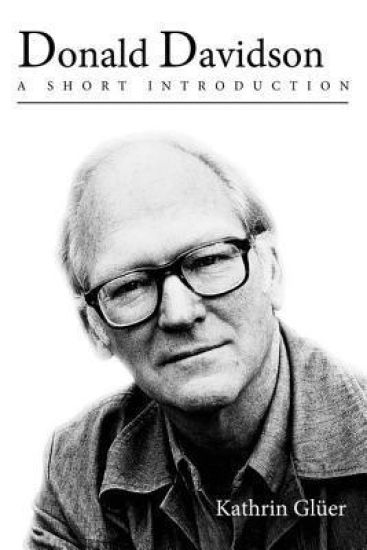
Donald Davidson

Donald Davidson

Kathrin Gl¨ uer

Oxford University Press Inc
2011
nidottu
Donald Davidson was one of the 20th Century's deepest analytic thinkers. He developed a systematic picture of the human mind and its relation to the world, an original and sustained vision that exerted a shaping influence well beyond analytic philosophy of mind and language. At its center is an idea of minded creatures as essentially rational animals: Rational animals can be interpreted, their behavior can be understood, and the contents of their thoughts are, in principle, open to others. The combination of a rigorous analytic stance with aspects of humanism so distinctive of Davidsonian thought finds its maybe most characteristic expression when this central idea is brought to bear on the relation of the mental to the physical: Davidson defended the irreducibility of its rational nature while acknowledging that the mental is ultimately determined by the physical. Davidson made contributions of lasting importance to a wide range of topics -- from general theory of meaning and content over formal semantics, the theories of truth, explanation, and action, to metaphysics and epistemology. His writings almost entirely consist of short, elegant, and often witty papers. These dense and thematically tightly interwoven essays present a profound challenge to the reader. This book provides a concise, systematic introduction to all the main elements of Davidson's philosophy. It places the theory of meaning and content at the very center of his thought. By using interpretation, and the interpreter, as key ideas it clearly brings out the underlying structure and unified nature of Davidson's work. Kathrin Glüer carefully outlines his principal claims and arguments, and discusses them in some detail. The book thus makes Davidson's thought accessible in its genuine depth, and acquaints the reader with the main lines of discussion surrounding it.
Donald Davidson

Donald Davidson

Kathrin Gl¨ uer

Oxford University Press Inc
2011
sidottu
Donald Davidson was one of the 20th Century's deepest analytic thinkers. He developed a systematic picture of the human mind and its relation to the world, an original and sustained vision that exerted a shaping influence well beyond analytic philosophy of mind and language. At its center is an idea of minded creatures as essentially rational animals: Rational animals can be interpreted, their behavior can be understood, and the contents of their thoughts are, in principle, open to others. The combination of a rigorous analytic stance with aspects of humanism so distinctive of Davidsonian thought finds its maybe most characteristic expression when this central idea is brought to bear on the relation of the mental to the physical: Davidson defended the irreducibility of its rational nature while acknowledging that the mental is ultimately determined by the physical. Davidson made contributions of lasting importance to a wide range of topics -- from general theory of meaning and content over formal semantics, the theories of truth, explanation, and action, to metaphysics and epistemology. His writings almost entirely consist of short, elegant, and often witty papers. These dense and thematically tightly interwoven essays present a profound challenge to the reader. This book provides a concise, systematic introduction to all the main elements of Davidson's philosophy. It places the theory of meaning and content at the very center of his thought. By using interpretation, and the interpreter, as key ideas it clearly brings out the underlying structure and unified nature of Davidson's work. Kathrin Gl¨ uer carefully outlines his principal claims and arguments, and discusses them in some detail. The book thus makes Davidson's thought accessible in its genuine depth, and acquaints the reader with the main lines of discussion surrounding it.
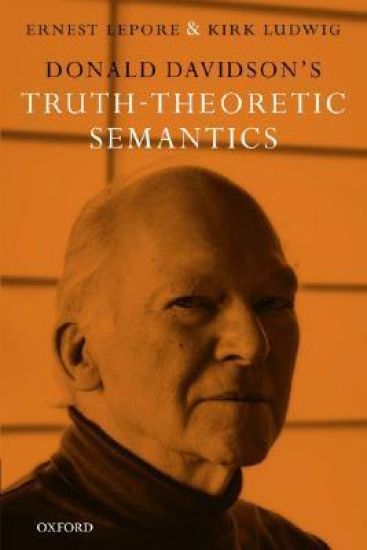
Donald Davidson

Donald Davidson

Ernie Lepore; Kirk Ludwig

Clarendon Press
2007
nidottu
Donald Davidson (1917-2003) was one of the most important philosophers of the late twentieth century. His work on language and the theory of meaning has been particularly influential.Two of the world's leading authorities on Davidson's philosophy, Ernest Lepore and Kirk Ludwig, provide a systematic exposition of his work in this field and of his contributions to philosophy of mind, metaphysics, and epistemology which spring from it. Their second aim is to assess Davidson's program critically, to mark its successes, but also to identify where its ccomplishments fall short of its ambitions, and, since it is an on-going research program, to assess its prospects for the future, and to contribute to the expansion of that program. Criticizing and extending Davidson's thought, as well as providing an introduction to it, Lepore and Ludwig address a broad academic audience. Their work will be of fundamental importance for those who are coming to Davidson's work for the first time; while some philosophical sophistication and training is presupposed, it is accessible both to advanced undergraduates and to graduate students. It will also be welcomed by professional philosophers, linguists, and anyone wishing to assess and understand Davidson's remarkable intellectual legacy.
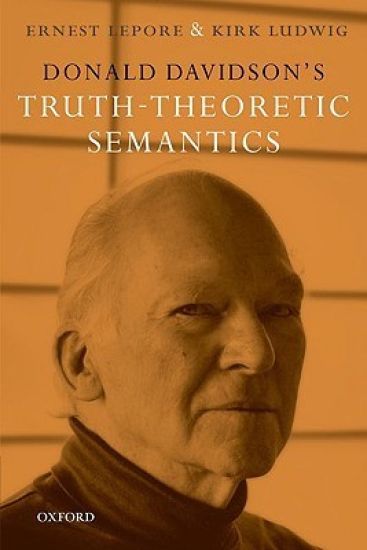
Donald Davidson's Truth-Theoretic Semantics

Donald Davidson's Truth-Theoretic Semantics

Ernest LePore; Kirk Ludwig

Clarendon Press
2007
sidottu
Ernest Lepore and Kirk Ludwig examine the foundations and applications of Davidson's influential program of truth-theoretic semantics for natural languages. The program uses an axiomatic truth theory for a language, which meets certain constraints, to serve the goals of a compositional meaning theory. Lepore and Ludwig explain and clarify the motivations for the approach, and then consider how to apply the framework to a range of important natural language constructions, including quantifiers, proper names, indexicals, simple and complex demonstratives, quotation, adjectives and adverbs, the simple and perfect tenses, temporal adverbials and temporal quantifiers, tense in sentential complement clauses, attitude and indirect discourse reports, and the problem of interrogative and imperative sentences. They not only discuss Davidson's own contributions to these subjects but consider criticisms, developments, and alternatives as well. They conclude with a discussion of logical form in natural language in light of the approach, the role of the concept of truth in the program, and Davidson's view of it. Anyone working on meaning will find this book invaluable.
Donald Davidson's Truth-Theoretic Semantics

Donald Davidson's Truth-Theoretic Semantics

Ernest LePore; Kirk Ludwig

Oxford University Press
2009
nidottu
Ernest Lepore and Kirk Ludwig examine the foundations and applications of Davidson's influential program of truth-theoretic semantics for natural languages. The program uses an axiomatic truth theory for a language, which meets certain constraints, to serve the goals of a compositional meaning theory. Lepore and Ludwig explain and clarify the motivations for the approach, and then consider how to apply the framework to a range of important natural language constructions, including quantifiers, proper names, indexicals, simple and complex demonstratives, quotation, adjectives and adverbs, the simple and perfect tenses, temporal adverbials and temporal quantifiers, tense in sentential complement clauses, attitude and indirect discourse reports, and the problem of interrogative and imperative sentences. They not only discuss Davidson's own contributions to these subjects but consider criticisms, developments, and alternatives as well. They conclude with a discussion of logical form in natural language in light of the approach, the role of the concept of truth in the program, and Davidson's view of it. Anyone working on meaning will find this book invaluable.
Donald Michie: machine intelligence, biology and more

Donald Michie: machine intelligence, biology and more

Ashwin Srinivasan

Oxford University Press
2009
sidottu
Donald Michie was an extraordinary character. In a scientific career that spanned nearly 65 years, he was the pioneer in several fields including computing, mouse embryology, transplantation biology, and machine intelligence. Tragically, he died in a car crash in 2007. Here, Ashwin Srinivasan presents a varied collection of Michie's writings, from Colossus and computers to mouse genetics and politics. Srinivasan, a computer scientist and grand-student of Donald Michie, introduces each section and brings together an engaging collection of lively essays, revealing Michie's remarkable personality and painting a picture of his life and interests.
Donald Davidson on Truth, Meaning, and the Mental

Donald Davidson on Truth, Meaning, and the Mental

Gerhard Preyer

Oxford University Press
2012
sidottu
The analysis of the connections between truth, meaning, thought, and action poses a major philosophical challenge--one that Donald Davidson addressed by establishing a unified theory of language and mind. This volume offers a reappraisal of Davidson's intellectual legacy. Twelve specially written essays by leading philosophers in the field illuminate a range of enduring philosophical problems, and engage in particular with Ernie Lepore and Kirk Ludwig's interpretation of Davidson's philosophy. The collection affirms Davidson's continuing influence on the study of language, mind, and action, and offers a variety of new perspectives on his work.