Kirjojen hintavertailu. Mukana 11 238 394 kirjaa ja 12 kauppaa.

Kirjahaku

Etsi kirjoja tekijän nimen, kirjan nimen tai ISBN:n perusteella.

1000 tulosta hakusanalla Donald MacKenzie

Material Markets

Material Markets

Donald MacKenzie

Oxford University Press
2019
nidottu
Financial markets, processes, and instruments are often difficult to fathom; the credit crisis highlights both their importance and their fragility. Donald MacKenzie is one of the most perceptive analysts of the workings of the financial world. In this book, he argues that economic agents and markets need to be analyzed in their full materiality: their physicality, their corporeality, their technicality. Markets are populated not by disembodied, abstract agents, but by embodied human beings and technical systems. Concepts and systematic ways of thinking that simplify market processes and make them mentally tractable are essential to how markets function. In putting forward this material sociology of markets, the book synthesizes and contributes to the field of social studies of finance; the application to financial markets not just of economics but of wider social-science disciplines, in particular science and technology studies. The topics covered include the development of financial derivatives exchanges; arbitrage; how corporate profit figures are constructed; the crucial new markets in carbon emissions; and a case-study of a hedge fund (based, unusually, on direct observation of its trading). The book will appeal to research students and academics across the social sciences, and the general reader will enjoy the book's explanations and analyses of some of the most important phenomena of today's turbulent markets.

Material Markets

Material Markets

Donald MacKenzie

Oxford University Press
2008
sidottu
Financial markets, processes, and instruments are often difficult to fathom; the credit crisis highlights both their importance and their fragility. Donald MacKenzie is one of the most perceptive analysts of the workings of the financial world. In this book, he argues that economic agents and markets need to be analyzed in their full materiality: their physicality, their corporeality, their technicality. Markets are populated not by disembodied, abstract agents, but by embodied human beings and technical systems. Concepts and systematic ways of thinking that simplify market processes and make them mentally tractable are essential to how markets function. In putting forward this material sociology of markets, the book synthesizes and contributes to the new field of social studies of finance: the application to financial markets not just of economics but of wider social-science disciplines, in particular science and technology studies. The topics covered include the development of financial derivatives exchanges (non-existent in 1970, but now trading products equivalent to $13,000 for every human being on earth); arbitrage; how corporate profit figures are constructed; the crucial new markets in carbon emissions; and a case-study of a hedge fund (based, unusually, on direct observation of its trading). The book will appeal to research students and academics across the social sciences, and the general reader will enjoy the book's explanations and analyses of some of the most important phenomena of today's turbulent markets.

Inventing Accuracy

Inventing Accuracy

Donald Mackenzie

MIT Press
1993
pokkari
"Mackenzie has achieved a masterful synthesis of engrossing narrative, imaginative concepts, historical perspective, and social concern."Donald MacKenzie follows one line of technology-strategic ballistic missile guidance through a succession of weapons systems to reveal the workings of a world that is neither awesome nor unstoppable. He uncovers the parameters, the pressures, and the politics that make up the complex social construction of an equally complex technology.
Mechanizing Proof

Mechanizing Proof

Donald Mackenzie

MIT Press
2004
pokkari
Most aspects of our private and social lives-our safety, the integrity of the financial system, the functioning of utilities and other services, and national security-now depend on computing. But how can we know that this computing is trustworthy? In Mechanizing Proof, Donald MacKenzie addresses this key issue by investigating the interrelations of computing, risk, and mathematical proof over the last half century from the perspectives of history and sociology. His discussion draws on the technical literature of computer science and artificial intelligence and on extensive interviews with participants.MacKenzie argues that our culture now contains two ideals of proof: proof as traditionally conducted by human mathematicians, and formal, mechanized proof. He describes the systems constructed by those committed to the latter ideal and the many questions those systems raise about the nature of proof. He looks at the primary social influence on the development of automated proof-the need to predict the behavior of the computer systems upon which human life and security depend-and explores the involvement of powerful organizations such as the National Security Agency. He concludes that in mechanizing proof, and in pursuing dependable computer systems, we do not obviate the need for trust in our collective human judgment.
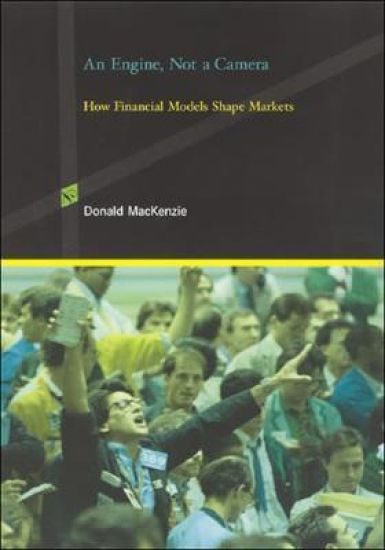
An Engine, Not a Camera

An Engine, Not a Camera

Donald Mackenzie

MIT Press
2008
pokkari
In An Engine, Not a Camera, Donald MacKenzie argues that the emergence of modern economic theories of finance affected financial markets in fundamental ways. These new, Nobel Prize-winning theories, based on elegant mathematical models of markets, were not simply external analyses but intrinsic parts of economic processes.Paraphrasing Milton Friedman, MacKenzie says that economic models are an engine of inquiry rather than a camera to reproduce empirical facts. More than that, the emergence of an authoritative theory of financial markets altered those markets fundamentally. For example, in 1970, there was almost no trading in financial derivatives such as "futures." By June of 2004, derivatives contracts totaling $273 trillion were outstanding worldwide. MacKenzie suggests that this growth could never have happened without the development of theories that gave derivatives legitimacy and explained their complexities.MacKenzie examines the role played by finance theory in the two most serious crises to hit the world's financial markets in recent years: the stock market crash of 1987 and the market turmoil that engulfed the hedge fund Long-Term Capital Management in 1998. He also looks at finance theory that is somewhat beyond the mainstream-chaos theorist Benoit Mandelbrot's model of "wild" randomness. MacKenzie's pioneering work in the social studies of finance will interest anyone who wants to understand how America's financial markets have grown into their current form.
Trading at the Speed of Light

Trading at the Speed of Light

Donald MacKenzie

PRINCETON UNIVERSITY PRESS
2021
sidottu
A remarkable look at how the growth, technology, and politics of high-frequency trading have altered global financial marketsIn today’s financial markets, trading floors on which brokers buy and sell shares face-to-face have increasingly been replaced by lightning-fast electronic systems that use algorithms to execute astounding volumes of transactions. Trading at the Speed of Light tells the story of this epic transformation. Donald MacKenzie shows how in the 1990s, in what were then the disreputable margins of the US financial system, a new approach to trading—automated high-frequency trading or HFT—began and then spread throughout the world. HFT has brought new efficiency to global trading, but has also created an unrelenting race for speed, leading to a systematic, subterranean battle among HFT algorithms.In HFT, time is measured in nanoseconds (billionths of a second), and in a nanosecond the fastest possible signal—light in a vacuum—can travel only thirty centimeters, or roughly a foot. That makes HFT exquisitely sensitive to the length and transmission capacity of the cables connecting computer servers to the exchanges’ systems and to the location of the microwave towers that carry signals between computer datacenters. Drawing from more than 300 interviews with high-frequency traders, the people who supply them with technological and communication capabilities, exchange staff, regulators, and many others, MacKenzie reveals the extraordinary efforts expended to speed up every aspect of trading. He looks at how in some markets big banks have fought off the challenge from HFT firms, and how exchanges sometimes engineer technical systems to favor certain types of algorithms over others.Focusing on the material, political, and economic characteristics of high-frequency trading, Trading at the Speed of Light offers a unique glimpse into its influence on global finance and where it could lead us in the future.
Trading at the Speed of Light

Trading at the Speed of Light

Donald MacKenzie

PRINCETON UNIVERSITY PRESS
2023
pokkari
A remarkable look at how the growth, technology, and politics of high-frequency trading have altered global financial marketsIn today’s financial markets, trading floors on which brokers buy and sell shares face-to-face have increasingly been replaced by lightning-fast electronic systems that use algorithms to execute astounding volumes of transactions. Trading at the Speed of Light tells the story of this epic transformation. Donald MacKenzie shows how in the 1990s, in what were then the disreputable margins of the US financial system, a new approach to trading—automated high-frequency trading or HFT—began and then spread throughout the world. HFT has brought new efficiency to global trading, but has also created an unrelenting race for speed, leading to a systematic, subterranean battle among HFT algorithms.In HFT, time is measured in nanoseconds (billionths of a second), and in a nanosecond the fastest possible signal—light in a vacuum—can travel only thirty centimeters, or roughly a foot. That makes HFT exquisitely sensitive to the length and transmission capacity of the cables connecting computer servers to the exchanges’ systems and to the location of the microwave towers that carry signals between computer datacenters. Drawing from more than 300 interviews with high-frequency traders, the people who supply them with technological and communication capabilities, exchange staff, regulators, and many others, MacKenzie reveals the extraordinary efforts expended to speed up every aspect of trading. He looks at how in some markets big banks have fought off the challenge from HFT firms, and how exchanges sometimes engineer technical systems to favor certain types of algorithms over others.Focusing on the material, political, and economic characteristics of high-frequency trading, Trading at the Speed of Light offers a unique glimpse into its influence on global finance and where it could lead us in the future.
Salute from a Dead Man

Salute from a Dead Man

Donald MacKenzie

The Murder Room
2014
pokkari
Ritchie Duncan, a convict, is released from prison and decides to go clean. But when he is handed some top secret film containing electronic data by a girl in a bar there ensues mayhem and murder. The film is the property of her communist agent boyfriend, and when she refuses to surrender it her connection is killed and she is kept quietly alive in a nursing home until Duncan can save her.'Donald MacKenzie is a born storyteller' Guardian
Death is a Friend

Death is a Friend

Donald MacKenzie

The Murder Room
2014
pokkari
'Donald MacKenzie is a born storyteller' GuardianEvery thief dreams of committing the perfect crime. Cameron, Thorne and Gun are convinced that the jewel robbery they have planned cannot possibly go wrong, but jealousy mistrust and fear doom the enterprise from the start.One of them dies a slow, hideous death; the other two find they have walked into hell. Soon, a beautiful woman and two desperate men find themselves trapped by their own actions. And when the thread of tension snaps they learn that death can indeed be a friend.