Kirjojen hintavertailu. Mukana 11 342 296 kirjaa ja 12 kauppaa.

Kirjahaku

Etsi kirjoja tekijän nimen, kirjan nimen tai ISBN:n perusteella.

1000 tulosta hakusanalla Donald N Panther-Yates

The Eighth Arrow

The Eighth Arrow

Donald N Panther-Yates

Lulu.com
2018
sidottu
One of the last migratory American Indian tribes, the Tihanama people of Tennessee ranged from the Great Lakes to the Florida Panhandle. Other Southeastern peoples called them the Big Medicine tribe. They were known for their legends, antiquity, trail markings, knowledge of herbs, funeral ceremonies, songs, paints and dyes. This collection by Donald Panther-Yates is as unique as its subject-there is no other like it. The Eighth Arrow story will completely alter your understanding of Native American spirituality. It may change your life.
El origen del hombre rojo: La historia legendaria de su ascenso y caída sus victorias y derrotas y la profecía de su futuro
Son pocos los momentos de nuestras vidas en los que nos encontramos con un texto electrizante. Nos da esa sensaci n de que " esto era lo que me estaba perdiendo ". En el mundo de los nativos norteamericanos, donde la comunicaci n oral ocupa el lugar de la palabra escrita, esa revelaci n suele ocurrir cuando escuchamos por primera vez -o comprendemos por primera vez- la historia del origen, la naturaleza y el car cter de nuestra gente. En el pasado, esas narraciones se relataban en las recitaciones ceremoniales que ten an lugar durante los encuentros, para asegurar que se transmitieran a las generaciones futuras. No tenemos nada "m s original" que "El origen del hombre rojo".
Wax and Gold – Tradition and Innovation in Ethiopian Culture

Wax and Gold – Tradition and Innovation in Ethiopian Culture

Donald N. Levine

University of Chicago Press
2014
nidottu
In Abyssinian poetry, the "wax" is the obvious meaning, the "gold" is the hidden meaning. In Wax and Gold, Donald N. Levine explores mid-to-late-twentieth-century Ethiopian society on the same two levels, using modern sociology and psychology to seek answers to the following questions: What is the nature of the traditional culture of the dominant ethnic group, the Amhara, and what are its enduring values? What aspects of modern culture interest this society and by what means has it sought to institutionalize them? How has tradition both facilitated and hampered Ethiopian efforts to modernize? Enriched by the use of Ethiopian literature and by Levine's deep knowledge of and affection for the society of which he writes, Wax and Gold is both a scholarly and a personal work.
Visions of the Sociological Tradition

Visions of the Sociological Tradition

Donald N. Levine

University of Chicago Press
1995
sidottu
In this work, Don Levine moves from the origins of systematic knowledge in ancient Greece to the present day in order to present an account that is at once a history of the social science enterprise and an introduction to the cornerstone works of Western social thought. "Visions" has three meanings, each of which corresponds to a part of the book. In Part 1, Levine presents the ways previous sociologists have rendered accounts of their discipline, as a series of narratives - or "life stories" - that build upon each other, generation to generation, a succession of efforts to envisage a coherent past for the sake of a purposive present. In Part 2, the heart of the book, Levine offers his own narrative, reconnecting centuries of voices into a dialogue among the varied strands of the sociological tradition: Hellenic, British, French, German, Marxian, Italian and American. Here, he tracks the formation of the sociological imagination through a series of conversations across generations. From classic philosophy to pragmatism, Aristotle to W.I. Thomas, Levine maps the web of visionary statements - confrontations and oppositions - from which social science has grown. Throughout each stage, Levine demonstrates how social knowledge has grown in response to three recurring questions: How shall we live? What makes humans moral creatures? How do we understand the world? He anchors the creation of social knowledge to ethical foundations, and shows how differences in those foundations disposed the shapers of modern social science - among them, Marshall and Spencer, Comte and Durkheim, Simmel and Weber, Marx and Mosca, Dewey and Park - to proceed in vastly different ways. In Part 3, Levine offers a vision of the contemporary scene, setting the crisis of fragmentation in social sciences against the fragmentation of experience and community. By reconstructing the history of social thought as a series of fundamentally moral engagements with common themes, he suggests new uses for sociology's intellectual resources: not only as insight about the nature of modernity, but also as a model of mutually respectful communication in an increasingly fractious world.
Visions of the Sociological Tradition

Visions of the Sociological Tradition

Donald N. Levine

University of Chicago Press
1995
nidottu
In this work, Don Levine moves from the origins of systematic knowledge in ancient Greece to the present day in order to present an account that is at once a history of the social science enterprise and an introduction to the cornerstone works of Western social thought. "Visions" has three meanings, each of which corresponds to a part of the book. In Part 1, Levine presents the ways previous sociologists have rendered accounts of their discipline, as a series of narratives - or "life stories" - that build upon each other, generation to generation, a succession of efforts to envisage a coherent past for the sake of a purposive present. In Part 2, the heart of the book, Levine offers his own narrative, reconnecting centuries of voices into a dialogue among the varied strands of the sociological tradition: Hellenic, British, French, German, Marxian, Italian and American. Here, he tracks the formation of the sociological imagination through a series of conversations across generations. From classic philosophy to pragmatism, Aristotle to W.I. Thomas, Levine maps the web of visionary statements - confrontations and oppositions - from which social science has grown. Throughout each stage, Levine demonstrates how social knowledge has grown in response to three recurring questions: How shall we live? What makes humans moral creatures? How do we understand the world? He anchors the creation of social knowledge to ethical foundations, and shows how differences in those foundations disposed the shapers of modern social science - among them, Marshall and Spencer, Comte and Durkheim, Simmel and Weber, Marx and Mosca, Dewey and Park - to proceed in vastly different ways. In Part 3, Levine offers a vision of the contemporary scene, setting the crisis of fragmentation in social sciences against the fragmentation of experience and community. By reconstructing the history of social thought as a series of fundamentally moral engagements with common themes, he suggests new uses for sociology's intellectual resources: not only as insight about the nature of modernity, but also as a model of mutually respectful communication in an increasingly fractious world.
Powers of the Mind

Powers of the Mind

Donald N. Levine

University of Chicago Press
2006
sidottu
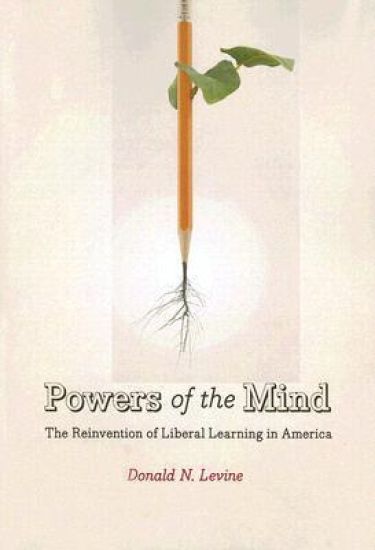
It is one thing to lament the financial pressures put on universities, quite another to face up to the poverty of resources for thinking about what universities should do when they purport to offer a liberal education. In Powers of the Mind, former University of Chicago dean Donald N. Levine enriches those resources by proposing fresh ways to think about liberal learning with ideas more suited to our times. He does so by defining basic values of modernity and then considering curricular principles pertinent to them. The principles he favors are powers of the mind—disciplines understood as fields of study defined not by subject matter but by their embodiment of distinct intellectual capacities. To illustrate, Levine draws on his own lifetime of teaching and educational leadership, while providing a marvelous summary of exemplary educational thinkers at the University of Chicago who continue to inspire. Out of this vital tradition, Powers of the Mind constructs a paradigm for liberal arts today, inclusive of all perspectives and applicable to all settings in the modern world.
Powers of the Mind

Powers of the Mind

Donald N. Levine

University of Chicago Press
2007
nidottu
In "Powers of the Mind", former University of Chicago dean Donald N. Levine considers the liberal education that our universities purport to offer, finds it lacking, and in response proposes fresh and invigorating ways to think about liberal learning that are more suited to our times. Levine begins by defining basic values of modernity and then considering pertinent curricular principles. The principles he favors are powers of the mind - disciplines understood as fields of study defined less by their subject matter than by the distinct intellectual capacities they embody. To illustrate, Levine draws on his own lifetime of teaching and educational leadership, while providing a marvelous summary of exemplary educational thinkers at the University of Chicago who continue to inspire. Out of this vital tradition, "Powers of the Mind" constructs a paradigm for liberal arts today, inclusive of all perspectives and applicable to all settings in the modern world.
The Flight from Ambiguity

The Flight from Ambiguity

Donald N. Levine

University of Chicago Press
1988
nidottu
The essays turn about a single theme, the loss of the capacity to deal constructively with ambiguity in the modern era. Levine offers a head-on critique of the modern compulsion to flee ambiguity. He centers his analysis on the question of what responses social scientists should adopt in the face of the inexorably ambiguous character of all natural languages. In the course of his argument, Levine presents a fresh reading of works by the classic figures of modern European and American social theory—Durkheim, Freud, Simmel and Weber, and Park, Parsons, and Merton.
Post-Intellectualism and the Decline of Democracy

Post-Intellectualism and the Decline of Democracy

Donald N. Wood

Praeger Publishers Inc
1996
sidottu
Our society's institutional infrastructures—our democratic political system, economic structures, legal practices, and educational establishment—were all created as intellectual outgrowths of the Enlightenment. All our cultural institutions are based on the intellectual idea that an enlightened citizenry could govern its affairs with reason and responsibility. In the late 20th century, however, we are witnessing the disintegration of much of our cultural heritage. Wood argues that this is due to our evolution into a ^Upost-intellectual society^R—a society characterized by a loss of critical thinking, the substitution of information for knowledge, mediated reality, increasing illiteracy, loss of privacy, specialization, psychological isolation, hyper-urbanization, moral anarchy, and political debilitation. These post-intellectual realities are all triggered by three underlying determinants: the failure of linear growth and expansion to sustain our economic system; the runaway information overload; and technological determinism. Wood presents a new and innovative social theory, challenging readers to analyze all our post-intellectual cultural malaise in terms of these three fundamental determinants.
Post-Intellectualism and the Decline of Democracy

Post-Intellectualism and the Decline of Democracy

Donald N. Wood

Praeger Publishers Inc
1996
nidottu
Our society's institutional infrastructures—our democratic political system, economic structures, legal practices, and educational establishment—were all created as intellectual outgrowths of the Enlightenment. All our cultural institutions are based on the intellectual idea that an enlightened citizenry could govern its affairs with reason and responsibility. In the late 20th century, however, we are witnessing the disintegration of much of our cultural heritage. Wood argues that this is due to our evolution into a ^Upost-intellectual society^R—a society characterized by a loss of critical thinking, the substitution of information for knowledge, mediated reality, increasing illiteracy, loss of privacy, specialization, psychological isolation, hyper-urbanization, moral anarchy, and political debilitation. These post-intellectual realities are all triggered by three underlying determinants: the failure of linear growth and expansion to sustain our economic system; the runaway information overload; and technological determinism. Wood presents a new and innovative social theory, challenging readers to analyze all our post-intellectual cultural malaise in terms of these three fundamental determinants.
The Unraveling of the West

The Unraveling of the West

Donald N. Wood

Praeger Publishers Inc
2003
sidottu
The West is declining, and Wood blames it on the self-implosion of our intellectual cultural heritage. Modernism is collapsing under its own weight, as postmodern ideals eat away at the West's twin pillars of reason and responsibility. Our media-fueled, image-driven, non-linear recasting of the good life has led to the rejection of reason, the enshrinement of greed, ecological debasement, retribalization, and the erosion of democratic mores. Wood thoughtfully explains the origins of our current cultural malaise, and argues that western culture literally becomes more unreasonable as we abandon our Enlightenment heritage and become an anti-intellectual society. There are steps we can take to reclaim our intellectual heritage. We need a sense of balance, and affirmation of the best qualities of modernism and postmodernism. Although science and religion must be championed, there is much value in passion and spontaneity, for religion and existential faith, for tradition and for community. Some remedies Wood considers include a return to the liberal arts, environmental restoration, economic restructuring and equity, and worldwide political reform.
Culture and Customs of Korea

Culture and Customs of Korea

Donald N. Clark

Greenwood Press
2000
sidottu
For centuries, although strongly influenced by the Chinese, Koreans have maintained a unique civilization with their own language, social organization, food, national costume, political institutions, and customs. The disruptions of the 20th century have included a long and difficult period of foreign rule and a devastating civil war. However, Koreans continue to prize their traditional culture, and the younger generations have embraced Koreanness with a determination to assert Korea's place in the world. Culture and Customs of Korea artfully depicts the past and present in North and South Korea with chapters on the story of the Korean people, thought and religion, arts and literature, performing arts, daily life and folkways, life in a Korean village, life in urban Korean, and gender, marriage, and the lives of Korean women. A chronology and glossary supplement the text.
Culture and Customs of Korea

Culture and Customs of Korea

Donald N. Clark

Greenwood Press
2000
nidottu
For centuries, although strongly influenced by the Chinese, Koreans have maintained a unique civilization with their own language, social organization, food, national costume, political institutions, and customs. The disruptions of the 20th century have included a long and difficult period of foreign rule and a devastating civil war. However, Koreans continue to prize their traditional culture, and the younger generations have embraced Koreanness with a determination to assert Korea's place in the world. Culture and Customs of Korea artfully depicts the past and present in North and South Korea with chapters on the story of the Korean people, thought and religion, arts and literature, performing arts, daily life and folkways, life in a Korean village, life in urban Korean, and gender, marriage, and the lives of Korean women. A chronology and glossary supplement the text.
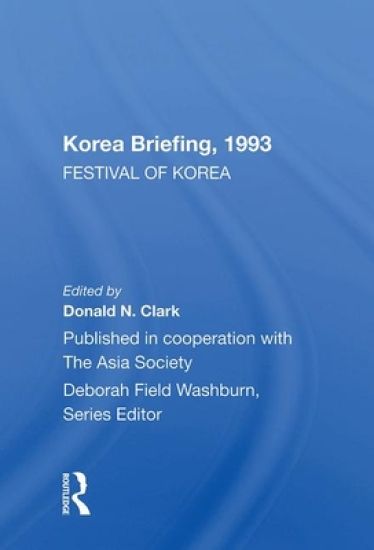
Korea Briefing 1993

Korea Briefing 1993

Donald N. Clark

Routledge
2020
sidottu
Published in conjunction with The Asia Society's Festival of Korea, this expanded issue of Korea Briefing provides historical insight into Korea, with retrospective chapters on politics and economics, and illuminates Korea's cultural heritage through chapters on music, dance, and literature. In addition, the political and economic chapters treat events of the past year, outlining the challenges and possibilities facing Kim Young-sam, the newly elected South Korean president. Another chapter examines the implications for U.S. policy toward Korea of Bill Clinton's election to the U.S. presidency. A chapter by the editor describing the U.S. outlook toward Korea is balanced by a chapter on the changes in Korean perspectives on the United States since the Korean War. The Korean American community's struggles in the United States are explored in a chapter that addresses the aftereffects of the Los Angeles riots in the broader context of issues facing the Korean American community.
Korea Briefing 1993

Korea Briefing 1993

Donald N. Clark

Routledge
2022
nidottu
This edition of Korea Briefing, the fourth in the series, is issued in conjunction with The Asia Society's Festival of Korea, a yearlong, nationwide celebration of Korean history, culture, and contemporary life.